
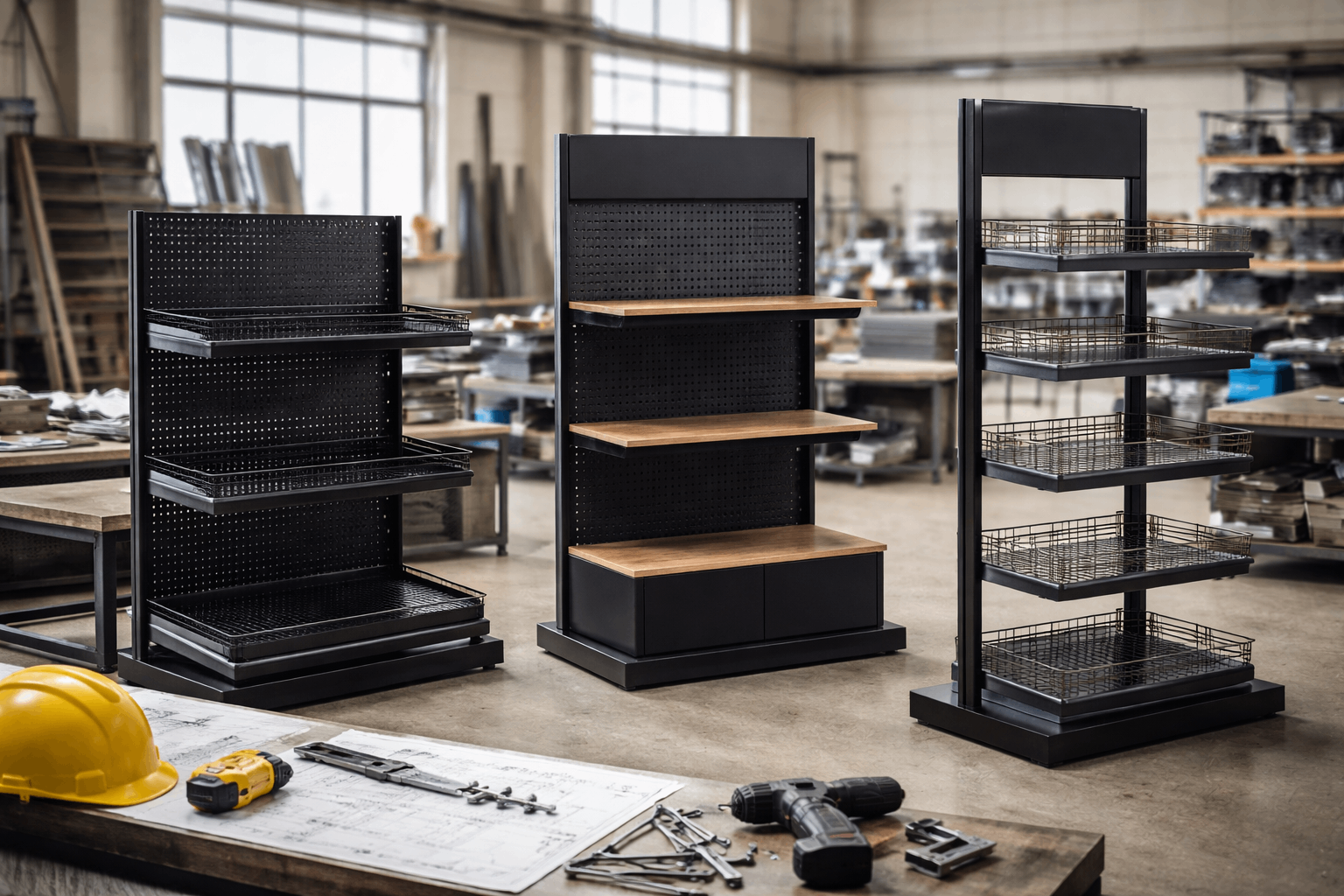
For overseas buyers, a display rack is rarely judged as a visual piece alone. In most cases, it sits inside a much larger sourcing decision—one that affects packaging, freight, installation, store rollout, maintenance, and reorder consistency. That is why custom product display development deserves to be discussed in commercial and technical terms, not only in design language.
At that stage, procurement teams are not browsing for decoration ideas. They are trying to answer practical questions. Can the fixture carry the product load with confidence? Will the finish still look presentable after shipping and store use? Can the unit be packed efficiently, assembled without friction, and repeated across multiple orders without quality drift? Those are the questions that shape real buying decisions.
That is also why metal display racks continue to draw attention from importers, distributors, and retail fixture buyers. In many wholesale programs, metal offers a stronger mix of durability, structural control, freight efficiency, and repeatability than short-life alternatives. For buyers comparing suppliers, that tends to matter far more than broad promises about brand image or in-store exposure.
Why B2B Buyers Search This Topic Differently
A retail buyer or sourcing manager does not move through supplier content in the same way as an end consumer. They are usually scanning for signs of capability. They want to know whether the supplier understands product weight, packaging constraints, assembly logic, store layout, and long-term usage conditions. Content that stays too general may sound polished, but it rarely helps with real supplier selection.
That is why B2B readers respond more strongly to articles that connect display racks design with cost control and execution. They want to see how a fixture choice may affect landed cost, assembly time, stock presentation, damage risk, and replacement frequency. A well-written article can quietly do an important job here: it helps buyers decide whether a supplier seems experienced enough for a serious inquiry.
Their browsing habit is different too. Many overseas buyers compare several supplier websites in one sitting. They scan headings, tables, and a few key paragraphs rather than reading every line in order. Structure matters more than many brands expect. A clear hierarchy and commercially relevant sections make the article easier to scan and easier to trust.
Start with Performance, Not Appearance
A custom rack can look premium in a proposal and still disappoint once it reaches the store. That usually happens when the design has been shaped for approval meetings rather than for daily use. A fixture may have a clean silhouette, attractive branding, and a refined finish, yet still create trouble if the reach depth feels awkward, the base lacks confidence, or the refill process takes too long.
A better place to begin is with the daily job of the fixture. Should it support heavier SKUs? Should it help shoppers compare products quickly? Should it ship flat to reduce freight? Should it allow faster replenishment in a busy store? Once those requirements are clear, the project becomes less subjective and far more reliable from a commercial point of view.
For wholesale buyers, that shift changes the whole conversation. Taste becomes less important than measurable performance. Better access, cleaner product separation, and stronger stability usually create more value than a more decorative structure.
Why Metal Usually Makes More Sense for Wholesale Programs
Metal, wood, acrylic, and cardboard all have valid uses, but they do not solve the same business problem. Cardboard may work for short-term promotions. Acrylic can suit selected premium presentations. Wood can support a warmer store identity. Yet when the requirement is durability, repeatability, and rollout consistency, metal usually gives buyers the strongest overall result.
That is why many buyers searching for custom metal display racks or a metal display rack manufacturer start with metal. It offers predictable load-bearing performance, better dimensional stability, and stronger resistance to repeated handling. Those advantages become even more important when the fixture will be used across multiple stores, multiple countries, or repeated seasonal programs.
Metal also gives more room to solve wholesale execution issues well. It can be engineered for knock-down packing, modular accessories, and more reliable hardware connections. That improves freight efficiency and reduces installation problems at destination. A fixture can look excellent in one approved sample, but if carton protection is weak or tolerances drift during mass production, the whole program becomes harder to control.
Material Comparison for Wholesale Buyers
| Consideration | Metal fixture | Short-life alternatives |
|---|---|---|
| Load capacity | Stable and predictable with correct engineering | Often lower or less consistent |
| Repeated handling | Strong resistance to wear and deformation | More vulnerable to damage |
| Reorder consistency | High with controlled fabrication | Greater variation across batches |
| Freight efficiency | Can support knock-down design | Depends heavily on structure |
| Lifecycle value | Strong for long-term programs | Often better for temporary use |
What Buyers Actually Want to See in a Display Proposal
For many buyers, this is the point where a supplier’s website starts to feel either credible or generic. A proposal does not need to be complicated, but it should make clear how the display concept moves from requirement review to sample approval and then into repeatable production. That kind of process visibility often separates a real manufacturing partner from a company that only presents ideas well.
When buyers review a custom retail display proposal, they usually need more than a rendering and a unit price. They want confidence that the concept can become a reliable production program. That includes product load support, finish durability, packing method, hardware logic, and fit with the intended store layout.
It also helps when the supplier understands that a low initial price is not always a low total cost. A unit that looks cheaper at quotation stage can become expensive later if it increases freight waste, slows installation, causes breakage, or needs frequent replacement. That is why many buyers compare landed cost and lifecycle value together rather than looking at ex-works price alone.
A well-designed display rack becomes commercially valuable when it protects presentation and reduces hidden costs at the same time. That message usually lands better with B2B buyers than broad promises that the fixture will simply improve customer engagement or drive sales.
In practice, buyers often want to see a path like this: requirement review, structural confirmation, sample validation, packaging check, and then controlled mass production. Even a short explanation of that path helps reassure procurement teams that the supplier understands execution, not just appearance.
The Design Questions That Matter Most in Wholesale Sourcing
In real projects, the most important design questions are usually practical. What is the weight of each SKU? How many units should be displayed without making the fixture look crowded? Will it stand against a wall, near checkout, or in a wider aisle? Does it need casters? Should it ship assembled or flat-packed? These decisions shape the structure far more than surface styling ever will.
Maintenance matters just as much. Buyers do not only want a fixture that looks good on day one. They want one that stays neat after repeated use. If products are difficult to return to position, if hooks begin to tilt, or if the surface marks too easily, the fixture loses value quickly. Strong display programs usually depend on details such as hook spacing, shelf pitch, base balance, protective packing, and reset speed.
For supermarket, convenience, and specialty retail, details such as label visibility, replenishment rhythm, and shelf branding can also affect the buying decision. A fixture that supports faster restocking and clearer grouping will usually outperform one that only looks impressive in a showroom.
Why Simpler Designs Often Perform Better
Many buyers learn this through experience: more parts do not automatically create more value. Some of the strongest display stands and floor fixtures look simpler because they solve the right problems cleanly. A simpler structure can reduce visual noise, improve product focus, shorten assembly time, and lower the chance of shipping damage.
That principle becomes especially useful in international rollout programs. Once a design becomes too complex, even small production or assembly variations can create bigger downstream problems. Cleaner structures are easier to standardize, easier to inspect, and easier to reset in store. They also tend to support more stable reorder performance.
Simple does not mean basic. It means purposeful. A well-designed fixture should support product access, keep merchandise orderly, and make the presentation easy to maintain without competing with the product itself.
What Strong Suppliers Do Differently
A capable display fixture manufacturer does more than quote from a drawing. Strong suppliers review product dimensions, display quantity, store environment, export route, packing method, and installation conditions together. That is where real customization begins. Changing only color or adding a logo may improve appearance, but it does not necessarily improve performance.
For overseas buyers, that distinction matters. A supplier that improves structure, pack-out, hardware logic, and usage flow is helping create a better wholesale program, not just a different-looking fixture. That kind of support is often what buyers mean when they search for a partner rather than simply a vendor.
At Yishang Display, this is how we approach custom fixture development. The aim is not to make the design look complicated. It is to help buyers create a program that is easier to approve, easier to ship, easier to install, and easier to repeat across markets.
A Practical Review Standard Before Approval
Three risks usually deserve extra attention before any wholesale display program is approved: structural risk, shipping risk, and repeat-order risk. Structural risk affects safety and load performance. Shipping risk affects damage rates, carton efficiency, and installation quality at destination. Repeat-order risk affects whether future batches will match the approved sample closely enough to support consistent rollout across markets.
Before moving a fixture into production, buyers usually benefit from a simple review standard. Will the structure support the full product load with a margin of safety? Will the unit still look organized after repeated shopper handling? Will the finish remain presentable after shipping and store use? Can staff assemble and replenish it without confusion?
It is also useful to review compliance and process control. For many programs, RoHS and ISO 9001 are not the whole story, but they are still useful quality signals. They can support buyer confidence when a project depends on stable materials, controlled production, and reliable repeat orders.
Evaluation Checklist for Bulk Programs
| Review point | Why it matters to buyers |
|---|---|
| Structural stability | Reduces safety risk and display failure |
| Finish durability | Supports brand presentation over time |
| Carton planning | Helps control freight and damage risk |
| Assembly logic | Improves installation speed and consistency |
| Refill usability | Helps stores maintain a neat display |
| Production repeatability | Supports reliable reorders and rollout consistency |
Conclusion
The best custom product display development is not about making a fixture look unusually customized. It is about making the whole program easier to execute, from requirement review and sample approval to shipping, installation, daily use, and repeat orders. That is the language wholesale buyers understand, and it is the kind of content that helps build trust before inquiry.
For buyers evaluating a custom metal display rack manufacturer, the most useful questions are often the simplest ones: Will the structure hold up, will the shipment arrive in good condition, and will the next order match the first one? If those answers are clear, the project is already on stronger ground.
Yishang Display focuses on metal fixture solutions that balance presentation, durability, freight efficiency, and production consistency. If you are planning a new display program, we would be glad to review your product requirements and discuss a practical solution.