
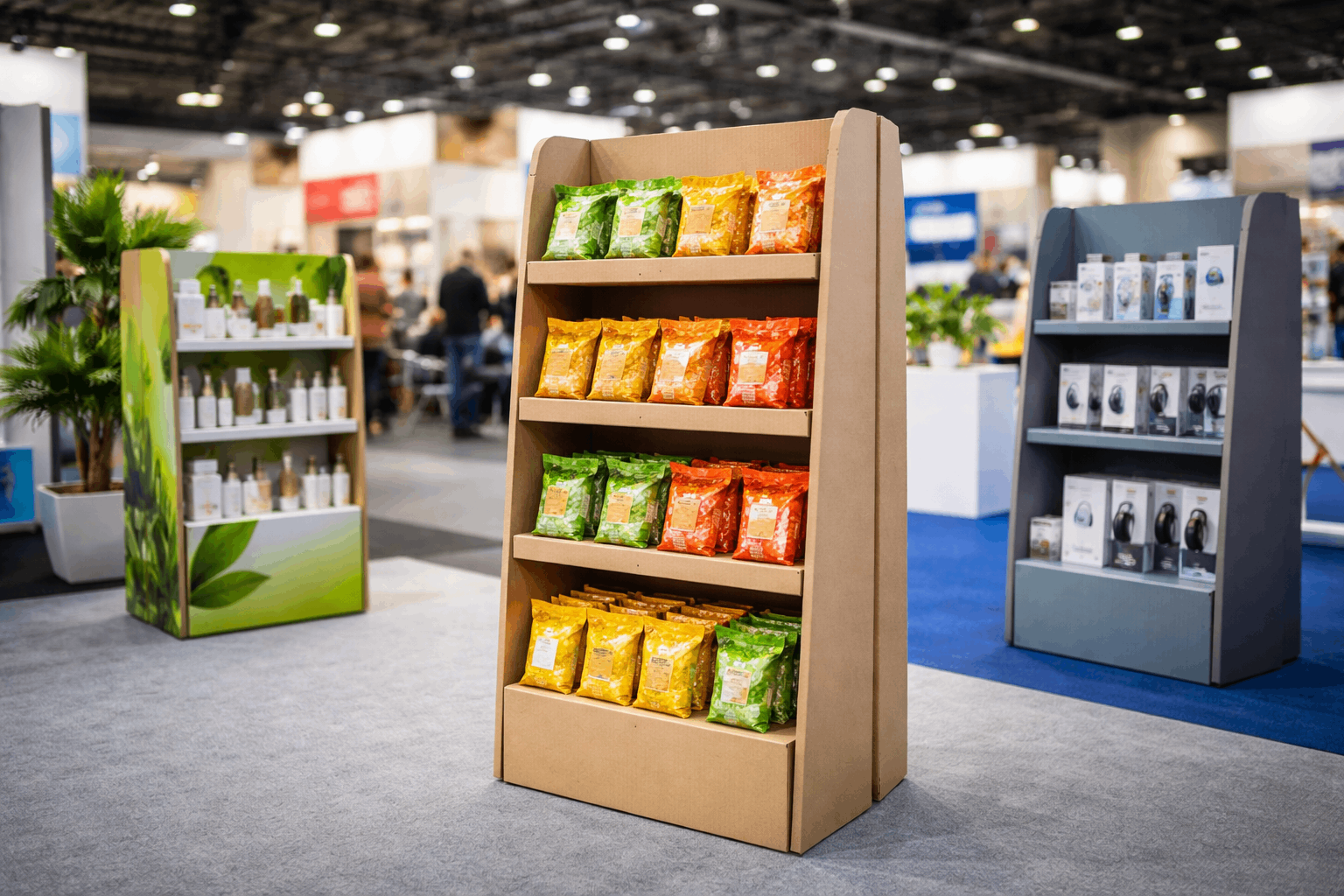
When wholesale buyers search for the best corrugated displays for trade shows, they are usually trying to answer a very practical question: will this display ship well, set up without trouble, support the product properly, and still make sense after more than one event? That is quite different from the way an end consumer reads a blog post. For B2B buyers, a display is never just a visual tool. It sits inside a larger decision that includes sales presentation, logistics, repeat orders, and supplier reliability.
That is why comparing display options by material alone rarely tells the full story. A corrugated display may look cost-effective at first glance, yet the better choice depends on how often it will be used, how heavy the products are, how it will be packed for export, and whether the same unit can be reproduced consistently later. In some trade show programs, corrugated is exactly the right fit. In others, a metal display stand or a hybrid system makes better commercial sense over time.
This article is written for overseas buyers who need to compare display solutions in practical business terms. It looks at where corrugated displays work well, where they start to lose efficiency, and how to judge display programs through the lens of repeat use, sourcing risk, and trade show ROI.
What “Best” Means in a Real Trade Show Buying Decision
In trade show sourcing, best rarely means lowest price. A display only earns that label when it works well in the full context of the project. For wholesale buyers, that usually means more than a good appearance. The display should present products clearly, support natural booth interaction, pack efficiently for export, assemble without creating extra work, and stay consistent enough to justify reordering.
A more useful way to evaluate a display starts with three questions. Does it help the product stand out in a crowded exhibit space? Can it handle shipping, assembly, and product loading without losing shape or stability? And if the same concept is used across several events, does it still hold up financially after the first show is over? These are the kinds of questions procurement teams actually ask when they compare display stands and display systems.
That distinction matters because displays are often reviewed as if they were simple printed items. In reality, they behave more like event assets. A lower opening quote can still lead to a more expensive outcome if the display creates freight inefficiencies, replacement pressure, or an uneven presentation from one event to the next.
Why Corrugated Displays Are Still a Strong Choice in the Right Context
Corrugated displays remain a strong option because they solve a very specific problem well. They are relatively fast to produce, lightweight and easy to transport, and flexible enough to support short-cycle campaigns. If the goal is a regional launch, a temporary promotion, or a display plan built around lightweight products, corrugated can be a very efficient answer.
They become especially useful when graphics need to change often. A corrugated display can be customized to fit updated messaging, seasonal promotions, or retailer-specific requirements without the longer development cycle that usually comes with more engineered fixtures. For buyers working against tight deadlines, that kind of flexibility can be more valuable than extra structural life.
The key is simple: corrugated performs best when its strengths match the job. It works well when visual communication and quick deployment matter most. It becomes less efficient when the same unit is expected to solve a longer-term structural problem.
Where Buyers Start to Reassess Corrugated Display Programs
The point of reassessment usually comes when the event program becomes more demanding. A display that performs well for one show can feel much less convincing once it needs to travel multiple times, keep its shape through repeated assembly, or support products that visitors want to pick up and compare.
At that stage, the discussion becomes more practical. Procurement teams start asking whether the structure will still feel stable after freight, whether replacement costs are likely to rise, and whether the same display can be reproduced with dependable quality. In more technical or premium categories, there is often another concern in the background: whether a temporary-looking fixture still tells the right product story.
This is often the moment when buyers stop thinking only in material terms and start thinking in performance terms. The question is no longer whether corrugated displays are good in general. It becomes whether they are still the best fit for the event schedule, the product interaction, and the brand presentation the booth now needs.
The ROI Question That Matters More Than Unit Price
To maximize your ROI, it helps to look beyond what a display costs on day one and focus instead on how it performs over time. In trade show programs, return on investment is usually shaped by cost per event, replacement frequency, setup labor, freight efficiency, and the quality of presentation that finally reaches the buyer on the show floor.
A low-priced display can still produce a weak return if it needs replacing after one or two events, requires extra protective packing, or starts to lose visual authority earlier than expected. Those costs rarely appear all at once. They tend to show up in small, frustrating increments, which is exactly why they are so easy to overlook during sourcing.
A more durable system may cost more at the start and still deliver a better result over time. That is why experienced procurement teams often compare display programs by lifecycle value rather than by opening quote alone.
| Comparison Factor | Corrugated Display | Metal Display Stand | Hybrid Display System |
|---|---|---|---|
| Typical use cycle | Short-term or limited reuse | Medium to long-term reuse | Flexible multi-event use |
| Best for | Lightweight products and fast campaigns | Heavier products and repeat programs | Buyers balancing graphics and structure |
| Main cost strength | Lower initial spend | Lower replacement frequency | Better cost balance over time |
| Main sourcing concern | Damage sensitivity and reuse limits | Higher opening budget | More planning at design stage |
| Brand impact | Good for campaign visibility | Strong for premium and technical products | Balanced and adaptable |
This comparison is not meant to be a fixed pricing rule. Final cost still depends on dimensions, finish, packaging, order quantity, and engineering detail. The value of the table is in showing the comparison logic stronger buyers tend to use.
What a Display Must Do Before It Can Be Called Effective
A good trade show display does more than hold products. It needs to make the offer easy to understand. In a crowded exhibit space, visitors decide quickly whether a booth is worth stopping for. If the display helps the product category, brand message, and featured items read clearly at a glance, it is already doing part of the selling work.
It also needs to support the way buyers interact with products. A fixture can look impressive in a concept drawing and still disappoint in use if it does not support natural handling. Buyers may want to lift an item, compare formats, inspect details, or discuss specifications while the product remains on display. If the structure feels unstable, confidence tends to drop immediately.
There is also the question of tone. Graphics matter, but structure, finish, and stability matter too. In many B2B categories, physical confidence is part of commercial credibility. A display that looks dependable usually helps the product feel that way as well.
Quick Fit Guide: When Corrugated Makes Sense—and When It Does Not
For overseas buyers, the quickest way to avoid sourcing mistakes is to match the display logic to the event program. Corrugated usually makes sense when the project is short-cycle, the products are lightweight, the graphics may need to change quickly, and the buyer wants a cost-conscious solution that is easy to set up and easy to transport.
That fit starts to weaken when the same unit needs to travel repeatedly, support heavier or more tactile products, or maintain a stronger premium presence over time. In those cases, the better question is not whether corrugated is good in general. It is whether a metal display stand or a hybrid system will protect long-term ROI more effectively.
Seven Smarter Ways to Choose the Right Display Logic
One useful starting point is to judge the display by the number of events it needs to support. A one-time launch and a repeat-use program should never be measured by the same standard. It also helps to separate freight convenience from selling performance. A display can be easy to transport and still fail to make a lasting impression where it counts.
Material choice should also reflect product behavior. If visitors only need to see the message, a lighter temporary structure may be enough. If they need to lift, test, compare, or inspect the product closely, the fixture needs stronger support. The same thinking applies to brand fit. If your brand identity and messaging depend on reliability, engineering quality, or premium presentation, the display should reinforce that impression rather than weaken it.
There is also the question of reorder reality. Can the same display be reproduced with stable dimensions, finish, packing standards, and quality control? That often matters more than the first order itself. In many projects, hybrid solutions deserve earlier consideration as well. Corrugated can handle changeable visual elements, while metal supports the parts that need repeatable structure. Looking one step ahead usually leads to better decisions, especially when display programs are likely to become more demanding over time.
Corrugated, Metal, or Hybrid: A More Useful Comparison for B2B Buyers
For wholesale buyers, the better comparison is not which material sounds more attractive in theory. It is which display logic reduces sourcing risk and supports the intended trade show result. Corrugated is often the right answer when campaigns are short, goods are lightweight, and the priority is quick rollout with flexible graphics.
Metal display stands become more attractive when repeat use, higher load-bearing needs, and stronger presentation standards begin to shape the project. This is common in categories such as hardware, automotive accessories, bottled products, tools, and technical goods, where structure does more than hold products. It also helps communicate quality.
Hybrid systems deserve more attention because they often match real procurement behavior more closely than single-material thinking. They allow buyers to keep visual flexibility where updates are frequent and invest in durable support where repeated use matters most.
What Overseas Buyers Quietly Look For in a Supplier’s Content
When overseas buyers read supplier blogs, they are usually checking for more than information. They are looking for signs that the supplier understands packaging efficiency, OEM and ODM capability, export readiness, material fit, and how a display is likely to perform after shipping. Useful content reduces uncertainty before an inquiry is even sent.
This is also where quality process starts to matter. Buyers may look for evidence of ISO 9001 discipline, RoHS-related compliance where relevant, and a supplier’s ability to explain sampling, finish options, load-bearing design, and pack-down logic in a practical way.
A supplier does not need to sound official to be credible. In fact, content usually works better when it sounds experienced, clear, and commercially grounded. Buyers are more likely to respond to useful specifics than to broad claims.
What to Confirm Before Requesting a Quote
Before asking a supplier to quote a custom trade show display, serious buyers usually confirm a few project details first. They check product dimensions and weight, expected event frequency, shipping method, target packing size, required graphic update method, and whether the same unit may need to be reordered later. Those details often determine whether corrugated, metal, or hybrid is the best commercial fit.
This is also the stage where search behavior becomes more specific. Buyers may start looking for terms such as custom trade show display manufacturer, OEM display supplier for trade shows, reusable display stands for exhibitions, export-ready display stands, or heavy-duty display stand for trade shows. Content that answers these practical questions tends to be more useful than content that simply repeats general material benefits.
Conclusion
The best corrugated displays for trade shows are the ones that match the real demands of the program. They are a strong choice when the project depends on speed, lighter product loads, flexible graphics, and cost-conscious execution.
For buyers managing broader trade show programs, the more useful decision model is based on sourcing behavior rather than material labels alone. Freight efficiency, setup reliability, repeat use, reorder consistency, and brand presentation all matter. In many cases, that naturally points toward a more durable metal display stand or a hybrid system that balances flexibility with structure.
If you are comparing corrugated display options or planning a reusable display program for upcoming trade shows, Yishang Display can help you evaluate the most practical direction based on product type, event frequency, and sourcing priorities. Send us your project brief, and we will help you develop a display solution that is realistic to produce, efficient to use, and built for commercial trade show performance.