
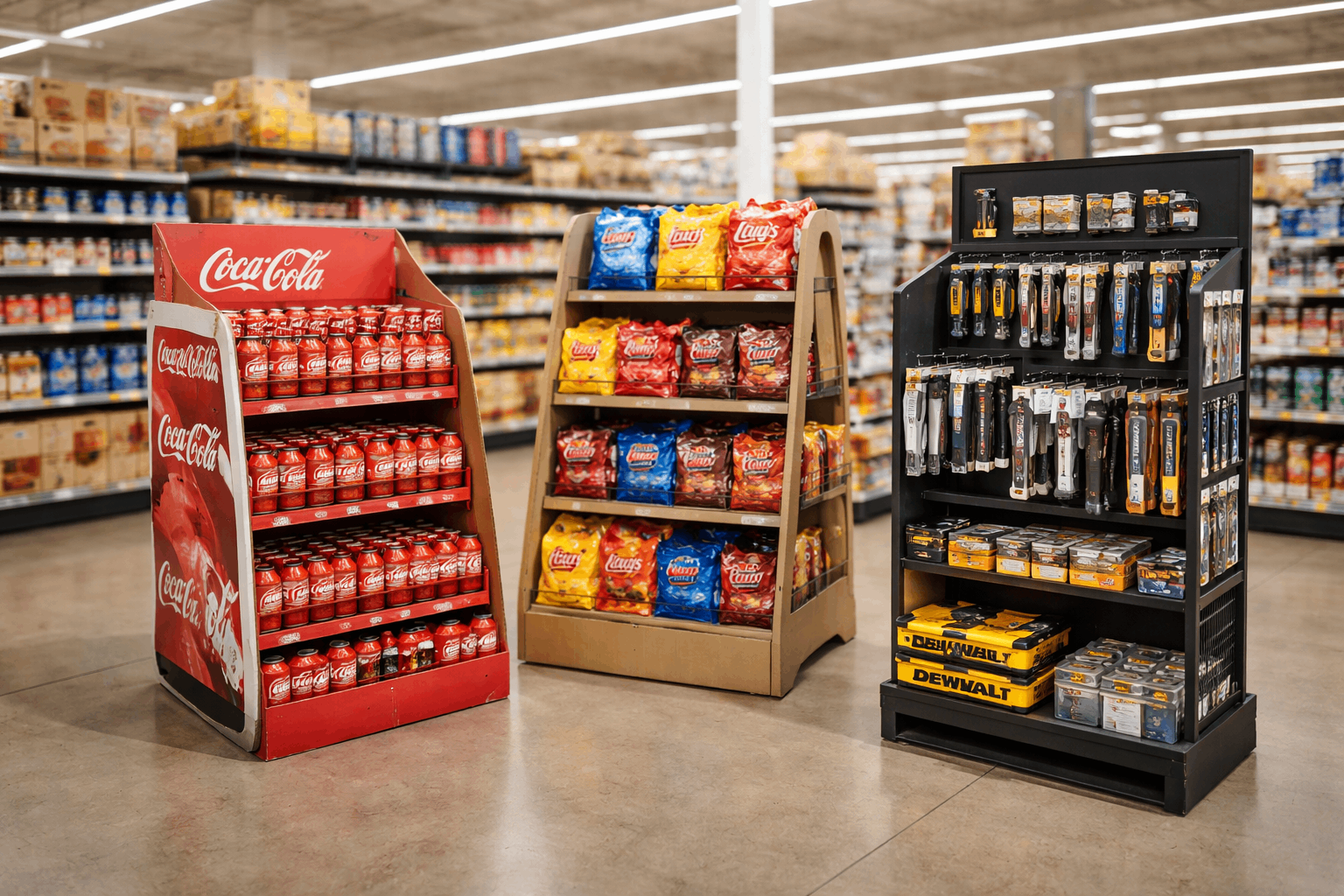
Wholesale buyers do not read supplier blogs the way end consumers do. Most of the time, they scan for useful signals: does the supplier understand product load, export packaging, replenishment pressure, retail execution, and long-term cost? That is why a good article on corrugated displays for brand activations should do more than repeat familiar claims about looks or sustainability. It should, above all, help the reader make a better sourcing decision.
Corrugated displays are a common search entry point because they are lightweight, printable, and practical for short campaigns. That part is true. But for overseas buyers managing distributor programs, retail chains, or multi-country launches, the real decision usually goes further than that. They need to weigh speed, durability, branding flexibility, landed cost, and replacement risk before choosing a display system. And that is where the conversation becomes more interesting.
This is also where Yishang Display can add something genuinely useful. Instead of treating corrugated as the automatic answer, this guide looks at where corrugated works well, where metal displays often perform better over time, and why hybrid solutions are, in many cases, the more commercially balanced option.
Why Corrugated Displays Stay High on Buyers’ Shortlists
Corrugated displays remain popular because they solve several short-term merchandising needs rather efficiently. They are easy to print, relatively efficient to transport, and quick to adapt for promotional campaigns. For limited-time activations, supermarket promotions, and seasonal point of sale programs, that combination can be commercially useful.
They also support a sustainability story that procurement teams and marketing teams can both understand without much friction. Recyclable material, lighter shipping weight, and flat-packed storage are all straightforward advantages. In lightweight product categories, especially where the campaign has a clear end date, these points can make corrugated a sensible first option.
The limitation is not the material itself. It is, more often, the way the material is applied. Once buyers begin using the same logic for programs that demand more from structure, repetition, or retail durability, the limits start to show.
How Overseas Wholesale Buyers Evaluate a POS Display Supplier and Program
A wholesale buyer will usually judge a display the same way they judge other supply decisions: through risk, repeatability, and total cost. That is especially true when the buyer is comparing a custom retail display manufacturer or an export-ready display supplier rather than sourcing a simple one-off promotional unit. The display has to arrive safely, assemble reliably, hold the product correctly, and remain presentable after repeated handling. If one of those points starts to fail after export, the original quotation advantage tends to look much less convincing.
That is why B2B buyers focus on a different set of details from consumer-facing readers. They look at load capacity, assembly complexity, carton efficiency, customization feasibility, and field performance. They also think in terms of landed cost rather than factory price alone. Freight, damage risk, storage, labor at destination, and replacement cycles all shape the real economics of a display program.
That buying habit affects search behavior as well. Professional buyers often search with commercial phrases such as custom metal display racks, retail display stands, POS display manufacturer, export display fixtures, reusable display systems, or OEM display solutions. They are not only comparing styles. In most cases, they are trying to reduce downstream problems before they commit to tooling, volume, or rollout.
Where Corrugated Displays Work Best
Corrugated displays work best when the campaign is short, the SKU weight is modest, and the visual message needs to change quickly. For a new product launch, a supermarket promotion, or a checkout campaign, a well-designed corrugated display can support visibility, simplify rollout, and control initial spend. In those settings, the logic is fairly clear.
They are also useful when the merchandising goal depends more on graphics than on long-term service life. Here, the display acts mainly as a promotional communication tool. If the campaign is expected to last only a few weeks and replenishment is limited, corrugated can be an efficient point of sale solution—sometimes a very efficient one.
For wholesale buyers, then, the key is not to overextend the material. It is to match corrugated to the right use case rather than treat it as a universal answer.
Where Corrugated Starts to Lose Efficiency
The pressure points appear when the display is expected to do more than support a short visual campaign. Repeated replenishment, uneven product weight, shopper contact, and movement on the retail floor can reduce structural neatness over time. Once the fixture starts to bow, loosen, or look untidy, the merchandising effect weakens even if the unit is still technically standing.
This matters more in categories such as beverages, hardware, automotive accessories, pet products, and sports goods. These products usually require stronger load-bearing capacity, better shelf stability, and cleaner long-term presentation. Under those conditions, the lowest first cost does not always produce the best total value. In fact, it often does not.
This is often the point where buyers expand the discussion from corrugated displays to metal displays or mixed-material structures. Not because corrugated has no role, but because the project has moved into a different performance category.
The Better Procurement Question: What Does the Program Require?
The strongest display decisions begin with project demands, not with material preference. Campaign duration is one of the first filters. A short promotional window can justify a temporary display. A repeat program across multiple stores or markets changes the economics and increases the value of reuse.
Product weight is the next major factor. Lightweight impulse items do not create the same structural pressure as bottled drinks, boxed pet food, tools, or stacked merchandise. Once products become heavier—or replenishment becomes more frequent—the display needs to behave more like a durable retail asset.
Store conditions matter too. A display in a controlled location behaves differently from one placed on an aisle end, a promotional island, or near checkout counters. Buyers sourcing for those environments are not just buying attention. They are buying stability, easier maintenance, and, perhaps most importantly, more predictable execution.
Corrugated, Metal, or Hybrid? A More Practical Comparison for Retail Display Procurement
Corrugated displays are often the right answer when the brief is driven by speed, lightweight deployment, and a defined campaign period. They remain practical for temporary retail programs where shipping efficiency and graphic flexibility are more important than reuse.
Metal displays become more attractive when buyers need stronger load capacity, longer service life, and better presentation consistency. Metal display racks are often better suited to premium supermarket racks, heavy product merchandising, repeated replenishment, and multi-store rollouts where the fixture needs to stay stable through longer campaign periods.
Hybrid display solutions are frequently the most commercially balanced option. This is often the case in supermarket programs, beverage promotions, and other multi-store campaigns where buyers want the long service life of metal display racks but still need changeable graphics for seasonal execution. A metal frame can provide the structural support, while corrugated or acrylic panels carry campaign graphics. This approach can reduce full-unit replacement and support seasonal updates without rebuilding the entire fixture. For many buyers, that flexibility is not just convenient. It is commercially sensible.
| Evaluation Factor | Corrugated Displays | Metal Displays | Hybrid Display Solutions |
|---|---|---|---|
| Best fit | Short-term campaigns | Long-term retail programs | Multi-phase activations |
| Load-bearing capacity | Low to medium | Medium to high | Medium to high |
| Graphic flexibility | Excellent | Moderate | High |
| Reusability | Limited | Strong | Strong |
| Export resilience | Moderate | Strong | Strong |
| Premium presentation | Moderate | Strong | Strong |
| Replacement frequency | Higher in demanding use | Lower | Lower |
What Actually Improves Visibility in Store for Brand Activations
Visibility is often described too loosely in supplier content. In practice, a display improves visibility when it attracts attention, keeps the presentation orderly, and makes the product easy to shop. If one of those elements fails, the display may still be noticeable while performing poorly as a selling tool.
That is why buyers tend to look beyond graphics alone. A bold header can create first-glance impact, certainly, but sustained performance depends on shelf alignment, product accessibility, and the ability of the display to stay neat after replenishment. In real retail conditions, visual discipline is part of commercial performance. It is not a cosmetic extra.
Material choice affects this directly. For example, a beverage activation shipped to multiple retail locations may begin with corrugated as the obvious idea because the graphics are easy to update and the first quotation looks attractive. But once product weight, replenishment frequency, and transit handling are considered, a metal or hybrid structure often becomes the more reliable retail display solution. Corrugated can create strong initial impact. Metal displays and hybrid systems often hold that impact longer because they preserve shape and product organization more effectively in demanding environments. For wholesale buyers responsible for repeated execution, that stability can matter just as much as the first impression—sometimes more.
Sustainable Point of Sale Solutions Need a Lifecycle View in B2B Procurement
Sustainable point of sale solutions are often discussed only in terms of recyclability. That is relevant, and corrugated displays clearly benefit from that association. But for B2B buyers, sustainability is also tied to replacement frequency, service life, and the total resource use of the full program.
A display that is easy to recycle but replaced several times may not be the strongest long-term option. By contrast, a reusable metal structure with replaceable branding panels may support a more efficient lifecycle in recurring retail programs. The better answer depends on campaign duration, use intensity, and the cost of replacement after shipment.
This is why many procurement teams compare total landed cost rather than factory price alone. Freight, storage, labor, damage risk, and reorder frequency all shape the final economics. What looks inexpensive at the start can, in certain cases, become surprisingly costly over time.
| Sustainability Lens | Corrugated-Focused Logic | Metal-Focused Logic | Better Procurement View |
|---|---|---|---|
| Main narrative | Recyclable material | Reusable structure | Full lifecycle value |
| Strongest fit | Short promotions | Repeat programs | Match the use cycle |
| Main risk | More frequent replacement | Higher upfront cost | Evaluate landed cost |
| Best question | Is it easy to recycle? | Can it be reused? | What is the long-term program cost? |
Why Production Control and Export Readiness Matter
For overseas procurement teams, design is only one part of supplier evaluation. Production consistency, packaging quality, and export readiness matter just as much. Buyers want confidence that approved samples can be repeated accurately at volume and that the display will arrive in market in usable condition.
That is where structured manufacturing control becomes important. Quality management systems such as ISO 9001 can support repeatability, while compliance expectations such as RoHS may be relevant for certain components or finishes depending on the project. These details do not replace good structural design, but they do strengthen trust in the supplier’s operating discipline.
At Yishang Display, this is the practical side of value. Buyers often move faster when the supplier can connect design, mixed-material engineering, bulk production, and export packaging into one workable solution. Not flashy, perhaps—but useful.
Design for Retail Reality, Not Just for Samples
A strong display concept has to survive actual store conditions. That means hooks, shelves, baskets, reinforcements, and base structure should all be selected around the SKU set, product weight, and replenishment pattern from the beginning.
Daily use matters just as much as first presentation. If a fixture becomes untidy quickly, or if it is difficult for store staff to refill, the program loses efficiency. Small structural weaknesses become expensive when repeated across many stores.
This is another reason hybrid systems are gaining attention in professional retail programs. For buyers comparing reusable POS displays, custom metal display racks for supermarkets, or retail display stands for heavy products, the appeal is not theoretical. It comes from lower replacement pressure, better rollout consistency, and easier long-term maintenance. They allow structural performance and visual branding to be managed separately, which often makes the display easier to update and more durable in use.
Conclusion: Better Display Decisions Start with Better Buying Logic
Corrugated displays remain a useful option for brand activations, especially in short campaigns with lightweight products and strong graphic requirements. They are flexible, practical, and commercially efficient in the right setting.
But for wholesale buyers managing export programs, heavier SKUs, repeated replenishment, or multi-store execution, the better answer is often more nuanced. Metal displays and hybrid display solutions can offer stronger structure, lower replacement pressure, and better long-term value.
If you are comparing display options for an upcoming retail program, Yishang Display can help assess corrugated, metal, and hybrid solutions based on product load, campaign length, and export requirements.