
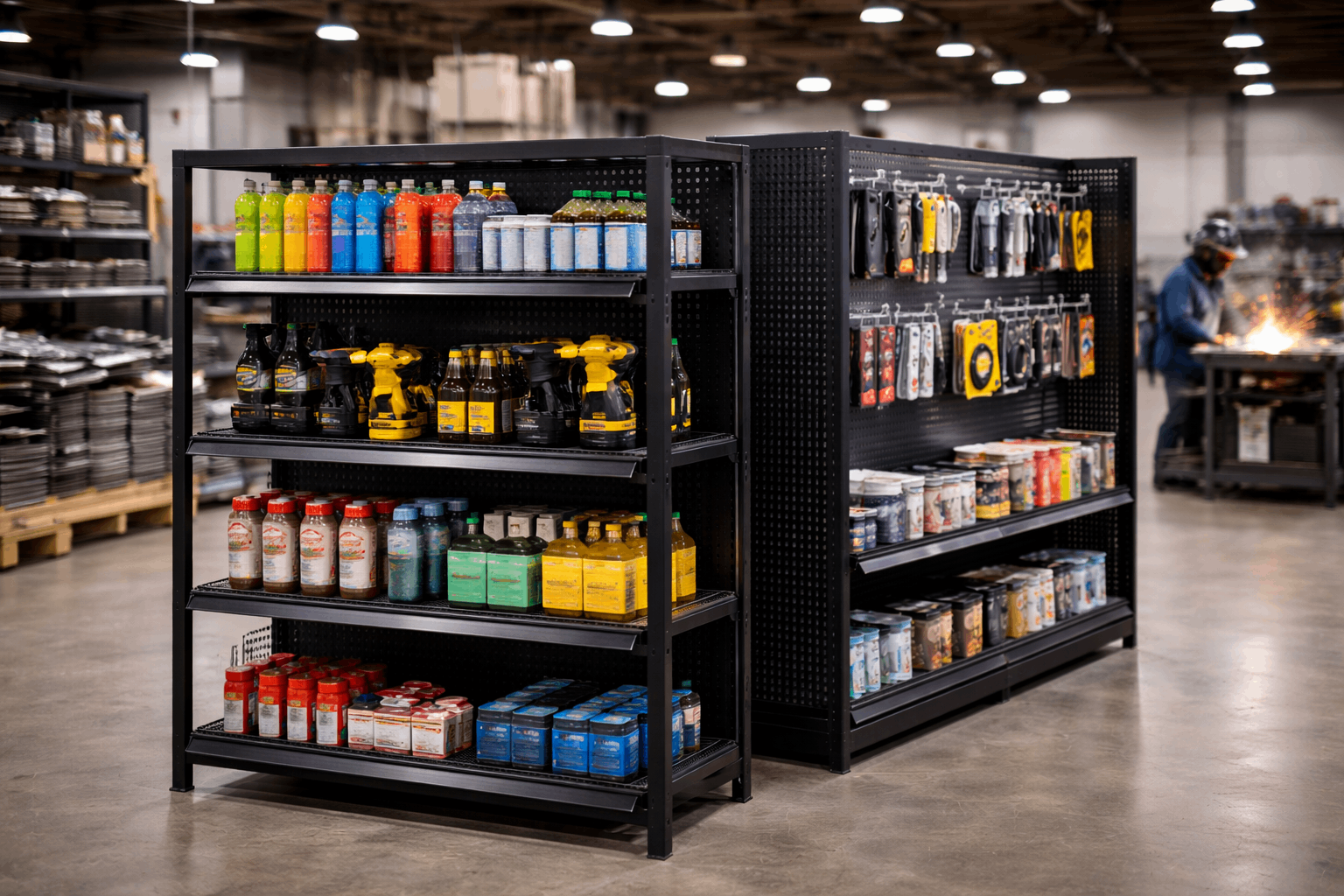
For overseas wholesale buyers, a point of sale display is not just a merchandising tool. It is also part of the freight plan, the store rollout plan, and the total cost structure behind a retail program. A display may only have a few seconds to capture attention in store, but buyers evaluate it over a much longer cycle that includes production, packing, shipping, assembly, replenishment, and replacement.
That is why custom point of sale displays should be judged in practical terms. Buyers comparing suppliers are usually not looking for abstract design ideas. They are trying to understand which structure will support the product properly, fit the retail environment, and keep total landed cost under control. For higher-volume or longer-cycle programs, metal point of sale displays often offer a stronger commercial balance than short-life alternatives.
What an Effective POS Display Really Needs to Do
An effective display starts with visibility, but visibility alone is not enough. In most retail settings, shoppers decide very quickly whether to stop, scan, or move on. The display needs to interrupt that routine without overwhelming the product. Strong shelf presence matters, but product clarity matters more.
This is where good POS display design creates real value. The structure should make the product easy to see, the lead SKU easy to identify, and the buying action easy to take. Clean shelf layout, sensible product-facing logic, and controlled branding usually outperform designs that try to do too much at once.
For wholesale buyers, effectiveness also includes what happens after installation. A fixture that looks attractive on day one but becomes untidy after replenishment, unstable after partial sell-through, or difficult for store staff to maintain will lose value quickly. In practical terms, a strong display supports visibility, usability, and continuity at the same time.
Why Attractive Display Concepts Still Underperform in Stores
Many display programs fail because they are designed for approval rather than for use. A concept may look premium in a presentation while still performing poorly in store because the frame blocks products, takes up too much space, or loses visual order once shoppers start interacting with it. The product then competes with the display instead of benefiting from it.
Cost logic creates another common problem. Buyers naturally compare ex-factory price, but the real project cost is much broader. Freight volume, assembly time, replacement frequency, and transit damage often influence return on investment more than a small difference in unit price. A fixture that looks cheaper in quotation may become more expensive across the full program.
Operational fit is equally important. A display that requires complicated assembly, depends on tools stores do not carry, or loses balance after stock starts moving creates friction throughout the rollout. This is one reason procurement teams value suppliers who understand not only how a display should look, but how it should behave in daily use.
Why Customization Matters in Real Retail Programs
Standard display stands can work for simple promotions, but many wholesale programs are not simple. Product weight, pack size, SKU count, placement zone, and campaign duration all change what a display needs to do. When those conditions are specific, generic fixtures often create mismatch cost rather than savings.
That is where custom POS displays become commercially useful. Customization allows the structure to match the product, the store layout, and the intended selling task. It can improve product fit, reduce wasted space, and make replenishment more efficient. In practice, this often matters more than adding extra decorative elements.
Good customization does not mean making every part unique. In many successful programs, hidden structural components are standardized for manufacturing efficiency, while visible areas are customized for product hierarchy, branding, and category fit. This helps buyers keep the display tailored without turning it into an unnecessarily expensive project.
Why Metal Displays Often Make Better Commercial Sense
For many categories, the main issue is not whether a display can attract attention. It is whether the display can keep performing after freight, setup, repeated replenishment, and daily handling. This is where custom metal display racks usually provide a clear advantage. They offer stronger load-bearing capacity, better structural stability, and better resistance to damage than many short-life materials.
These strengths matter most in categories such as beverages, hardware, automotive accessories, pet products, and sporting goods. In those environments, display failure is not a small aesthetic problem. If shelves deform, frames lean, or finishes wear too quickly, the result is poorer presentation, lower retailer confidence, and more replacement cost.
Metal also allows more design flexibility than many buyers expect. A metal fixture can be powder-coated for durability and brand consistency, then combined with acrylic sign holders, wood shelves, or printed panels for a more premium look. This makes metal suitable not only for heavy-duty categories, but also for cleaner branded presentations where reliability still matters.
The long-term business case is often the strongest reason to choose metal. A metal display may not always have the lowest starting price, but it often has better lifecycle value. Lower replacement pressure, stronger repeatability, and better reuse potential can all improve program economics over time.
Material Comparison for POS Display Programs
| Criteria | Metal Displays | Acrylic-Based Displays | Cardboard/Paper Displays | Wood-Integrated Displays |
|---|---|---|---|---|
| Load-bearing capacity | High | Moderate | Low to moderate | Moderate |
| Resistance to handling damage | High | Moderate | Low | Moderate |
| Reusability potential | High | Moderate | Low | Moderate |
| Best fit for long-cycle programs | Excellent | Selective | Limited | Selective |
| Packaging efficiency | Strong when engineered as knock-down | Moderate | Strong for short-term use | Moderate |
| Typical procurement value | Strong lifecycle value | Premium visual use | Lower initial cost | Category-specific appeal |
For buyers comparing options, the point is not that one material is always best. The point is that material should match the product load, use cycle, shipping plan, and replacement risk. When the program requires durability and consistency, metal often becomes the safer commercial choice.
Designing from the Store Backward
Good retail display design starts with the store environment, not the factory drawing. The first question should be where the display will stand and what kind of competition for attention it will face. Checkout areas, endcaps, queue zones, and aisle placements all create different conditions for footprint, sightline, and customer access.
The second question is what the shopper needs to understand immediately. In most stores, the display has only a short moment to communicate the product category, highlight the lead item, and guide the eye toward a purchase decision. Hero SKU placement, open product visibility, and controlled branding usually outperform messages that try to say too much at once.
Only after these conditions are clear should the structure be engineered around the product. Unit weight, pack dimensions, facing count, refill frequency, and expected handling all shape the right solution. For overseas buyers, this is also the stage where packing method, assembly logic, and rollout practicality need to be considered because they directly affect landed cost.
The Design Decisions That Influence Cost Most
One major decision is how much structure is actually needed. More material does not always create more value. In many cases, a cleaner frame improves product visibility and controls cost at the same time. This is often where experienced engineering makes the difference between a fixture that looks expensive and one that performs efficiently.
Capacity planning is another important factor. More shelves and more facings may look attractive in a concept stage, but oversized displays can increase freight volume, occupy too much floor space, and make replenishment harder. For procurement teams, it is usually better to size the display around realistic sales movement and store behavior than around maximum theoretical stock load.
Service life is the third major decision. A short promotion, a seasonal project, and a permanent fixture should not be built with the same logic. The expected use cycle influences material choice, connection system, finish specification, and packing format. This is why knock-down, modular, and reusable structures continue to attract attention from buyers trying to improve both shipping efficiency and long-term value.
Where Buyers Usually Save Costs Successfully
Meaningful savings usually come from stronger engineering rather than weaker materials. Structural efficiency can reduce unnecessary material use without sacrificing reliability. This may involve improving tube thickness, shelf geometry, wire spacing, or component count so the display still performs as required while using less wasteful structure.
Freight is another major cost lever, especially in export projects. A knock-down display or flat-pack design can improve container efficiency and reduce shipping volume significantly when engineered well. The key is to lower freight cost without creating assembly problems at store level. A design that saves space in transit but becomes frustrating to install is not a complete solution.
Another useful strategy is to standardize hidden components while customizing visible branding zones. This helps buyers maintain a branded retail appearance without making every part a custom cost center. It also avoids overdesign, where additional decorative details increase manufacturing complexity without improving sell-through.
Structure Logic by Deployment Need
| Priority | Fixed Metal Structure | Knock-Down Metal Structure | Modular Metal Structure |
|---|---|---|---|
| Best application | Permanent placement | Freight-sensitive rollout | Repeat campaigns and adjustable use |
| Shipping efficiency | Moderate | High | High |
| Assembly requirement | Low to moderate | Moderate | Moderate |
| Reusability | High | High | Very high |
| Load-bearing strength | High | High when well engineered | High |
| Long-term cost control | Strong | Strong | Strongest in multi-cycle use |
For wholesale buyers, this comparison is usually more useful than style-based advice because it connects the structure directly to rollout scale, assembly conditions, and total landed cost.
Why Useful Life Matters in Sustainable Display Planning
Many buyers now ask whether a display solution is sustainable, but the most useful answer is usually practical. A display becomes more sustainable when it lasts longer, creates less replacement waste, and can be reused where the program justifies it. In that sense, useful life often matters more than simple material labels.
This is one reason metal fixtures remain highly relevant in long-cycle programs. A structure that maintains performance over repeated use can reduce disposal pressure and support better material efficiency over time. For buyers looking for sustainable and eco-friendly solutions in a realistic procurement context, durability and reusability are often more meaningful than short-term claims.
A Better Project Brief Usually Leads to a Better Quote
Many display problems begin before the first sample is made. If the supplier does not receive clear information about product size, product weight, SKU count, retail placement, packaging format, and refill pattern, the design process becomes less precise from the beginning. That usually leads to more revisions, more uncertainty, and less accurate pricing.
Commercial inputs matter just as much. Rollout quantity, campaign duration, shipping expectations, and reuse plans all influence the correct structure. Buyers who define these points earlier usually receive more realistic proposals and a smoother development process. A better brief does not just help the supplier. It helps the buyer compare solutions more accurately.
Project Inputs That Shape the Final Display
| Brief Input | Why It Matters |
|---|---|
| Product size and weight | Determines shelf strength, spacing, and frame design |
| SKU count | Shapes capacity, hierarchy, and product visibility |
| Placement zone | Affects footprint, access, and shopper sightline |
| Refill frequency | Influences shelf design and store usability |
| Rollout quantity | Changes production planning and logistics strategy |
| Campaign duration | Helps define the right level of structural permanence |
| Shipping expectations | Impacts packing method and setup logic |
Conclusion
The most effective custom point of sale displays do not succeed because they look busy. They succeed because they make products easier to notice, easier to buy, and easier to manage throughout the life of the program. For wholesale buyers, that is usually the difference between a display that is merely attractive and one that creates real commercial value.
At Yishang Display, we focus on display solutions that support both retail performance and procurement efficiency. If you are evaluating options for a new rollout, we would be glad to discuss your product, channel, and cost targets and explore a practical display approach with you.
Frequently Asked Questions
What makes a custom POS display effective for wholesale retail programs?
A strong display should attract attention, present the product clearly, and remain stable through repeated handling and replenishment. For wholesale buyers, effectiveness also includes freight efficiency, assembly practicality, and consistency across bulk production.
Are metal POS displays more cost-effective than temporary display materials?
They often are in heavier or longer-cycle programs. Although the initial quote may be higher, metal POS displays can reduce replacement frequency, improve durability, and provide stronger lifecycle value.
How can buyers reduce costs associated with custom display projects?
The most effective ways are usually better engineering, stronger packing efficiency, and careful control of unnecessary complexity. A well-designed knock-down structure can often reduce shipping cost without weakening performance.
Can custom point of sale displays support reuse and more sustainable retail programs?
Yes. Custom point of sale displays can be designed to be more sustainable when the structure supports longer use, reuse, and efficient shipping. In many cases, reusable metal systems offer a stronger practical answer than one-time fixtures.
What information should buyers prepare before requesting a quote?
It is best to prepare product dimensions, product weight, SKU count, target placement zone, expected rollout quantity, campaign duration, shipping expectations, and any reuse plan. This helps the supplier recommend a display that better matches the actual buying plan.