
Overseas buyers do not usually search supplier blogs for general inspiration. They are more often trying to answer a practical question: which retail display format is most suitable for this product, this store environment, and this rollout plan. That is why a useful article on types of retail displays should not stop at naming display categories. It should show which formats work better in specific retail conditions and explain what those choices mean for procurement, shipping, setup, and long-term use.
At Yishang Display, we see this pattern often. Buyers tend to begin with product requirements, not display shapes. They want to know whether a fixture can support the load, fit the retail footprint, withstand repeated shopper contact, and remain cost-effective after freight, assembly, and store execution are considered. In practice, the most effective retail display is usually the one that matches the product, program duration, and operating conditions, not simply the one that looks strongest in a rendering.
In practical terms, the most effective retail display formats usually fall into a few clear groups: floor and freestanding displays for visibility, end caps and countertop units for conversion, sidekick and inline fixtures for product flow, pallet and PDQ formats for volume programs, gravity feed systems for replenishment efficiency, and display cases or protected fixtures for higher-value presentation.
What Makes a Retail Display Effective
A good display first needs to be noticed. But visibility alone does not make a display effective. The fixture also needs to make the product easy to understand, easy to reach, and easy to replenish. If the structure blocks access, becomes untidy after one day on the sales floor, or takes too much labor to maintain, its selling value starts to fall.
For wholesale buyers, execution also shapes effectiveness. A display needs enough structural stability for the product load. It should be practical to pack, reasonable to assemble, and suitable for the selling objective. Some display formats stop traffic. Others are better for basket building, category comparison, or volume movement. This is why the real decision is not just about display type. It is about display fit.
Floor Displays and Freestanding Units
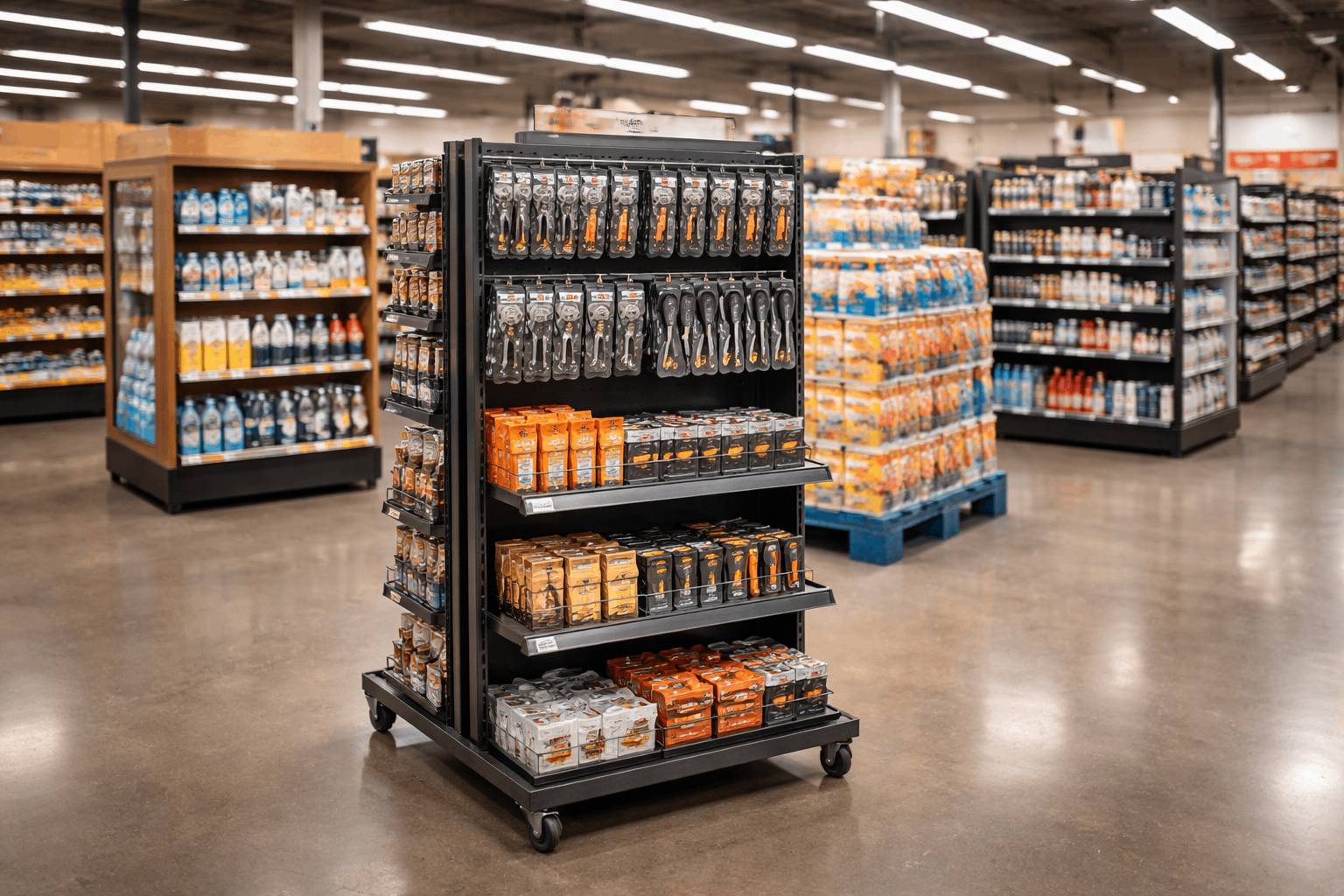
Floor displays remain one of the most versatile retail display examples because they create visibility outside the product’s standard shelf position. They work especially well for launches, seasonal programs, promotional offers, and categories that need stronger exposure without changing the entire aisle layout. For buyers managing multiple stores or markets, that flexibility is one of the main reasons freestanding units stay in demand.
The commercial advantage of a freestanding display is not only that it attracts attention. It can also be configured with shelves, hooks, baskets, or sign holders to suit different product mixes. That makes it more practical for broader retail programs where one format may need to serve several SKUs or store types.
The right structure matters here. A lightweight unit may be suitable for a short campaign, but a longer program often needs better stability and stronger load-bearing support. This is also why many buyers compare broader custom retail display solutions before locking in a final format. That is one reason buyers often choose metal freestanding displays for hardware, pet products, beverages, automotive accessories, and other categories where product weight and repeated use place more demands on the fixture.
End Cap and Countertop Displays
End cap displays perform well because they sit where shoppers naturally pass while moving in and out of aisles. For promotional packs, bundled items, and faster-moving products, they can improve exposure without taking up a separate floor location. For buyers, this means end caps can support stronger turns in a limited footprint, which is why they are widely used in grocery, convenience, and mass retail programs.
Retail counter displays work best at the buying moment. Retailers place them at checkout points, service desks, and other small zones where customers pause briefly. In these locations, accessories, trial sizes, confectionery, and other low-friction products can sell well even with modest capacity. The value of the format is less about volume and more about timing, convenience, and consistent presentation.
For procurement teams, the key question is whether the unit is meant for a brief promotion or for ongoing daily use. That affects material choice, packing method, setup efficiency, and total cost. A compact display can still be highly effective when it is easy to place, easy to refill, and reliable across a wider rollout.
Sidekick, Inline, and Gravity Feed Displays
Sidekick displays are useful when brands need additional selling space close to a main category without taking a large footprint. By positioning related products beside the primary purchase zone, they support cross-selling in a practical way. This is often valuable for hardware accessories, small electronics, pet add-ons, or impulse-oriented packaged goods.
Inline fixtures and gondola displays do not attract as much attention as promotional displays, but they do a large amount of everyday merchandising work. They support category organization, help shoppers compare products more easily, and create a more predictable browsing experience. For many buyers, these quieter formats matter because they influence daily sell-through rather than only short campaign visibility.
Gravity feed displays add another operational advantage. They keep products front-faced and easier to grab, which can reduce shelf maintenance and improve presentation between replenishment cycles. For beverages, snacks, and selected personal care or packaged goods, this can support both shopper convenience and labor efficiency.
Pallet, PDQ, and Dump Bin Displays
Some retail display programs are built primarily for volume, speed, and execution. In those cases, pallet displays often become a strong option. They are common in supermarkets, club stores, and seasonal campaigns where product capacity matters as much as visual presentation. Their main strength is not refinement. It is their ability to move larger quantities efficiently.
PDQ displays solve a related problem. They support faster setup and help reduce inconsistency across store locations. That matters in programs where rollout speed is important and store teams have limited time for installation. A display that is simpler to execute well can often outperform a more complex concept that is harder to ship, harder to assemble, or harder to maintain.
Dump bins and case stacker displays are also relevant in this group. They look less controlled, but they can perform well for promotional packs, value-led programs, and categories that benefit from casual browsing. For buyers, the evaluation is usually based on cost efficiency, speed, and suitability for the product type.
Multi-Tiered and Protected Displays
Some categories need more than visibility. They need the display to organize product variation, support a more premium presentation, or offer more protection. Multi-tiered fixtures are useful when several SKUs need to remain visible within a compact footprint. This is often relevant in cosmetics, personal care, food gifts, and similar categories where comparison is part of the buying decision.
These displays only work well when designers resolve spacing, balance, and product weight properly. If those factors are ignored, the fixture can feel crowded or unstable once real products are loaded. That is why experienced buyers tend to evaluate this display type by performance as much as appearance.
Display cases and other protected displays, often using metal structures combined with acrylic or glass elements, are useful for products that need more control or stronger perceived value. In these cases, the display does more than hold the product. It shapes how the product is interpreted at the point of sale.
Why Material Choice Affects Display Performance
Material is not only a visual preference. It affects freight, assembly, maintenance, durability, and the useful life of the fixture. The same display concept can perform very differently depending on what it is made from and how it is engineered. That is one reason buyers should discuss material choice early in the buying process, not after they have already decided on the structure.
Buyers often select metal when a program needs better stability, stronger load support, and a longer service life. That is especially relevant for freestanding units, heavier product categories, and displays expected to remain presentable under repeated use. Acrylic is useful when product visibility and cleaner presentation are priorities. Wood can support certain premium concepts, while cardboard remains practical for lighter and shorter-term promotions.
For buyers, the useful comparison is not metal versus another material in the abstract. Many teams reviewing long-term programs also compare fixture materials alongside metal display racks to judge durability and service life more accurately. The more important question is whether the chosen structure can perform under actual retail conditions. If the product is heavier, the traffic is higher, or the program runs longer, a stronger fixture is often the more reliable investment.
What Buyers Usually Compare Before Sending an Inquiry
By the time a buyer reaches an article like this, they often already know the product category and the retail goal. What they still need is confidence that the supplier understands the project commercially. They want to know whether the fixture suits the load requirement, store conditions, rollout timing, and level of customization needed.
That is why content on retail displays should connect presentation with procurement logic. Teams should evaluate a floor unit in terms of visibility, stability, packing, and service life. They should assess a countertop unit in terms of turnover, footprint, and replenishment. They should judge a pallet unit in terms of volume movement and execution speed. Without that connection, the content becomes too generic to help a serious buyer move forward.
Industry research continues to show that in-store presentation influences purchase decisions, especially in categories with multiple competing options and frequent impulse add-ons, a point also reflected in broader guidance on retail product displays. The exact percentage differs by market and product type, but the commercial conclusion is consistent: display choice still affects shopper behavior, which is why buyers continue to evaluate fixtures carefully.
Choosing the Right Direction for a Display Program
- If the main challenge is visibility, floor displays or end caps may be the strongest starting point.
- If the opportunity lies in basket building, counter units or sidekicks may be more suitable.
- If the goal is volume movement, pallet formats, gravity feed systems, or other higher-capacity structures may be more efficient.
A reliable process does not begin with a shape. It begins with the product, the retail setting, the expected duration of the program, and the level of shopper interaction. Once those points are clear, the right display direction becomes easier to define.
Frequently Asked Questions
What type of retail display is best for heavy products?
For heavier products, buyers usually look for stronger freestanding units, reinforced shelving, or metal-based fixtures that offer better load-bearing support and stability over time.
What is the difference between an end cap and a sidekick display?
An end cap is positioned at the end of an aisle and is mainly used for high-visibility promotion. A sidekick is a smaller secondary display placed next to a main category to support cross-selling.
Are metal retail displays better for long-term programs?
In many cases, yes. Metal displays are often chosen for longer programs because they can offer better stability, longer service life, and more reliable performance under repeated use.
How do buyers choose between floor displays and pallet displays?
Buyers usually select floor displays when visibility and brand presentation matter most. Pallet displays make more sense when the goal is volume movement, fast replenishment, and efficient store execution.
At Yishang Display, we help buyers match structure, material, and merchandising purpose from the beginning. If you are planning a retail display project and want to evaluate the most practical direction for your product and retail environment, feel free to send us your requirements.