
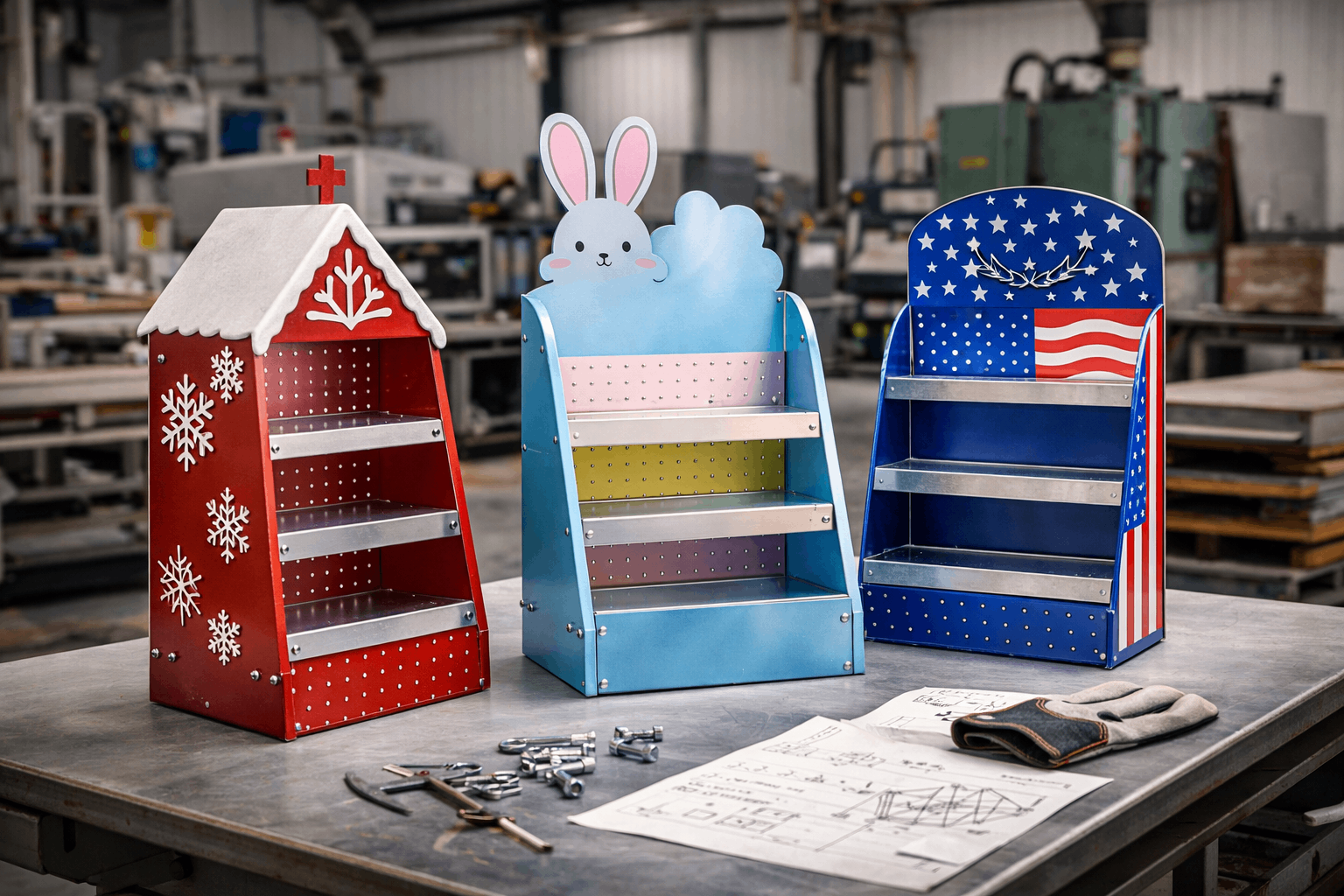
For overseas wholesale buyers, holiday and specialty themed displays are practical sourcing projects before they are visual campaigns. A fixture may look attractive on a supplier website, but the real decision usually depends on whether it is stable, cost-effective to ship, suitable for the product, and reliable across stores.
That is where many display articles become less useful for B2B readers. They spend too much time on seasonal styling and too little on the factors that affect approval, ordering, and downstream retail use. Yishang Display takes a more practical approach. We look at themed displays through the same lens buyers use when comparing suppliers: structure, materials, shipment efficiency, rollout practicality, and long-term performance.
A display that underperforms does not only weaken presentation. It can also create repacking issues, replacement costs, inconsistent setup, and retailer complaints. For importers, distributors, and retail supply buyers, those risks matter as much as appearance. That is why the most effective seasonal display fixtures are the ones that help products sell while staying dependable through the full campaign period.
What Holiday and Specialty Themed Displays Mean in B2B Buying
Holiday themed displays are usually built for fixed seasonal windows such as Christmas, Valentine’s Day, Halloween, Easter, or Lunar New Year. In retail, those periods already create demand. In B2B buying, they create a compressed timeline. The display has to be approved, produced, packed, shipped, and store-ready before a short selling season begins.
Specialty themed displays follow the same project logic, but they are often tied to narrower campaigns. Buyers may use them for sports promotions, pet product launches, branded collaborations, beverage activations, or category-specific events. These programs are often attractive because they help wholesalers and importers offer something more differentiated than a standard holiday fixture.
In both cases, the display should be treated as a commercial display solution rather than a decorative item. The key sourcing question is not only which theme looks right. It is whether the structure, material mix, and delivery plan make the fixture workable in real retail conditions.
How Wholesale Buyers Usually Evaluate a Display Supplier
Most wholesale buyers do not read supplier blogs for inspiration alone. They scan for useful signals. They want to know whether the supplier understands material suitability, product support, packing logic, assembly time, production consistency, and the practical difference between a fixture that looks good in photos and one that works on the shop floor.
This is why broad claims such as “high quality” or “great service” usually carry less weight than specific explanations. Buyers respond better to content that explains how a retail display stand performs under load, when metal display fixtures make more sense than lighter materials, or how reusable display fixtures can improve long-term value in repeat seasonal programs.
Their search behavior reflects the same intent. Common search patterns often combine product type, function, and sourcing language, such as custom holiday displays, specialty themed displays, wholesale display stand supplier, export display fixtures, metal display fixtures, POP display manufacturer, knock-down display stand, or display fixtures for chain stores. Content that reflects this language is easier for buyers to evaluate and easier for search engines to understand.
The Best Themed Displays Make Products Easier to Buy
A well-designed themed display should make the product easier to understand and easier to shop. That sounds obvious, but it is where many seasonal programs become less effective than expected. When graphics, headers, or decorative elements take over, product visibility weakens. Shoppers may notice the fixture, but they do not always understand the assortment quickly enough to buy.
For wholesale buyers, this matters because a fixture that reduces retail friction is easier to sell downstream. Retailers are more likely to reorder when the display is practical, visually clear, and easy for store staff to maintain. In that sense, a good display supports not only the product, but also the relationship between importer, retailer, and store team.
The most effective holiday retail displays keep the theme in service of the product. The seasonal message creates context, but shelf layout, accessibility, and product grouping still do most of the selling work. That is especially important for point-of-purchase displays, floor display stands, and temporary retail fixtures used in high-traffic areas.
Choosing Between Holiday and Specialty Themes
Holiday programs are often the right fit when demand is already linked to a familiar calendar event. Gift sets, festive beverages, snacks, and limited-season packaging usually benefit from a seasonal presentation because the shopper already understands the buying occasion. In these projects, speed, repeatability, and store compatibility are often more valuable than unusual visual treatment.
Specialty themed displays become more useful when a buyer wants stronger differentiation or serves customers with specific campaign needs. A sports-related promotion, a pet-themed launch, or a category activation can create a clearer retail story than a broad holiday frame. This gives wholesalers and importers more flexibility when offering custom display solutions to different retail accounts.
In practice, the strongest approach is sometimes a combination of both. A seasonal framework can establish timing, while a more targeted specialty theme helps the product line stand out in a crowded retail environment.
Why Structure Matters More Than Visual Excitement
In this category, structure is often more important than visual excitement. A fixture that looks impressive in a rendering can still create problems if the base is unstable, the shelves flex under product weight, or the header design makes the unit harder to pack efficiently. These problems may not appear during concept approval, but they become obvious during shipment and store rollout.
This is especially relevant for buyers working with heavier products, multi-SKU assortments, or repeated seasonal programs. Load-bearing performance, shelf spacing, base stability, and finish durability all influence whether the display still looks organized after days or weeks of use. That is why experienced buyers usually pay close attention to structural details even when they are sourcing visually driven displays.
At Yishang Display, this is one of the areas where planning makes a visible difference. A themed fixture should not only support a campaign idea. It should also support product weight, store handling, and practical replenishment.
Why Metal Fixtures Often Make Sense for Seasonal Programs
Metal display fixtures are often a practical choice for B2B programs because they provide stronger structural consistency and longer service life. They are well suited to higher-traffic retail settings, heavier merchandise, and display programs that may be reused or refreshed with new graphics for another season.
For buyers, that matters because a lower upfront cost does not always lead to a better total outcome. If a fixture arrives damaged more easily, loses shape in store, or creates replacement issues during a campaign, the landed value of the program becomes weaker. A more durable retail display stand can often protect margins more effectively over time.
Metal also works well in mixed-material systems. A metal frame can provide strength, while acrylic, wood, corrugated panels, or replaceable graphics shape the final appearance. This gives buyers more flexibility when balancing durability, brand presentation, and budget.
Material Choice Should Match Real Use Conditions
Material selection should be based on how the display will actually be used. If the fixture is carrying heavier products, moving through a demanding shipping route, or expected to support more than one campaign, stronger structural materials usually make more sense. If the program is short-term, lightweight, and highly cost-sensitive, corrugated solutions may still be appropriate.
The goal is not to make every project more complex than necessary. It is to choose a structure that matches the product, the store environment, and the expected campaign life. Buyers usually value this kind of explanation because it helps them compare options in commercial terms rather than only visual terms.
| Material option | Best fit | Main strength | Main trade-off |
|---|---|---|---|
| Metal | Heavy products, reusable fixtures, multi-store rollout | Strength, stability, longer service life | Higher initial unit cost |
| Acrylic | Premium product zones, visibility-led displays | Clean appearance and strong product visibility | Limited load support without a solid frame |
| Wood | Warm or premium visual language | Strong visual character | May add weight and cost |
| Corrugated | Short-term lightweight campaigns | Lower cost and faster launch | Lower durability over time |
Packaging, Shipment, and Store Rollout Matter More Than Many Buyers Expect
A seasonal display is not only a retail fixture. For overseas projects, it is also a shipped product. Carton size, part protection, knock-down structure, packing density, and assembly method all affect freight cost, damage rate, and store readiness. A design that looks efficient on screen may be less attractive once shipping and rollout costs are added.
This is why experienced buyers pay attention to packaging practicality early. If the display uses too many fragile parts, takes too long to assemble, or creates inconsistent setup across locations, the project becomes harder to manage. In short campaign windows, those issues can affect sell-through as much as front-end design.
Well-planned display solutions reduce that risk. They balance visual impact with practical shipping, straightforward installation, and repeatable store execution.
A Short Buyer Checklist Before Asking for a Quote
Before requesting samples or pricing, it helps to confirm a few core points. Buyers usually get better results when they know the product weight range, target store format, display footprint limits, preferred material direction, and whether the project is single-use or intended for repeat seasonal rollout.
It is also worth checking whether the fixture needs knock-down packing, how much graphic change is expected between campaigns, and whether the structure should support reusable headers or interchangeable panels. These details affect quotation accuracy, freight efficiency, and long-term value much earlier than many buyers expect.
What Buyers Usually Check Before Approving a Program
Before approving a seasonal display program, buyers usually want to confirm that the fixture is structurally suitable, efficient to ship, realistic to assemble, and easy for store teams to replenish. These points often matter more than whether the unit has one additional decorative feature or a more elaborate graphic header.
The table below summarizes the factors that most directly influence procurement decisions.
| Performance factor | Why buyers care | Commercial implication |
|---|---|---|
| Structural stability | Reduces complaints and replacement risk | More dependable store performance |
| Product visibility | Helps retailers sell more clearly | Faster shopper recognition |
| Replenishment efficiency | Affects store labor and display appearance | Better campaign maintenance |
| Packaging practicality | Influences freight cost and transit safety | Better landed-cost control |
| Theme clarity | Supports seasonal relevance without clutter | Easier retailer acceptance |
| Material suitability | Matches structure to load and duration | Lower performance risk |
When suppliers explain these points clearly, buyers can evaluate a project with more confidence. That is usually more useful than a long list of generic product benefits because it connects the display directly to purchasing risk, downstream use, and account value.
A More Practical Way to Source Holiday and Specialty Themed Displays
For importers, distributors, and retail supply buyers, a themed display should be viewed as a retail tool with seasonal relevance, not simply as decorative support. The strongest programs combine timing, product fit, durable structure, and manageable logistics. That is what makes a display easier to approve, easier to deliver, and easier for retail customers to use successfully.
Yishang Display writes about holiday and specialty themed displays from that practical angle because it is often the most useful one for B2B buyers. The key question is not how to make a display look festive in theory. It is how to source a fixture that works in stores, supports products well, and creates fewer problems after the order is placed.
If you are comparing structures, materials, or customization options for a seasonal display project, Yishang Display is ready to discuss the details with you. A short inquiry is enough to start the conversation.