
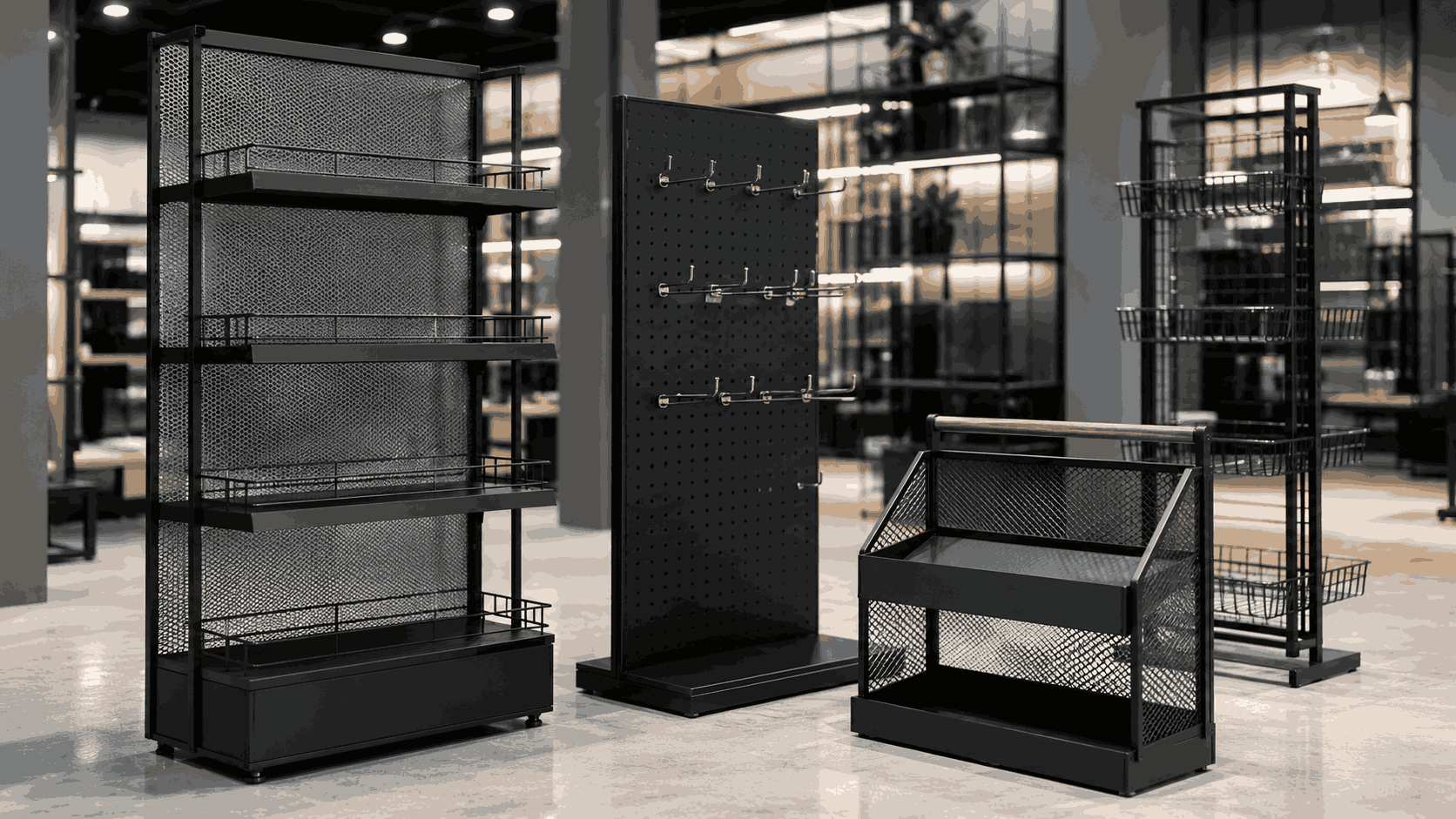
Choosing a product display stand involves more than retail appearance. For overseas wholesale buyers, importers, distributors, and sourcing teams, the fixture must support real products, ship safely, assemble smoothly, and perform well in repeat orders.
A display may look attractive in a product photo. The real test comes later. Shelves carry full loads. Store staff restock the unit every day. Cartons move through international shipping. The same design may need consistent production across hundreds or thousands of pieces.
This guide helps B2B buyers compare major product display stand types. It focuses on retail display fixtures for hardware, beverage, automotive, pet product, food, wine, spirits, sports goods, fashion, and industrial channels.
Yishang Display mainly manufactures metal display stands. The company also supports acrylic, cardboard, wood, and mixed-material solutions when a project needs them.
How Wholesale Buyers Should Think About Product Display Stand Types
Many display articles focus on visual merchandising. That angle has value, but it does not fully match wholesale purchasing. Importers and distributors care about the whole sourcing path, not only the store scene.
A practical display project moves through quotation, sampling, production, export packaging, assembly, retail use, and reorders. Each stage can affect cost and customer satisfaction. A good product display stand must balance product presentation with procurement reliability.
A beverage display rack offers a simple example. It may need strong shelf presence near an aisle. At the same time, the buyer must check shelf load, bottle spacing, front lips, anti-slip details, carton protection, and flat-pack options.
These details may look small during early design. They often decide whether a bulk order runs smoothly after sample approval.
Floor Standing Display Stands
Floor standing display stands sit directly on the retail floor. They suit products that need strong visibility, larger capacity, or independent placement away from existing shelves.
Wholesale buyers often choose this type for flexible retail channels. One structure can work in supermarkets, hardware stores, automotive shops, beverage sections, liquor stores, pet product areas, sports goods retailers, and industrial showrooms.
Metal floor standing display stands work well for heavy products and high-traffic retail spaces. A metal frame can support reinforced shelves, hooks, baskets, wheels, header panels, and adjustable layers.
Before approving this type, buyers should check load capacity, base width, shelf depth, weight distribution, assembly method, and carton size. A stand may look stable when fully loaded. It may react differently when shoppers remove products from one side first.
Countertop Display Stands
Countertop display stands sit on checkout counters, reception desks, trade show tables, promotional counters, and point of purchase areas. They suit small packaged goods, samples, accessories, brochures, cosmetics, and small hardware items.
This type helps distributors place products near the transaction point. It does not require floor space. Retailers can use it in convenience stores, service counters, showrooms, and promotion kits.
Acrylic countertop displays give clear product visibility. Cardboard options can support short campaigns. Metal countertop display stands fit heavier products, reusable programs, and premium retail fixtures.
Packaging matters for wholesale orders. Countertop displays often include visible corners, logo plates, printed panels, or polished surfaces. Good inner protection helps reduce scratches, dents, and complaints after export shipping.
Pegboard and Hook Display Stands
Pegboard and hook display stands help buyers manage many SKUs. Retailers often use them for tools, cables, automotive accessories, pet accessories, sports goods, and packaged products with hanging holes.
Their value comes from flexibility. Buyers can move hooks, adjust product spacing, and support different assortment plans with one frame. This helps distributors serve different retailers without creating a new display for every product group.
Metal pegboard displays offer strength and an adjustable layout. Buyers should review the hole pattern, hook thickness, hook length, panel strength, package compatibility, and total load balance.
One hook may hold one product safely. A full display panel creates a different stress condition. A strong design keeps the frame, panel, hooks, and base working together.
Shelf Display Stands
Shelf display stands support bottles, cans, boxes, printed literature, pet supplies, food products, household goods, and fashion accessories. Retailers like shelves because staff can restock and maintain them easily.
A metal shelf display rack can use flat shelves, angled shelves, tiered shelves, adjustable shelves, or shelf-and-hook combinations. This flexibility helps both standard retail products and custom product display projects.
Beverage, beer, wine, and spirits displays often need strong shelves, front lips, anti-slip details, clear labels, and reliable load capacity. Boxed goods may need better spacing, product alignment, and easy replenishment.
The shelf design should also fit the packing plan. Flat-pack racks need reliable hardware, clear instructions, and cartons that protect coated or printed parts. A good rack should work in the warehouse as well as in the store.
Wall-Mounted Display Stands
Wall-mounted display stands help retailers use vertical space. They suit tools, automotive accessories, pet products, sports items, packaged hardware, and printed literature.
This format helps wholesalers serve smaller stores. It increases product density without crowding the floor. It also helps retailers arrange items by size, series, category, or accessory type.
Metal wall-mounted systems can support hooks, pegboards, grid panels, shelves, and modular accessories. Buyers should check mounting hardware, wall load, product weight, safety clearance, and installation method.
Export orders need clear assembly instructions. Even a strong display can cause complaints if store staff struggle to install it. Simple installation protects the buyer’s relationship with downstream retailers.
Rotating and Mobile Display Stands
Rotating display stands let shoppers view products from all angles in a compact area. Retailers often use them for brochures, accessories, keychains, eyewear, lightweight hardware, and small packaged items.
The rotation function looks simple. In daily use, base weight, bearing quality, balance, and customer handling all matter. A light base or uneven product layout can make the display feel unstable.
Mobile display stands use wheels or casters. Retailers can move them between entrances, aisles, promotional areas, warehouses, and exhibition booths. They work well for seasonal campaigns and flexible retail layouts.
For bulk purchasing, buyers should check caster quality, locking function, frame strength, center of gravity, carton protection, and full-load stability. Metal often fits this type because mobile displays face movement and vibration.
How Material Choice Affects Procurement Value
Material choice affects more than appearance. It influences load capacity, unit cost, service life, packing volume, surface protection, maintenance, and reorder potential.
The lowest-cost material does not always give the best sourcing result. A cheaper display can create higher costs if it has a short lifespan, high damage rate, weak assembly experience, or inconsistent quality across repeat orders.
Metal often works as the main load-bearing structure when durability matters. It supports strong frames, stable production, and repeatable quality. Manufacturers can powder coat, paint, polish, plate, or combine metal with acrylic, wood, printed boards, or cardboard graphics.
Acrylic suits lightweight products that need a clean and clear presentation. Cardboard fits short-term POP stands and seasonal campaigns. Wood can create a warmer retail feel for wine, boutique, and lifestyle products.
Mixed-material designs often give buyers a useful middle ground. A metal frame can provide strength. Acrylic, wood, or printed panels can support branding. For example, a metal shelf display with printed signage can carry heavy bottles and still show campaign graphics.
Key Procurement Factors Before Sample Approval
Sample approval should confirm more than appearance. Buyers need to know how the display will perform after production, shipping, installation, and daily retail use.
Load capacity deserves early attention. Buyers should check total load and load distribution. Top-heavy structures, uneven shelf loading, and long hook rows can affect stability.
Packaging also plays a major role. Flat-pack display stands can reduce freight volume. They also need reliable hardware and clear assembly instructions. Fully assembled displays can save installation time, but they usually increase shipping volume.
Surface finish needs careful review. Powder coating, painting, plating, and polishing should show stable color, scratch resistance, and suitability for the target retail environment. Repeat orders need consistent finishing because color differences can weaken brand presentation.
What to Prepare Before Requesting a Custom Display Stand Quote
A clear RFQ helps the supplier recommend a better structure and provide a more accurate quotation. A product photo alone rarely gives enough detail for a custom product display project.
Buyers should prepare product size, product weight, packaging style, SKU quantity, quantity per display, preferred display location, target retail environment, expected order quantity, and destination country.
They should also confirm shelves, hooks, baskets, wheels, signage, lighting, electric functions, brand colors, and logo placement. These choices affect structure, cost, packing method, and production feasibility.
International buyers may also ask about export packaging, sample approval, quality inspection, RoHS-related material control, and ISO 9001-based quality management. Early discussion saves time during sampling and reduces uncertainty before mass production.
How to Evaluate a Metal Display Stand Supplier
A reliable metal display stand supplier should discuss practical production details, not only price. Buyers should expect clear answers about material thickness, welding quality, surface treatment, load-bearing design, assembly method, packaging safety, and production consistency.
The lowest quotation may not protect the buyer. Weak structure, inconsistent coating, or poor carton design can create damage, rework, and customer complaints after shipment.
Customization capability also matters. Many buyers need OEM and ODM support for private-label displays, brand colors, special dimensions, logo panels, mixed materials, and retail-channel requirements. A capable supplier can turn product requirements into a display that buyers can manufacture, pack, ship, and reorder with confidence.
Yishang Display focuses on custom metal display stands and related retail display fixtures for overseas wholesale buyers. The brand brings over 26 years of manufacturing experience, exports to 50+ countries, OEM and ODM support, RoHS and ISO 9001 certification, and annual production of 10,000+ display stands.
FAQ About Product Display Stand Types
What are the main types of product display stands?
The main types include floor standing displays, countertop displays, wall-mounted displays, pegboard displays, hook displays, shelf display racks, rotating displays, mobile displays, and custom display stands.
Wholesale buyers should also consider product weight, packing method, assembly process, and repeat production requirements.
Which display stand type works best for wholesale buyers?
No single type works best for every buyer. Metal floor stands, shelf racks, pegboard displays, and hook displays often fit long-term retail programs because they offer stronger structure and better customization flexibility.
The right choice depends on product load, SKU quantity, store format, branding requirements, and the need for a reusable display solution.
Are metal display stands better than cardboard displays?
Metal displays fit heavy products, repeated use, high-traffic stores, and long-term retail programs. Cardboard displays fit lightweight products, short campaigns, and printed promotional displays.
Some buyers combine both materials. A metal frame provides strength, while printed cardboard panels support seasonal messaging.
What information helps a custom display stand quotation?
Buyers should provide product size, product weight, packaging style, SKU quantity, quantity per stand, target retail environment, preferred material, branding requirements, estimated order quantity, and destination country.
Clear RFQ information helps the manufacturer recommend the right structure, estimate cost, and prepare a useful sample.
Conclusion
A product display stand should fit the product, the retail environment, and the procurement goal. For overseas wholesale buyers, the right display needs to look professional. It also needs to load safely, pack efficiently, assemble smoothly, and support repeat production.
When durability, customization, and long-term retail performance matter, metal display stands often provide the stronger choice. For custom projects, Yishang Display can help turn product requirements into export-ready display solutions built for wholesale purchasing.