
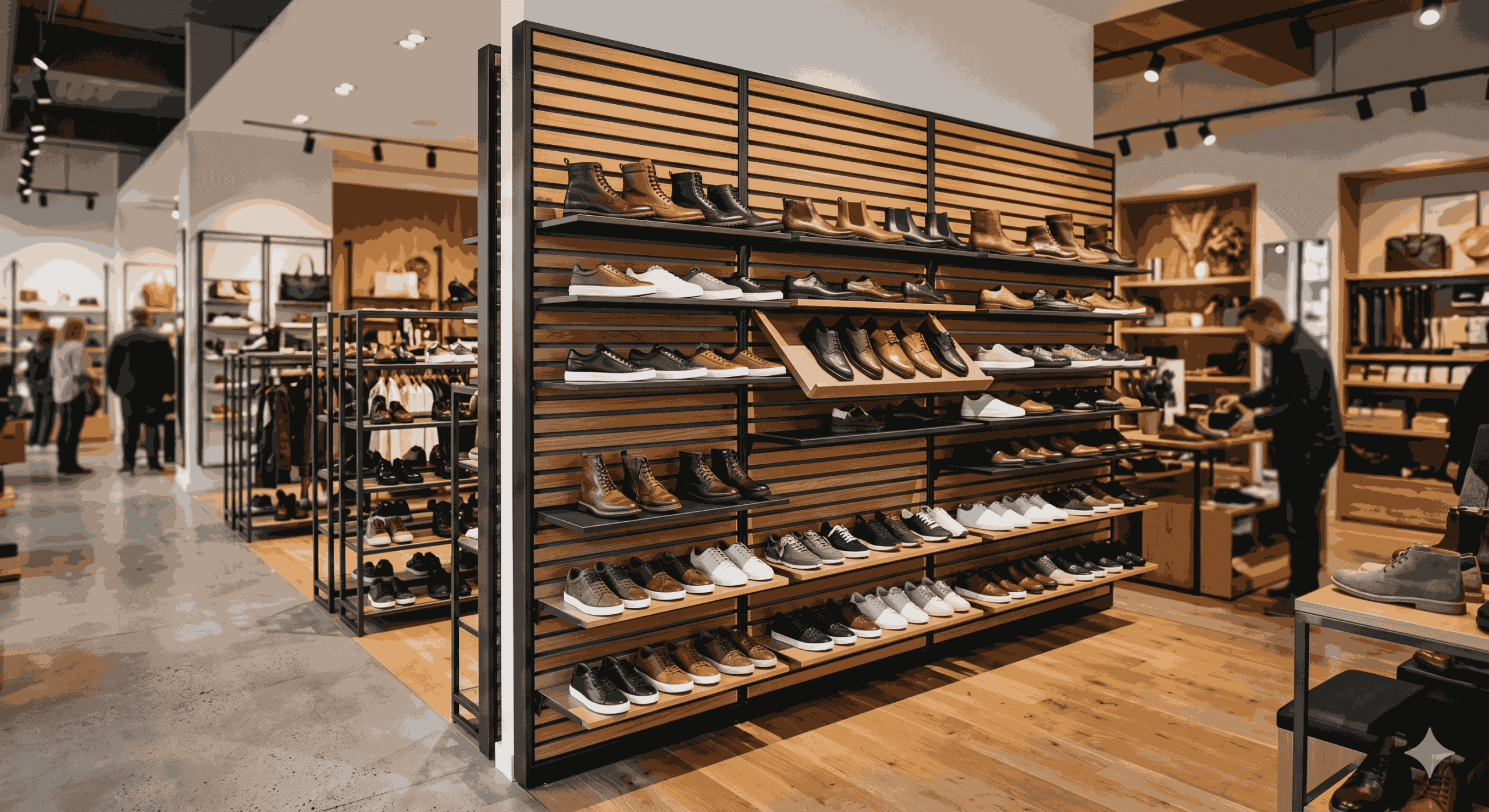
Overseas wholesale buyers and store procurement managers understand that physical product presentation directly dictates commercial conversion rates. A strategic shoe display rack setup is not merely a piece of metal furniture; it is an active sales tool. When engineered correctly, this merchandising strategy transforms a standard store floor into an optimized, high-density environment.
For international importers sourcing retail fixtures, selecting the right partner is critical. At Yishang Display, we specialize in manufacturing heavy-duty retail racks that balance structural durability with visual elegance. By focusing on smart engineering, we help global brands turn standard retail floor space into a powerful engine for revenue growth.
The Optics of Footwear Display: Why Framework Profiles Matter First
The physical structure supporting a product is the most critical strategy for establishing its perceived market value. When retail stores utilize thick wooden partitions or bulky plastic display profiles, they unintentionally create visual shadows. This blockage casts lower shelves into darkness, making a significant portion of inventory practically invisible.
To prevent a flat uninteresting presentation, Yishang Display builds systems with ultra-slim high-tensile metal profiles of $\le 15\text{ mm}$. This structural choice allows ambient light to wrap around the product entirely, highlighting fine leather grains and detailing from any angle. By maximizing light penetration, this method is proven to guide the customer’s eye naturally toward premium items.
Using minimalist metal shoe display rack setups improves the customer experience by keeping the visual pathways clear. Shoppers can scan the entire store layout effortlessly, which lowers the physical barrier to product interaction. For procurement teams, choosing thin-profile metal stands over bulky wood alternatives translates to higher visual density and better space utilization.
Strategic Implementation to Maximize Sales: Three Foundational Setup Zones
To systematically convert foot traffic into transactions, the retail environment must be divided into distinct functional zones. Rather than placing uniform racks throughout the space, visual merchandising teams should deploy specialized fixtures tailored to customer behavior.
This systematic flow guides the customer journey from the moment they cross the threshold to the point of sale. By directing traffic strategically through your store layout, you can control the flow of attention and direct shoppers toward high-margin items. Let us analyze the three critical display setups that drive retail performance.
1. The Perimeter Wall Solution: Maximizing Vertical Space
The perimeter wall represents approximately $60\%$ of a store’s vertical selling space, making it a critical asset. Organizing your most important products along these vertical surfaces creates an architectural anchor that guides the customer journey.
Using heavy-duty retail racks along the walls enables stores to display dense, high-volume footwear lines without structural deformation. High-quality metal shelves save space while providing an exceptional load-bearing capacity of $\ge 50\text{ kg}$ per segment. This high load-bearing capability ensures that heavy work boots or winter gear remain safely presented for years to come.
2. Central Island Configurations: Creating a Clear Visual Path
Once shoppers pass the entrance, freestanding metal gondolas act as natural traffic coordinators. Placing these multi-tiered island fixtures in the center of your store layout guides the customer into a comfortable flow.
These low-profile setups can be customized with adjustable height stands to display complementary accessories alongside primary footwear lines. This design encourages the customer to interact with the products, boosting touch-rates and elevating the overall customer experience. By adjusting the shelving pitch from $15^\circ$ to $45^\circ$, you present the shoe profile directly to the customer’s natural line of sight.
3. Interactive Feature Showcases: Elevating the Touch Rate
For high-margin sneaker drops or luxury heels, static shelving often fails to capture the customer attention and excitement needed to justify premium prices. These premium lines demand a dedicated, high-impact stage.
Integrating a custom display, such as a manual or motorized rotating showcase, creates a better customer experience and drives impulse buying. These specialized metal pillars use premium bearings to allow silent, smooth $360\text{-degree}$ rotation under targeted spotlighting. This kinetic element draws the customer’s focus immediately, turning a passive product view into an interactive experience that boosts sales.
Material Integrity & Risk Mitigation: B2B Procurement Standards
From a procurement perspective, commercial fixtures are a long-term capital investment. Footwear displays endure constant sliding of rubber outsoles, impacts from heels, and chemical sanitizers. This continuous wear factor quickly degrades low-grade materials, leading to frequent replacement costs.
| Metric / Feature | Commercial-Grade Steel (Metal) | Traditional Wood Millwork | Standard Molded Acrylic |
|---|---|---|---|
| Average Useful Lifespan | $10\text{+ Years}$ | $2\text{ to }3\text{ Years}$ (High-wear) | $1\text{ to }2\text{ Years}$ (Scratch prone) |
| Load-Bearing Capacity | High ($\ge 50\text{ kg}$ per shelf segment) | Moderate (Prone to moisture bowing) | Low (Bends under heavy leather boots) |
| Surface Resilience | High (Scratch-resistant powder coating) | Low (Soles scuff paint; chips easily) | Very Low (Easily clouded by micro-scratches) |
| Seasonal Adaptability | Dynamic (Tool-free magnetic/clip brackets) | Rigid (Requires carpentry/screws) | Static (Fixed molded pockets) |
| Environmental Compliance | RoHS-compliant non-toxic coatings | Requires chemical adhesives/resins | Petropolymers (Non-recyclable composites) |
Buying cheaply finished metal display stands results in chipping, flaking, and structural wobbling within months. To protect brand reputation, Yishang Display manufactures under strict ISO 9001 quality systems. This precise manufacturing standard guarantees perfect weld joints and zero micro-wobbles during customer interactions.
We protect public health and ensure regulatory compliance by applying electrostatically non-toxic, RoHS-compliant powder coatings. These specialized industrial finishes provide a highly resilient surface that withstands daily chemical cleaning and abrasive impacts. This level of quality is essential for building a loyal customer base that associates your retail apparel display with premium standards.
Operational Agility and Freight Efficiency: Solved for Global Importers
Footwear retail is characterized by rapid inventory transitions, shifting from summer sandals to heavy winter boots in hours. When spaces rely on rigid, fixed wooden millwork, seasonal product resets become operational bottlenecks that drain valuable labor hours.
To keep your store adaptable, our fixtures are designed with CNC-punched slots and universal clip-in brackets. This strategic implementation to maximize operational speed allows a single associate to reconfigure an entire wall segment in under $15\text{-minutes}$. Reducing display turnaround times ensures the retail floor remains visual, dynamic, and aligned with current inventory.
Furthermore, shipping freight optimization is a major cost driver for international wholesale importers. All display systems from Yishang Display are engineered with smart Knock-Down (KD) structures. This flat-pack packaging method reduces shipping volume by up to $70\%$, significantly lowering ocean freight costs and maximizing container capacity.
The Footwear Retail Display Audit: A 4-Point Diagnostic Checklist
To determine if your current retail store displays are driving conversion or quietly suppressing sales, execute this quick engineering inspection:
- The Shadow Test: Measure light levels on bottom-row display shelves. If the illumination drops below $< 300\text{ lux}$, your shelving profiles are too thick, creating dark dead zones.
- The Deflection Test: Place three pairs of heavy leather boots on your longest shelf. Any visible downward curvature indicates structural material fatigue.
- The Turnaround Metric: Time your visual merchandising team during a reset. If changing a layout takes longer than $15\text{-minutes}$ or requires tools, your fixtures are draining profits.
- The Touch Barrier: Approach an island display and pick up a shoe with one hand. If the display base directly wobbles or shakes, the fixture lacks the engineering required to project a secure brand image.
Conclusion
Maximizing sales in footwear retail is a discipline that blends human ergonomics with robust metal engineering. Investing in high-durability, modular metal display setups from Yishang Display is the smartest operational strategy to secure long-term retail success and drive exceptional sales per square meter.
If you are looking to elevate your retail layout with premium, certified OEM/ODM metal display setups, contact our engineering team today to receive a custom quote.