
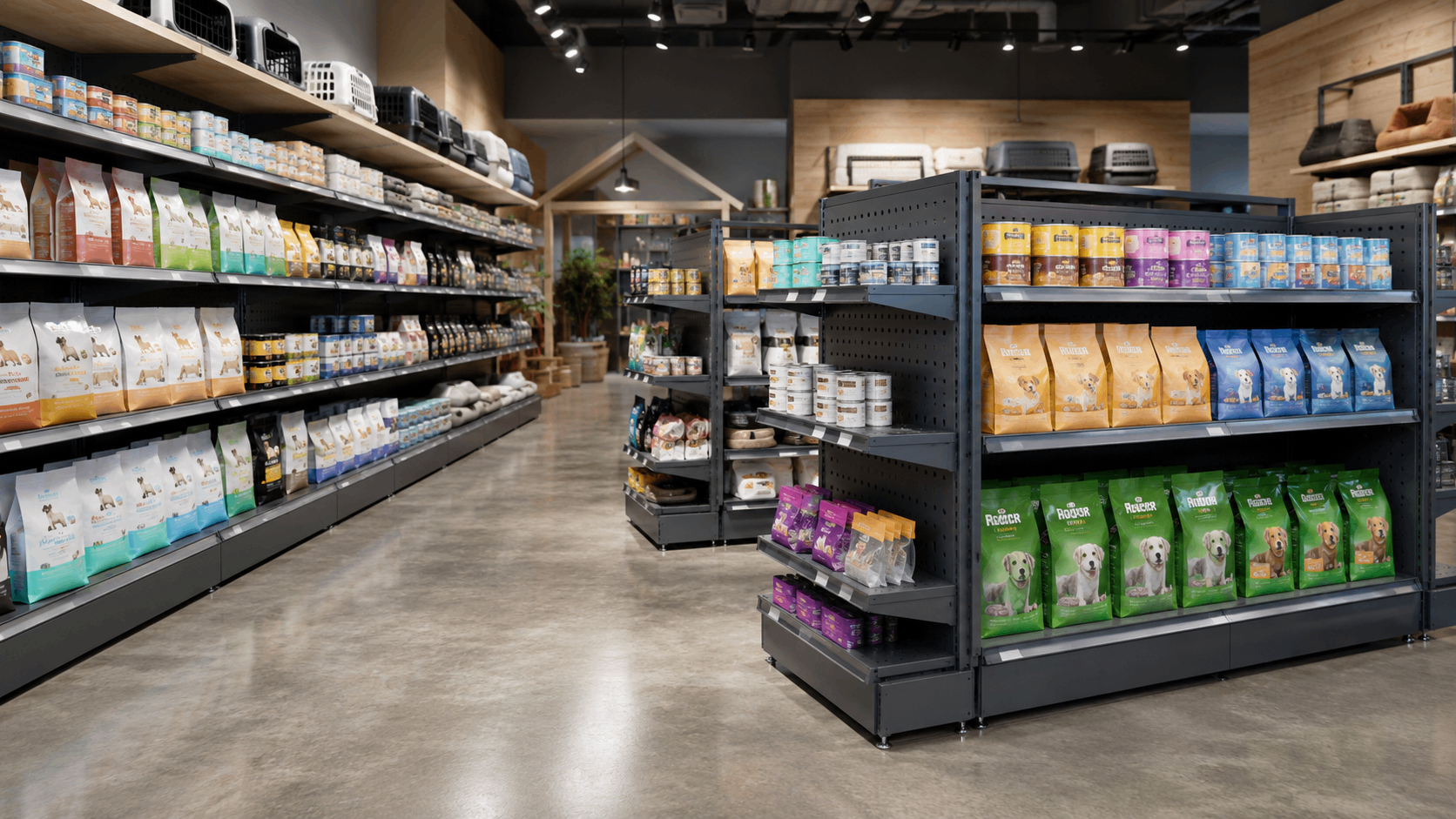
For overseas wholesalers, importers, distributors, and retail project buyers, choosing a gondola retail system is rarely just about how a fixture looks in a store. A good display rack also needs to make sense in production, shipping, installation, and repeat orders.
Product photos can show the shape of a rack, but they do not always show the details that matter in bulk purchasing. Shelf load, steel thickness, coating quality, packaging protection, assembly structure, and batch consistency can all affect the final buying experience.
That is why many professional buyers prefer to evaluate gondola shelving from both sides: how it performs on the sales floor and how reliable it is as a wholesale product. A fixture should help retailers display products clearly, while also giving buyers confidence in quality, shipping, and long-term supply.
Start with Procurement Value, Not Only Store Layout
Store layout still matters. A rack should support product visibility, customer movement, and practical merchandising. But for wholesale buyers, the decision usually goes deeper than that.
A distributor may supply the same fixture to supermarkets, convenience stores, hardware shops, pet stores, beverage retailers, or promotional display projects. The rack needs enough flexibility to fit different retail environments without requiring a completely new design every time.
This is where procurement value becomes important. A well-designed metal gondola display rack should be easy to quote, sample, produce, pack, ship, assemble, and reorder. If a rack looks good but creates problems during installation or repeat production, it is not a strong wholesale product.
For B2B buyers, the better choice is usually the system that balances product fit, load performance, customization options, export packaging, and total landed cost. Price matters, but it should be read together with structure and reliability.
Main Gondola Options for Wholesale Buyers
Wall-mounted gondola shelving, freestanding gondolas, end cap displays, and hybrid layouts all serve different purposes. The right choice depends on the buyer’s target market, product category, and downstream customer needs.
A compact convenience store may need wall shelving to keep the central floor open. A supermarket may need double-sided gondola units to create aisles. A brand promotion project may need end cap displays for better visibility. A chain store rollout may need all of these fixtures working together as one system.
| Buyer Need | Suitable Fixture | Procurement Value |
|---|---|---|
| Perimeter product display | Wall-mounted gondola shelving | Saves floor space and fits many small retail formats |
| Center aisle merchandising | Freestanding gondola shelving | Supports two-sided display and flexible store layouts |
| Promotional campaigns | End cap display racks | Adds high-visibility selling points for seasonal products |
| Multi-zone retail projects | Hybrid gondola layout | Creates a coordinated fixture package |
| Heavy product categories | Heavy-duty metal gondola shelving | Reduces stability and deformation risks |
| Private label or project orders | Custom metal gondola racks | Supports branding, special sizes, and repeat specifications |
This comparison helps buyers avoid treating all gondola shelving as the same product. A rack for lightweight packaged goods and a rack for beverage cartons may look similar at first glance, but they should not be designed or purchased in the same way.
Wall-Mounted Gondola Shelving for Perimeter Display
Wall-mounted gondola shelving is usually placed along the store perimeter. It helps retailers organize products neatly while keeping the central floor open for movement, browsing, or larger displays.
For wholesalers, this type of fixture has broad market potential. It can be supplied to supermarkets, pharmacies, convenience stores, hardware shops, pet supply stores, beverage sections, and printed material areas. Because it is space-efficient, it is often easier for downstream customers to adopt.
The key is to look beyond the single-sided structure. Buyers should confirm shelf depth, upright strength, back panel type, wall fixing method, coating finish, and packaging protection before production.
A light-duty wall unit may work well for small packaged items, but heavier categories need more attention. Canned food, automotive oils, tools, pet food, and bottled drinks require stronger shelf support and better stability. In these cases, metal construction is not just a material choice; it directly affects service life.
Freestanding Gondola Shelving for Center Aisles
A freestanding gondola is commonly used in the middle of a store to create aisles and display products from one or both sides. Double-sided gondola units are especially useful in supermarkets, discount stores, convenience stores, and multi-category retail spaces.
For wholesale buyers, freestanding metal gondolas are attractive because they can serve many retail formats. The same basic structure can often be adapted with shelves, hooks, baskets, pegboard panels, mesh panels, dividers, or signage holders.
The main concern is stability under real use. A center aisle rack is touched from both sides, restocked frequently, and often used for products with higher turnover. It needs to remain stable when customers browse, staff replenish stock, and shelves are fully loaded.
For beverage cartons, canned goods, tools, wine, beer, spirits, pet food, and automotive products, buyers should confirm shelf load capacity and base stability before approving the design. A sample should be reviewed not only for appearance, but also for how the rack performs under expected product weight.
End Cap Displays and Hybrid Fixture Packages
End cap displays sit at the end of aisles, where shoppers naturally slow down, turn, or notice promotional products. They are often used for seasonal goods, new arrivals, bundled products, and high-margin items.
For wholesalers, metal end cap displays can be a useful add-on product. They are easy to combine with wall-mounted or freestanding gondolas, helping buyers offer a more complete retail fixture package to their customers.
A hybrid fixture package is often more practical for chain stores and project buyers. Wall-mounted units can define the perimeter, freestanding gondolas can create aisles, and end caps can improve promotional visibility.
This type of combination gives downstream retailers more flexibility. They can adapt the same display system to different store sizes, product categories, and merchandising campaigns without replacing the entire fixture layout.
Why Metal Is Often the Better Choice for Bulk Orders
Metal is widely used in retail display manufacturing because it offers strength, repeatability, and customization flexibility. For wholesale buyers, these qualities affect not only product performance but also customer satisfaction and future reorder potential.
Metal gondola shelving is especially suitable for heavy or frequently restocked products. It can be used for beverages, hardware, tools, pet food, canned goods, household products, automotive items, wine, beer, spirits, and other dense merchandise.
Another advantage is production control. Metal components can be cut, punched, bent, welded, coated, and assembled according to defined specifications. This helps maintain consistent shelf size, hole position, accessory fitting, and surface finish across batch orders.
Other materials still have their place. Wood can create a warmer retail look, acrylic can work for lightweight transparent displays, and cardboard may suit short-term promotions. For export-ready store fixtures and long-term wholesale programs, however, metal usually offers stronger procurement value.
Technical Details Buyers Should Confirm Before Production
Professional buyers rarely compare display racks by price alone. A lower quotation may reflect thinner material, weaker coating, simpler packaging, or limited inspection.
Before confirming an order, it is helpful to review the technical details that affect performance, shipping, and repeatability. These points make quotations easier to compare and reduce the risk of misunderstandings during sampling or mass production.
| Specification | What to Confirm | Why It Matters |
|---|---|---|
| Shelf load | Expected weight per shelf under full use | Helps prevent bending and instability |
| Material thickness | Steel gauge or structural requirement | Affects strength and service life |
| Shelf depth | Product packaging size and display method | Impacts product fit and visibility |
| Back panel | Pegboard, mesh, solid, or slat-style panel | Determines accessory compatibility |
| Accessories | Hooks, baskets, dividers, fences, signage holders | Supports different merchandising needs |
| Surface finish | Powder coating, color, edge treatment | Affects appearance and cleaning |
| Assembly method | Fixed, modular, or knock-down structure | Influences shipping and installation |
| Export packaging | Carton, foam, pallet, labeling, hardware packs | Reduces damage and missing parts |
| Batch consistency | Sample approval and production inspection | Protects repeat order reliability |
These are not only factory details. They influence total landed cost, installation time, customer complaints, replacement risk, and the buyer’s ability to reorder the same product later.
Export packaging deserves careful attention. Metal racks may travel through long-distance shipping, warehouse handling, and local delivery before they reach the store. Strong cartons, protected corners, clear labels, and organized hardware packs can prevent many avoidable problems.
When Custom Metal Gondola Racks Make More Sense
Standard gondola units are useful for general retail display, especially when the product size and store layout are simple. But many wholesale projects require more specific solutions.
Custom metal gondola racks become more practical when buyers need special dimensions, stronger shelves, branded colors, logo panels, or a specific accessory layout. They are also useful when the same fixture needs to support different retail markets or private label programs.
A pet store distributor may need deeper base shelves for large pet food bags and hooks for accessories. A beverage display project may need stronger shelves, bottle dividers, and branded header cards. A hardware store buyer may need pegboard backs, bins, hooks, and reinforced base shelves.
Customization is not only about appearance. It affects product fit, shelf capacity, container loading, assembly speed, packaging volume, and long-term value. A well-planned custom design can turn a buyer’s retail concept into a fixture that is practical to manufacture and repeat.
How to Evaluate Supplier Reliability
A good sample is important, but it does not tell the whole story. Overseas wholesale buyers also need to know whether the supplier can maintain the same standard during mass production.
Useful questions include how the factory controls cutting, bending, welding, polishing, surface treatment, pre-assembly inspection, and final packaging. Small details such as hole alignment, shelf fitting, coating adhesion, edge smoothness, and hardware completeness can affect the final installation experience.
For project-based orders, buyers may also want to discuss sample approval, inspection standards, packaging tests, production lead time, and how repeat orders are managed. These conversations often reveal whether a supplier understands wholesale procurement or only sells ready-made fixtures.
Yishang Display focuses on OEM and ODM metal display rack projects for wholesale and project-based buyers. The brand supports custom retail display solutions for multiple industries, with RoHS and ISO 9001 certifications as part of its quality and compliance foundation.
Total Procurement Value Matters More Than Unit Price
Unit price is always part of sourcing, but it should not be separated from structure, packaging, durability, and repeatability. A cheaper rack may become more expensive if it leads to shipping damage, unstable shelves, difficult assembly, or customer complaints.
For wholesale buyers, total procurement value includes purchase cost, product lifespan, load performance, packaging reliability, installation efficiency, after-sales risk, and reorder consistency.
This does not mean every rack needs to be overbuilt. The better approach is to match the structure to the product category, retail environment, and target market.
A good display rack supplier should help buyers find that balance. The fixture should be strong enough for real use, efficient enough for bulk shipping, and flexible enough for different downstream customers.
FAQ for Overseas Wholesale Buyers
What type of gondola shelving is best for wholesale buyers?
The best option depends on your target customers. Wall-mounted units are suitable for perimeter displays, freestanding units work well for central aisles, and end cap displays support promotions. For buyers serving multiple retail formats, a hybrid system is often more flexible.
Why do wholesalers often choose metal gondola shelving?
Metal offers stronger load capacity, better durability, repeatable production, and wider customization options. It is suitable for bulk retail display orders where quality consistency and long-term use matter.
What information should buyers provide before requesting a quote?
Buyers should provide product size, product weight, shelf requirements, back panel preference, accessory needs, color, logo requirements, quantity, shipping destination, and packaging expectations.
Can one metal gondola design fit different industries?
Yes, if the structure is modular. A metal rack can be adapted with shelves, hooks, baskets, pegboards, mesh panels, dividers, and signage. This allows distributors to serve multiple industries with one flexible product platform.
When should buyers choose a custom gondola solution?
Custom design is useful when standard sizes do not fit the product, when heavier load capacity is required, or when the buyer needs private label branding, special colors, unique accessories, or consistent fixtures for chain store projects.
Choosing a Gondola System That Works Beyond the Store
The right gondola retail system should support both retail performance and wholesale procurement needs. It should help downstream customers display products effectively while giving buyers reliable quality, practical packaging, customization flexibility, and repeat order consistency.
For heavy products, long-term use, and export-ready bulk orders, metal gondola display racks are often the more practical choice. Yishang Display can support custom metal retail display rack projects based on product category, target market, branding needs, and shipping requirements.