
For overseas wholesalers, importers, distributors, and brand procurement teams, a shelf display is rarely just a rack. It becomes part of a retail program that has to work in the store, survive transport, support product weight, and stay consistent across multiple locations.
A display may look impressive in a rendering, but buyers usually judge it by more practical questions. Will it hold the planned shelf load? Can it be packed safely for export? Will store staff assemble it without confusion? Can the same design be repeated across a bulk order without finish or size differences?
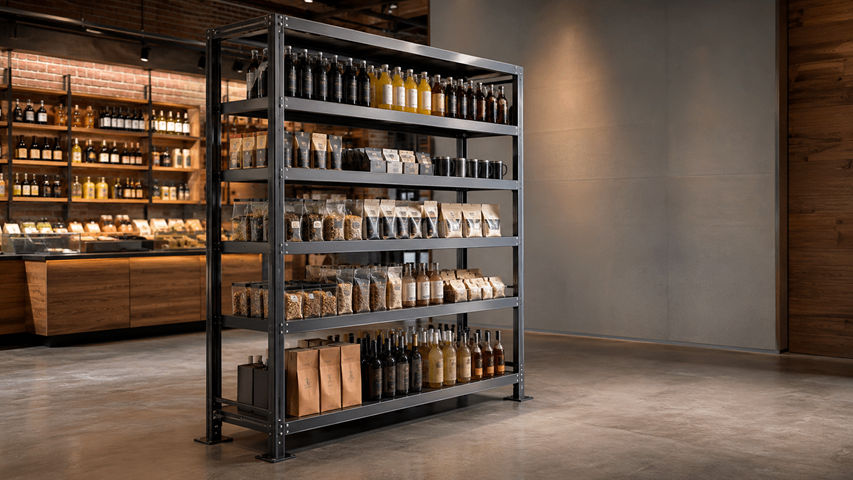
That is why custom metal display racks are often selected for long-term retail programs. Metal gives the structure the strength needed for heavier products and repeated restocking, while still allowing space for signage, hooks, baskets, adjustable shelves, acrylic details, wood accents, or printed graphic panels.
The seven shelf display ideas below are written with wholesale buyers in mind. They connect retail sales performance with the concerns that matter before placing a bulk order: durability, usability, packaging, sample approval, and total project value.
What Makes a Shelf Display Worth Buying in Bulk?
A good shelf display does more than make products look organized. It helps shoppers notice products faster, compare options more easily, and pick up items without hesitation. At the same time, it should help buyers reduce replacement cost, shipping damage, assembly issues, and inconsistent presentation across stores.
For a purchasing team, the lowest quoted price is not always the safest choice. A weak display can become expensive after installation if shelves bend, parts scratch during transport, or store teams struggle with setup. A metal shelf display may take more planning at the design stage, but it often provides stronger value when the project involves heavy products, frequent handling, or long campaign cycles.
| Buyer Concern | What to Confirm Before Production | Why It Matters |
|---|---|---|
| Shelf load | Unit weight and total quantity per shelf | Helps prevent bending and unstable placement |
| SKU fit | Product size, packaging style, and SKU count | Supports cleaner layout and future product changes |
| Export packaging | Knock-down structure, carton protection, pallet plan | Reduces freight damage and improves container use |
| Assembly | Tool requirements, part structure, and instructions | Saves time for distributors and store teams |
| Finish consistency | Powder coating, painting, plating, or polishing | Keeps brand presentation consistent across stores |
| Long-term value | Campaign duration and expected reuse | Helps buyers evaluate cost beyond the first order |
A display program is easier to manage when these details are discussed early. It also makes the RFQ more accurate, which helps both buyer and supplier avoid unnecessary revisions.
Secret 1: Design the Rack Around Aisle Visibility
In real stores, shoppers do not always stop directly in front of a display. They notice products from the side, from a distance, or while passing several other visual signals. If the rack blocks the product or hides the main selling point, the display loses value before anyone interacts with it.
For wholesale buyers, aisle visibility affects the return of the entire retail rollout. A sample may look clean in a factory photo, but the result can be weaker in store if the side frame covers product facings or the shelf depth pushes items too far back.
A custom metal display rack can use open sides, angled shelves, raised product zones, or tiered layouts to improve sightlines. The structure stays strong, but the product remains easier to see. This matters for beverages, hardware, automotive accessories, pet products, packaged food, wine, spirits, and sports goods, where product weight and visibility need to work together.
The display does not need to be loud. It needs to give shoppers a clear reason to slow down, look closer, and understand what is being offered.
Secret 2: Match Prime Shelf Space With Load Capacity
Prime shelf space is valuable, but product placement should always respect weight and reach. A high-margin product may deserve a visible position, while heavy cartons, bottles, tools, or bulk packs may perform better on reinforced lower shelves.
This does not mean heavier products lose visibility. Clear signage, raised sample products, angled facings, or branded header panels can still draw attention while keeping the main stock at a safer height. The result is more practical for shoppers and easier for store staff to refill.
For custom metal shelf display projects, buyers should provide unit weight, packaging dimensions, maximum quantity per shelf, and expected total shelf load. These details help the manufacturer evaluate shelf span, support bars, welding points, base structure, and material thickness before sample production.
A rack can look fine when empty. The real test comes when it is fully stocked, moved, cleaned, and restocked over time. Load planning helps prevent problems that may only appear after the display enters stores.
Secret 3: Turn SKU Variety Into a Clear Buying Path
Wholesale buyers often manage product lines with several sizes, colors, models, flavors, or price levels. Without a clear structure, SKU variety quickly becomes visual clutter. Shoppers may see many options but still feel unsure about which one fits their needs.
A better layout gives the customer a simple comparison path. Products can be arranged by entry-level, standard, and premium options; small, medium, and large sizes; daily-use and heavy-duty versions; or different application scenarios. The display becomes easier to understand without needing long explanations.
Metal display racks support this logic through tiered shelves, vertical columns, pegboard panels, hooks, dividers, shelf lips, and wire baskets. These parts keep product groups separated while maintaining a consistent overall look.
For distributors supplying several retail locations, this structure has another benefit. Store teams can refill products more accurately because the fixture itself guides the layout. That reduces the chance of messy presentation after the first few days of use.
Secret 4: Build Product Combinations That Retailers Can Sell
Shoppers often buy around a task rather than a single product. A car care spray may sell better beside microfiber towels and brushes. Pet food can sit naturally near bowls, toys, or grooming tools. Hardware products can be paired with fasteners, repair accessories, or small tools.
These product combinations help retailers present a more complete solution. For wholesale buyers, that makes the display easier to sell into retail channels because it supports add-on purchases and improves the use of limited floor space.
Metal display racks are well suited for mixed-product layouts. Shelves can hold boxes or bottles, hooks can carry hanging packs, baskets can hold small accessories, and side panels can support product messages. Different formats can sit together without making the fixture unstable.
This flexibility is useful when the same display program needs to serve different regions, store formats, or seasonal campaigns. Instead of developing a new rack for every product bundle, buyers can use a modular metal structure and adjust accessories as needed.
Secret 5: Reduce the Small Friction Points That Hurt Store Use
Some problems only appear after a display reaches the store. Products may be difficult to reach. Shelves may be too deep. Items may slide sideways. The rack may shake when touched. Staff may need extra time to refill or clean the fixture.
These details matter because they affect repeat business. A retailer may accept one shipment, but if store teams complain about assembly, stability, or daily maintenance, the program becomes harder to continue.
A metal shelf display can reduce these issues with practical structural details. Reinforced shelves, anti-slip edges, shelf lips, side guards, dividers, adjustable layers, stable bases, and optional wheels all help the rack work better in daily use.
These features are not decorative. They are the kind of details that make a display easier to shop, easier to refill, and more reliable after installation. For B2B buyers, that reliability is part of the product value.
Secret 6: Make Durability Visible in the Fixture Design
Durability is often discussed as a cost issue, but it also affects brand presentation. A rack that bends, rusts, scratches easily, or feels unstable can weaken the product image. A clean, solid, well-finished display makes the selling area feel more professional.
Metal is a strong choice for long-term retail programs because it can support repeated handling, frequent restocking, and heavier products. Surface treatment also shapes the final impression. Powder coating, painting, polishing, plating, and other finishes can help match brand color requirements while improving service life.
Other materials can still add value when used in the right place. Acrylic can create a clearer or more premium look. Wood can add warmth. Cardboard graphics can carry seasonal messages. When the main requirements are load capacity, stability, and long-term use, metal should remain the main structure.
For a wholesale display project, durability is not created by material alone. Buyers should also confirm welding quality, shelf reinforcement, base structure, surface finish, assembly hardware, and export packaging. These details help determine whether the approved sample can be repeated consistently in a bulk order.
Yishang Display develops custom display rack projects with metal as the main material and acrylic, cardboard, or wood as optional supporting materials. For quality-related requirements, Yishang Display currently has RoHS and ISO 9001 credentials.
Secret 7: Refresh the Message Without Replacing the Whole Rack
Retail campaigns change more often than store fixtures. For buyers managing repeated promotions or multi-market programs, it can be more efficient to keep the metal frame and update the communication parts.
Header panels, shelf talkers, side graphics, magnetic signs, acrylic sign holders, QR code panels, and removable accessories allow the same rack to support different messages. A seasonal campaign, product launch, or regional promotion can be updated without replacing the complete fixture.
This approach separates the structural layer from the campaign layer. The metal frame provides service life and stability. Graphics and accessories provide flexibility.
For distributors and brand owners, this can reduce storage pressure and simplify planning. Instead of keeping several complete display versions, they can update selected parts while continuing to use the same rack system.
When a Metal Shelf Display Is the Better Choice
A metal shelf display is usually a strong fit when products are heavy, frequently handled, or expected to remain in stores for a long period. It is also useful when the rack needs to hold mixed formats such as boxes, bottles, hanging packs, brochures, samples, or accessories.
Lightweight fixtures can still work for short promotions or low-weight products. They may be suitable when speed and low upfront cost matter more than reuse. The better choice depends on product weight, campaign duration, store traffic, expected service life, and brand presentation needs.
| Project Condition | Practical Display Choice |
|---|---|
| Short campaign with lightweight products | Cardboard or temporary fixture |
| Heavy products with repeated restocking | Metal display rack |
| Seasonal graphics with long-term structure | Metal frame with replaceable printed panels |
| Mixed SKUs with shelves, hooks, and baskets | Custom metal display rack |
| Multi-store rollout requiring consistency | Bulk metal display rack with approved sample standard |
For overseas buyers, the question is rarely only about material cost. A more useful way to evaluate the project is to look at risk across production, shipping, assembly, store use, and replacement. In many long-term programs, metal offers a stronger balance of structure, customization, and total value.
Why Sample Approval Matters Before Bulk Production
A good sample is not only a visual reference. It is the standard for mass production. Before a bulk order begins, buyers can use the sample stage to confirm dimensions, shelf load, finish color, signage position, assembly process, packaging protection, and replaceable parts.
This step is especially helpful for custom metal display rack projects because small structural changes can affect cost, stability, packing volume, and store installation. A shelf that is slightly too deep may reduce product access. A weak base may only show problems after loading. A finish that looks different under retail lighting may affect brand consistency.
Sample approval gives both sides a clearer production target. It also helps reduce communication gaps once the project moves into mass production. For buyers managing overseas procurement, that clarity can save time and reduce risk.
What Buyers Should Include in a Display Rack RFQ
A clear RFQ helps suppliers give a more accurate quotation and practical design response. Instead of sending only a reference image, buyers can share product dimensions, packaging size, unit weight, expected shelf load, SKU count, order quantity, display location, and target retail channel.
It is also useful to include finish requirements, branding needs, assembly preference, and packaging expectations. If the rack needs adjustable shelves, hooks, baskets, pegboard, wheels, signage, lighting, manual operation, or electric function, those details should be mentioned early.
For export projects, packaging should not be treated as an afterthought. Knock-down structure, carton protection, hardware packing, pallet loading, and container efficiency can all affect project cost and delivery safety.
Yishang Display supports OEM and ODM custom metal display rack projects for overseas buyers. Buyers preparing a bulk order can share product details, target quantity, retail application, and branding requirements to develop a practical display solution.
Closing Thoughts
A successful shelf display should be designed from the buying decision backward. It needs to help shoppers notice products, understand options, reach items easily, and trust the presentation. For wholesale buyers, it also needs to support stable production, efficient shipping, simple assembly, and long-term store use.
Custom metal display racks are valuable because they connect retail performance with procurement practicality. When visibility, load planning, SKU layout, usability, durability, refreshable signage, and sample approval are considered together, the display becomes more than a store fixture. It becomes a long-term retail asset.
FAQ
What is a shelf display?
A shelf display is a retail fixture used to present products in a way that improves visibility, organization, access, and product comparison. It can be placed in aisles, endcaps, checkout areas, counters, promotional zones, or freestanding retail spaces.
Why do wholesale buyers choose metal shelf displays?
Wholesale buyers often choose metal shelf displays because they offer stronger load capacity, better stability, longer service life, and more customization options for long-term retail programs.
What information is needed for a custom metal display rack quote?
Buyers should provide product size, packaging size, unit weight, expected shelf load, SKU count, order quantity, display location, surface finish requirements, branding needs, assembly method, and packaging requirements.
Are metal display racks suitable for heavy products?
Yes. Metal display racks are suitable for many heavy or frequently handled products, including hardware, automotive accessories, beverages, pet products, food products, sports goods, wine, beer, spirits, and industrial retail products.
Can metal shelf displays be combined with other materials?
Yes. Metal can be used as the main structure, while acrylic, cardboard, or wood can be added for transparency, graphics, warmth, or seasonal campaign communication.
Why is sample approval important before bulk production?
Sample approval helps confirm structure, dimensions, shelf load, finish, signage position, packaging, and assembly before mass production. It reduces the risk of quality differences in bulk orders.
Are metal display racks better than cardboard displays?
It depends on the project. Cardboard displays are often suitable for short-term lightweight promotions, while metal display racks are usually better for long-term use, heavier products, frequent restocking, and stronger brand presentation.
What certifications does Yishang Display have?
Yishang Display currently has RoHS and ISO 9001 credentials. Other certifications should only be mentioned if they are specifically available for the project.