
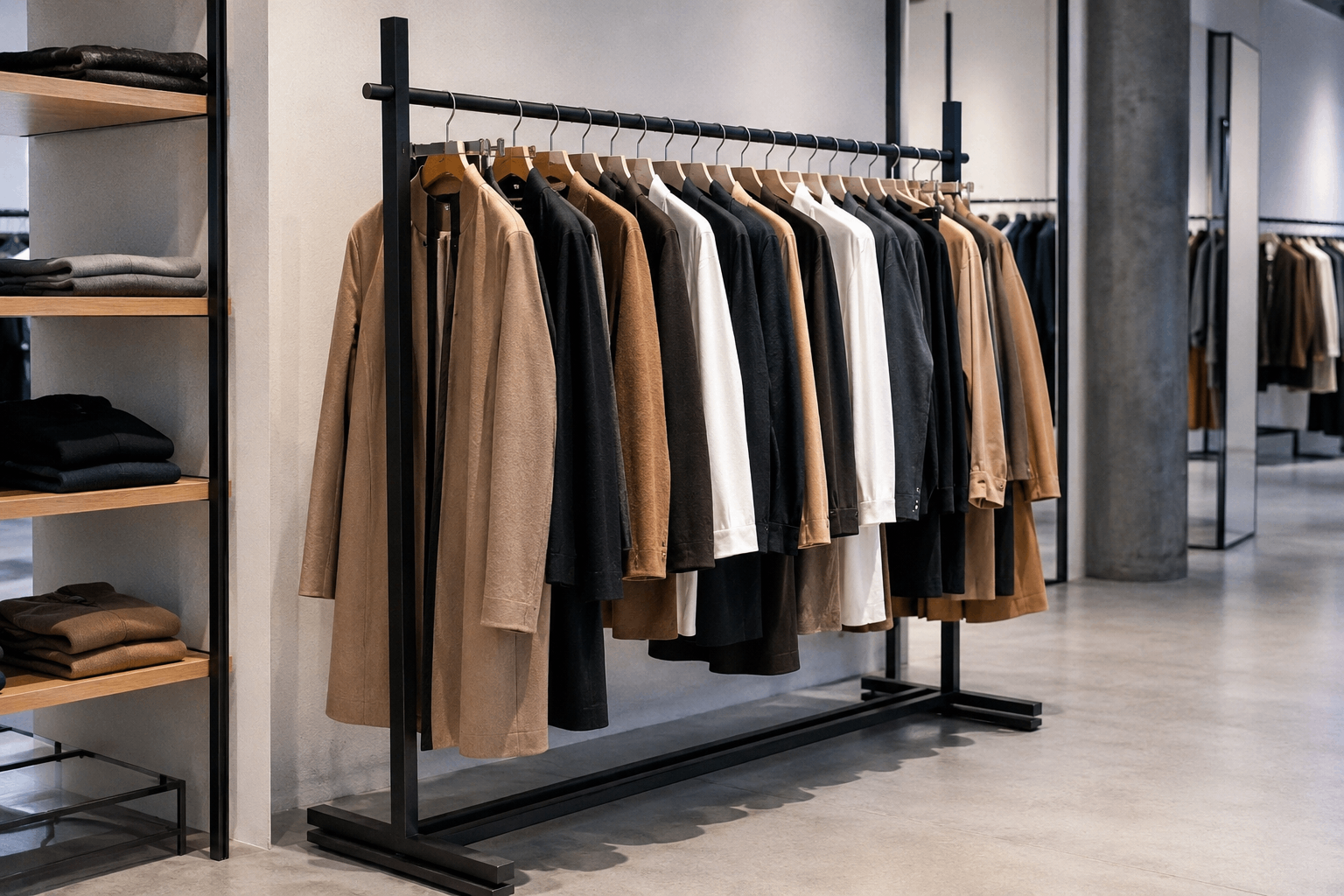
From Store Display to Wholesale Buying Decision
For overseas wholesalers, importers, distributors, and retail fixture buyers, a clothing rack is rarely just a store display item. For buyers sourcing wholesale garment racks or custom metal clothing racks, it has to pass a longer test: sampling, quotation review, load evaluation, export packing, shipping, installation, and, ideally, repeat-order planning.
A rack may look attractive in photos. Most B2B buyers, however, will look past the first impression. They want to know whether the structure stays stable, whether the finish remains consistent across batches, whether the packaging can reduce transit damage, and whether the same design can be reordered without unexpected changes.
That is where the right metal garment rack becomes useful. It should help retailers display apparel clearly, but it should also give wholesale buyers confidence in durability, production consistency, and long-term supply. In other words, it needs to support both the brand image and the buying decision.
What Wholesale Buyers Check Before Choosing a Rack
Wholesale buyers often compare several suppliers in a short time. Their browsing behavior is practical, even a little impatient: they scan for product specifications, customization options, quality control signals, export experience, and signs that the supplier understands bulk purchasing.
| Specification Area | What Buyers Should Clarify |
|---|---|
| Material | Steel, stainless steel, or metal combined with wood, acrylic, or signage panels |
| Finish | Powder coating, chrome plating, brushed metal, matte black, white, or custom color |
| Structure | Single-rail, double-rail, 4-way, rolling, adjustable, foldable, or knock-down design |
| Load Requirement | Light garments, coats, denim, uniforms, sportswear, or mixed apparel categories |
| Branding | Logo plate, sign holder, custom color, private-label display elements |
| Order Planning | MOQ, sample approval, lead time, bulk order quantity, repeat-order needs |
| Packing | Carton protection, parts labeling, inner packing, export-ready packaging |
Their first concerns often include load-bearing capacity, MOQ flexibility, sample development, lead time, surface finish consistency, carton protection, and inspection process. These details help buyers estimate not only the unit price, but also the real purchasing risk behind that price.
Different buyers will naturally value different things. A distributor may prefer a neutral rack design that can sell across several markets. A chain-store buyer may focus more on batch consistency and installation efficiency. A brand buyer, meanwhile, may care about custom finish, logo placement, and whether the rack fits the store identity.
In all cases, the rack has to perform beyond the first impression. Style attracts attention, yes, but structure, packing, cost control, and reorder stability decide whether the product is truly suitable for wholesale supply.
Turn Brand Positioning into Clear Rack Specifications
Brand identity still matters in rack selection. A display fixture influences how customers read the store environment, garment value, and retail mood. For wholesale purchasing, though, brand direction should be translated into clear specifications before a quotation or sample request.
A premium fashion customer may need slimmer lines, smooth welds, lower display density, and a brushed or matte finish. A streetwear retailer may prefer black powder coating and a stronger industrial frame. A fast fashion chain may need higher capacity, easy restocking, and a durable surface finish.
| Retail Positioning | Suggested Rack Specification | Buyer Value |
|---|---|---|
| Premium boutique | Slim steel frame, refined finish, smooth edges | Supports a higher-value display image |
| Streetwear retail | Black powder-coated frame, bold structure | Fits stronger visual branding |
| Fast fashion chain | High-capacity frame, modular layout | Handles frequent product changes |
| Sportswear retailer | Heavy-duty structure, shelves, adjustable rails | Supports apparel, shoes, and accessories |
| Pop-up or event retail | Knock-down design, movable base | Saves freight space and installation time |
| Distributor inventory | Neutral finish, flexible dimensions | Easier to resell across different markets |
This approach makes customization more practical. Instead of asking for a “unique rack,” buyers can define frame size, finish, load requirement, logo position, packaging method, and expected order quantity. The result is usually smoother communication, faster sampling, and more accurate quotations.
Match the Rack to Garment Weight, Display Density, and Daily Use
Different apparel categories create different structural requirements. Lightweight shirts may only need a simple single-rail structure. Coats, denim, uniforms, workwear, and winter collections are a different matter; they often require stronger load-bearing performance and a more stable base.
This is especially important for wholesale buyers because their customers may use the same rack in very different environments. A design that works well for T-shirts may not hold up when a retailer loads it with heavy jackets. That kind of mismatch often appears after delivery, not during the first sample review.
Key technical points include tube thickness, rail strength, base footprint, welding quality, connection points, and anti-tip stability. These details are not always obvious in catalog images, but they strongly affect daily retail performance.
Display density should also be considered. High-capacity racks are useful for fast-moving products, while premium displays often need more spacing. A good metal display rack should hold enough inventory without making garments difficult to browse or reducing perceived value.
For buyers serving different retail channels, flexibility is a real advantage. A rack that can handle several garment types, remain stable under realistic load, and keep the display clean is easier to sell, reorder, and recommend.
Why Metal Construction Fits Commercial and Wholesale Supply
Metal remains one of the most practical materials for commercial garment display because it balances strength, durability, and design flexibility. A steel frame can handle repeated loading, staff movement, customer handling, and seasonal merchandising changes better than many light-duty alternatives.
For wholesalers and importers, durability is also a business advantage. Fewer bent frames, scratched finishes, unstable bases, or replacement claims mean fewer after-sales problems. This is one reason metal garment racks are widely used in retail fixture supply.
Surface treatment is another major buying point. Powder coating can create matte black, white, or custom colors. Chrome plating can provide a clean retail look. Brushed metal can support a more premium atmosphere. Anti-rust treatment and even coating coverage help protect the rack during shipping and store use.
Metal can also work with acrylic, wood, cardboard, or printed signage panels when the display concept requires mixed materials. Even then, for most commercial projects, the metal frame should remain the structural core when strength and service life are priorities.
Choose a Structure That Fits Shipping, Assembly, and Reorder Needs
For wholesale garment racks, structure affects more than store presentation. It also affects carton size, freight cost, container loading, installation time, and damage risk. These details may seem secondary at first, but they can influence the real landed cost of the product.
Fixed racks may provide excellent stability for permanent retail spaces, although they can occupy more shipping volume. Knock-down structures can reduce freight cost, but only when the assembly method is simple and the final rack remains stable.
Movable and rolling garment racks are useful for retailers that change displays frequently. Casters should roll smoothly, lock securely, and support the loaded frame without wobbling. Adjustable racks can also help buyers serve customers with different garment lengths or seasonal categories.
Depending on the buyer’s product line, common commercial options may include single-rail garment racks for basic apparel, double-rail racks for higher display capacity, 4-way clothing racks for promotional areas, rolling racks for flexible merchandising, and knock-down racks for export or pop-up retail.
Foldable and knock-down designs are especially suitable for pop-up retail, trade shows, and export-ready display fixtures. The best designs reduce shipping volume while avoiding weak joints, excessive small parts, or difficult assembly.
Use Customization to Improve Market Fit, Not Just Appearance
Custom rack design is valuable when it solves a clear purchasing or branding need. Buyers may need a specific size, custom finish, logo plate, sign holder, shelving combination, stronger frame, or packaging solution for their target market.
OEM and ODM support can help wholesalers build a product line that is easier to sell and reorder. Custom dimensions, colors, surface finishes, shelves, wheels, mixed materials, and knock-down structures can all be useful when they match real market demand.
At the same time, over-customization can create problems. A shape that looks impressive may increase tooling cost, carton volume, assembly time, and quality variation. In many B2B projects, the better design is not the most complicated one. It is the one that looks right, packs well, installs easily, and performs consistently.
Before confirming mass production, buyers should review drawings, material thickness, load requirements, finish samples, logo placement, carton protection, assembly instructions, and inspection standards. Quality systems such as ISO 9001 and material compliance such as RoHS can support supplier evaluation when relevant to the order.
Evaluate the Supplier Through Production and Delivery Details
A wholesale order depends on more than the rack itself. Buyers are choosing a supplier that must communicate clearly, develop samples, control production, inspect goods, protect packaging, and support repeat orders.
A capable clothing rack manufacturer should be able to explain material choices, surface finish options, load considerations, packing methods, and customization limits. If a supplier only discusses price and appearance, buyers may not have enough information to judge long-term reliability.
Useful supplier signals include retail fixture experience, OEM and ODM capability, export packing knowledge, stable production capacity, quality control procedures, and clear feedback during sample development. These factors matter most when the order will be repeated or supplied to multiple retailers.
| Buyer Concern | What to Check | Why It Matters |
|---|---|---|
| Load performance | Tube thickness, rail strength, base design | Reduces bending and shaking |
| Finish consistency | Powder coating, plating, color control | Protects brand image and reorder quality |
| Export protection | Carton strength, inner packing, part protection | Reduces scratches and shipping claims |
| Assembly efficiency | Knock-down design, screws, instructions | Saves installation time |
| Customization control | Drawings, samples, logo position | Reduces misunderstanding before production |
| Production reliability | QC process, batch consistency | Supports stable wholesale supply |
Yishang Display focuses on metal display racks and custom retail fixtures for wholesale and commercial projects. For overseas buyers, the value is not only production. It is also the ability to reduce uncertainty from sample approval to shipment.
Avoid Purchasing Decisions That Create Hidden Costs
One common mistake is choosing a rack based only on product photos. A product image may show the shape clearly, but it does not reveal weld strength, material thickness, coating quality, base stability, or packaging protection.
Another mistake is focusing only on the lowest unit price. Price matters in wholesale purchasing, of course. Still, it should be evaluated together with durability, shipping damage risk, production consistency, and after-sales cost. A slightly stronger rack may be more profitable if it reduces complaints and repeat-order problems.
Some buyers also customize too much for appearance without considering logistics. A special frame may look attractive, but if it increases carton size or assembly difficulty, it may reduce commercial value. Good customization should support both display appeal and supply chain efficiency.
It is also risky to treat all metal racks as the same. Steel thickness, welding method, coating process, base design, and QC standards vary between suppliers. Buyers who understand these differences can compare quotations more accurately.
A Practical Selection Matrix for Wholesale Buyers
| Wholesale Scenario | Recommended Rack Direction | Commercial Benefit |
|---|---|---|
| Supplying boutiques | Slim metal racks with refined finishes | Helps retailers create a premium display |
| Supplying fashion chains | Standardized commercial garment racks | Supports multi-store consistency |
| Supplying streetwear retailers | Black powder-coated industrial racks | Fits modern brand positioning |
| Supplying sportswear stores | Heavy-duty racks with shelves | Handles mixed product categories |
| Supplying pop-up retailers | Knock-down or movable racks | Reduces freight volume and setup time |
| Building distributor inventory | Neutral, repeatable designs | Easier to sell across markets |
| Supporting private-label projects | Custom metal racks with logo options | Creates stronger product differentiation |
This matrix helps buyers connect product design with market demand. The best option is not always the most decorative. For wholesale supply, it is the design that fits the target customer, performs reliably, ships efficiently, and can be reordered with confidence.
Final RFQ Checklist for Buyers
Before requesting a quotation, buyers should define the target market, garment type, expected load, preferred finish, quantity range, and destination market. These details help the supplier recommend a realistic structure instead of a generic model.
For export projects, packaging method and carton size should be discussed early. For custom orders, drawings, finish samples, logo placement, and sample approval should be confirmed before mass production.
A strong RFQ usually includes product dimensions, material preference, surface finish, branding requirements, packing expectations, estimated order quantity, and compliance needs such as RoHS. Clear information makes communication faster and sample development more efficient.
FAQ: Choosing Metal Garment Racks for Wholesale Supply
Are metal garment racks suitable for wholesale buyers?
Yes. Metal garment racks are suitable for wholesale buyers because they offer strength, customization flexibility, and commercial-grade performance. They can serve boutiques, chain stores, pop-up retailers, showrooms, and distributors when the structure and finish match the market.
What should importers check before placing a bulk order?
Importers should check material thickness, load capacity, welding quality, surface treatment, packaging protection, assembly method, sample approval, batch consistency, and quality inspection. These details affect both product performance and shipment reliability.
Can display racks be customized for different markets?
Yes. Custom options may include size, color, finish, logo placement, shelves, wheels, adjustable rails, mixed materials, and knock-down construction. For wholesalers, customization should match market demand while remaining practical for production and shipping.
What finish works best for commercial rack supply?
The best finish depends on the target customer. Matte black powder coating suits streetwear and modern retail, chrome and brushed finishes work well for premium spaces, and white or custom powder coating can support minimalist or private-label projects.
Why is packaging important for overseas orders?
Packaging protects the rack during long-distance transport and helps reduce scratches, coating damage, missing parts, and customer complaints. For bulk orders, packaging design is part of product quality.
Are custom metal racks worth it for wholesalers?
They are worth it when they improve market differentiation, brand consistency, load performance, shipping efficiency, or reorder potential. The most effective custom designs are practical, stable, easy to assemble, and suitable for repeat production.
Choose a Rack That Supports Brand Value and Wholesale Reliability
A clothing rack should help retailers present apparel with confidence, but for overseas buyers it must also support stable supply, efficient shipping, consistent quality, and repeatable production.
For wholesalers, importers, distributors, and fashion brands looking for custom metal display solutions, Yishang Display can help develop practical rack designs for commercial retail projects. Send your target market, quantity, size, finish, and packaging requirements to start a focused quotation discussion.