
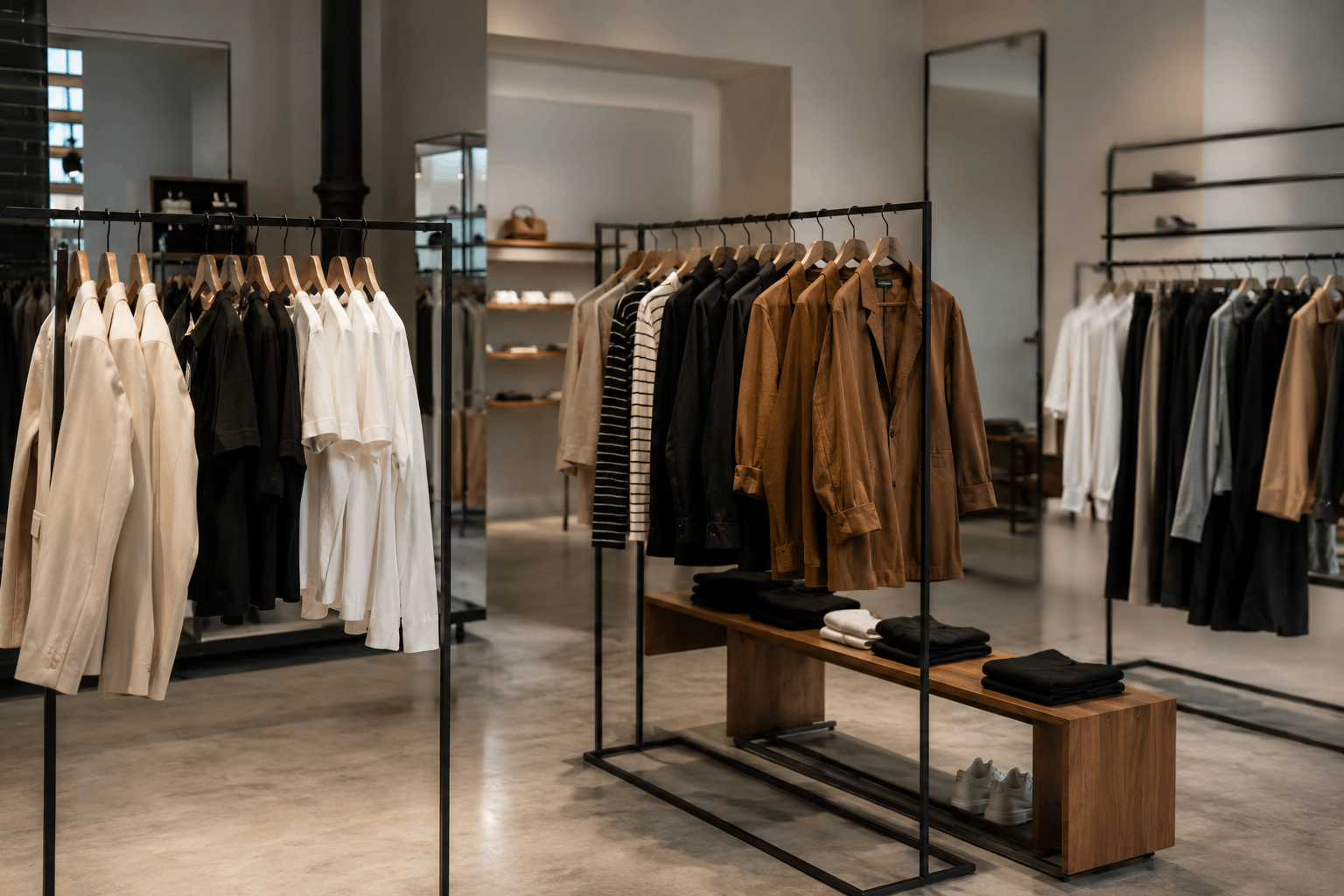
For overseas wholesalers, importers, retail fixture distributors, and project buyers, sourcing clothing racks for shops is rarely just a style decision. It is, in many cases, a margin-and-risk decision. The right rack can support resale value, repeat orders, freight efficiency, and fewer customer complaints. The wrong one may look perfectly fine in a sample photo, yet start creating problems once the bulk order is packed, shipped, assembled, and used in real stores.
This guide focuses on metal clothing racks for wholesale sourcing. It is written for buyers who need more than attractive display ideas. If your goal is to compare suppliers, control landed cost, request customization, or build a repeatable product line, the key question is simple: can this rack be produced consistently, shipped safely, and perform reliably in day-to-day retail use?
Wholesale Buyer Snapshot
When reviewing a supplier page, most overseas buyers want to know very quickly whether the product fits their purchasing reality. For metal clothing racks, the first checkpoints are usually not decorative details. They are bulk order suitability, customization flexibility, export packaging, quality control, and repeat order stability.
| Buyer Concern | What to Check Before Inquiry |
|---|---|
| Bulk order suitability | Batch consistency, structure repeatability, and stable production control |
| Customization | Size, finish, logo, hooks, shelves, wheels, and private-label options |
| Export value | Knock-down structure, carton size, packing density, and component protection |
| Quality control | Drawing confirmation, sample approval, finish approval, and inspection standards |
| Repeat orders | Spare parts, finish consistency, reorder communication, and long-term supply support |
What Wholesale Buyers Need to Confirm First
A terminal store owner may first care about how a rack looks on the shop floor. A wholesale buyer usually looks further. Can the product be sourced repeatedly? Can it be packed efficiently, shipped safely, assembled without confusion, and resold with fewer after-sales issues? That difference matters because wholesale buying is not a one-rack decision. It is often a multiple rack display program, a container order, a distributor catalog item, or a private-label fixture project.
The first confirmation should cover product use, expected load, target market, packing method, and order plan. Buyers should also check whether the supplier can provide drawings, samples, finish references, assembly instructions, or production photos when needed. These details may seem small, but they often prevent misunderstandings before mass production begins.
For B2B buyers, a successful retail fixture program depends on repeatable quality. Stable dimensions, consistent finish, reliable welding, clear carton labeling, suitable component protection, and controlled assembly parts all affect the buyer’s ability to resell with confidence. A supplier who understands these details is often more valuable than one who only provides a low quotation.
Match Rack Type to the Buyer’s Market
Many buying guides start with rack types: two-way racks, four-way racks, round racks, straight racks, rolling racks, wall-mounted rails, and industrial pipe racks. These terms are useful, of course, but wholesale buyers should first think about the customer segment they serve.
A distributor selling to boutiques may need matte black, brushed metal, or gold-tone racks that help communicate a stronger brand position. A wholesaler serving discount stores may prefer standard clothing racks with simple assembly, stable pricing, and efficient carton packing. A shopfitting project buyer, meanwhile, may care more about drawings, batch consistency, installation speed, and future reorder control.
Round racks for high-volume browsing can work well for clearance zones or basic apparel. Four-way racks can create outfit combinations and support the customer journey in fashion shops. Straight metal rails are practical for wall lines and compact store layout plans. Rolling racks are often useful for stock movement, seasonal merchandising, and back-of-house handling.
The right choice is not necessarily the rack that looks most impressive online. It is the rack that fits the buyer’s market, garment weight, shipping method, store layout, and business goals.
Choose the Right Supply Level: Standard, Semi-Custom, or Custom
Standard clothing racks still have strong value in wholesale catalogs. They are easier to price, easier to reorder, and suitable for basic retail display, stockrooms, supermarkets, and light apparel. For buyers who need a dependable entry-level product, standard metal racks may be exactly the right choice.
Still, standard racks do not solve every purchasing need. A fixed height may not suit long garments. A narrow base may not support heavy coats. A basic finish may not match a private-label program. A fully welded structure, while strong, may increase freight cost if the carton volume is too large.
Semi-custom racks often give wholesalers the best balance. You can keep a tested structure while adjusting color, size, logo plates, shelves, hooks, wheels, carton design, or surface finish. Fully custom metal racks are more suitable when the buyer needs an exclusive product line, a high load structure, or a display that supports a very specific retail concept.
| Sourcing Situation | Better Choice | ROI Verdict: Best For |
|---|---|---|
| Basic retail fixture catalog | Standard metal rack | Stable repeat orders and easier inventory planning |
| Same frame with market-specific finish | Semi-custom metal rack | Product differentiation without high development risk |
| Private-label display program | Custom metal rack | Brand image and exclusive market positioning |
| Heavy garments or workwear | Reinforced metal rack | Fewer claims from bending or wobbling |
| Export or multi-store rollout | Dismantlable metal rack | Lower packing volume and easier installation |
Calculate ROI Beyond Unit Price
For wholesalers and importers, the lowest unit price is not always the best investment. A better ROI view includes landed cost, carton volume, damage rate, assembly time, customer complaints, reorder stability, and resale value. These are the factors that decide whether a rack remains profitable after shipment.
A low-cost rack can become expensive if cartons are oversized, container loading is inefficient, coating scratches easily, or customers report unstable assembly. In wholesale trade, each small defect can multiply across many units. Even a minor packaging weakness can become a real cost when the order is distributed across several customers.
A practical cost-benefit review connects product engineering with commercial results. Tube thickness affects durability. Knock-down structure affects freight. Surface protection affects claim rate. Assembly instructions affect labor time. Batch consistency affects repeat orders. None of these points are glamorous, but in bulk sourcing, they are often where profit is protected.
| Cost Factor | What Wholesale Buyers Should Check |
|---|---|
| Unit price | Material, order quantity, rack structure, and customization level |
| Landed cost | Carton size, packing density, container loading, and freight impact |
| Durability | Tube thickness, welding quality, reinforced rail, and base strength |
| Finish quality | Powder coating, chrome finish, scratch resistance, and color consistency |
| Assembly cost | Knock-down design, screw quality, manual clarity, and installation time |
| Damage risk | Edge protection, surface wrapping, carton strength, and drop protection |
| Repeat order value | Batch consistency, spare parts, communication, and stable production control |
The secret to better ROI is not simply paying more. It is knowing which specifications protect margin, and which shortcuts may create cost later.
Evaluate the Metal Structure Before the Appearance
Metal clothing racks are strong wholesale products because their value can be explained through measurable details. Buyers can compare tube thickness, rail strength, base stability, strong welds, connector accuracy, surface treatment, and high load capacity.
This makes them ideal for wholesale programs where buyers need to explain product value to their own customers. A high load metal rack for coats or workwear is easier to sell when the structure is clearly reinforced. A powder-coated rack for boutiques is easier to position when the finish supports the brand image your customers want to project.
That said, metal is not automatically better simply because it is metal. A rack becomes reliable when the frame design, rail support, welding, base width, screw quality, and surface finish work together. A thin metal rack with weak joints can perform worse than a better-engineered structure using the same general material.
Before discussing only color or style, buyers should confirm tube size, tube thickness, joint design, base design, and assembly method. These details decide whether the product can support repeat orders, especially when the same model will be sold across different markets.
Confirm Load Capacity Based on Real Garment Use
Load capacity directly affects customer satisfaction and claim risk. An empty rack may look elegant, but the real test begins when it is fully loaded with garments. Coats, jackets, denim, uniforms, and workwear place more stress on the rail and base than light shirts or dresses.
A high load rack needs more than a thick rail. It also needs a suitable base, balanced frame geometry, secure joints, and a finish that can handle daily contact. In practice, the buyer should ask how the rack performs when weight is uneven, when garments are pulled from one side, or when staff move the rack during store changes.
| Garment Type | Recommended Rack Focus |
|---|---|
| T-shirts and light tops | Standard rail and smooth browsing access |
| Dresses and shirts | Stable height and clean presentation |
| Denim and trousers | Stronger rail and base support |
| Coats and jackets | Reinforced frame and higher load capacity |
| Uniforms and workwear | Heavy-duty metal rack with long service life |
| Sportswear | Flexible display with hooks, shelves, or mixed accessories |
For wholesale projects, expected load, tube thickness, rail reinforcement, and sample testing should be discussed before bulk production. Clear specifications help buyers communicate value to their own customers and reduce misunderstandings after delivery.
Treat Surface Finish and Packaging as One Quality System
Surface finish is not only a design choice. It is a visible quality signal. In wholesale trade, scratches, uneven coating, rust marks, or color differences are easy to notice and difficult to explain to customers.
Different finishes serve different markets. Matte black powder coating is common for boutique and fashion display. Chrome is practical for commercial retail and stockrooms. White coating works well for lifestyle and children’s apparel. Gold-tone and brushed metal finishes can help buyers build premium product lines or an edgy modern retail style.
Packaging is closely connected to finish quality. A good rack can lose value if components rub against each other in the carton. For export orders, buyers should pay attention to surface wrapping, foam protection, corner guards, carton strength, component separation, and clear part labeling. It is a practical detail, but often a decisive one.
| Finish | Suitable For | Wholesale Buyer Notes |
|---|---|---|
| Matte black powder coating | Fashion, streetwear, boutique retail | Strong market appeal and flexible positioning |
| Chrome finish | Commercial retail and stockrooms | Familiar look and practical resale value |
| White powder coating | Lifestyle stores and kidswear | Clean appearance but needs better surface protection |
| Gold-tone finish | Premium apparel and boutiques | Higher visual value; finish consistency is critical |
| Brushed metal | Industrial or refined interiors | Suitable for higher-end display programs |
| Metal + wood | Lifestyle or warm interiors | Adds value while keeping metal structure strong |
| Metal + acrylic signage | Brand and promotional displays | Useful for private-label or campaign displays |
Good packaging protects more than the product. It protects margin, customer relationships, and repeat order opportunity.
Use Dismantlable Designs When They Improve Export Value
Flexible dismantlable displays are especially relevant for overseas wholesalers. Traditional fixed displays can be strong, but they may increase shipping volume and storage pressure. A well-designed knock-down rack can lower packing volume, simplify warehousing, and make distribution easier.
This means buyers can offer a larger display product without always paying for bulky shipping. For chain stores, pop-up shops, exhibitions, and seasonal programs, dismantlable racks can also support quicker installation and layout changes.
The key is engineering. A dismantlable rack should not feel temporary after assembly. Strength depends on connector design, screw quality, joint reinforcement, tube thickness, base structure, and hole accuracy. Simple enough to install, but still solid once in place — that is the goal.
| Structure | Best For | Main Advantage | Risk If Poorly Made |
|---|---|---|---|
| Welded metal rack | Fixed heavy-duty use | Strong and simple | Higher shipping volume |
| Dismantlable metal rack | Export, wholesale, chain stores | Better packing and storage efficiency | Loose joints or weak connectors |
| Modular metal display system | Changing retail layouts | High flexibility and repeat use | Requires stronger planning and production control |
The best multiple rack solution is often not the most complex one. It is the design that balances strength, carton efficiency, assembly time, and market price.
Clarify MOQ, Samples, and Lead Time Before Quotation
Many wholesale buyers search for clothing rack suppliers when they are already close to sending an RFQ. At this stage, the supplier should help clarify practical order conditions, not only product appearance. MOQ may depend on rack structure, finish, customization level, and whether special tooling or private-label packaging is required.
Sample approval is also important for custom metal clothing racks. A sample can confirm the structure, surface finish, load performance, assembly method, and packaging logic before the buyer commits to a bulk order. For repeat products, buyers may not need to sample every order, but first-order confirmation often reduces risk.
Lead time should be discussed together with order quantity, surface treatment, packaging requirements, and production schedule. Powder coating, chrome finish, logo plates, custom cartons, or mixed-material components may affect the timeline. Clear communication at this stage helps buyers plan shipping, customer delivery, and inventory rotation.
Look for Quality Control Signals Before Placing a Bulk Order
When overseas buyers browse a supplier website, they look for signs that the factory understands bulk production risk. Phrases such as “high quality” are not enough unless they are supported by specific details.
Useful quality signals include drawings, sample approval, finish samples, structure confirmation, load discussion, carton design, production inspection, and clear communication before shipment. These details help buyers feel that the supplier can manage a real order, not just produce a good-looking sample.
For custom metal racks, drawings and samples are especially important. They help confirm dimensions, hole positions, logo placement, color finish, packaging method, and assembly logic before mass production.
Certifications should be stated accurately. RoHS can support material compliance expectations, while ISO 9001 relates to quality management systems. If other certifications are not available, they should not be claimed. Clear certification language is often more persuasive to professional buyers than broad claims.
| Supplier Signal | Why It Matters for Wholesale Buyers |
|---|---|
| Drawing confirmation | Reduces size, hole-position, and assembly misunderstandings |
| Sample approval | Confirms structure, finish, stability, and packaging before bulk production |
| Finish sample | Helps control color consistency and surface expectations |
| Export packaging plan | Reduces scratches, dents, missing parts, and carton damage |
| Spare parts support | Helps with screws, wheels, connectors, and signage components |
| Repeat order control | Keeps future batches closer to the approved sample |
Practical Sourcing Questions Buyers Ask Before Inquiry
Before sending an inquiry, wholesale buyers usually want to know whether the rack can support their purchasing model.
- Can it be customized for private label?
- Can the MOQ be discussed based on structure and order complexity?
- Can the product be packed flat to reduce freight?
- Are spare parts available for connectors, screws, wheels, or signage panels?
These questions are practical because they affect purchasing risk. A buyer sourcing wholesale garment racks or custom metal clothing racks is rarely looking for a one-time sample only. More often, they are checking whether the supplier can support repeat orders, consistent finish, stable packaging, and reliable communication across future projects.
For metal racks for shops, the most useful supplier response is specific rather than promotional. Instead of only saying that the rack is customizable, it is more helpful to explain which parts can be changed, how samples are confirmed, how packaging is planned, and how repeat orders are controlled.
A Practical 2026 Sourcing Framework for Metal Clothing Racks
Wholesale buyers need a clear way to compare rack options. One useful approach is to evaluate product fit, market fit, structure fit, packaging fit, operation fit, and supply fit.
Product fit means the rack matches garment weight, length, and display style. Market fit means the design suits the buyer’s customer base, whether boutiques, supermarkets, chains, stockrooms, or shopfitting projects.
Structure fit focuses on rail strength, base design, tube thickness, welds, connectors, and load performance. Packaging fit checks carton volume, surface protection, assembly parts, and warehouse efficiency.
Operation fit considers whether the rack is easy to assemble, move, clean, restock, and maintain. Supply fit asks whether the manufacturer can control samples, drawings, QC, packaging, and repeat orders.
| Fit Point | What It Means | Key Question for Buyers |
|---|---|---|
| Product Fit | Matches garment weight and category | Will it support the target product range? |
| Market Fit | Matches the buyer’s customer segment | Is it suitable for boutiques, chains, supermarkets, or stockrooms? |
| Structure Fit | Performs in daily retail use | Are the rail, base, welds, joints, and tube thickness reliable? |
| Packaging Fit | Ships and stores efficiently | Does the carton protect the finish and reduce volume? |
| Operation Fit | Supports installation and daily use | Is it easy to assemble, move, clean, and maintain? |
| Supply Fit | Supports repeat sourcing | Can samples, drawings, QC, and repeat orders be controlled? |
This framework can guide your investment without making the decision overly technical. It connects rack design with resale value, freight cost, installation experience, and long-term supplier reliability.
What to Send When Requesting a Quote
A clear RFQ helps the supplier respond with a more accurate solution. Instead of asking only for a general price, buyers can share the target market, rack style, estimated order quantity, required size, expected load, preferred finish, logo or private-label needs, packing preference, destination market, and sample requirement.
This does not mean every detail must be final before inquiry. It simply gives the manufacturer enough context to recommend the right structure, finish, packing method, and quotation direction. For example, a knock-down garment rack for export may require a different carton plan from a welded heavy-duty rack for local installation.
When buyers provide reference images, usage scenarios, or expected retail channels, the supplier can also suggest whether a standard, semi-custom, or custom metal rack is the better choice. This shortens communication and makes the final buying checklist easier to complete.
Final Buying Checklist Before Ordering Clothing Racks for Shops
Before placing a bulk order, buyers should confirm the target market, garment category, expected load, display purpose, and preferred rack structure. They should also review material, tube thickness, rail reinforcement, base stability, finish type, and accessories such as wheels, shelves, hooks, signage, or logo panels.
For export orders, the checklist should include carton size, packing method, component protection, assembly instructions, spare parts, sample approval, finish approval, production consistency, and inspection standards.
If the product is intended for private label or a distributor catalog, buyers should also consider whether the design can support repeat orders, stable resale positioning, and future line extensions.
A strong buying process does not make sourcing slower. It helps both buyer and manufacturer work from the same technical expectations before production begins.
Where Yishang Display Fits In for Overseas Buyers
If your project requires durable metal structure, custom dimensions, bulk production, export packaging, and OEM or ODM support, Yishang Display can help develop practical metal display rack solutions for wholesale and project purchasing needs.
Yishang Display has over 26 years of retail display rack manufacturing experience, with products exported to more than 50 countries. The brand focuses on metal display racks and can also combine acrylic, wood, and cardboard when a project requires signage, shelves, branding, or promotional display functions. Current certifications include RoHS and ISO 9001.
Send your rack design, target market, load requirement, or reference image to discuss a practical OEM or ODM solution.
FAQ
What do wholesale buyers look for when sourcing clothing racks for shops?
Wholesale buyers usually look beyond appearance. They care about unit cost, landed cost, high load capacity, carton size, packaging protection, assembly time, finish consistency, sample approval, repeat order stability, and OEM or ODM support.
Are metal clothing racks a good choice for wholesale and export orders?
Yes. Metal clothing racks are suitable for wholesale and export because they offer strong structure, flexible finishes, custom sizing, and reliable long-term retail performance. When designed as dismantlable racks, they can also improve shipping and storage efficiency.
What is the difference between standard and custom metal clothing racks?
Standard racks are suitable for basic display needs and repeat catalog sales. Custom metal racks are designed around specific dimensions, load capacity, brand colors, logo placement, surface finish, accessories, packaging, and market requirements.
Are flexible dismantlable displays strong enough for commercial use?
Yes, if they are properly engineered. Strength depends on tube thickness, connector design, screw quality, joint reinforcement, base structure, assembly accuracy, and load performance.
What finish is best for metal clothing racks?
The best finish depends on the target market. Matte black is popular for modern fashion stores, chrome is practical for commercial retail, white works well for lifestyle shops, and gold-tone or brushed finishes are often used for boutique or premium displays.
What should buyers confirm before placing a bulk order?
Buyers should confirm drawings, samples, material, tube thickness, load capacity, finish quality, packaging method, carton protection, assembly instructions, production consistency, inspection standards, MOQ discussion, and available certifications such as RoHS and ISO 9001.
See Also
- How to Choose Custom Metal Display Racks for Retail Stores
- Metal vs Wood Clothing Racks: Which Is Better for Shops?
- Powder Coated vs Chrome Metal Clothing Racks
- Flexible Dismantlable Displays for Export Buyers
- How to Check Load Capacity for Retail Clothing Racks
- OEM & ODM Metal Display Rack Manufacturing Guide
- Retail Store Fixture Buying Guide for Chain Stores