
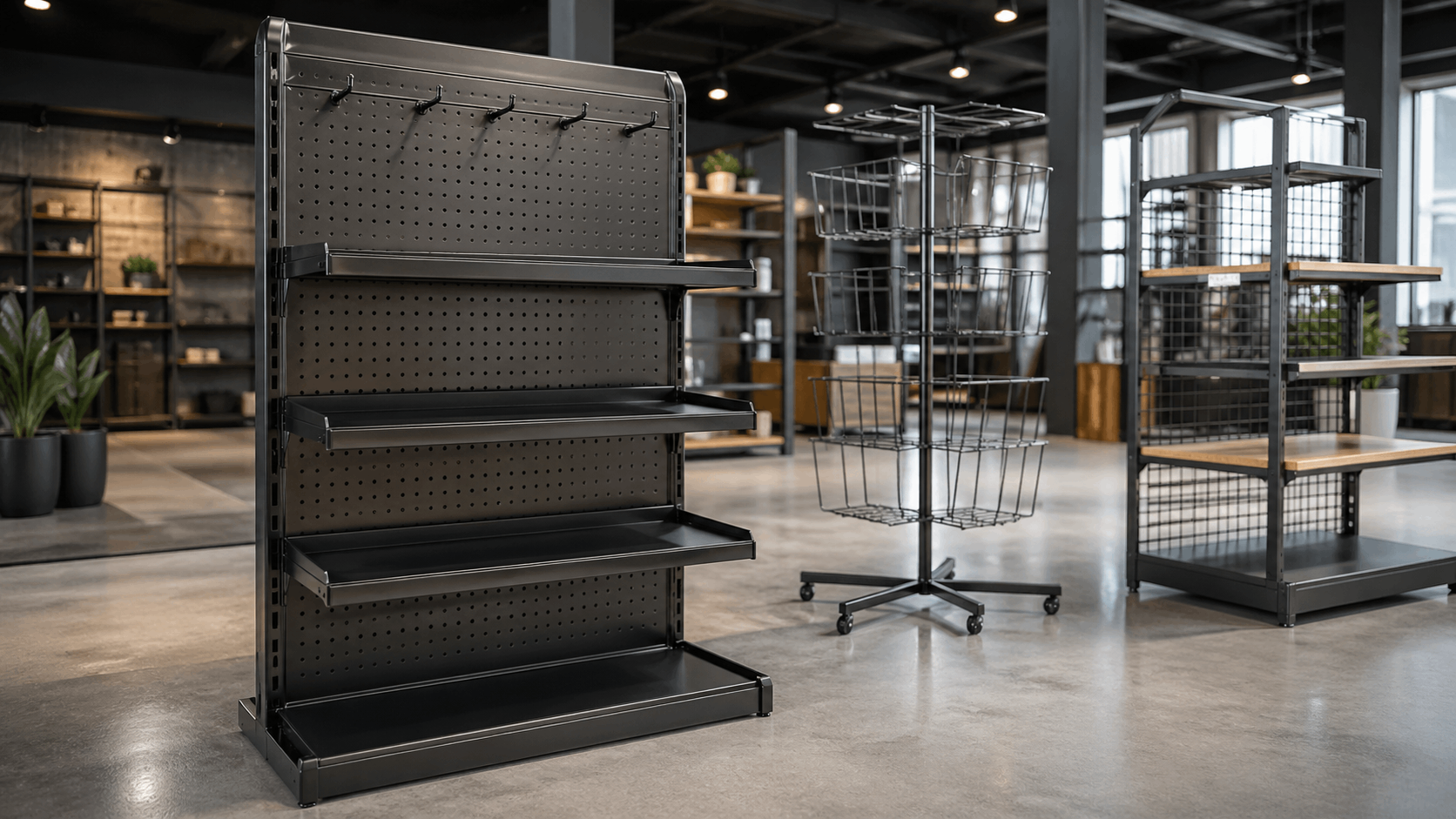
For overseas wholesale buyers, a custom metal display rack is rarely just a product with a unit price. It affects landed cost, container loading, resale margin, delivery reliability, and, perhaps most importantly, the buyer’s ability to supply retailers with consistent quality. A quotation that looks low at first can become less attractive if the rack is difficult to assemble, poorly packed, unstable under load, or hard to repeat in future orders.
Most importers, distributors, retail fixture wholesalers, and brand sourcing teams know this from experience. They usually look beyond the price line and ask a more practical question: what specification is supporting this quote? Metal type, tube size, sheet thickness, welding method, load capacity, surface finish, packing style, and inspection scope all matter. These details decide whether the display is suitable for sample approval, trial orders, bulk procurement, and repeat programs.
This article explains the five cost factors that matter most when sourcing custom metal display racks from an overseas manufacturer. The focus is practical rather than theoretical: how to compare quotations, understand MOQ and sample logic, control avoidable cost, and select a specification that can hold up in real retail use.
Key Points for Wholesale Buyers
The price of custom metal display racks is shaped by five connected areas: structure, metal specification, load requirement, surface finish, and delivery conditions. These factors influence not only production cost, but also MOQ planning, freight efficiency, assembly time, damage rate, batch consistency, and long-term resale value.
A useful quotation should make the specification clear enough for buyers to compare offers fairly. When two suppliers quote different prices, the difference may come from material thickness, welding details, coating quality, carton strength, assembly design, or inspection standards. Understanding these items helps buyers find better value, not just the lowest number on paper.
Factor 1 — Structure: The Starting Point of Manufacturing Cost
Structure is the first major cost driver because it determines how the rack is actually manufactured. Tube bending, wire forming, sheet metal cutting, welding, drilling, grinding, assembling, and testing all depend on the structural design. A fixed floor-standing rack with simple shelves is usually easier to produce than a rotating stand, foldable rack, wall-mounted fixture, or knock-down display with hooks, baskets, dividers, and signage panels.
For wholesale procurement, structure also affects whether the product can be repeated smoothly in bulk. A sample may look acceptable, but if the design has difficult welding angles, weak connection points, or poor hole alignment, the same issue can show up across a larger batch. That may lead to slower assembly, unstable racks, inconsistent appearance, or packaging problems during export. None of these issues is dramatic in a drawing, but they can become expensive in a shipment.
Knock-down design is common for export projects because it can improve packing density and reduce freight pressure. Still, it only works well when the engineering is accurate. The rack needs reliable connectors, labeled parts, stable locking points, and clear instructions. A flat-packed display only creates real savings when it reduces shipping volume without creating installation complaints later.
Manual and electric structures should also be evaluated separately. Manual metal display racks are usually more cost-effective because they use fewer functional parts. Electric or motorized retail display devices may require motors, wiring, rotating systems, controls, and additional inspection. That extra function can be useful, but it naturally increases development cost and production complexity.
Factor 2 — Metal Specification: Material and Thickness Define the Cost Base
After structure, buyers need to check the metal specification. Metal is selected when the display must carry weight, last longer, and perform better than cardboard or lightweight plastic fixtures. Acrylic, wood, or printed panels can improve branding, of course, but the main cost base of a durable rack usually comes from metal material, thickness, fabrication, and finishing.
Steel is widely used because it offers a practical balance between strength and cost. Stainless steel costs more, but it provides better corrosion resistance and a more premium appearance. Iron can be economical for standard structures when surface treatment is suitable. Aluminum is lighter and corrosion-resistant, although the structure still needs careful engineering for load-bearing performance.
Thickness changes cost directly. Thicker tubes increase raw material use. Larger wire diameter improves strength but adds weight. Thicker sheet metal can make shelves more stable. Stronger base plates reduce tipping risk. Extra reinforcement adds welding time, labor cost, and finishing work. This is why two racks with the same outside dimensions may still have noticeably different prices.
For importers and distributors, material choice also affects landed cost. A heavy-duty display may be necessary for tools, beverages, or automotive accessories, but over-specifying the metal can increase container weight and reduce margin. The right specification is not always the thickest one. It is the one that matches product weight, target market, expected service life, and freight plan.
| Metal Option | Main Advantage | Cost Level | Suitable Use |
|---|---|---|---|
| Steel | Strong and cost-effective | Medium | Supermarket, hardware, beverage, food, and pet product displays |
| Stainless steel | Better corrosion resistance and premium look | Higher | High-end stores, humid environments, long-life fixtures |
| Iron | Practical for many general structures | Low to medium | Standard metal display racks with suitable coating |
| Aluminum | Lightweight and corrosion-resistant | Medium to higher | Displays where lower weight is important |
Factor 3 — Load Requirement: The Specification Must Match the Product
Load requirement is where many quotation differences become easier to understand. A retail display device is not priced only by height, width, or number of shelves. It is priced by what it must hold, how that weight is distributed, how often the display will be restocked, and how stable it must remain during daily retail use.
A literature rack may need angled pockets and good product visibility. A wine display needs stronger shelves, stable bottom support, and anti-slip details. Hardware and automotive displays often require reinforced hooks, thicker frames, and stronger welding. Beverage displays need high shelf load and a base that remains stable after repeated restocking. Pet food or packaged goods displays may need multiple shelves and easy-clean surfaces.
For wholesale buyers, the risk is not limited to one failed sample. The real issue is a batch of racks causing complaints across several retail customers. If shelves bend, hooks deform, or the rack shakes when fully loaded, the buyer may face replacement costs, extra freight, delayed resale, and pressure from downstream clients.
A practical quotation should therefore be based on product weight per shelf, hook, layer, or display zone. Once the supplier understands the actual load requirement, the structure can be reinforced only where needed. This helps buyers avoid weak specifications without paying for unnecessary overbuilding.
Factor 4 — Surface Finish and Branding: Appearance Must Support Long-Term Use
Surface finish affects both appearance and service life. For metal display racks, finishing helps protect against rust, scratches, peeling, and color inconsistency. It also affects how the display presents the buyer’s brand, or the buyer’s customer’s brand, in retail environments. A rack does not need to look luxurious in every project, but it does need to stay presentable for its intended use.
Powder coating is a common choice for indoor metal display racks because it is durable, cost-effective, and available in many colors. Spray painting is useful when flexible color matching is required. Chrome plating creates a bright retail appearance for selected display styles. Galvanizing can be considered when anti-rust performance is important. Brushed or polished stainless steel is more suitable for premium retail fixtures.
For overseas distributors, finish consistency across batches matters. A color difference between repeat orders can create problems when supplying chain stores or brand clients. Approved color samples, clear coating requirements, and surface inspection standards help reduce this risk before mass production. It is a small detail at the quotation stage, but often a big one during repeat supply.
Branding elements also influence cost. Logo plates, acrylic headers, printed graphics, replaceable signs, LED parts, or decorative panels can help a display stand out, but they also require sampling, inspection, and protective packing. For wholesale programs, replaceable branding panels can be useful because the same base rack may serve different customers or promotional campaigns.
Factor 5 — Quantity, Packaging, and Inspection: The Final Unit Cost Is Decided at Delivery Level
The final unit cost changes when a project moves from sample to bulk order. A sample usually costs more because it includes drawings, material preparation, manual fabrication, surface treatment trials, assembly checks, packaging review, and possible revisions. MOQ also matters because some costs, such as setup, jigs, color matching, and packaging preparation, are easier to absorb when the order volume is higher.
Buyers should separate sample cost, trial order cost, and bulk order cost in their pricing plan. A sample verifies structure and finish. A trial order checks assembly, packaging, and retail feedback. A larger order tests production stability, inspection consistency, and container loading efficiency. Each stage serves a different procurement purpose, so buyers should avoid expecting sample pricing to match mass production pricing.
Packaging is not a secondary detail for metal display racks. Even strong metal structures can be scratched, dented, or bent during long-distance transportation if the carton design is weak. Export packaging may include reinforced cartons, foam, corner protection, hardware bags, labels, pallets, wooden crates, and assembly instructions.
Fully assembled racks are convenient for retailers, but they occupy more shipping volume. Knock-down packaging can improve packing density and help buyers save money on freight, especially when buying in bulk. This only works, however, when the parts are protected well and the assembly process is clear.
Inspection should be part of the quotation discussion. Welding inspection, load-bearing checks, surface finish inspection, trial assembly, carton review, and pre-shipment inspection help reduce disputes after delivery. Buyers should also confirm whether the quote is based on EXW, FOB, CIF, or another trade term, because shipping responsibility and landed cost can change the real purchasing decision. For Yishang Display, available certifications include RoHS and ISO 9001, supporting quality management and compliance expectations for international buyers.
How Wholesale Buyers Can Compare Quotations More Accurately
A quotation should help buyers understand the specification, not only the total amount. When reviewing several suppliers, compare the same items side by side: structure, metal specification, load capacity, finish, branding, packaging, quantity, inspection, and trade terms. This makes it easier to see whether a lower price comes from better efficiency or from a weaker specification.
| Quotation Item | What to Check | Why It Matters |
|---|---|---|
| Structure | Welded, knock-down, rotating, foldable, or fixed | Affects production stability, assembly, and packing efficiency |
| Metal specification | Material, tube size, wire diameter, sheet thickness | Affects strength, weight, and landed cost |
| Load capacity | Weight per shelf, hook, or layer | Reduces deformation and complaint risk |
| Surface finish | Powder coating, painting, plating, galvanizing, polishing | Affects durability, appearance, and batch consistency |
| Branding | Logo, color, header panel, signage | Affects market presentation and production steps |
| Quantity | Sample, trial order, bulk order, repeat order | Changes unit price and production planning |
| Packaging | Carton, foam, pallet, wooden crate, knock-down packing | Affects damage rate and freight efficiency |
| Inspection | Welding, load, finish, assembly, packaging checks | Supports reliable delivery and fewer disputes |
| Trade terms | EXW, FOB, CIF, or buyer-arranged shipping | Affects landed cost and responsibility after shipment |
A low quotation is not necessarily wrong. Some suppliers may have better production efficiency or stronger material sourcing. The key is transparency. Buyers need to know what is included, what is simplified, and what may affect shipping, assembly, or retail use.
How to Control Cost Without Weakening the Display
Cost control is most effective when it starts during design. Buyers can often reduce unnecessary cost by using standard tube sizes, simplifying non-essential decorative parts, confirming real load requirements, and choosing a modular structure. These decisions help use fewer materials where possible while keeping strength where it matters.
Packaging design can also reduce total cost. A well-designed knock-down rack can improve container loading and reduce freight pressure. Replaceable logo panels may allow distributors to reuse the same base rack for different customers or campaigns. Powder coating may be a practical choice when it matches the use environment and budget.
The cost cuts that create problems are usually the ones that weaken the product silently. Reducing metal thickness too much, removing reinforcement from load-bearing shelves, using weak cartons, or skipping assembly checks may lower the first quotation but increase claims later. A cost-effective display should still be stable, durable, safe, and suitable for the target retail market.
Information to Prepare Before Requesting a Quote
A clear inquiry helps the supplier give a more accurate quotation. Buyers should provide product weight, display size, number of shelves or hooks, usage environment, target quantity, expected MOQ range, preferred finish, logo requirements, packaging expectations, shipping plan, trade term preference, and target market. Drawings, reference photos, or product samples can reduce misunderstanding and speed up evaluation.
For wholesale procurement, it is also useful to clarify the order stage. A sample test, trial order, container shipment, and repeat program require different planning. The supplier can then decide whether to focus on fast sampling, bulk production efficiency, packing density, easy assembly, or long-term consistency.
Assembly should be discussed before production. If the display will be delivered to multiple retailers, clear instructions and labeled parts are important. If distributors need fast warehouse handling, carton size, pallet loading, and hardware organization may matter as much as the rack itself.
FAQ
What is the typical MOQ for custom metal display racks?
MOQ depends on structure, material, finish, packaging, and customization level. A simple standard-style metal rack may support a lower trial quantity, while a highly customized rack with special tooling, color matching, or complex packaging usually requires a higher order volume to control unit cost.
Should wholesale buyers choose knock-down or fully assembled packaging?
Knock-down packaging is often better for bulk export because it improves packing density and can reduce freight cost. Fully assembled racks are easier for end users, but they take more space. The better choice depends on container loading, assembly difficulty, product protection, and the buyer’s distribution model.
What affects the cost of a custom metal display rack?
The main factors are structure, metal specification, load requirement, surface finish, quantity, packaging, and inspection. For wholesale buyers, these factors also affect landed cost, damage risk, assembly efficiency, and repeat-order stability.
Why are metal display racks more expensive than cardboard displays?
Metal racks require cutting, bending, welding, finishing, assembly, and stronger packaging. They usually cost more upfront, but they offer better durability, stronger load capacity, and longer service life for repeated retail use.
Does metal thickness change the price?
Yes. Tube thickness, wire diameter, and sheet thickness affect raw material use, weight, welding difficulty, and freight cost. The right thickness should match the product load rather than simply making the rack heavier.
Why does a sample cost more than a bulk order?
A sample includes design work, manual production, surface treatment trials, assembly checks, packaging review, and possible revisions. In mass production, setup and tooling costs are spread across more units.
How can wholesale buyers reduce custom display rack costs?
Buyers can reduce cost by confirming real load requirements, using standard material sizes, simplifying unnecessary decoration, choosing efficient packaging, and increasing quantity after sample approval. The goal is to remove waste, not weaken the display.
What should buyers provide for an accurate quotation?
Buyers should provide product weight, size, quantity, material preference, finish, logo needs, packaging requirements, shipping plan, target market, and reference drawings or photos.
Conclusion — The Right Price Comes From the Right Specification
A custom metal display rack should not be judged by unit price alone. For overseas wholesale buyers, a stronger decision is to evaluate structure, metal specification, load requirement, surface finish, quantity, packaging, inspection, and trade terms together. This creates a clearer view of true cost and reduces avoidable risk.
The right display should protect the buyer’s margin while meeting real retail use requirements. A rack that is properly engineered, finished, packed, and inspected can support better product presentation, fewer claims, and stronger repeat business.
Yishang Display supports OEM and ODM custom metal display racks for overseas wholesale buyers, distributors, brands, and retail fixture importers. Share your product weight, target quantity, display requirements, and packaging needs to receive a practical quotation for your project.