
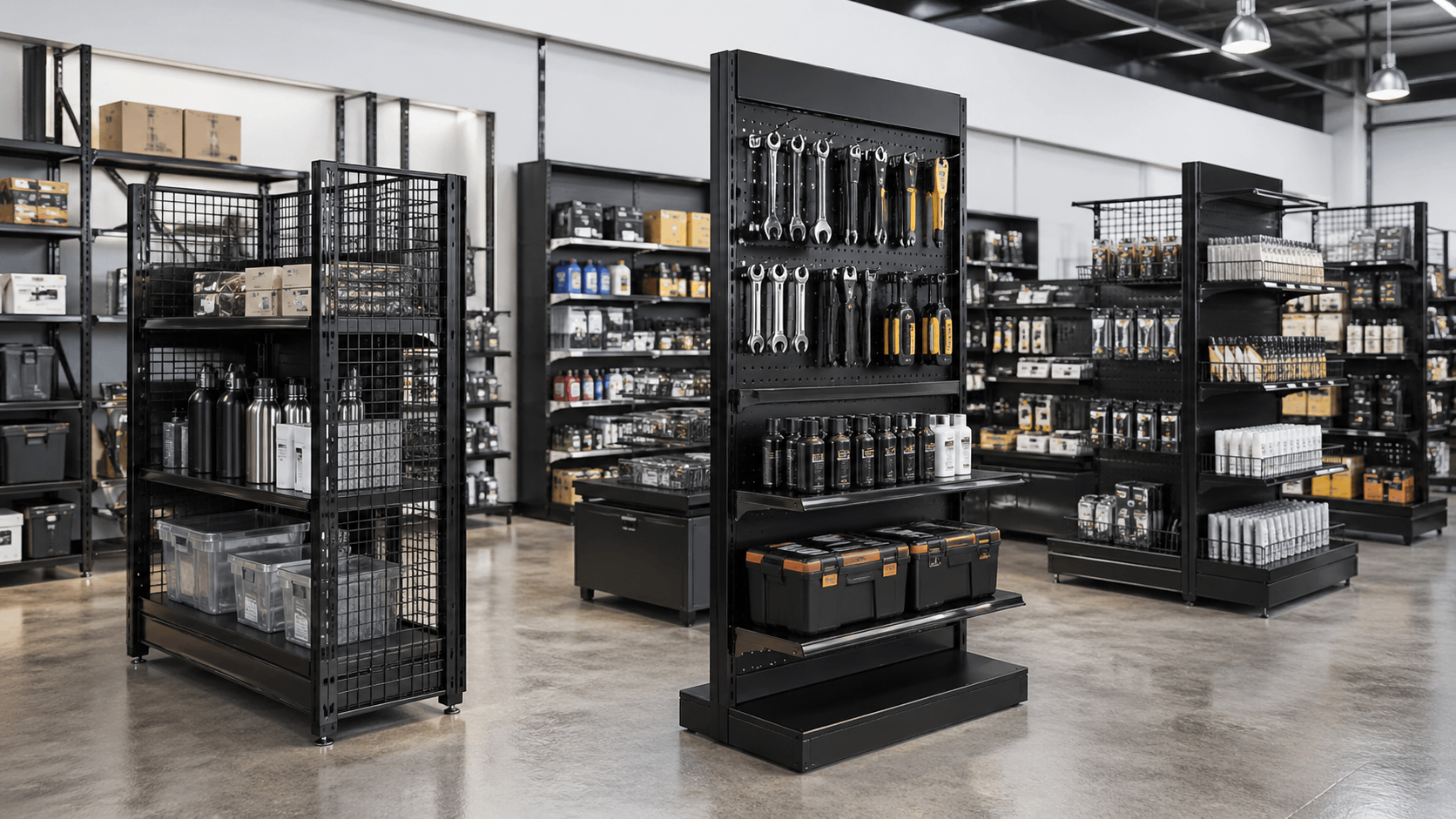
For overseas wholesalers, importers, and distributors, a metal display rack is rarely just a store fixture. It is a bulk-purchased product that has to move through a long chain of real-world steps: manufacturing, export packing, ocean freight, warehouse handling, store delivery, assembly, daily use, and, quite often, future reorders.
That full journey is where many display rack projects either prove their value or start creating problems. A sample may look polished in photos. But the real test begins when hundreds of units need to be produced with the same structure, finish, carton setup, hardware kit, and assembly logic.
For this reason, choosing the best metal display racks for multi-location rollouts should begin with procurement priorities. Appearance still matters, of course, but wholesale buyers usually look more closely at load capacity, repeatable quality, export-ready packaging, total landed cost, easy assembly, and supplier reliability.
This guide focuses on the sourcing factors that matter most when buying custom metal display racks in bulk. It is written for buyers who need display solutions that help protect margin, reduce after-sales risk, and support consistent presentation across multiple retail locations.
What Wholesale Buyers Need to Know Before Sourcing Metal Display Racks
Wholesale buyers tend to scan supplier websites quickly. They are looking for signs that a manufacturer can handle bulk production, customization, export packaging, stable quality, and clear communication. A beautiful product image may catch the eye, but it rarely answers the questions that matter before an RFQ.
For a distributor supplying supermarkets, hardware stores, beverage programs, pet supply chains, or promotional campaigns, the rack has to serve downstream customers reliably. It should be strong enough for the product category, practical for warehousing, efficient to ship, and simple enough for store teams or local installers to assemble.
The most useful supplier information is specific. Buyers want to understand load capacity, metal structure, coating quality, carton protection, accessory packing, and reorder support. They also want to know whether the rack can be adjusted for different store formats without creating unnecessary tooling or production complexity.
A strong sourcing decision often starts with a few practical questions. What products will the rack hold? How many units are needed? Will the rack ship assembled or flat packed? Can shelves, hooks, signage panels, or fasteners be replaced later? These questions help buyers compare suppliers beyond unit price.
| Specification to Confirm | Why It Matters for Wholesale Buyers |
|---|---|
| Material and thickness | Affects load capacity, cost, weight, and long-term durability |
| Surface finish | Powder coating, plating, or painting affects appearance and corrosion resistance |
| Load capacity | Helps match the rack to beverages, hardware, pet products, literature, or light goods |
| Packing method | Flat-pack, foldable, or assembled packing changes freight cost and handling time |
| MOQ and order volume | Helps buyers judge whether the supplier fits trial orders or full rollouts |
| Sample and production lead time | Affects seasonal launches, retail campaigns, and delivery planning |
| Replacement parts | Supports reorders, after-sales service, and longer product lifecycle |
| Trade terms | EXW, FOB, CIF, or other terms influence total landed cost |
Why Multi-Location Rollouts Need a Procurement-Focused Approach
A display rack for one store can often be adjusted on site. A display rack for a multi-location rollout has far less room for improvisation. Once a bulk shipment leaves the factory, any design weakness may repeat across different stores, regions, or retail customers.
For wholesalers, that risk is commercial as well as technical. A rack that is too wide may not fit smaller aisles. A rack that is too heavy may raise freight and warehouse costs. A rack with unclear instructions may create repeated assembly questions from downstream customers.
A practical way to review a project is to evaluate four sourcing risks before confirming production.
| Sourcing Risk | What Buyers Should Check | Why It Matters |
|---|---|---|
| Rigidity | Frame strength, base stability, shelf span, anti-tip design | Reduces deformation and safety concerns |
| Repeatability | Size tolerance, coating consistency, hole position, logo placement | Keeps every store display visually consistent |
| Retail execution | Assembly method, hardware kit, instructions, carton labeling | Reduces store-level errors and support requests |
| Replacement | Hooks, shelves, panels, fasteners, reorder compatibility | Extends product life and supports repeat sales |
This view is more useful than asking for the lowest price first. For multi-location rollouts, the right display fixture is the one that protects margin after production, packing, shipping, installation, and customer use.
Why Metal Should Remain the Structural Core
Metal is widely used in retail display racks because it offers strength, dimensional stability, and long service life. For bulk orders, those qualities matter even more because the rack must perform consistently across different stores and markets.
Steel display racks are often preferred for heavier products such as hardware, beverages, wine and spirits, automotive accessories, and pet supplies. Aluminum may be suitable when lower weight is important. Powder-coated metal frames can provide a clean retail finish while helping the surface resist scratches from daily handling.
Other materials can improve visual merchandising, but they should support the structure rather than replace it when durability is the priority. Acrylic panels can improve product visibility. Wood accents can create a warmer or more premium look. Cardboard graphics can carry seasonal point-of-sale messages.
For most custom metal display racks, the frame, shelves, hooks, brackets, and base should carry the load. This keeps the display stable while still allowing branded panels, shelf talkers, header signs, and promotional graphics to fit your brand’s specific needs.
What Makes a Metal Display Rack Ready for Bulk Rollouts?
A rollout-ready rack is designed around real merchandise, repeat production, export packing, store-level assembly, and future reorder needs. It should not be judged only by its sample appearance, however attractive that sample may be.
Load capacity should be based on actual products. Buyers need to consider single product weight, total loaded weight, shelf span, product depth, center of gravity, restocking frequency, and customer handling. A beverage rack, for example, usually needs different shelf reinforcement than a literature rack or fashion accessory stand.
Production consistency is equally important. The bulk order must match the approved sample in size, coating color, hole location, shelf angle, logo panel position, and accessory fit. For wholesale buyers, inconsistent batches can create complaints from several customers at the same time.
Assembly should be simple enough for real store conditions. Store staff, warehouse teams, and local installers may not have technical training. Clear instructions, labeled parts, standard hardware, and tool-light assembly help reduce confusion and keep presentation consistent across multiple locations.
Packaging is part of product quality. Flat-pack display racks can reduce shipping volume, while protective foam, corner guards, separate hardware bags, and clear carton marks can reduce damage and missing parts. In a 300-unit order, even a small reduction in carton volume can affect container loading and total landed cost.
Choosing the Right Rack Structure for the Rollout
Different rollout plans call for different rack structures. Foldable metal display racks are useful when storage space, setup time, and shipping efficiency matter. They are often suitable for seasonal promotions, product launches, temporary displays, and trade programs.
The key is engineering. Foldable display stands should be checked for hinge strength, locking points, base stability, and full-load performance. A folding mechanism can save space, but it should not weaken the rack under commercial use.
Traditional metal display racks are usually a better fit for heavier products and long-term placement. They are commonly used for hardware, bottled drinks, automotive items, pet products, and premium supermarket display areas where durability and stability matter more than fast teardown.
Modular metal display racks can be especially practical for wholesalers serving multiple customers. A standard frame can be combined with adjustable shelves, removable hooks, baskets, trays, or branded panels. This helps buyers control inventory while still offering customized display solutions.
| Rollout Need | Suitable Rack Type | Procurement Benefit |
|---|---|---|
| Heavy products | Traditional or heavy-duty metal rack | Lower deformation risk |
| Seasonal campaign | Foldable metal rack | Easier storage and reuse |
| Mixed store layouts | Modular rack system | Flexible for different customers |
| Brand-specific display | Custom rack with signage | Better shelf branding and product impact |
| Export shipment | Flat-pack or foldable design | Improved freight efficiency |
| Frequent SKU changes | Modular shelves or hooks | Easier product updates |
The best choice is not always the most complex design. More often, it is the design that matches product weight, store format, shipping method, campaign duration, and resale expectations.
How Buyers Should Prepare an RFQ
A clear RFQ helps suppliers quote more accurately and reduces revision time. Instead of only asking for a general display rack price, buyers should provide product size, product weight, quantity per rack, expected order volume, target market, and preferred packaging method.
It is also useful to share store environment details. A freestanding floor display, countertop rack, endcap display, wall-mounted rack, rotating stand, and checkout display all require different design choices. If the rack will be used by several retail customers, the supplier should know whether one standard version is enough or several size options are needed.
Customization should be discussed with cost control in mind. For wholesale supply, it is often better to standardize the main metal frame and customize the visible parts, such as header signs, logo panels, shelf layout, hooks, baskets, or color finish.
This balance allows the rack to be tailored to brand requirements without making production unnecessarily expensive. It also makes reorders easier because the core structure remains stable while visual elements can be updated for different customers.
Before confirming a bulk order, buyers may also ask a few direct questions. Can the rack be flat packed to reduce freight volume? What is the estimated carton size and gross weight? Can the sample be tested under full product load? Are hooks, shelves, and signage panels replaceable? Can the same design be reordered later with matching color and dimensions?
These questions are simple, but they reveal a lot. They help show whether the supplier is thinking like a long-term manufacturing partner rather than only quoting a one-time display rack order.
Hidden Costs That Affect Total Landed Cost
A low unit price can become expensive if the product creates problems after shipment. For display racks, the most common hidden costs come from freight volume, surface damage, missing accessories, assembly confusion, and short product life.
Shipping volume is often overlooked. Fully assembled racks may reduce installation time but can increase freight and warehouse cost. Flat-pack racks may reduce volume, but only if assembly is simple enough for store teams or distributors to manage.
Surface protection is another key issue. Powder-coated metal displays can be scratched if edges, corners, logo panels, and acrylic parts are not protected correctly. A small packing failure, repeated across a large order, can create replacement requests and customer service pressure.
Accessory control also matters. Missing screws, hooks, shelves, or signage parts can delay store setup. For buyers supplying multiple locations, a well-organized hardware kit and clear carton labeling can save more time than many decorative design upgrades.
Quality Control Before Bulk Production and Shipment
For wholesale orders, quality control should begin before mass production. Sample approval should cover more than appearance. Buyers should check product fit, full-load performance, stability, assembly steps, packing method, finish color, and branding position.
During production, inspection should focus on repeatability. Useful inspection points may include raw material checking, metal thickness, cutting accuracy, welding consistency, hole position, powder coating adhesion, coating thickness, color matching, accessory quantity, and carton marking.
Before shipment, random assembly checks and packaging inspections can reduce rollout risk. A practical pre-shipment review may include surface scratch checks, hardware kit counts, carton protection review, full-load verification, and confirmation that labeled parts match the installation instructions.
Buyers may also request production photos, packing photos, or third-party inspection depending on the order value and destination market. For large retail rollouts, these records can make communication easier if goods are distributed across several warehouses or customer locations.
Certification claims should remain accurate. Yishang Display supports RoHS-compliant production and ISO 9001 quality management. Other certificates should only be mentioned when valid documents are available for the specific product or process.
Practical Sustainability for Wholesale Buyers
Sustainability should stay connected to product value. For wholesalers, the practical benefit of a sustainable metal display rack is longer service life, repeat use, repairability, and fewer replacement orders caused by weak construction.
A reusable metal frame can support multiple campaigns. Replaceable hooks, shelves, signage panels, acrylic inserts, wheels, and connectors can extend the life of the fixture without replacing the entire rack.
Modular and flat-pack designs can also improve operational efficiency. They may reduce storage pressure, simplify replacement, and allow one core display system to serve different product lines or retail customers.
This is why sustainability should be linked to lifecycle value rather than broad environmental claims. The longer the rack remains useful, the better it protects both the buyer’s budget and the downstream customer’s store presentation.
How to Evaluate a Metal Display Rack Manufacturer
A reliable manufacturer should understand more than basic fabrication. For overseas wholesale orders, the supplier should ask about product weight, store format, target quantity, packaging requirements, branding needs, destination market, and reorder expectations.
Clear communication is part of supplier quality. Overseas buyers often need drawings, material suggestions, sample confirmation, production updates, packing details, and accurate export documents. A supplier that responds clearly can reduce misunderstandings before goods leave the factory.
The supplier should also know how to move from prototype to bulk production. A controlled process may include design review, drawing confirmation, sample making, packing test, pilot order, mass production, inspection, and export shipment.
One important question is whether the 500th rack will match the first. Consistent tooling, welding, coating, carton marking, and accessory control help protect the buyer’s reputation with downstream customers.
Where Yishang Display Fits
Yishang Display is most relevant for buyers who need custom metal display racks for wholesale supply, retail distribution, or multi-location rollout projects. The brand focuses on metal structures while also supporting acrylic, cardboard, and wood elements when a display requires additional visual merchandising.
For overseas wholesalers, distributors, and bulk buyers, Yishang Display supports OEM and ODM projects, including freestanding racks, countertop displays, foldable racks, rotating stands, modular display systems, manual structures, and electric display solutions.
With more than 26 years of retail display rack manufacturing experience, annual production of 10,000+ display racks, export experience to 50+ countries, RoHS-compliant production, and ISO 9001 quality management, Yishang Display can support buyers that need durable, customizable, and scalable display rack solutions.
The most suitable projects are those where buyers need a balance of metal fabrication, branded display design, export packaging, repeatable production, and practical cost control for bulk purchasing.
Final Buying Advice
Choose foldable metal display racks when storage space, campaign reuse, and shipping efficiency are priorities. Choose traditional racks when heavy products, long-term placement, and strong stability matter most.
Choose modular racks when your customers have different store layouts or frequently changing SKUs. Choose custom metal display racks when standard racks cannot fit the product, brand image, loading requirement, or packaging plan.
The right display rack should help buyers control cost, reduce damage, simplify assembly, support reorders, and maintain a consistent brand presentation across multiple locations.
Conclusion
The best metal display racks for multi-location rollouts are not simply the strongest or lowest-cost options. They are the racks that can be produced consistently, shipped safely, assembled easily, stocked reliably, and reordered with confidence.
For overseas wholesalers and bulk buyers, the strongest purchasing decision comes from evaluating structure, packaging, quality control, supplier communication, and lifecycle value together.
If you are sourcing custom metal display racks for wholesale supply or retail distribution, Yishang Display can help develop OEM and ODM solutions around your product category, branding needs, packing requirements, and bulk purchasing plan.
Frequently Asked Questions
What do wholesale buyers care about when sourcing metal display racks?
Wholesale buyers usually care about stable quality, competitive bulk pricing, safe export packaging, easy assembly, customization options, production consistency, reorder support, and clear supplier communication.
Are foldable metal display racks strong enough for retail use?
Yes, foldable metal display racks can be strong enough when the hinges, locking points, base structure, and load capacity are properly engineered. Buyers should test the rack under full product load before bulk ordering.
How can metal display racks support brand consistency?
They can be produced with consistent dimensions, colors, logo panels, shelf layouts, signage areas, and finishes. This helps wholesalers and distributors supply a consistent display solution across multiple locations.
What should buyers check before placing a bulk order?
Buyers should check product weight, full-load capacity, rack dimensions, sample quality, packaging method, carton size, hardware kit, surface finish, assembly steps, and supplier production consistency.
Can metal display racks be customized with other materials?
Yes. Metal can serve as the main structural frame, while acrylic, wood, or cardboard can be added for visibility, premium appearance, shelf branding, or promotional point-of-sale graphics.
How do metal display racks reduce long-term costs?
A durable rack can reduce replacement frequency, support repeated campaigns, allow component replacement, improve shipping efficiency, and maintain consistent store presentation over time.
How do I choose the right manufacturer?
Look for metal fabrication experience, OEM and ODM capability, quality control systems, sample development, export packaging support, bulk production capacity, and clear communication for overseas orders.