
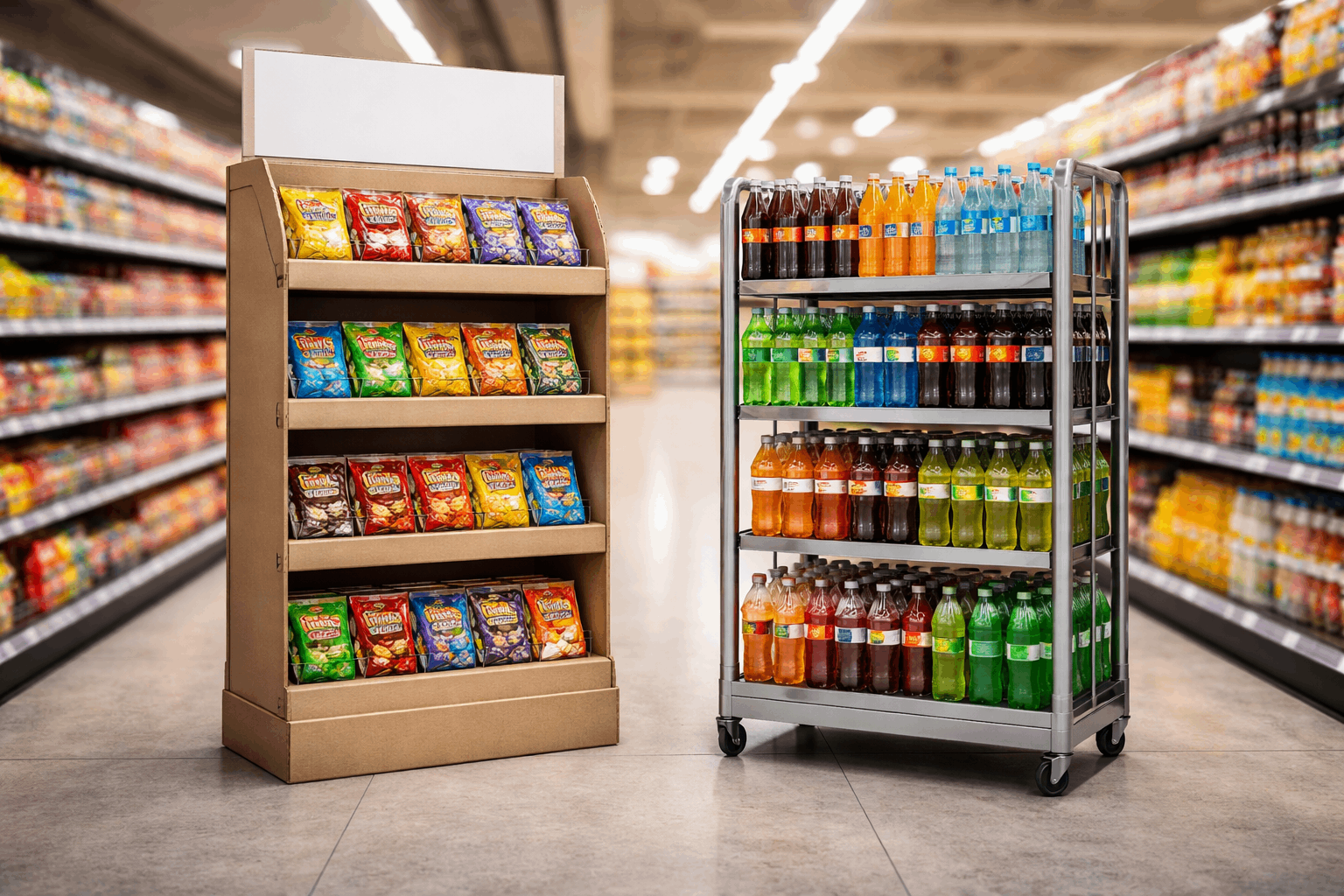
When overseas buyers look for the best corrugated displays for supermarkets, they are usually evaluating far more than display style. In most cases, they are trying to work out whether a unit will suit the product, the store environment, the promotion cycle, and the budget behind the rollout.
In practical terms, buyers searching this topic are often deciding between short-term corrugated solutions and longer-lasting metal display racks. The real task is not just selecting a display, but avoiding an expensive mismatch between material, product category, and retail use.
That is why this topic matters to importers, distributors, retail program managers, and brand procurement teams. A display may look convincing in a concept drawing or sample photo. The real test, though, comes later, after shipping, installation, repeated refill, and daily shopper contact.
Corrugated displays are still a practical choice for many supermarket promotions. They are lightweight, relatively cost-effective, and easy to customize. But they are not automatically the best answer for every category. In quite a few programs, buyers also need to compare corrugated displays with metal display racks to see which option is likely to create better long-term value.
Quick answer for wholesale buyers
For short supermarket promotions, corrugated displays are often the better fit because they are faster to launch, easier to ship, and more flexible for campaign graphics.
For heavier products, repeated refill, or longer in-store use, metal display racks often create better lifecycle value because they hold their structure, appearance, and merchandising performance more consistently.
The right choice depends less on display type alone and more on product weight, usage cycle, traffic level, and total project cost.
What “best” really means in supermarket display sourcing
In wholesale sourcing, “best” rarely means one thing only. Sometimes it means lower landed cost and faster rollout. Sometimes it means stronger shelf stability, better repeat-order consistency, or simply fewer store-level problems after delivery.
That is exactly why the same display format can work well in one project and underperform in another. A short snack promotion near checkout has very different requirements from a semi-permanent floor display for beverages, pet products, or bulk packaged goods. One rewards speed and graphic flexibility. The other calls for more structural strength and a steadier presentation over time.
Before comparing materials, buyers need to define the job clearly. Product weight, refill frequency, display duration, traffic level, and shelf presentation standards all shape whether a supermarket display is truly the right fit. Without that context, even a well-made display can turn out to be the wrong commercial decision.
Where corrugated displays work best in supermarkets
Corrugated displays tend to perform best in short-cycle, promotion-led retail programs. They are especially useful for seasonal campaigns, new product launches, trial packs, checkout promotions, and limited-time supermarket offers where speed matters almost as much as cost.
They also work well with lighter categories such as snacks, confectionery, personal care products, small packaged foods, and promotional bundles. In these cases, the display is usually expected to attract attention, support clear branding, and deliver short-term merchandising impact rather than act as a long-term fixture.
Logistics is another reason corrugated remains attractive. Foldable corrugated displays are easier to ship and store than heavier permanent fixtures, which can help buyers improve container utilization, simplify warehousing, and reduce setup pressure at store level. For short-term rollouts, that practical advantage can matter more than people first assume.
In the right application, corrugated is not a weak alternative at all. It is a practical promotional tool that can be customized to fit specific product promotions, campaign graphics, and store layouts with relatively little friction.
Where corrugated displays begin to lose their advantage
The limits of corrugated usually show up when the retail task becomes more demanding. Supermarkets are high-contact environments. Displays are refilled under time pressure, moved by staff, touched by shoppers, and exposed to cleaning routines, moisture, and daily friction.
In these conditions, the issue is often not sudden failure. More often, it is gradual decline. Edges soften, surfaces lose visual sharpness, and shelves may become less firm after repeated handling. The unit may still stand, certainly, but it no longer delivers the same merchandising quality.
That matters because display performance affects more than appearance. Once a unit becomes harder to refill, less stable on the floor, or less tidy in presentation, it starts creating hidden cost in the form of replacement pressure, lower retailer confidence, and weaker store execution.
Corrugated performance is also highly application-specific. Board grade, flute type, reinforcement, shelf span, product footprint, and humidity all influence results. So two displays that look similar online may perform very differently in live retail use. Buyers, understandably, often underestimate this part.
The decision point: when corrugated is no longer the best option
There is a point at which corrugated stops being the most efficient choice. Usually, that happens when the display needs to stay on the floor longer, carry heavier products, tolerate frequent refill, or maintain a cleaner appearance across a longer campaign window.
At that stage, the sourcing discussion changes. The question is no longer whether corrugated can be produced. It becomes whether corrugated still makes business sense once usage pressure, replacement risk, and in-store performance are taken seriously.
This is where many buyers begin comparing corrugated display options with metal display racks. The comparison is not really about one material being better in theory. It is about which material delivers the right balance of cost, durability, and retail performance for the exact supermarket job.
Why metal display racks often perform better in demanding supermarket programs
Metal display racks are often the stronger option when the display needs to do more than support a short campaign. They offer higher load-bearing capacity, better structural stability, and stronger resistance to repeated handling.
Those advantages show up in very practical ways. Shelves stay aligned more consistently. Products remain better organized. Store staff can refill the unit more easily. And the display is usually more likely to keep a clean appearance after extended use in a busy retail environment.
This makes metal particularly suitable for supermarket programs that need repeat use, longer floor placement, or stronger day-to-day reliability. For buyers managing category fixtures rather than one-time promotions, that difference can have a direct effect on total project performance.
In beverage rollouts, for example, buyers often find that refill speed matters almost as much as load capacity. A display that technically holds the product but slows replenishment or loses alignment too quickly can still become a weak retail solution.
The cost comparison should be made carefully. Metal often carries a higher upfront price, yes, but it can also deliver stronger lifecycle value through reuse, lower replacement frequency, and more consistent performance across multiple deployments. In that sense, the long-term economics are often more favorable than the initial quote suggests.
| Evaluation Factor | Corrugated Display | Metal Display Rack |
|---|---|---|
| Best Use Scenario | Short-term promotions | Long-term merchandising |
| Product Weight Range | Light to moderate | Moderate to heavy |
| Refill Frequency Tolerance | Moderate | High |
| Appearance Retention | Short to medium term | Medium to long term |
| Reusability | Limited in many projects | Strong |
| Fit for High-Traffic Areas | Selective | Better suited |
Which supermarket categories are better suited to metal display racks
Some categories place more pressure on a display from the start. Beverages, beer, wine and spirits, pet products, hardware items, automotive accessories, and larger food packs typically need stronger shelf support and better structural consistency.
In these categories, the issue is not just weight. It is the combination of weight, repeated customer handling, stock turnover, and the need to keep products faced neatly across the selling cycle. That makes stability and refill efficiency much more important to the buying decision.
Metal display racks are often better suited to these conditions because they support a more controlled and durable presentation. If the display is expected to remain on the floor as a regular in-store fixture rather than a short promotion, metal usually offers a better fit.
How buyers should compare display options before placing an order
A sound sourcing comparison goes beyond first cost. Buyers should look at shipping efficiency, assembly method, product load, refill frequency, expected display life, and whether the same display concept is likely to be reused.
For example, foldable corrugated displays may reduce shipping and storage pressure, which is valuable for short-cycle promotions. Reusable metal fixtures may support better return on investment in longer-running programs because they reduce replacement needs and maintain a better retail standard over time.
A useful supplier article should therefore help buyers connect material choice to real procurement decisions such as landed cost, store execution, repeat order potential, and the performance expected after installation. Otherwise, the content may sound polished, but it will not be very useful.
What wholesale buyers usually want to know about a supplier
When overseas buyers read a supplier’s blog, they are usually asking a practical question: does this company understand the real commercial and operational demands behind the project? General claims about quality are not enough on their own.
What matters more is whether the supplier can discuss structural suitability, customization, production consistency, and material fit in a way that reflects real project experience. Buyers want to know whether the display can be customized to the product, whether the supplier can manage bulk production reliably, and whether the recommendation is based on use case rather than on pushing a single material.
This is where Yishang Display can communicate effectively without sounding overly promotional. A strong brand message in this type of article is built by showing a clear understanding of when corrugated is the right tool, when metal is the better solution, and how to balance branding, function, and sourcing practicality.
A useful supplier is not the one that recommends the same material every time, but the one that helps buyers avoid an expensive mismatch.
| Supplier Evaluation Area | Why It Matters to Buyers |
|---|---|
| Material Matching Capability | Helps choose the right structure for the retail task |
| Structural Design Knowledge | Supports shelf stability and product safety |
| Customization Flexibility | Aligns branding, size, and functionality |
| Production Consistency | Reduces rollout risk in bulk orders |
| Multi-Material Experience | Makes recommendations more credible |
| Quality Control Process | Supports repeatable delivery performance |
Conclusion: the best supermarket display is the one that fits the retail job
Corrugated displays can be an excellent solution for supermarkets looking for fast, visual, and cost-effective promotional execution. They are especially useful when the product is light, the campaign is short, and launch speed matters.
But the best corrugated displays for supermarkets are not defined by trend or price alone. The better decision comes from matching the display format to product weight, store traffic, refill needs, and expected service life.
For wholesale buyers, that is the difference between a display that simply ships and a display that performs. If you are comparing corrugated display options or long-term metal fixtures for your supermarket program, Yishang Display can help you evaluate the right fit.