

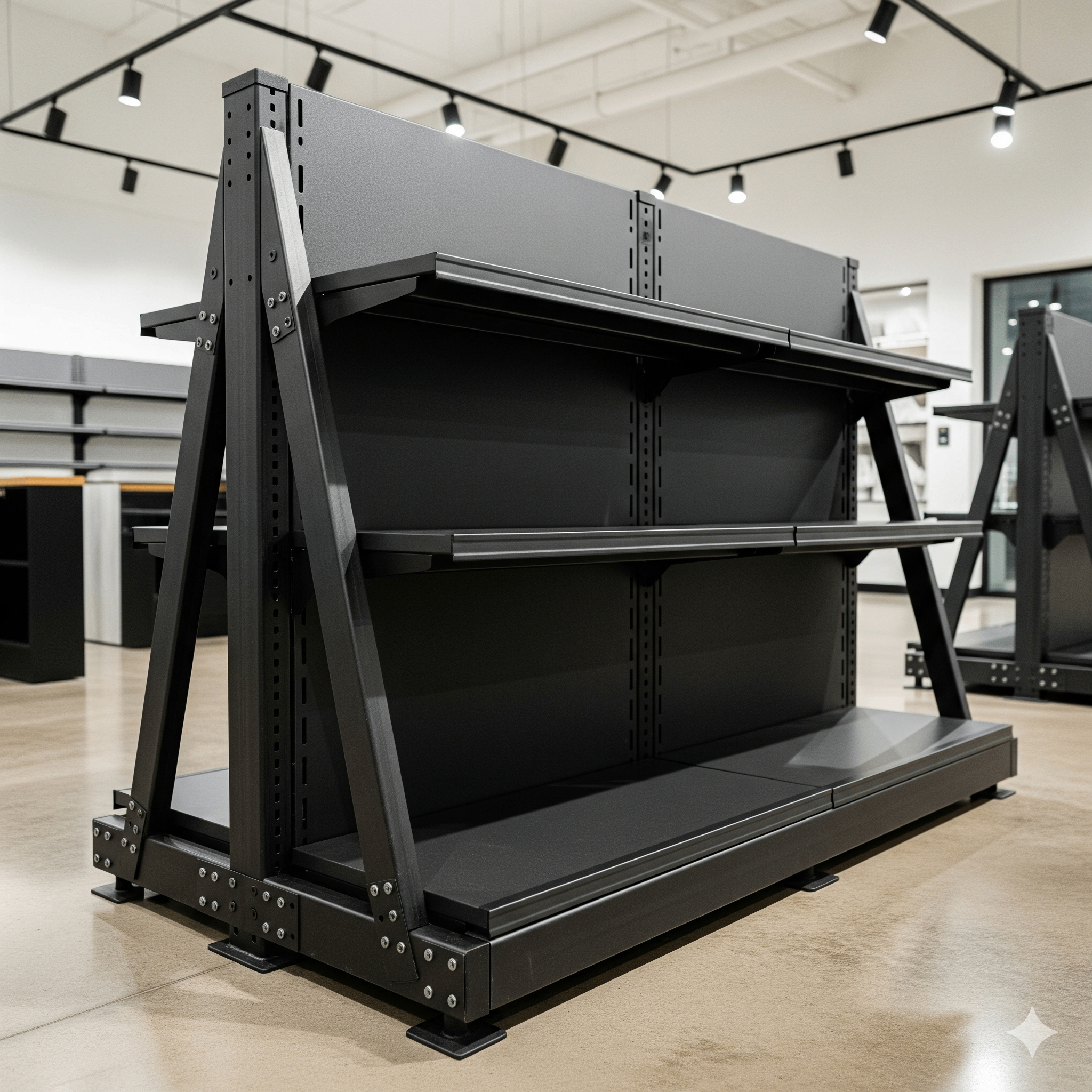
An Engineering & Procurement Guide to High-Performance Retail Fixtures
Meta Description: For global procurement managers, a “good” display isn’t just aesthetic—it’s about lowering TCO, optimizing logistics, and ensuring compliance. Read Yishang Display’s manufacturing analysis on maximizing B2B value.
I. Introduction: The Hidden Costs of “Cheap” Displays
For a Category Manager equipping 500 retail stores, the definition of a “good” display is fundamentally different from that of a designer. While visuals attract shoppers, profitability is determined by engineering.
In the global supply chain, a display fixture is a strategic asset measured by Total Cost of Ownership (TCO). A rack with a low unit price becomes a liability if it incurs:
- Exorbitant freight costs due to poor packaging density.
- High damage rates during ocean transit.
- Early corrosion failure in humid retail environments.
Therefore, the question “What makes a good display?” is actually a question of risk management: How do we balance aesthetic appeal with supply chain efficiency and longevity?
This guide moves beyond surface-level design tips. Drawing on Yishang Display’s 26 years of manufacturing data for export markets, we analyze the structural, logistical, and commercial factors that protect your margins. We deconstruct how to choose custom retail display racks that perform as reliably on the balance sheet as they do on the sales floor.
II. The Structural Imperative: Ensuring Mass Production Consistency
For wholesale buyers, variability is the enemy. A perfect sample is useless if the 5,000-unit production run suffers from inconsistent welds or material deviations. A “good” display must offer industrial predictability.
2.1 The Metal Advantage: Asset Longevity vs. Replacement Cycle
While cardboard or mixed-material displays have lower upfront costs, they often fail the TCO test for permanent fixtures. From a procurement standpoint, metal serves as the most reliable backbone, offering the highest strength-to-volume ratio.
Investing in industrial-grade steel fixtures extends the asset lifecycle to 3–5 years. In contrast, weaker materials force frequent replacement cycles that drain operational budgets. For floor displays in high-traffic zones, metal provides the necessary resilience to withstand daily collisions with shopping carts and cleaning equipment without structural compromise.
The Engineering Reality: Quality is defined by specifications, not adjectives. A superior display utilizes steel tubing with verified wall thicknesses (typically 1.0mm to 2.0mm, depending on load calculations). This technical rigor prevents the “sagging shelf” phenomenon, ensuring your retailer clients maintain a pristine planogram for years, not just months.
2.2 Robotic Precision: Eliminating the Human Error
In high-volume display procurement, manual welding introduces risk. A “good” manufacturing process integrates Robot Welding technology. This ensures that the critical joints on the 1st rack are mechanically identical to those on the 5,000th rack.
Why This Matters for Safety: We rigorously avoid “cold welds” that can snap under stress. Adhering to ISO 9001 manufacturing standards ensures deep-penetration welds. For a wholesaler, this consistency is your insurance policy against liability claims caused by in-store structural failures. It allows you to supply major retail chains with confidence.
2.3 Surface Engineering & Sustainability (ESG)
A display must perform globally—from the dry heat of Arizona to the humidity of Singapore. Powder coating is the industry standard, but its application defines its quality.
A “good” display undergoes a multi-stage pre-treatment (pickling and phosphating) before coating to ensure molecular adhesion. Validation through ASTM B117 Salt Spray Tests is crucial to prove corrosion resistance.
The Sustainability Factor: Modern procurement is increasingly driven by ESG (Environmental, Social, and Governance) goals. Unlike mixed plastics which are difficult to recycle, powder-coated steel is 100% recyclable at the end of its life. Furthermore, our compliance with RoHS standards ensures lead-free, non-toxic materials, protecting your brand’s reputation in strict markets like the EU and California.
III. The Functional Muscle: Helping Retailers Sell More
A B2B buyer adds value by supplying tools that improve retail operations. If your display is difficult to restock or organize, retailers will reject it. “Good” design is rooted in operational efficiency.
3.1 Adaptability: Future-Proofing Inventory
Retail planograms evolve. A fixed-welded display becomes obsolete when packaging sizes change. To protect inventory value, intelligent design incorporates adaptability.
Standard systems, such as slotted uprights allowing for 25mm shelf increments, ensure the fixture remains useful regardless of product updates. This modularity allows a wholesaler to service multiple product categories (e.g., boxed goods vs. blister packs) using a single, versatile metal chassis. This drastically simplifies warehousing and reduces SKU complexity.
3.2 The “Strike Zone” and Labor Savings
Sales per square foot is the ultimate metric for your clients. A good display maximizes this by respecting human ergonomics, placing high-margin SKUs in the “Strike Zone” (hip to eye level).
Beyond placement, we consider the “labor cost” of the display. Features like gravity-feed shelving for beverages or angled tiers for automotive oils ensure products are “auto-facing.” This reduces the time store staff spend organizing shelves. When you supply a display that saves the retailer labor hours, you transition from a vendor to a preferred partner.
IV. The Nervous System: Supply Chain Optimization
This is the most critical differentiator for the B2B buyer. The cost of “shipping air” kills profit margins. A “good” display is engineered for the container, not just the store.
4.1 Flat-Pack Engineering: The Mathematics of Freight
To maximize container loading efficiency, successful procurement strategies prioritize Knock-Down (KD) or Flat-Pack designs. The challenge is fragmenting a complex structure without compromising rigidity.
Through precision-engineered interlocking joints and reinforced bolting systems, shipping volume can be reduced by 60% to 70% compared to pre-assembled units.
The Financial Impact: If a 40HQ container costs $4,000, fitting 1,000 flat-packed units versus 300 assembled units radically alters unit economics. Detailed container loading plans allow you to calculate accurate landed costs before production begins. This transforms freight from a fixed burden into a manageable variable.
4.2 Packaging Integrity: The ISTA Standard
Damage in transit is a direct loss. A “good” display is protected by packaging engineered to survive the journey from factory to warehouse.
We recommend adhering to ISTA 3A testing protocols (drop, compression, vibration tests). High-density foam and honeycomb cardboard reinforcements ensure that heavy metal components arrive pristine. Avoiding insurance claims and replacement shipments is a key part of supply chain efficiency.
4.3 The “10-Minute” Assembly Rule
Time is money at the retail destination. A display requiring specialized tools and 45 minutes to assemble frustrates retailers.
A “tool-less” or “minimal tool” philosophy—utilizing wing nuts and snap-locks—aims for an assembly time of under 10 minutes. Clear, visual instruction manuals (or QR codes for video guides) reduce installation friction, ensuring campaigns launch on time.
V. Synthesis: Industry-Specific Engineering
A “one-size-fits-all” approach rarely works in specialized procurement. Here is how engineering adapts to specific industry stressors:
Scenario A: Automotive & Hardware (Chemical Resilience)
In this sector, the threat isn’t just weight—it’s chemistry. Brake fluids, oils, and solvents eat through standard paint.
- The Engineering Solution: Industrial-grade textured powder coatings that resist chemical abrasion.
- Safety Focus: Wider bases with low centers of gravity to prevent tipping when loaded with heavy batteries or tools.
Scenario B: Beverage & FMCG (Hygiene & Rust)
High turnover means constant cleaning and exposure to moisture (mopping or refrigeration condensation).
- The Engineering Solution: Specialized anti-corrosion treatments on base legs to prevent “creeping rust.”
- Hygiene Focus: Smooth, easy-to-wipe surfaces that meet food safety standards and maintain a premium look despite heavy abuse.
Scenario C: Luxury & Fashion (Invisible Strength)
For high-end markets, the mechanics must be invisible.
- The Engineering Solution: Hybrid constructions where a steel core provides strength but is clad in wood or acrylic.
- Detail Focus: Polished welds that disappear under coating, ensuring the fixture elevates the brand image rather than looking like industrial warehousing.
VI. The Procurement Checklist: Is Your Display “Good”?
Before finalizing your next order, use this 5-point audit to ensure your specification meets global standards:
- Safety Check: Does the manufacturer use ISO 9001 certified robotic welding to ensure consistent load-bearing capacity?
- Logistics Check: Has the design been optimized for Flat-Pack to maximize container density?
- Durability Check: Is the powder coating verified by ASTM Salt Spray tests (minimum 48 hours)?
- Assembly Check: Can store staff assemble the unit in under 10 minutes without specialized tools?
- Compliance Check: Are all materials RoHS compliant to avoid customs issues in the EU/US?
VII. Frequently Asked Questions (FAQ)
Q: How long does a powder-coated metal display last? A: With industrial-grade powder coating, a metal display typically lasts 3–5 years in a standard retail environment, significantly outperforming wood or corrugated options.
Q: Can Yishang Display match my brand’s specific color? A: Yes. We use the RAL color matching system to ensure the powder coating perfectly aligns with your brand identity while maintaining industrial durability.
Q: What is the lead time for a custom display order? A: Typically, a prototype takes 7–10 days. Once approved, mass production (e.g., 500–1000 units) usually takes 25–30 days depending on complexity.
VIII. Conclusion: Engineering Value into the Supply Chain
For the overseas wholesale buyer, a “good” display is one that solves problems silently.
- It solves freight costs through smart flat-pack design.
- It solves risk through ISO-standardized manufacturing.
- It solves longevity through industrial material selection.
A display is an investment in your supply chain’s efficiency. At Yishang Display, we act as your engineering partner, not just a factory. We align our manufacturing protocols with your procurement KPIs—speed, precision, and cost control.
Ready to optimize your next retail rollout?
[Contact Yishang Display] to review your current designs and discover how value-engineering can improve your ROI.