

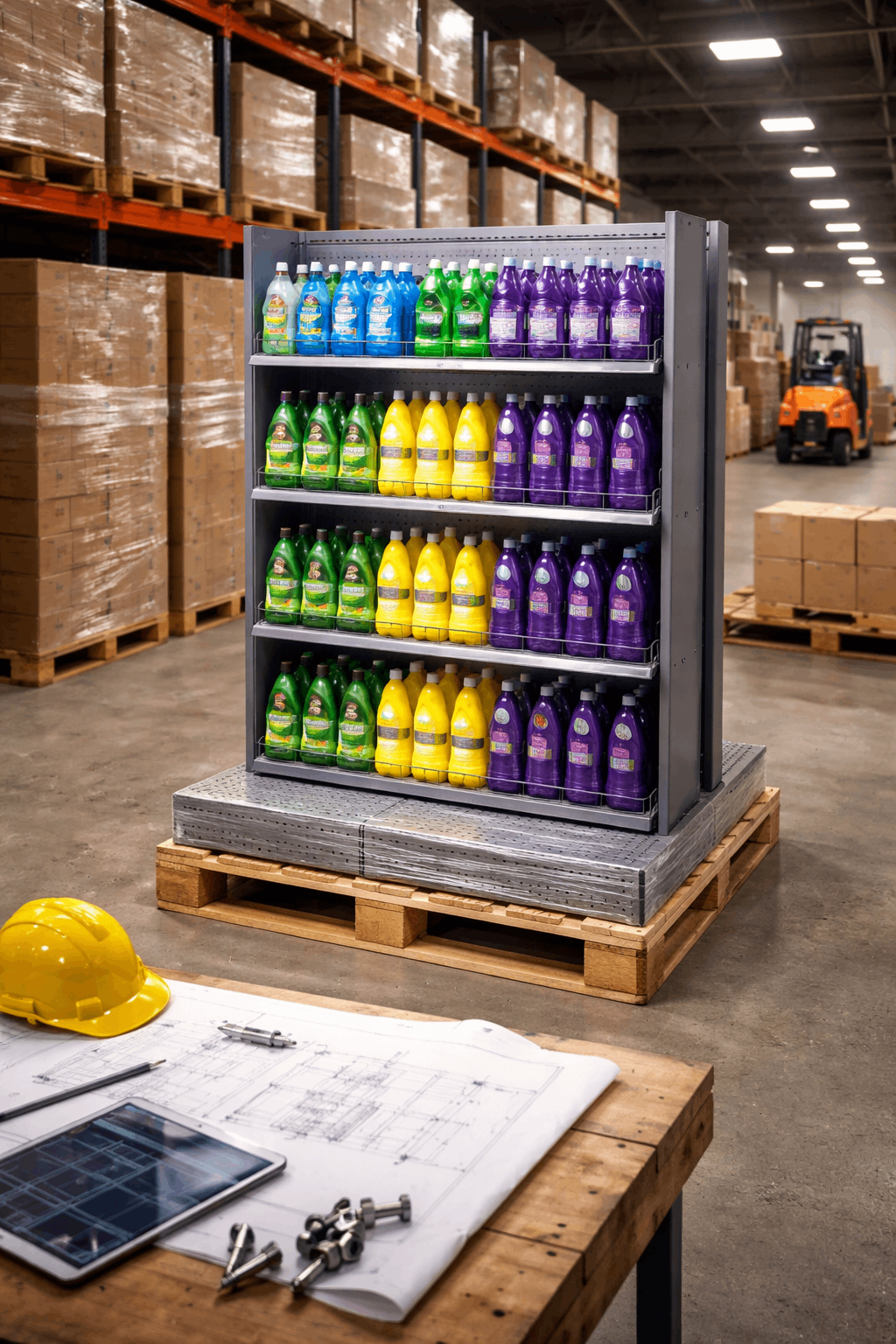
For overseas distributors, importers, and wholesale buyers, Walmart is not simply another retail channel. It is one of the most structured retail environments in the world, where packaging, logistics, and merchandising execution must work together with minimal friction.
Buyers sourcing retail fixtures for Walmart programs usually evaluate suppliers differently from standard product sourcing. The question is not only whether a display looks appealing. The real question is whether the display works within Walmart’s operating system — from pallet shipping to store replenishment.
Displays that ignore packaging logic often create problems later in the rollout. Shelves may not align with case packs. Barcode visibility may be reduced after stocking. Displays may take too long for store teams to assemble or fail under product weight. These issues increase operational cost across a retail network.
For that reason, experienced buyers look for suppliers who understand packaging compatibility, structural engineering, freight efficiency, and real store conditions. This article explains how designing displays around Walmart packaging requirements supports those priorities and helps buyers select more reliable display partners.
Why Walmart Packaging Requirements Matter to Wholesale Buyers
Most wholesale buyers searching for Walmart display suppliers are not simply asking about packaging rules. They are evaluating whether a manufacturer understands the operational logic behind those rules.
Packaging requirements exist to ensure products move efficiently through Walmart’s supply chain. Cartons must stack correctly on pallets. Products must be identifiable in distribution centers. Store employees must be able to replenish shelves quickly without breaking down packaging unnecessarily.
If a display ignores these realities, the fixture may slow down replenishment or create extra labor for store teams. Over thousands of stores, even small inefficiencies can translate into significant cost.
For procurement teams, this is why display development usually starts with packaging data. Case pack quantities, carton dimensions, pallet footprint, and barcode orientation all influence whether the final display performs well in a retail program.
The Retail System Behind Walmart Display Programs
To understand how packaging affects displays, it helps to look at how products move through Walmart’s retail system.
Products are first packed at the factory and loaded onto pallets for shipment to Walmart distribution centers. At these facilities, cartons are sorted and prepared for delivery to individual stores. Once the products arrive at the store, they are stored temporarily in the backroom before being placed on shelves or displays.
Each stage relies on standardized packaging. Cartons must be strong enough for pallet stacking, clearly labeled for identification, and easy for store teams to open and restock.
Walmart supplier documentation also highlights factors such as carton durability, palletizing practices, trailer loading efficiency, and product labeling. Displays that align with these logistics principles integrate more smoothly into the system.
For buyers, the implication is straightforward: a display should support the movement of products through the supply chain rather than interrupt it.
What Are Walmart’s Packaging Requirements in Practical Terms
From a display sourcing perspective, Walmart packaging requirements mainly affect how products are handled, replenished, and presented in stores.
Several packaging factors influence display design directly:
- Case pack quantities determine how shelves should be sized
- Carton dimensions influence shelf depth and width
- Product weight affects load-bearing requirements
- Barcode placement affects scanning visibility
- Pallet footprint influences display base size
Retail-ready packaging formats such as SRP (shelf-ready packaging) or PDQ trays are also commonly used in Walmart stores. These packaging styles allow products to move from shipping cartons directly onto shelves or displays with minimal unpacking.
When display shelves are designed to match packaging formats, store teams can replenish entire rows quickly. If the packaging does not fit the display, employees must restock products individually, which slows store operations.
Packaging Factors That Affect Display Engineering
| Packaging factor | Why buyers care | Display implication |
|---|---|---|
| Case pack quantity | Determines replenishment speed | Shelf capacity should align with case packs |
| Carton size | Affects shelf fit | Shelf width and depth must match cartons |
| Product weight | Affects safety and durability | Stronger materials may be required |
| Barcode location | Affects checkout efficiency | Product orientation must remain visible |
| Pallet footprint | Affects freight efficiency | Display base often aligns with pallet size |
How Packaging Data Influences Display Engineering
Once packaging data is available, it begins to shape the display structure in practical ways.
Shelf capacity is one of the clearest examples. If a product is shipped in cartons containing twelve units, a shelf that holds ten creates unnecessary labor during restocking. Store employees must open cartons and place items individually.
A shelf designed for twelve or twenty-four units, however, allows full cartons to be stocked quickly. This small alignment can significantly improve replenishment efficiency across multiple stores.
Weight distribution is another important factor. Categories such as beverages, automotive accessories, pet products, and hardware tools place substantial loads on displays. Engineers must consider reinforcement, shelf thickness, and frame stability.
Manufacturers who request packaging specifications early in development typically produce displays that perform more reliably in retail environments.
Walmart Floor Display Requirements and Store Conditions
In addition to packaging considerations, Walmart floor display requirements influence how displays are designed for the sales floor.
Displays are often placed in high-traffic areas such as aisle intersections, end cap displays, or promotional zones. These areas experience frequent interaction from customers and store equipment.
For buyers, stability becomes a key concern. A display must remain balanced when fully stocked and withstand repeated product replenishment throughout the day.
Assembly complexity also matters. Displays that require many parts or special tools can create difficulties during store rollout. Simpler designs often result in more consistent installation across locations.
Factors Buyers Evaluate in Floor Displays
| Evaluation factor | Procurement impact |
|---|---|
| Base stability | Reduces store safety risk |
| Assembly time | Improves rollout efficiency |
| Product accessibility | Supports faster replenishment |
| Display footprint | Fits designated store areas |
| Material durability | Reduces fixture replacement cost |
Common Walmart Display Options Used in Retail Programs
Retail programs inside Walmart typically use several common display formats. Buyers evaluate each format based on durability, cost, logistics efficiency, and merchandising purpose.
Corrugated Retail Pallet Display
Corrugated pallet displays are frequently used for short promotional campaigns or seasonal product launches. These displays can be shipped pre-loaded on pallets and placed directly on the sales floor.
They are cost-effective and lightweight, making them suitable for fast-moving packaged goods. However, corrugated materials are usually less durable than metal fixtures, especially in high-traffic environments.
Full Pallet Retail Display
Full pallet retail displays are designed to sit directly on standard shipping pallets. These units are useful when large volumes of product must be sold quickly.
Because pallet displays align with logistics systems, they often simplify freight planning and warehouse handling.
Metal Floor Displays
For longer-term retail programs, metal floor displays often provide the best structural performance.
Metal fixtures support heavier products. Buyers comparing options often review solutions such as custom metal retail displays or retail display racks when evaluating long-term merchandising programs, maintain stability in high-traffic areas, and generally last longer than temporary materials. For buyers managing categories such as tools, automotive accessories, or sporting goods, durability becomes a key cost factor.
When Metal Displays Make More Sense Than Corrugated
A common question among buyers is when to choose a metal fixture instead of a temporary corrugated display.
Corrugated displays often work well for short-term promotions where cost and speed are the main priorities. However, they may struggle with heavier products or longer merchandising programs.
Metal displays typically become more practical when:
- Products are heavy or bulky
- Displays remain in stores for extended periods
- Store traffic is high
- Structural consistency is important across multiple rollouts
For many retail programs, the decision is less about visual appearance and more about total lifecycle cost.
Freight Efficiency and Pallet Planning
For overseas buyers, freight efficiency plays a significant role in display procurement decisions.
Displays designed around standard pallet dimensions. For example, many suppliers develop pallet-ready structures similar to pallet retail displays to improve freight efficiency allow better stacking during shipping. Higher pallet density can improve container utilization and reduce transport cost.
Experienced buyers often evaluate not only the display structure but also how the fixture packs flat, how many units fit per pallet, and how well it survives transit.
A supplier who considers both display engineering and packaging design can help optimize total landed cost rather than only fixture price.
How Wholesale Buyers Evaluate Display Suppliers
When selecting a display supplier, procurement teams typically look beyond visual design. They assess whether the manufacturer can support a full retail program.
Key evaluation factors include engineering capability, production scalability, packaging knowledge, and communication quality.
Suppliers who provide clear technical drawings, packaging recommendations, and freight planning advice often inspire greater buyer confidence.
Signals Buyers Look For When Choosing a Supplier
| Supplier signal | Why it matters |
|---|---|
| Engineering-focused explanations | Indicates real development experience |
| Understanding of retail logistics | Helps avoid rollout problems |
| Material-specific knowledge | Supports correct fixture selection |
| Freight and pallet planning | Improves total landed cost |
| Clear technical communication | Simplifies project coordination |
Long-Term Display Performance and Risk Reduction
When display programs fail, the issues often appear during rollout rather than during design.
Shelves may sag under product weight. Parts may be missing or difficult to assemble. Displays may block barcode visibility or slow replenishment.
These are the types of risks buyers try to avoid when researching topics such as Walmart floor display requirements or retail-ready displays.
Detailed planning around packaging compatibility and structural design helps reduce these problems before production begins.
Future Trends in Retail Display Development
Retail display design continues to evolve as retailers look for better efficiency and more adaptable merchandising systems.
Modular displays that allow graphic updates without replacing the entire fixture are becoming more common. Hybrid structures combining metal frames with replaceable panels also support longer display lifecycles.
As supply chains become more data-driven, the connection between packaging engineering and display design will likely become even stronger.
FAQ: Questions Buyers Often Search Before Choosing a Supplier
What are Walmart’s packaging requirements for displays
For display sourcing, the most relevant requirements typically involve case pack compatibility, pallet footprint alignment, barcode visibility, and support for retail-ready packaging formats.
What types of displays does Walmart use
Common display formats include corrugated pallet displays, full pallet retail displays, power wing displays, PDQ trays, and metal floor displays for heavier products.
What is the difference between POP and POS displays
POP displays are positioned throughout the store to increase product visibility. POS displays are typically located near checkout areas and are designed to influence immediate purchase decisions.
When should a buyer choose a metal display instead of corrugated
Metal displays are generally preferred for heavier products, longer campaigns, and high-traffic store locations where structural durability is essential.
Conclusion
For wholesale buyers sourcing displays for Walmart programs, packaging compatibility and structural reliability are often more important than visual appearance alone.
Displays that align with packaging logic, pallet logistics, and store replenishment processes tend to perform more successfully across large retail networks.
Manufacturers who understand these operational relationships can provide stronger support for complex retail rollouts.
For buyers evaluating metal display suppliers for retail programs, Yishang Display focuses on combining structural engineering with practical retail logistics to help displays perform reliably from shipment to store floor. Buyers researching fixture suppliers may also review resources about retail display manufacturing to better understand industry standards. for retail programs, Yishang Display focuses on combining structural engineering with practical retail logistics to help displays perform reliably from shipment to store floor.