

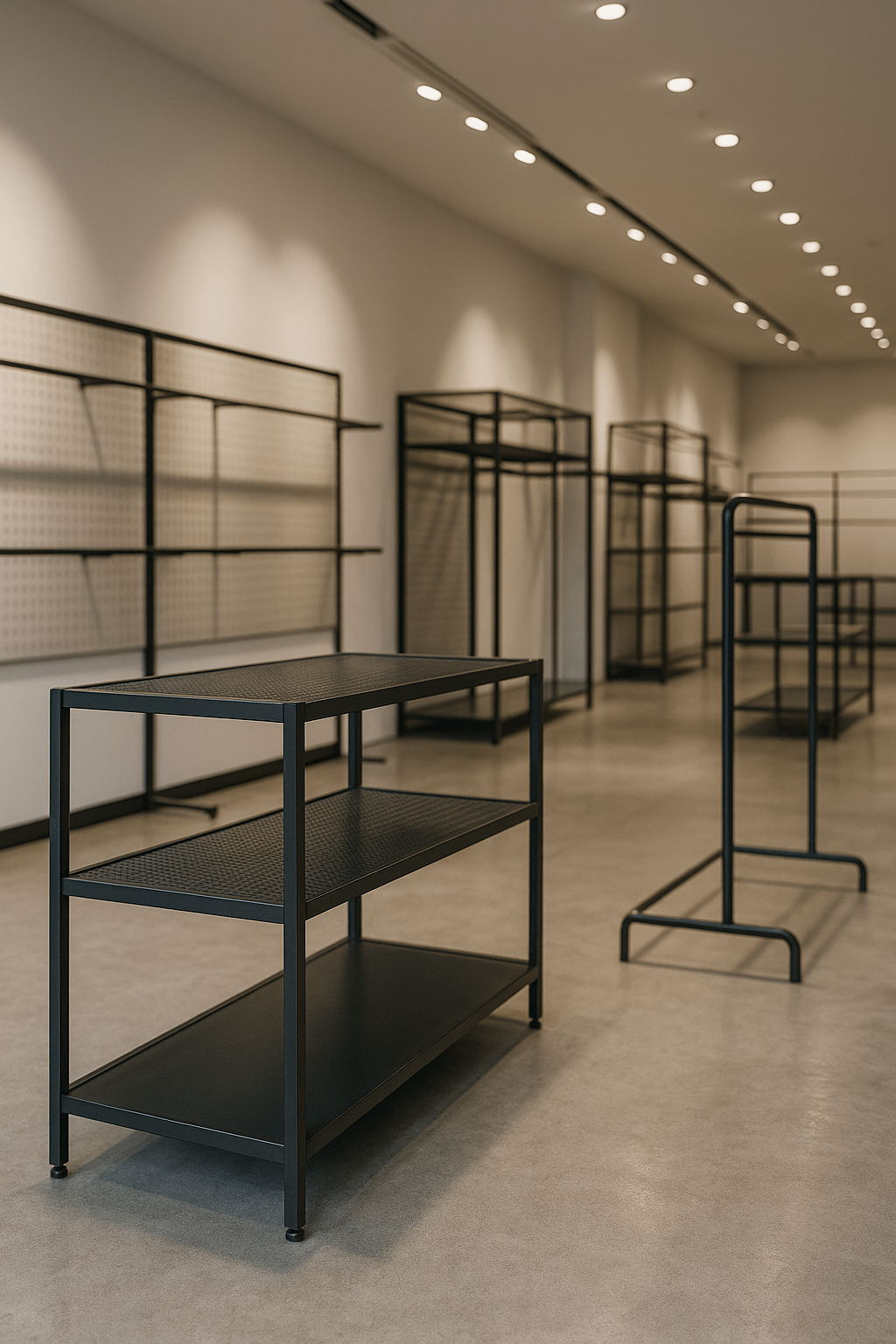
I. Introduction: Why Visual Merchandising Is Now a Procurement Issue
Visual merchandising has evolved into a strategic component of retail performance—and for global wholesale buyers, it matters because the display structure directly affects sell‑through, store safety, and lifecycle cost. Retailers no longer view displays as disposable props. They expect engineered fixtures that hold alignment, withstand heavy use, and support multiple merchandising cycles.
Procurement teams look for displays that deliver long-term value: structural accuracy, predictable visibility, and multi-store consistency. Metal fixtures offer a more reliable foundation than temporary materials, which is why buying decisions now consider engineering quality, compliance, transport durability, and customization capacity.
This article reframes visual merchandising through the lens of procurement—not creative theory—highlighting the structural, financial, and operational factors buyers must evaluate in 2025.
II. What Visual Merchandising Means for Buyers Today
For overseas buyers, visual merchandising is not about style preferences. It is a performance system tied to how well the display maintains visibility, supports product weight, and delivers consistency across various store conditions.
Visibility as a Structural Requirement
A display that shifts, bends, or loses alignment disrupts how shoppers see products. Procurement teams therefore assess load ratings, frame rigidity, weld quality, and long-term structural stability to ensure visibility stays consistent—whether the display is in a hypermarket or a compact convenience store.
Material Quality Signals Supplier Reliability
Metal fixtures communicate engineering capability and manufacturing control. Buyers interpret material quality as a sign of whether the supplier can support large-volume orders, maintain tolerances, and meet compliance requirements—factors essential for avoiding claims and maintaining brand credibility.
Experience Depends on Stability
From lighting modules to QR activation panels, modern displays integrate more technology than ever. These elements only function properly if the structure supports them safely. Procurement teams therefore treat structural assurance—not aesthetics—as the foundation of experience delivery.
III. Why Visual Merchandising Matters More Than Ever for Retail Profitability
Reliable Visibility Improves Sell‑Through
Clear product facings and stable shelf angles directly affect rotation rates. A structurally accurate metal display ensures SKUs stay visible even under heavy restocking cycles—critical for beverages, hardware, and FMCG.
Strong Materials Reinforce Brand Trust
A display is part of the retail environment and contributes to brand perception. Metal fixtures project reliability and reduce the risks associated with sagging shelves, instability, or product damage—issues that increase operational cost.
Better Shopper Flow Reduces Decision Friction
Aligned, stable displays help shoppers navigate categories faster, especially in high-SKU spaces. Procurement teams value fixtures that support this behavior because it leads to higher conversion and stronger category performance.
Multi-Year Storytelling Lowers Replacement Frequency
A well-engineered frame supports seasonal graphics and product rotation without needing to be replaced. Buyers managing multi‑market rollouts consider this lifecycle flexibility essential for optimizing long-term investment.
IV. Why Metal Fixtures Are Leading the 2025 Material Shift
Durability Minimizes Risk and Replacement Costs
Metal withstands the realities of global logistics, humidity changes, and high-contact retail environments. Buyers choose metal because it lowers damage rates during shipping and reduces store-level replacement.
Lifecycle Sustainability Aligns With Retail ESG Goals
Retailers measure sustainability through longevity and reuse—not temporary materials. Metal displays offer a long service life and can be refurbished, reconfigured, or fully recycled, making them a practical way for retailers to meet ESG expectations.
Metal Enables Multi-Material Aesthetics
In addition to durability, metal frames support diverse regional design preferences by integrating wood panels, acrylic shelves, LED fronts, or digital elements—without compromising structural integrity. This adaptability helps global buyers maintain brand consistency without redesigning fixtures market by market.
Engineering Precision Reduces Liability Exposure
Metal provides predictable tolerances and load consistency. Buyers rely on this stability to meet regional safety codes and reduce risk during long-term deployment.
V. Visual Merchandising Techniques in 2025—Built for Scalable Procurement
Modular Systems for Multi-Campaign Flexibility
Buyers increasingly favor modular frames because they simplify installation, reduce shipping volume, and enable fast campaign updates. Metal modularity supports repeated reconfiguration without compromising structural reliability.
Height Architecture for High-Density Merchandising
Tiered metal displays help compact stores increase visibility without expanding footprint. Metal uprights maintain alignment under significant weight, ensuring SKUs remain at optimal sightlines.
Motion-Integrated Displays for Premium Promotions
Motorized or rotating displays capture attention in competitive aisles. Their mechanical stability depends on robust metal frames capable of handling vibration and rotational load.
Phygital Integration for Tech-Forward Retail
Screen mounts, sensor modules, and QR features must be supported by a structure that offers rigidity and safe cable management. Metal frames provide the necessary strength and internal routing capacity.
Long-Lifecycle Construction for Cost-Efficient Operation
Metal displays deliver stable presentation over many years, reducing waste and replacement cycles. Procurement teams evaluate this as part of lifecycle cost optimization.
Space-Efficient Structures for Urban Retail Expansion
Metal’s strength enables slim but high-capacity displays, helping retailers make the most of limited floor space—a growing global trend.
VI. Industry-Specific Considerations for Professional Buyers
Beverage & Alcohol
High-weight products require corrosion-resistant metal frames capable of supporting stacked loads with lighting or cooling integrations.
Automotive & Hardware
Buyers prioritize load certification, reinforced structures, and anti-corrosion finishing. Metal pegboards and uprights provide the required safety margin.
FMCG, Pet, and Grocery
Frequent restocking and strict hygiene requirements call for stable, easy-clean metal frames that maintain alignment.
Books & Printed Media
Metal supports tiered, angled displays that keep covers visible and prevent sagging over time.
Fashion & Sportswear
Seasonal updates demand structural flexibility. Metal frameworks simplify reset processes and support mixed-material designs.
VII. A Procurement-Ready Implementation Framework
Understand Regional and Retail Requirements
Different markets require different certifications, load expectations, and environmental performance. Yishang Display supports buyers with engineering documentation and region-specific adjustments.
Engineer First, Customize Second
Buyers achieve the best results when structural functions—load rating, stability, tolerances—are validated before aesthetic customization.
Evaluate Lifecycle Value, Not Unit Cost
Procurement excellence focuses on amortization and multi-year usability. Metal displays consistently outperform short-term materials on lifecycle ROI.
Plan Digital Integration Early
Screens and sensors require structural support and wiring routes. Metal frames reduce retrofitting costs and ensure long-term safety.
Prototype, Validate, Deploy
Testing ensures assembly efficiency, structural behavior, and real-world merchandising performance. Metal systems simplify iterative refinement before mass rollout.
VIII. ROI Metrics Buyers Use to Justify Their Decisions
A structurally engineered metal display delivers measurable value:
Sell-Through Reliability: Stable alignment improves product visibility and SKU rotation.
Maintenance Savings: Metal reduces repair frequency and presentation drift.
Superior Lifecycle Value: With 5–10 years of service life, amortized cost significantly decreases.
Transport Stability: Better protection during shipping reduces claims.
Lower Operational Risk: Strong structure improves in-store safety and compliance performance.
These metrics form a clear ROI narrative procurement teams can confidently present internally.
IX. Future Trends That Will Influence Buyer Requirements
The next phase of visual merchandising will prioritize:
- AI-driven shelf analytics,
- sensor-responsive displays,
- modular retail ecosystems,
- circular-material compliance,
- compact-format optimization.
Metal will remain the structural base enabling these innovations.
X. Conclusion: Strong Display Engineering Builds Stronger Retail
For overseas buyers, visual merchandising is an engineering‑driven investment. Metal fixtures from Yishang Display provide the stability, longevity, and adaptability required for modern retail environments.
If you’re exploring new display solutions or planning a multi-market rollout, our team is ready to support your project with engineered metal systems built for long-term performance.
XI. FAQ: High-Intent Questions Overseas Buyers Commonly Search
What is the most reliable type of retail display for multi-store rollouts?
Metal displays offer the best structural consistency, alignment retention, and logistics durability, making them the preferred choice for large-scale procurement.
Why do global retailers prefer modular metal displays?
Modularity reduces shipping volume, shortens installation time, and allows for ongoing campaign changes without structural replacement.
How do metal retail fixtures support sustainability goals?
Metal frames have longer lifecycles, can be refurbished or reconfigured, and are fully recyclable—aligning with modern ESG requirements.
Which industries benefit most from engineered metal displays?
Beverages, automotive, hardware, FMCG, pet products, books, and fashion all rely on high-load, high-precision merchandising structures.