

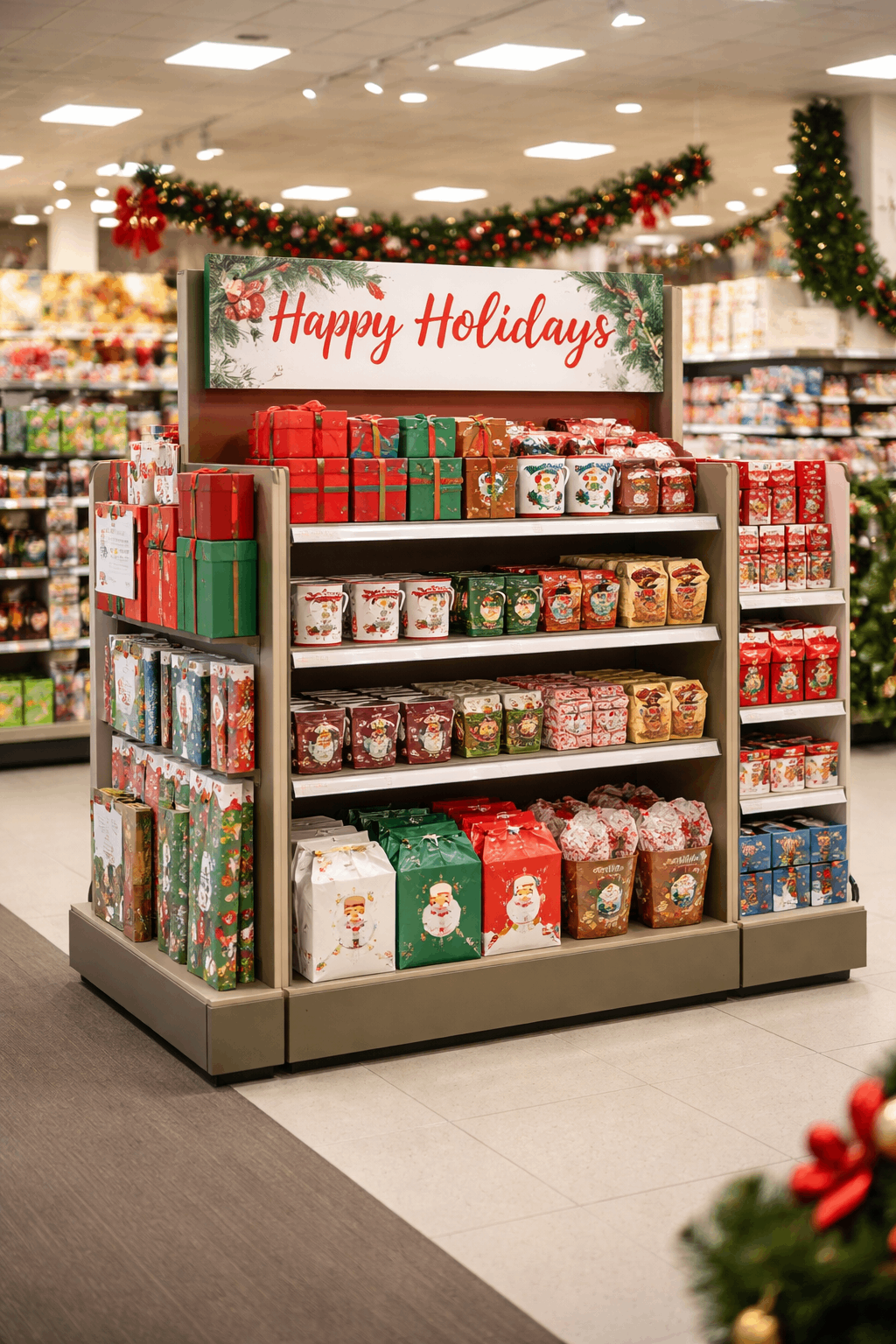
Holiday retail displays are often treated as seasonal décor. For wholesale buyers and sourcing managers, they are closer to temporary retail infrastructure: display systems that must ship efficiently, deploy consistently, and hold up in high‑traffic stores during peak weeks. When a program rolls out across dozens or hundreds of doors, small weaknesses—unstable bases, slow replenishment access, fragile finishes—turn into real cost.
This article is written for B2B decision makers who source retail display fixtures and merchandising racks for chain deployment. It focuses on what typically drives procurement outcomes: durability, modularity, footprint efficiency, safety, lead‑time predictability, and lifecycle value. You’ll also see language that buyers commonly use in search and evaluation—terms like retail fixture supplier, metal display rack, POP display, POS display, endcap display, floor display, and modular retail display systems—so the page matches the way wholesale teams research solutions.
What Holiday Retail Displays Really Are (Beyond Decoration)
If you search “holiday retail displays” you’ll find plenty of content about colors, lighting, and festive themes. That helps a visual merchandiser brainstorm, but it doesn’t answer the procurement question: what are holiday retail displays in a program rollout? In practice, in‑store holiday displays are merchandising systems designed to attract attention, present products clearly, and support fast, safe interaction—while being simple to deploy and maintain.
A display’s structure determines whether customers can see products from distance, reach them easily, and understand value quickly. For wholesale deployment, those outcomes depend on the retail display fixtures and their geometry more than on decorative props. That is why buyers evaluate display systems for retail in terms of footprint, stability, shelf deflection, and access for replenishment—especially when the same fixture must work in multiple store formats.
Material choice also changes the business case. Corrugated cardboard displays can be effective for lightweight items and short promotions, particularly as POP display solutions. For heavier categories or multi‑season reuse, metal retail display fixtures are often favored because they hold tolerances, resist fatigue, and retain appearance under repeated handling. Mixed‑material builds—metal frames with acrylic, wood, or printed panels—can balance durability with seasonal styling without sacrificing structural reliability.
Why Holiday Retail Displays Matter from a Commercial and Operational View
The importance of holiday retail displays becomes clear when you look at chain performance dynamics. During peak seasons, customers are more likely to make quick decisions under time pressure, and well‑structured displays reduce friction: they surface the right SKUs, make bundles easy to understand, and keep the product within reach. For wholesale programs, even modest uplifts per store can compound across a network.
Operationally, the display can either protect margin or quietly erode it. Poor access slows replenishment, creating out‑of‑stocks in the highest‑intent moments. Low durability increases replacement and repair. Unstable bases raise safety concerns in crowded aisles. Procurement teams therefore evaluate durable retail displays and heavy‑duty retail display fixtures through total cost of ownership: not only unit price, but also service calls, store labor, and reuse across seasons.
There is also a brand‑equity component that matters to buyers supplying national retailers. A flimsy fixture undermines premium positioning at shelf. A robust, clean display structure signals reliability. In many categories—beverage, pet products, hardware, specialty foods—perceived quality is shaped as much by the merchandising environment as by packaging.
The Structural Logic Behind Successful Holiday Retail Displays
High‑performing holiday retail displays combine materials engineering with modular design. Metal display racks and welded or bolted metal frames provide predictable load‑bearing capacity for heavier SKUs and frequent handling. Finishes matter more than most teams expect: abrasion‑resistant coatings reduce visible wear, which helps the fixture remain “sellable” through the entire campaign.
Corrugated cardboard displays remain relevant in modern retail, especially when speed and lightweight assortments are the priority. The difference is reinforcement and base design. Corrugated cardboard displays with internal ribs, corner protection, and a stable footprint can perform well as temporary floor displays or countertop units, but they usually have narrower load envelopes and shorter lifecycles. For multi‑wave programs, buyers often prefer modular retail display systems built around durable cores that accept interchangeable graphics and seasonal skins.
Modularity is a procurement advantage, not just a design feature. Modular holiday retail displays allow reconfiguration without teardown, so store teams can rotate hero SKUs, swap header cards, or adjust shelf spacing as inventory changes. That reduces downtime and prevents the “stale display” problem that appears when the same setup sits for weeks. In chain environments, reconfigurable retail displays also simplify logistics because the core kit stays consistent while seasonal accessories change.
Technical reference: load, stability, and surface performance
| Attribute | Typical wholesale threshold | Why buyers care |
|---|---|---|
| Shelf load rating | 25–60 kg per shelf | Prevents sag under frequent handling |
| Base stability margin | ≥ 1.5 safety factor | Reduces tip risk in crowded aisles |
| Fastener fatigue life | 10,000+ cycles | Supports repeated reconfiguration |
| Surface abrasion resistance | Medium–High | Preserves appearance across peak traffic |
Thresholds vary by category, store policy, and local safety guidance. Validate specifications against product weights and store risk assessments.
7 Tips for Creating Successful Holiday Retail Displays
Tip 1: Start with a display objective that procurement can measure
A holiday retail display strategy performs best when it starts with a clear objective that can be evaluated at store level. Conversion uplift, basket expansion, and premium storytelling each demand different fixture choices. A bundle‑driven endcap display needs reachability, clear grouping, and fast replenishment. A premium presentation may require controlled access and cleaner sightlines.
For wholesale rollouts, objective clarity reduces costly redesign loops. When the program intent is fixed early, fixture specs become simpler: shelf count, height ranges, signage zones, and accessory interfaces can be standardized. That standardization supports consistent execution across regions and store formats.
Tip 2: Engineer the display around product weight, size, and handling frequency
Product‑focused retail displays start with the physical realities of merchandise. Weight distribution, packaging geometry, and customer handling frequency should inform fixture selection. Heavy‑duty retail display fixtures help avoid micro‑failures like wobble and shelf deflection, which can undermine both safety and perceived quality.
Ergonomics is also part of performance. Items meant to be lifted should sit at safe reach heights and have enough clearance for hands. Fragile packaging benefits from tiered retail displays that distribute load and reduce crush risk. When the merchandising display structure mirrors product behavior, interaction friction drops and sell‑through is more resilient during peak traffic.
Tip 3: Use display height and tiering to control visual hierarchy across store formats
Retail display visual hierarchy is the grammar of in‑store communication. Height establishes distance visibility, while tiering supports close‑range comparison. In crowded seasonal environments, a coherent visual merchandising layout helps the shopper understand “what is here” in seconds.
For chain programs, hierarchy must travel well. A setup that works in a large supermarket can fail in a compact specialty store if it blocks sightlines or narrows aisles. Buyers should favor fixture systems with adjustable tiers and modular signage so the same core can be adapted without losing brand consistency.
Tip 4: Plan for refresh cycles so displays don’t decay mid‑campaign
Static displays decay as novelty fades. Modular holiday retail displays counter this by enabling quick refresh without new fixtures. Swapping header cards, rotating hero SKUs, changing shelf angles, or moving a feature from center to top tier can recover attention without additional footprint.
From a procurement standpoint, refresh capability protects inventory plans. When a SKU underperforms or supply shifts, the display system can adapt rather than forcing an emergency reorder. This is particularly valuable in the weeks before the actual holiday, when demand forecasts change quickly.
Tip 5: Balance seasonal styling with durability in high‑traffic zones
Durable holiday retail displays protect both brand presentation and operational stability. High‑traffic areas—entrances, endcaps, and power aisles—subject fixtures to abrasion, impacts, and frequent contact. Weak finishes can look tired halfway through the season, which reduces confidence at shelf.
A practical approach is to treat the core as durable infrastructure and use seasonal elements as replaceable layers. Metal frames can accept interchangeable panels or printed sleeves. For lightweight programs, corrugated cardboard displays can be used, but reinforcement and edge protection become important to keep the unit presentable.
Tip 6: Design for replenishment speed and staff workflows
Retail display restocking efficiency is a direct driver of sales during holidays. If replenishment is slow or awkward, out‑of‑stocks increase and the display loses visual coherence. Easy‑to‑assemble retail displays reduce setup time, while accessible shelf geometry makes peak‑hour refills faster.
Buyers often underestimate how much store labor influences program success. Fixtures that allow simple front‑loading, clear access paths, and intuitive modular connections reduce store friction. The result is more consistent execution across doors, fewer service issues, and higher in‑store display effectiveness.
Tip 7: Treat holiday displays as repeatable systems with lifecycle value
Repeatable retail display systems convert seasonal spend into long‑term capability. Reusable holiday retail displays built on scalable retail display solutions can be redeployed across multiple campaigns, regions, and planogram updates. That reduces waste and improves program ROI.
A repeatable system mindset also improves supplier performance. When a fixture family is standardized, lead times stabilize, spare parts become simpler, and updates can be managed as modular revisions rather than full redesigns. For wholesale buyers, that stability is often the difference between a smooth rollout and a high‑cost peak season.
Popular holiday retail display patterns that scale across categories
Popular holiday retail displays often share structural patterns because the constraints of peak season are similar across categories. Beverage and alcohol programs commonly use vertical blocking and controlled sightlines to build strong brand presence while keeping access open for high‑velocity refills. Food and snack programs often use island floor displays with tiered retail displays to compress choice and encourage bundle building.
In fashion and lifestyle, perimeter anchors and modular focal points protect traffic flow. In pet products, sturdy shelf systems and clear reach zones matter because packaging can be bulky. These patterns are less about theme and more about matching the display system to shopper behavior and store operations.
A useful procurement lens is to treat patterns as starting templates for fixture selection. Once the structure is right—height ranges, shelf spacing, stability—the seasonal skin can be changed without rebuilding the entire system. This approach shortens rollout cycles and reduces variability across doors.
When custom retail displays make sense, and when standard systems are better
Custom retail displays for holidays can deliver differentiation when standard fixtures cannot accommodate product geometry, unique storytelling, or strict brand guidelines. Bespoke retail display fixtures can also be valuable for launches or flagship environments, where the incremental lift justifies higher tooling or engineering cost.
Standard systems are often better when speed, reuse, and scalability dominate. A practical “custom vs standard” view is to ask whether the display’s unique elements are structural or cosmetic. If uniqueness is primarily cosmetic, a modular core with interchangeable seasonal skins can achieve the same effect with lower lifecycle risk. For many chains, hybrid architectures—standardized metal cores plus replaceable graphics—provide the best balance of performance and logistics.
Building a long‑term holiday display system for wholesale programs
A holiday retail display system matures through planning, reuse, and learning. Reusable retail display fixtures stabilize visual quality and reduce waste. Sustainable retail display systems also reduce procurement churn because the core hardware remains consistent while seasonal elements are updated.
In practice, long‑term retail display strategy integrates structural standards—load ratings, finish specifications, modular interfaces—with merchandising playbooks that guide refresh cycles. Over time, performance data accumulates across doors, making it easier to forecast which configurations convert, which replenish fastest, and which materials endure peak traffic.
For wholesale buyers, this system approach supports predictable outcomes. It also strengthens supplier relationships because it creates a shared language around specifications, timelines, packaging, and deployment support. When displays become infrastructure rather than one‑off projects, peak season becomes easier to manage.
Measurement, risk, and compliance for large‑scale rollouts
Operationalizing quality starts with measurement. Track exposure to the display, interaction rates, dwell time near the fixture, and SKU sell‑through before and after refresh. Pair these signals with store feedback to identify friction points in replenishment and safety. Even simple observations—where customers queue, where staff struggle to refill—can guide fixture revisions.
Risk management relies on standards‑led design. Validate load ratings, stability margins, and fastening systems against local guidance and store policy. Trust is reinforced when displays perform consistently under peak load without compromising safety. For buyers, supplier documentation—test reports, load guidance, assembly instructions, and packaging specs—helps reduce rollout risk and improves accountability.
Conclusion
Creating successful holiday retail displays at wholesale scale means aligning retail display strategy with structural logic: durable materials, modular systems, coherent visual hierarchy, and operational ease. When holiday retail displays are treated as repeatable systems rather than disposable scenes, buyers gain predictable execution and better lifecycle value.
If you are planning a chain rollout and want to compare materials, modular options, and deployment trade‑offs, Yishang Display can support a structured evaluation. A short inquiry is often enough to clarify fit for your category weights, store formats, and delivery timeline.