

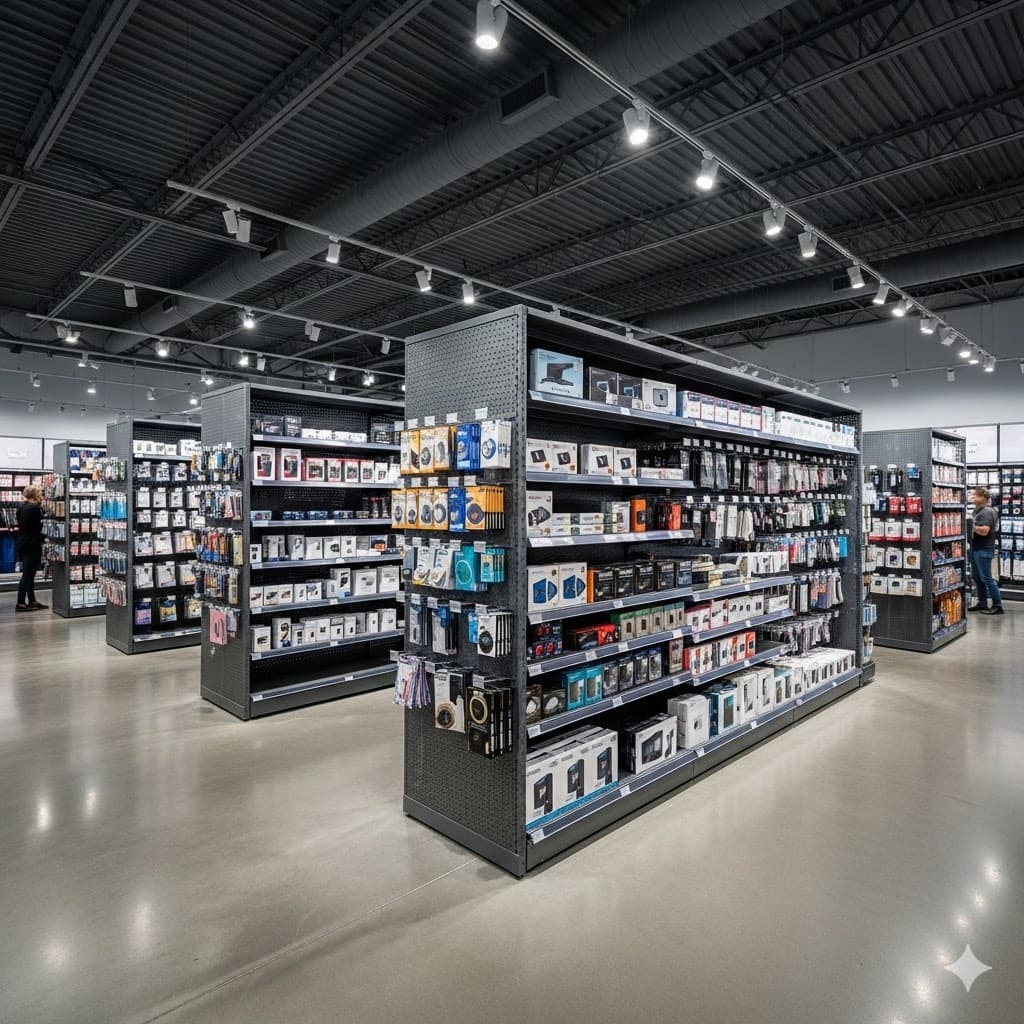
I. Introduction: Design Theory vs. Manufacturing Reality
For wholesale buyers and retail chain operators, a store layout is more than an architectural concept; it is a financial calculator. Every square foot represents potential revenue, but also potential liability.
The most common point of failure in global retail expansion is the disconnect between “Design” and “Execution.” A layout that looks efficient on a blueprint often fails because the retail display fixtures cannot support the inventory load, or the custom designs are too bulky for cost-effective international shipping.
This guide is not a design tutorial. It is a manufacturing feasibility study.
Written by the engineering team at Yishang Display (26+ years of manufacturing experience), this handbook bridges the gap between your floor plan and the factory floor. We analyze top retail layouts through the lens of structural integrity, supply chain efficiency, and Total Landed Cost, helping you source infrastructure that protects your profit margins.
II. Strategic Procurement: The 3 Pillars of Cost Control
Before finalizing a layout, professional buyers must evaluate the hardware implications. A strategic procurement approach focuses on three engineering factors that impact long-term ROI.
1. Compliance Engineering (ADA & ISO)
Facility managers know that aisle width is not just an aesthetic choice; it’s a legal one. Retail floor plans must often meet 36-48 inch aisle requirements (ADA/ISO).
- The Procurement Challenge: Standard “off-the-shelf” racks often force non-compliance in tight spaces.
- The Solution: Source Custom-Depth Shelving (e.g., 350mm vs. standard 450mm). This micro-adjustment allows you to maintain SKU density without violating safety codes.
2. Load Distribution Dynamics
High-traffic zones (Entrance, Checkout) face constant impact from shopping carts.
- The Procurement Challenge: Installing standard-grade fixtures in these “Golden Triangle” zones leads to rapid damage.
- The Solution: Specify Heavy-Gauge Steel with reinforced kick plates for high-touch areas. It is an upfront investment that prevents replacement costs in Year 2.
3. Material Science vs. Application
Deciding between High-Density (Grocery) or High-Experience (Boutique) layouts defines your material needs.
- The Solution: High-density demands Roll-Formed Steel for vertical strength. High-experience demands Laser-Cut Fabrication for aesthetic precision. Choosing a manufacturer with diverse machinery (like Yishang) consolidates your supply chain.
III. Spec Sheet: Matching Layouts to Hardware
Quick Reference for Procurement Managers
| Layout Type | Primary Hardware | Critical Spec Requirement | Ideal Steel Thickness |
|---|---|---|---|
| Grid / Straight | Gondola Shelving | High Load Capacity (100kg+/shelf) | 2.0mm – 2.5mm (Upright) |
| Loop / Forced-Path | Curved Rails / Bins | Tip-Proof Weighted Bases | 1.5mm (Tube walls) |
| Free-Flow | Custom Islands | 360° Finish Quality (No visible welds) | Mixed Material (Wood/Metal) |
| Angular | Angled Bays | CNC Precision (Tolerance <0.5mm) | 1.8mm (Frame) |
IV. High-Density Layouts: Engineering for Efficiency (Grid, Straight)
Target Sectors: Supermarkets, Hardware Chains, Pharmacies.
Engineering Definition: A Grid Layout maximizes floor space by utilizing parallel aisles with heavy-duty shelving, designed for high-volume inventory management and predictable traffic flow.
The grid store layout is the workhorse of retail. For the buyer, the priority is Standardization and Cost-Reduction.
The Engineering Imperative: Modular Savings
The failure point in Grid layouts is steel wastage.
- Manufacturing Insight: Utilizing Modular Systems (Starter and Add-on units) is critical. By sharing a central upright between spans, you reduce steel consumption and shipping weight by approximately 15% across a large project.
- Durability Check: For heavy merchandise (paint, canned goods), specifying uprights with a minimum thickness of 2.0mm is non-negotiable. Budget suppliers using 1.2mm steel create a safety hazard under full load.
The Spine Layout Nuance
In a Spine layout, central fixtures are often moved for seasonal promos.
- Procurement Tip: Source units with Industrial-Grade Locking Casters. Cheap plastic wheels flatten under static load. Demand reinforced casters capable of supporting dynamic loads to ensure your layout remains flexible.
V. Guided Layouts: Engineering for Flow (Loop, Forced-Path)
Target Sectors: Showrooms, Toy Stores, Home Goods.
Engineering Definition: A Loop Layout (or Racetrack) utilizes a controlled perimeter path to guide customers past all merchandise, requiring curved or directional fixtures to define the walkway.
The loop layout guides customers past every department. The engineering challenge is creating flow without sharp, dangerous edges.
The Engineering Imperative: Tube Bending & Safety
A loop path implies organic movement. Square-cornered racks disrupt this and pose injury risks.
- Manufacturing Insight: Sourcing from a factory with CNC Tube Bending capabilities allows for curved rails and rounded end-caps. This lowers liability in high-traffic zones.
- Anti-Tip Engineering: Freestanding displays (like Dump Bins) used to stop traffic pose a tipping hazard. These units must be engineered with Weighted Bases or a lowered center of gravity. Ask your supplier for “Tilt-Test” reports.
VI. Experiential Layouts: Engineering for Brand (Free-Flow, Boutique)
Target Sectors: Fashion, Specialty Shops, Bakeries.
Engineering Definition: A Free-Flow Layout rejects linear patterns in favor of asymmetric browsing zones, often requiring custom-fabricated ODM fixtures with 360-degree finish quality.
A free-flow retail layout rejects rigid patterns. This is where standard catalogs fail, and ODM (Original Design Manufacturing) becomes essential.
The Engineering Imperative: Finish Quality
In a grid, the back of the shelf is hidden. In free-flow, customers walk 360 degrees around the fixture.
- Quality Check: The Powder Coating or Electroplating (Chrome/Gold) must be flawless. Visible weld scars are unacceptable in boutique environments. Yishang Display utilizes automated robotic welding for consistent, smooth joints.
Hybrid Material Integration
Boutique layouts often mix metal frames with wood shelves.
- Manufacturing Insight: The hidden risk is Thermal Expansion. Wood expands with humidity; metal does not. If bolted tightly, wood will crack. We use “Floating Joint” mechanisms (slotted holes) that allow materials to breathe, ensuring fixture longevity in variable climates.
VII. Visibility Layouts: Engineering for Security (Angular, Geometric)
Target Sectors: Electronics, Wine & Spirits.
Engineering Definition: Visibility Layouts utilize angled or diagonal aisles to improve line-of-sight for cashiers, integrating passive loss prevention directly into the floor plan structure.
These layouts use angles to improve sightlines for loss prevention.
The Engineering Imperative: Precision Tolerance
Standard racks are designed for 90-degree corners. Angled layouts require custom brackets.
- Procurement Tip: If manufacturing tolerance is loose, a long row of angled shelves will “drift” and become crooked. Demand CNC Laser Cutting precision to ensure every angle is identical for perfectly aligned installation.
- Integrated Security: For high-value SKUs, source hybrid fixtures with Integrated Lockable Glass Cases. Locks embedded into the steel frame offer superior security compared to retrofitted external locks.
VIII. Infrastructure: Permanent POP & POS Integration
A common procurement inefficiency is treating pop vs pos displays as disposable purchases.
The Engineering Fix: Integrate marketing into permanent infrastructure. Instead of buying flimsy cardboard stands, source Permanent Metal Frames designed to accept interchangeable magnetic signage.
- The Benefit: A hybrid End-Cap that serves as a permanent POP station reduces long-term waste and ensures your marketing displays match the structural quality of your store.
IX. Supply Chain Logic: Reducing Total Landed Cost
This is where B2B profit is protected. Efficient logistics can save more money than negotiating the unit price.
1. Knock-Down (KD) Design
Shipping “air” destroys margins. A fully welded rack is logistical suicide for global trade.
- The Standard: We engineer Knock-Down (KD) designs where a 2-meter rack disassembles into flat components. This reduces shipping volume by up to 70%, allowing you to fit 3x more units in a 40HQ container.
2. Tool-Free Installation
High labor costs in Western markets mean complex assembly destroys project budgets.
- The Standard: Demand systems using keyhole slots and button-locks that require zero power tools for 80% of the assembly. This allows store staff to handle setup, eliminating expensive third-party installation crews.
Case Study: The ROI of KD Design
Scenario: Shipping 500 Display Units from China to USA.
- Welded Unit: 1.5 CBM/unit = 750 CBM total = 12 Containers needed.
- Yishang KD Unit: 0.4 CBM/unit = 200 CBM total = 3 Containers needed.
- Result: You save the ocean freight cost of 9 containers simply by choosing the right engineering.
X. FAQ: Technical Questions from Procurement Managers
Q: What is the standard load capacity for metal gondola shelving? A: Standard units support 80-100kg per shelf (UDL). For heavy-duty applications (hardware/auto parts), specify reinforced brackets to achieve 150kg+ capacity.
Q: How do I ensure my fixtures are compliant for export to the EU/USA? A: Ensure your manufacturer provides RoHS Certification (freedom from hazardous substances like lead) and material mill certificates.
Q: Can Yishang Display work from our architectural CAD files? A: Yes. Our engineering team converts architectural CAD/PDFs into manufacturing blueprints, identifying potential structural issues before production begins.
XI. Conclusion: Partnering for Scale
The success of a retail store layout is not defined by the architect’s drawing, but by the procurement manager’s ability to source the right infrastructure.
A layout is only as profitable as the fixtures that support it. Whether you are implementing a high-efficiency Grid or a high-margin Boutique layout, the requirements for Structural Engineering, Global Compliance, and Logistics Efficiency remain constant.
Optimize Your Supply Chain. Don’t settle for “off-the-shelf” compromises. Contact Us for a Free Engineering Review of your floor plan today. Let Yishang Display’s team validate your design for manufacturing efficiency and cost-savings.