

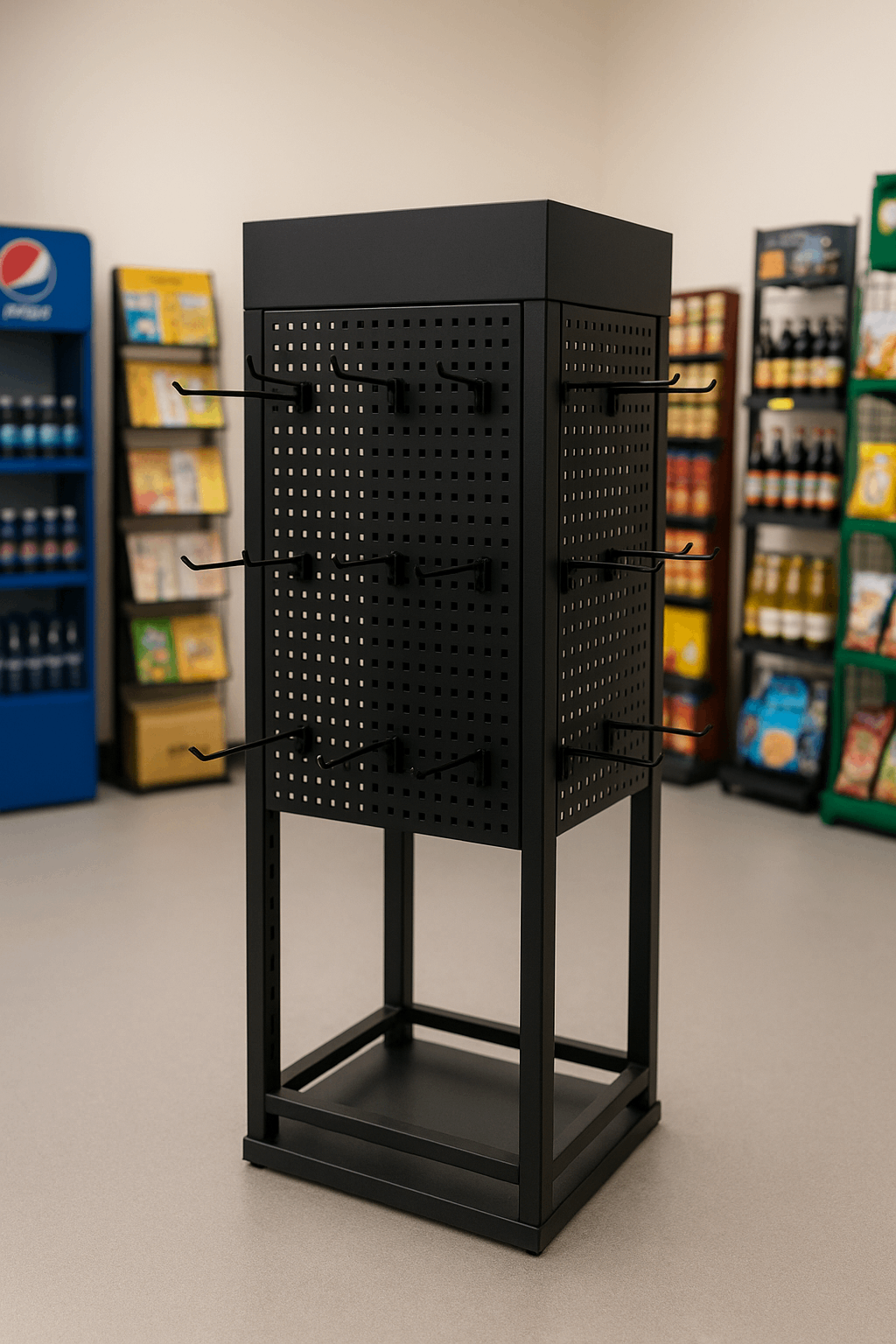
Introduction: Your Display Stand Isn’t a Cost—It’s a Capital Investment in Performance
For a retail procurement leader, display height isn’t just aesthetics—it’s ROI, ADA compliance, and SKU productivity.
A well-engineered fixture acts as a silent, 24/7 sales engine—optimized for shopper psychology and operational flow.
While many focus on products, the display unit’s structure, material, and height zoning are the true performance levers.
This guide decodes the science of vertical merchandising from the perspective of an OEM metal display supplier. It offers a clear framework to source scalable, compliant, and high-conversion retail hardware—engineered to endure and deliver.
Whether you’re sourcing bulk custom display racks, launching a modular floor display program, or comparing POS fixture manufacturers in China, this blueprint is engineered for your sourcing decisions.
Part 1: The Human Blueprint — Decoding the End-User Your Clients Serve
For wholesale buyers sourcing retail display systems, user-centric design is not optional—it’s foundational.
Before a single bracket is fabricated, engineering must begin with shopper behavior. A display’s true performance lies in how well it removes friction and invites interaction.
Understanding the subconscious habits of end-users allows your retail clients to create environments that convert traffic into sales with consistency and scale.
1.1 The Science of Sight: Cognitive Fluency and Its Impact on Sales
The retail adage “eye-level is buy-level” is a useful shorthand, but for procurement professionals, the operative principle is cognitive fluency.
The human brain favors designs that require less effort to process. Ergonomically optimized displays reduce both physical and mental workload for shoppers.
Each unnecessary bend or reach introduces friction—often leading to hesitation or abandonment. In contrast, a properly engineered display aligns with the brain’s preference for simplicity.
This subtle ease accelerates decision-making, shortens dwell time, and elevates the overall brand experience—translating into measurable gains for your retail clients.
From a B2B perspective, your hardware purchase becomes a direct contributor to your clients’ top-line revenue.
1.2 The Ergonomic Reality: The Hard Numbers Behind a Performance Display
To convert psychology into predictable retail outcomes, design must rely on the science of anthropometry.
Instead of designing for an “average person,” display systems must accommodate the full ergonomic range of a diverse customer base—including ADA compliance, child-height interaction, and senior accessibility.
This is particularly critical for buyers in North America and Europe, where compliance with accessibility standards is non-negotiable.
Designer’s Specification Sheet: Critical Ergonomic Data
| Ergonomic ZoneHeight Range (from floor)Strategic Importance for Display Engineering | ||
|---|---|---|
| The Golden Zone (Picking) | 36 to 66 inches (91 to 168 cm) | The ergonomic power zone. Enables effortless grabbing, improving shopper interaction and reducing strain. |
| The Gaze Zone (Viewing) | 48 to 60 inches (122 to 152 cm) | The primary attention zone. Ideal for feature SKUs and high-margin products. |
| The Accessibility Mandate (ADA) | 9 to 48 inches (23 to 122 cm) | Legal requirement in the US; best practice worldwide. Ensures inclusivity for all shoppers. |
These numbers introduce a key procurement challenge: optimizing revenue-driving zones without violating compliance standards.
The most effective solution? Modular engineering. Fixtures that flexibly accommodate multiple zones of engagement—without redesign or replacement—maximize both compliance and conversion.
For global sourcing managers, modularity isn’t a design perk; it’s a risk-mitigation strategy.
Part 2: The Hardware Blueprint — Engineering the Optimal Display Solution
For wholesale display procurement, hardware decisions impact more than aesthetics—they determine lifecycle value and in-store performance.
Once you’ve aligned design with shopper behavior, the next layer of performance is physical execution. Material choices, modular adaptability, and precise height specification define whether a display merely functions—or excels.
2.1 Material Matters: Engineering for Durability, Perception, and ROI
Your material choice sends a signal. For buyers responsible for high-volume rollouts, the right substrate balances cost, resilience, and brand expression.
- Metal (Engineered Strength & Longevity): Especially for heavy-duty and high-traffic retail, metal is the preferred material. As a custom OEM metal display supplier, we at Yishang Display prioritize structural integrity, load-bearing stability, and finish consistency. Powder-coated finishes ensure brand alignment across all locations.
- Wood (Premium Brand Expression): Natural textures evoke craftsmanship and warmth. Wood is ideal for boutique food, beauty, or apparel categories where emotional engagement boosts AOV. Engineered wood options provide stability with reduced weight and logistics cost.
- Acrylic (Modern Minimalism & Transparency): Crystal-clear acrylic elevates visibility while preserving product focus. Lighter and safer than glass, it’s a common choice for cosmetics, eyewear, or electronics where sleek aesthetics support premium pricing.
📌 Tip: Procurement professionals should verify material grade, surface treatment type, and impact/load tolerance during the quoting stage—especially for multi-location deployments.
2.2 The Power of Modularity: Future-Proofing Your Display Investment
Retail doesn’t stand still. Your fixture shouldn’t either.
Modular displays enable brands to reconfigure layouts, adjust shelf heights, or swap components seasonally—without downtime or new tooling.
- Adjustable shelves let retailers reposition products within the ergonomic zone as inventory or planograms change.
- Tool-free assembly reduces install time and maintenance friction.
- Component interchangeability (like universal brackets or uprights) simplifies large-scale procurement.
📌 Buyers sourcing modular fixtures from Asia should clarify customization options upfront—e.g., bracket slot pitch, panel dimensions, or rail compatibility—to avoid costly retrofits.
Including modularity in your OEM purchase specs isn’t just about flexibility—it’s how procurement teams future-proof retail fixture investment.
2.3 The Height Equation: Balancing SKU Density with the In-Store Experience
How tall is too tall? That depends on the product, the store format, and the shopper profile.
- Low-Profile Units (<66 inches / 168 cm): Ideal for boutique and open-concept environments. Short fixtures improve sightlines and navigation, supporting a relaxed shopper experience.
- High-Profile Units (>72 inches / 183 cm): Maximize SKU density and vertical storage. Suitable for large-format retail and value-focused merchandising—provided aisle width accommodates visual relief.
Retailers buying display systems in bulk should factor in aisle spacing, display zone stacking, and planogram fluidity.
📌 Pro Tip: Consider adjustable-height options for retail clients testing multiple formats (e.g., convenience vs. flagship). It minimizes SKUs but expands utility.
Part 3: The Merchandising Blueprint — Translating Display Height Into Profit
For procurement teams, height isn’t just a measurement—it’s a merchandising strategy that drives engagement and conversion.
3.1 Vertical Product Mapping: From Traffic Flow to Sales Conversion
Display height should correspond to product type and intent:
- Eye-Level = Premium Products: Maximize visibility and perceived value. Ideal for feature launches or high-margin items.
- Hand-Level = Fast-Moving SKUs: Easy grab-and-go placement supports impulse purchases.
- Lower Levels = Economy & Bulk: Place larger-volume or value-tier products here. Acceptable trade-off in visibility for savings perception.
Organizing by vertical zone guides the shopper’s journey and supports intuitive navigation—crucial for basket building and cross-category merchandising.
For buyers managing bulk supermarket fixture programs or custom POS displays for beverages, this vertical logic is vital for layout ROI.
3.2 Visual Merchandising Harmony: How Height Shapes Brand Perception
Beyond placement logic, height consistency contributes to visual rhythm:
- Align top lines across multiple units for visual flow.
- Avoid extreme height jumps that break shopper sightlines.
- Group related items within a vertical column to reinforce category structure.
Procurement choices should enable this harmony—through adjustable shelf brackets, modular side panels, and consistent framing.
For retailers in fashion, tools, pet supplies, and cosmetics, visual alignment across modular display stands often improves conversion by reinforcing product value and brand hierarchy.
3.3 Adapting to Shopper Demographics: One Height Does Not Fit All
Demographic targeting matters. Display height must reflect shopper profiles:
- Children’s Items: Place between 24–36 inches to promote independent engagement.
- Senior-Focused Categories: Avoid high or low placement; maintain comfort zone (30–54 inches).
- Luxury Retailers: Use minimal height variation for clean lines and premium presentation.
Smart B2B sourcing includes asking: Is this height right for my end user? Whether you’re developing displays for wine, hardware, print literature, or electronics, shopper reach zones must be respected.
Part 4: The Financial Blueprint — Turning Height Strategy into Investment Logic
Strategic display height doesn’t just improve the in-store experience—it improves margins.
4.1 The ROI of Vertical Optimization
Optimized height placement leads to:
- Higher sell-through rates on priority SKUs
- Faster product location and retrieval (less restocking time)
- Enhanced perceived organization and brand polish
As a sourcing manager, you can directly influence this ROI by selecting fixtures that allow vertical flexibility and merchandising agility.
Retail buyers investing in OEM retail displays for supermarkets or convenience formats often underestimate the sales impact of shelf height—until analytics prove otherwise.
4.2 Beyond the Price Tag: Total Cost of Ownership (TCO)
Initial cost is only part of the equation. A smart display investment considers:
- Durability: Reduces breakage and warranty claims.
- Modularity: Lowers upgrade/replacement needs.
- Ease of install: Reduces labor costs across locations.
A well-built metal display system—engineered for ergonomic height targeting—delivers compounding returns across its service life.
Many B2B buyers opt for quick-turn solutions without analyzing lifetime performance. TCO-focused sourcing ensures long-term margin protection—especially for global rollouts or franchise consistency.
Conclusion: Elevating Your Standards
Choosing the right display height isn’t guesswork. It’s a calculated decision with implications for compliance, shopper psychology, merchandising, and ROI.
By sourcing from a manufacturer who integrates engineering logic with modular design, you unlock a measurable in-store advantage.
At Yishang Display, we specialize in custom metal retail display fixtures tailored for ergonomic efficiency, modular performance, and global-scale deployment.
Whether you’re planning an ADA-compliant retail fixture rollout, a heavy-duty POS display for tools, or a floor-standing stand for beverages—we build to spec and scale.
📌 Let’s build something that performs as well as it lasts. Contact us for a quote, sample request, or downloadable OEM display rack specification sheet tailored to your region.