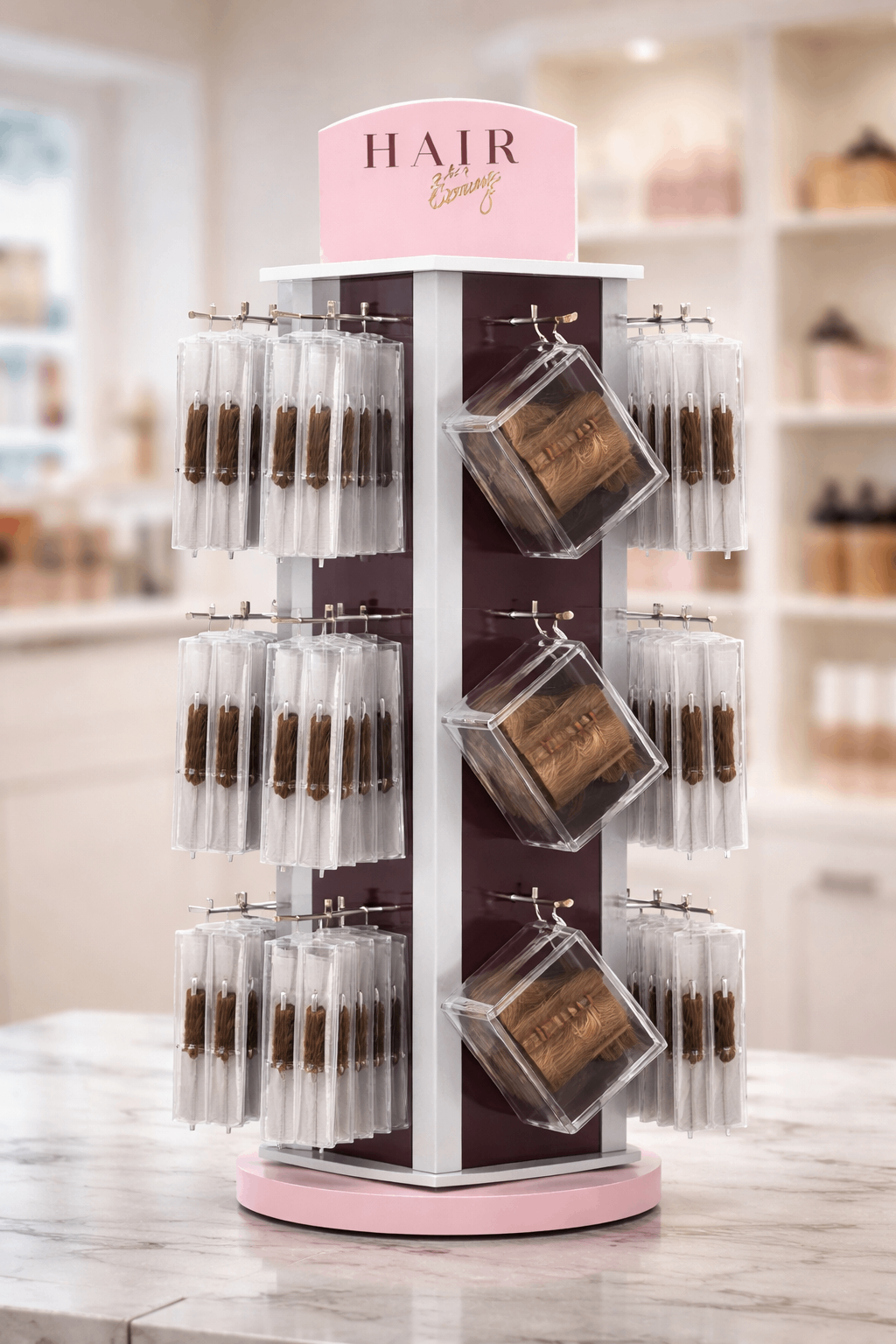
Overseas wholesale buyers evaluate retail displays very differently from end consumers. The primary concern is not visual novelty, but whether a display can be deployed repeatedly, perform consistently, and remain stable in real store conditions. This Tabletop 4-Way Rotating Acrylic Hair Extension Display is developed around those procurement realities.
Designed for retail display countertops, salon consultation desks, and high-traffic store display counters, this rotating acrylic display stand supports organized presentation of hair extension products in a compact footprint. The four-sided layout allows multiple SKUs to remain visible without expanding counter space, while controlled rotation enables intuitive browsing with minimal staff involvement.
This product is offered by Yishang Display as part of wholesale and custom display programs. The content below focuses on how the display functions in retail environments, how it supports procurement decision-making, and what factors matter when sourcing for multi-store deployment.
Countertop space is one of the most constrained and operationally sensitive areas in beauty retail. It must accommodate payment systems, daily cleaning, staff movement, and continuous customer interaction. Displays that interrupt this workflow or require frequent manual correction are often removed by store managers, regardless of initial design intent.
This tabletop rotating display is designed to function as a low-interference merchandising tool. Its vertical orientation allows hair extension packaging to remain visible without spreading horizontally across the counter. By prioritizing height over surface area, the display preserves working space for staff while maintaining SKU exposure.
From a procurement perspective, the core objective is repeatability. When the same display is deployed across multiple locations, buyers need predictable placement, consistent capacity, and stable customer interaction patterns. The four-sided countertop structure is engineered to maintain order after repeated handling, supporting standardized merchandising rather than ad-hoc store-level adjustments.
Hair extension products are purchased through comparison rather than impulse alone. Customers typically evaluate multiple attributes—length, color range, packaging details, and brand cues—before making a selection. Displays that restrict visibility or require customers to remove products to see alternatives increase friction and disrupt presentation.
A rotating tabletop display supports comparison behavior without increasing handling. Rotation allows customers to bring the assortment into view from a fixed position, while the four-sided layout distributes SKUs into clearly defined viewing planes. This reduces unnecessary product removal and helps maintain a clean, consistent presentation throughout the day.
For wholesale buyers operating multiple stores, this translates into operational efficiency. Displays that encourage controlled browsing require less staff time for reorganization and reduce the likelihood of damaged packaging, supporting lower maintenance costs over the lifecycle of the display.
Displays that appear similar in photographs can behave very differently once placed in-store. For procurement teams, structural behavior matters more than visual styling.
The four-way layout is designed to eliminate blind spots at the counter. Customers approach from multiple directions, especially in high-traffic retail environments. A single-facing stand creates front–back hierarchy, encouraging customers to pull products out of position. A four-sided structure provides usable display faces from all approach angles, reducing this behavior.
Rotation is intentionally controlled rather than free-spinning. A well-balanced rotating acrylic hair extension display should move smoothly under light force and then remain in position. This balance is achieved through alignment of the rotation mechanism and base weight distribution, ensuring stability even when product load becomes uneven during browsing.
As a manufacturer experienced in metal and mixed-material fixtures, Yishang Display selects acrylic for this tabletop display based on function rather than trend.
Acrylic is chosen for its visual neutrality. Transparent surfaces allow hair extension packaging and brand graphics to remain the focus. This is particularly important on retail display countertops, where surrounding items already compete for attention.
Maintenance is another consideration. Acrylic surfaces are easy to clean and support daily wipe-down routines common in beauty retail. When paired with appropriate thickness and reinforced structure, acrylic stands for display can deliver reliable performance in high-touch environments.
Where higher load or additional stability is required, acrylic components can be combined with internal metal reinforcement. This hybrid approach allows buyers to balance appearance, durability, and cost based on specific retail requirements.
Wholesale buyers often evaluate a display based on whether it will remain in place after the initial rollout. Stability is therefore a functional requirement rather than a secondary feature.
This tabletop 4-way rotating acrylic display is engineered so that the center of rotation and center of mass remain aligned as products are removed. This reduces tipping risk during uneven loading, a common issue in countertop merchandising.
Footprint control is equally important. The display is sized to integrate with common store display counters without interfering with POS equipment or staff movement. By increasing capacity vertically rather than horizontally, it supports higher SKU density while preserving counter usability.
Daily retail use also includes routine cleaning and repositioning. Structural joints, surface finishing, and export packaging are designed to withstand these repeated actions without loosening, scratching, or degrading in appearance.
Customization in wholesale display programs is driven by merchandising execution rather than decoration. Buyers sourcing custom displays that perform consistently across stores typically focus on capacity control, packaging compatibility, and repeatable production.
For hair extension programs, customization often starts with packaging format. This tabletop display is commonly configured for bagged or carded hair extension packs using peg hooks. Hook length, spacing, and angle can be adjusted to match packaging width, hang-hole position, and product weight, helping prevent overlap and uneven loading.
Capacity planning is handled at the planogram level rather than by fixed claims. Buyers typically group SKUs by length range, color family, or collection, assigning one category per display face. This four-sided layout allows each face to function as a mini planogram, improving visual clarity while keeping replenishment simple for store staff.
Branding elements such as header panels, color accents, and logo placement can be integrated where they support in-store recognition without complicating maintenance. Once a configuration is confirmed, repeatable manufacturing ensures that displays produced months apart maintain the same appearance, structure, and rotation behavior.
This acrylic hair extension display for retail is designed for environments where countertop merchandising directly influences purchasing decisions.
In beauty supply stores, it functions as an add-on merchandising unit near checkout, supporting incremental sales without crowding the counter. The rotating format allows customers to browse independently while maintaining visual order.
In hair extension specialty stores and salon reception areas, the display supports comparison-driven selection. Staff can rotate the assortment toward customers during consultations, reducing handling while keeping products visible and organized.
The following information is provided to support initial procurement review. Final specifications are confirmed during sampling based on packaging format and retail planogram requirements.
| Item | Description |
|---|---|
| Display Type | Tabletop 4-way rotating acrylic hair extension display |
| Construction | Acrylic structure with optional internal metal reinforcement |
| Display Faces | Four-sided (equal access from all directions) |
| Rotation | Manual, controlled rotation (balanced, non-free spinning) |
| Packaging Support | Peg hook configuration (custom spacing available) |
| Placement | Retail display countertop / store display counter |
| Custom Size | Available based on packaging and counter constraints |
| Branding | Header panel and logo integration |
| MOQ | Wholesale MOQ applies |
| Lead Time | Based on order volume and customization scope |
Overseas buyers sourcing manufacturing custom displays typically prioritize consistency, delivery reliability, and long-term cost control. MOQ is established to support stable material sourcing, controlled production processes, and consistent output across batches.
Pricing is influenced by structural and functional choices rather than surface appearance alone. Acrylic thickness, reinforcement requirements, hook configuration, header complexity, and export packaging all affect unit cost. Early confirmation of packaging dimensions allows the display to be engineered efficiently, avoiding unnecessary material usage or redesign later in the project.
Lead time should be planned around retail rollout schedules rather than single delivery dates. Buyers typically confirm structure and artwork first, approve a pre-production sample, and then release bulk production. Providing packaging samples, logo files, and quantity forecasts early helps reduce delays and supports predictable delivery timelines.
For overseas wholesale buyers, display quality is directly linked to operational risk. A countertop display that becomes unstable, scratches easily, or varies between production batches can generate hidden costs through store complaints, replacements, and brand inconsistency.
Quality control for this display focuses on material verification, structural assembly, and rotation performance. Acrylic sheets are checked for clarity and thickness consistency. During assembly, rotation alignment and load balance are inspected to ensure smooth, controlled movement under uneven product loading. Final inspection confirms surface condition and packaging integrity before shipment.
For projects requiring compliance documentation, materials can be supplied in alignment with RoHS requirements and managed under ISO 9001 quality systems, subject to buyer confirmation. Export packaging is designed to protect acrylic surfaces and rotating components during international transport, reducing damage rates and improving arrival condition at distribution centers.
This tabletop 4-way rotating acrylic hair extension display is best suited for retail programs that rely on countertop merchandising and manage multiple SKUs. It supports clear presentation, controlled browsing behavior, and efficient use of limited counter space.
It may not be suitable for applications requiring heavy security, oversized packaging, or floor-standing presentation. In those cases, alternative metal-based fixtures may offer better performance.
For buyers evaluating this display for wholesale rollout, the following information typically helps accelerate quotation and sampling:
If you are sourcing a repeatable countertop solution for a hair extension program, sharing these details allows Yishang Display to confirm suitability and propose a configuration aligned with your retail and procurement requirements.

Yishang Display specializes in crafting bespoke display solutions. From initial concept and prototyping through to full-scale production, our in-house team manages every phase—delivering a seamless, one-stop experience for your brand.
If you have any questions or need a quote, please send us a message. One of our specialists will get back to you within 24 hours and help you select the correct valve for your needs.
All of our products are available for sampling