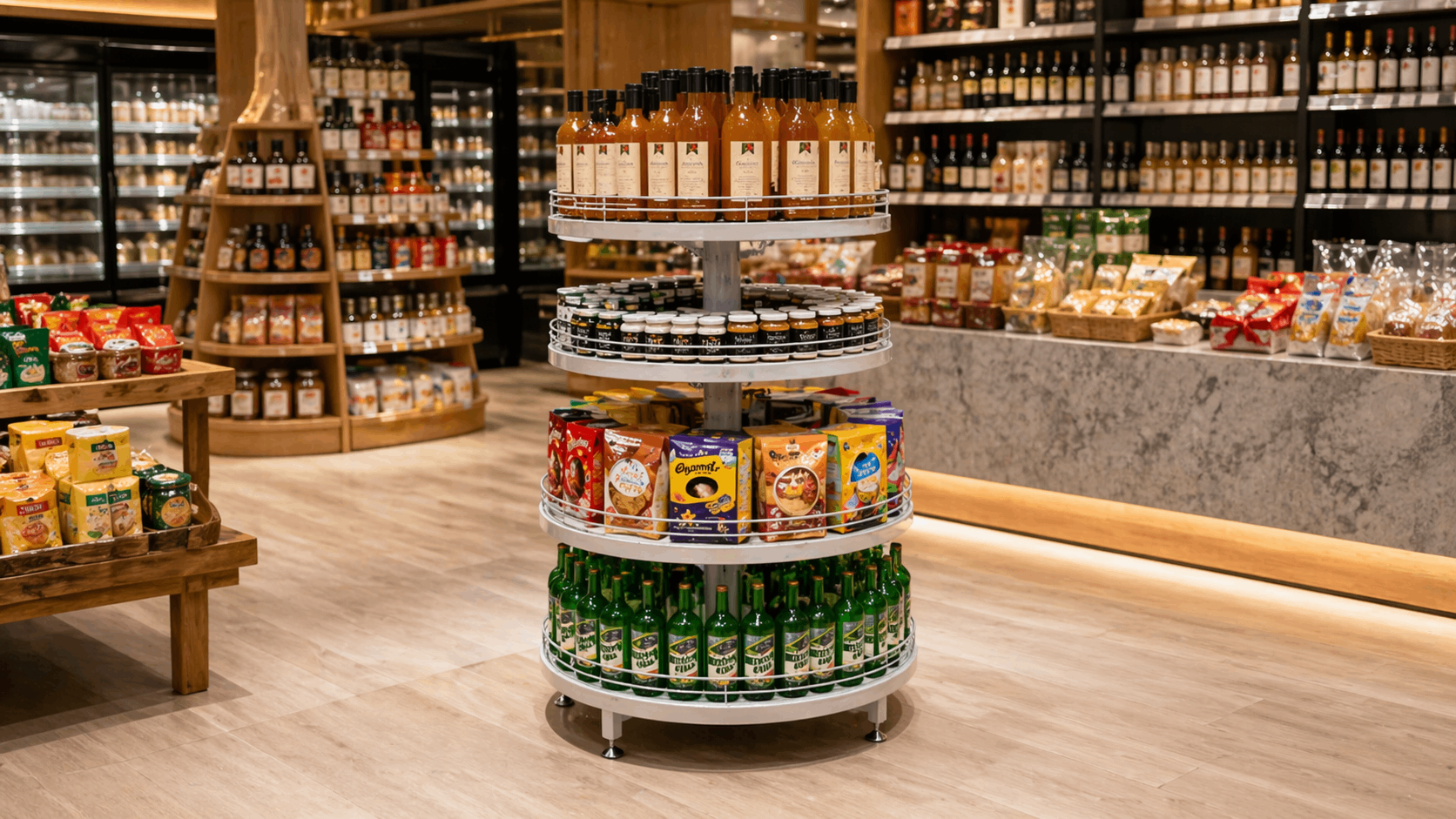
Overseas wholesalers, importers, and retail program buyers use a rotating supermarket retail store can snack food honey display stand when they need a compact fixture that makes commercial sense from the start.
The four-tier rotating layout works well for honey bottles, canned products, snacks, boxed treats, and bottled drinks. It lets buyers present several SKUs on one stand without making the retail space feel tight or cluttered.
In real sourcing work, the first questions are usually practical ones: shelf load, footprint, packing method, assembly time, and repeat-order consistency. This food display rack reflects those priorities, so buyers can assess it more easily, ship it more efficiently, and place it into a rollout plan with less friction.
A buyer searching for a food display stand or retail display rack is rarely looking for a vague idea. The real concern is whether the unit can increase facings, improve visibility, and fit naturally into an existing store layout without forcing major fixture changes. This design answers that with a circular footprint and a vertical shelf arrangement.
Compared with static shelving, a rotating unit gives shoppers a more natural browsing experience. Labels stay in view, products are easier to compare, and replenishment is simpler for store staff. In a retail campaign, that kind of convenience often matters just as much as appearance.
For sourcing teams, the appeal is also operational. Teams can line this display up with a retail brief more easily because the key variables stay clear: expected shelf load, target SKU mix, unit diameter, and whether the stand will support a short promotion or a longer-running category program.
This display works across several packaged food categories, so one program can use it as a food display stand, honey display stand, and can food display solution. The upper shelf suits honey bottles, syrups, sauces, or premium packaged items that benefit from eye-level presentation. The middle tiers fit canned goods, confectionery, and snack packs, while the lower level is better for heavier bottled drinks.
That flexibility helps buyers avoid unnecessary fixture duplication. Instead of sourcing a different stand for every category, they can group related products on one rotating unit and still keep the presentation clean and easy to shop. That is useful for supermarket promotions built around bottled condiments, canned food, snack assortments, or even a small chocolate bar display.
For wholesale programs, reuse value carries real weight. A fixture that moves between product families with only minor graphic or tier-spacing adjustments usually wins approval more easily across different customer accounts and regional projects.
The structure uses a central metal column with four circular shelves arranged vertically. Each level includes a retaining edge that helps keep bottles, cans, and snack packs stable during daily browsing. At the top, a branded header panel gives clear space for brand graphics that stay visible from a distance.
The shelf arrangement focuses on practical merchandising, not just visual effect. Smaller products can sit on the middle tiers, while heavier bottles are better placed on the bottom tier to keep the center of gravity lower and make replenishment easier. During sampling, teams should check shelf layout against actual SKU weight and diameter so the final display feels right in use, not just in a drawing.
The standard version shown here uses fixed feet. Teams can still discuss optional casters for projects that need easier repositioning between campaign locations. For buyers handling repeated promotional resets, that kind of flexibility can be useful, but the main goal stays the same: a rotating structure that is straightforward to use, easy to restock, and dependable in daily store operation.
For this type of display rack, material choice has a direct effect on load capacity, service life, and after-sales risk. A metal display stand gives better structural support for bottles, cans, and dense packaged goods than many lightweight alternatives. That matters even more in a rotating unit, where the fixture has to stay steady through frequent handling.
As a metal food display rack, this product supports long-term retail use. Powder-coated metal surfaces are easier to maintain and better able to handle repeated replenishment, transport, and store contact. Buyers can still add acrylic, wood, or printed panels when they want more visual impact, but the metal frame remains the main support system.
For wholesale procurement, a stronger structure often means fewer problems after delivery. Better rigidity helps the fixture keep its shape, improves stability during rollout, and lowers the chance of early wear in high-traffic locations. That kind of reliability is often more valuable than an over-designed display that looks impressive but adds complexity.
Once buyers confirm the structure and SKU mix, they usually want to understand how the stand performs on the sales floor. A rotating unit keeps more product facing outward at the same time, which helps shoppers recognize labels faster and reach items from different directions.
The vertical layout also improves floor efficiency. Instead of spreading goods across a wide zone, the stand builds presentation upward and keeps the footprint compact. For supermarkets, convenience stores, and promotional corners, that means stronger visibility without taking too much space from surrounding fixtures.
Different tiers also make assortment control easier. Buyers can group by flavor, pack size, price point, or category, so the display stays easier to understand, easier to replenish, and easier to keep looking tidy through the day.
A useful custom program starts with the actual products, not with a standard catalog size. This food display rack allows adjustments in overall height, shelf diameter, tier spacing, and load range to suit honey bottles, canned products, snack packs, or mixed assortments. That makes it easier to match the display to real SKU dimensions instead of forcing the merchandise into a fixed format.
Buyers can customize branding through the top sign, color finish, and graphic treatment. For buyers who want stronger shelf impact, the header area can carry campaign messaging, seasonal visuals, or logo artwork that helps the brand message stand out more clearly from a distance. Powder coating is a common choice because it keeps the surface durable and clean-looking in daily store use.
Mixed-material details can also be added where they genuinely improve the result. The display shown here uses a primarily metal-led structure, while a project can incorporate acrylic inserts, wood accents, or lightweight printed panels when extra visual detailing helps. In many cases, the best customization is not the most complicated one. It is the version that improves sell-through, transport efficiency, and store execution without making the fixture harder to manage.
When wholesale buyers review a retail display rack, they usually look at structural data before visual details. Load range, footprint, packing style, and assembly logic often matter more than broad claims. The specification below reflects the points buyers most often raise during RFQ review.
| Item | Typical Custom Range / Option |
|---|---|
| Main Structure Material | Metal |
| Optional Materials | Acrylic, wood, cardboard |
| Structure Type | Floor-standing, rotating, multi-tier |
| Rotation Mode | Manual or optional motorized design |
| Tier Quantity | Custom |
| Overall Size | Custom according to product and store space |
| Finish | Powder coating, painting, or other suitable finish |
| Branding | Custom logo header or graphic panel |
| Product Load | Engineered according to SKU weight |
| Mobility Option | Fixed feet or optional casters |
| Packing | Export packing, flat-pack, or knock-down |
| MOQ | Based on project scope |
| Order Type | OEM and ODM |
In export projects, buyers often ask about packing volume, assembly time, and consistency across repeat orders as early as the sampling stage. Those details shape freight cost, warehouse handling, and installation planning. A useful specification sheet should help a buyer judge real project fit, not just read through a list of dimensions.
This display works well in retail environments where traffic is naturally high and quick product recognition matters. Common placement points include aisle intersections, promotional islands, entrance areas, and checkout-adjacent spaces. In those spots, the stand acts as a compact focal point rather than competing with standard shelving.
It is also well suited to themed food promotions. Buyers can use it for bottled condiments, snacks, canned items, or even a chocolate bar display program when the assortment needs a vertical, rotating presentation. Because the footprint stays compact, the unit can strengthen visibility without taking too much space from surrounding fixtures.
Placement also affects specification. A stand for a checkout zone may need tighter dimensions and quicker product access, while a unit for a promotional island can support broader shelf surfaces and stronger visual graphics. Tying placement decisions back to fixture design helps reduce mismatch during sampling.
Experienced buyers tend to focus on a handful of practical points. Will the stand support the intended product weight? Will the rotation stay smooth after repeated use? Will the shelves fit the actual bottle diameter, can height, or snack pack depth? Those are the questions that shape a dependable buying decision.
They also look closely at project control. Can the sample reflect final production quality? Can the unit be packed efficiently for export? Can a supplier keep structure, finish, and branding consistent across repeat orders? For importers and wholesale distributors, those points usually matter far more than polished advertising language.
Buyers still need proof that the display will arrive with stable quality. Yishang Display, based in Guangdong, China, supports custom retail fixture programs with OEM and ODM service, ISO 9001 process control, and RoHS compliance relevant to export projects.
That background matters because it supports execution. Buyers need confidence that production will follow an approved sample and that the finished unit will stay practical in real stores.
Can this display hold honey bottles and canned products together?
Yes. Engineers can tailor the shelf layout to mixed SKU dimensions and weight, so the same unit can support bottled goods, canned products, and snack items in one program.
Is the rotating system manual or motorized?
The standard version is usually manual. Teams can discuss a motorized option when a project needs a powered presentation.
Can the number of tiers be changed?
Yes. Teams can adjust tier quantity, diameter, spacing, and edge detail to fit product size and merchandising goals.
Is it easy to ship and assemble?
Yes. Depending on the design, the project can use flat-pack or knock-down packing to reduce freight volume and keep installation practical at destination.
What information helps a buyer get a better quotation?
Product dimensions, unit weight, target quantity, preferred finish, branding needs, and store environment all help the project team prepare a more accurate proposal.
If you are sourcing a rotating food fixture for supermarket or grocery projects, sharing the product size, unit weight, target quantity, and display goal at the start usually leads to a faster and more accurate proposal.
Yishang Display can review the brief and suggest a structure that fits the merchandise, the shipment plan, and the retail environment.
Yishang Display specializes in crafting bespoke display solutions. From initial concept and prototyping through to full-scale production, our in-house team manages every phase—delivering a seamless, one-stop experience for your brand.
If you have any questions or need a quote, please send us a message. One of our specialists will get back to you within 24 hours and help you select the correct valve for your needs.
All of our products are available for sampling