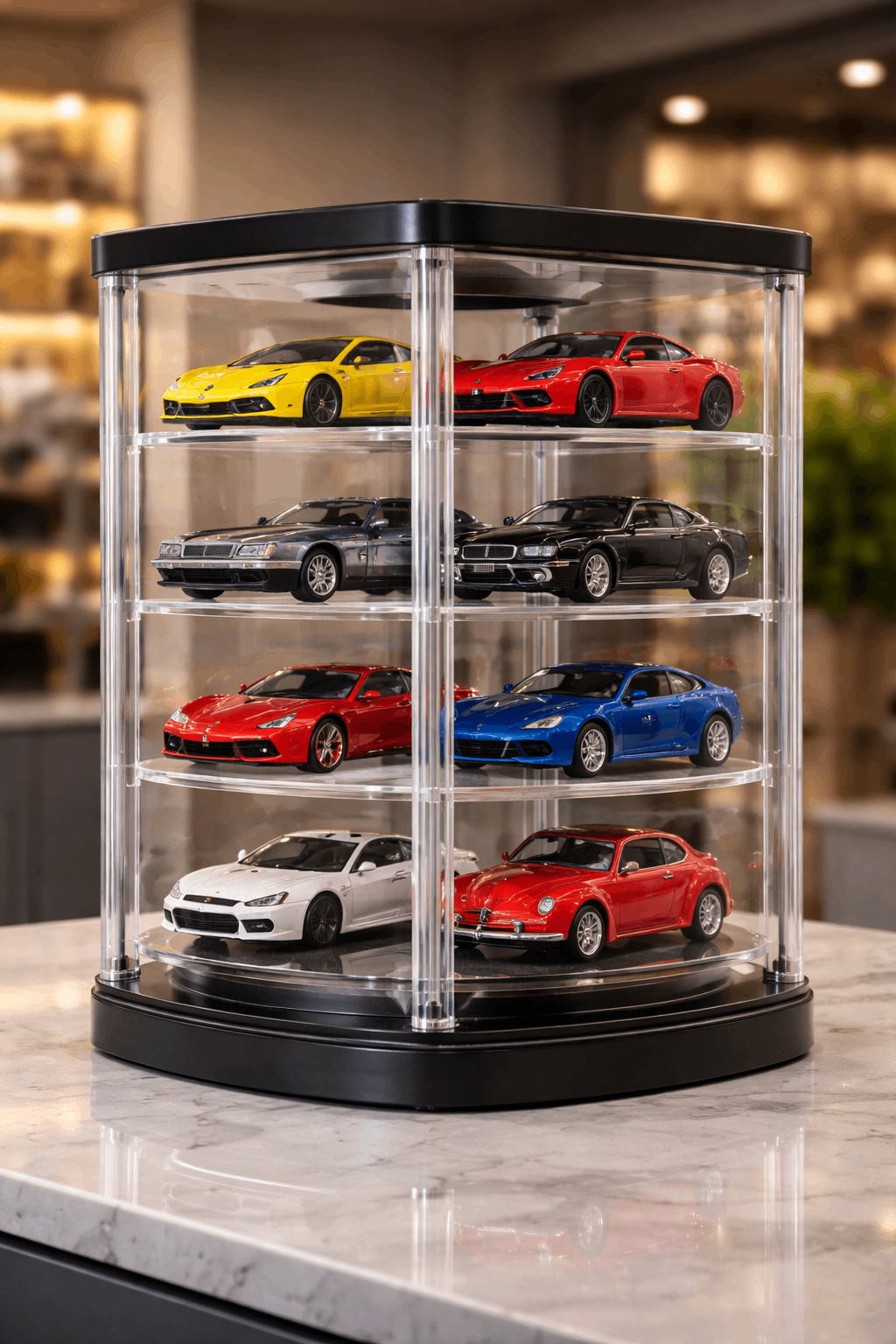
A rotating countertop transparent acrylic display case built for wholesale programs—clear visibility, stable rotation, and repeatable production.
Wholesale procurement teams don’t read product pages the way end customers do. The goal is usually simple: confirm fit, reduce risk, and move faster toward an RFQ. That means quickly understanding how the display behaves on real counters, how it protects collectible items, how it ships internationally, and how consistent it will be across repeat orders.
This page keeps the focus on the product—not company storytelling. It explains the design logic behind a toy display case that rotates smoothly, stays stable under load, and presents hot toys and model cars with premium clarity. If you are building a retail program, a chain rollout, or a seasonal campaign, the sections below are written to help you evaluate fit, define requirements, and move efficiently toward sourcing.
These reference points reflect how overseas wholesale buyers typically screen a display project before requesting a quotation. Final details are confirmed per project.
Collectors and gift buyers don’t browse hot toys the same way they browse everyday items. They look for details—paint lines, proportions, licensing marks, packaging condition—often comparing several units before deciding. In practical terms, that means the display must support multi-angle viewing without encouraging constant handling.
Open racks can work for high-turn, low-risk products, but they often fall short for collectibles. Items get moved, mixed, or scuffed. Staff end up “resetting” the display throughout the day, and presentation quality drifts. A well-designed hot toy display case keeps the assortment visible while protecting products from casual touch, dust, and accidental knocks.
For buyers running a model car display program (including boxed items, die-cast models, or a lego car display range), the job is not only to hold inventory. The job is to keep the assortment looking intentional—clean, aligned, and easy to scan—because presentation directly affects perceived value.
Countertop space is limited, yet it’s where attention concentrates—checkout lines, service desks, and promo counters. A rotating countertop transparent acrylic structure lets you present multiple SKUs without spreading outward. Instead of demanding more counter depth, it improves visibility with 360° access.
Rotation also reduces handling. In many stores, shoppers rotate a display far more often than they pick up items. That behavior matters for premium assortments because it reduces surface wear, missing parts, and messy shelf appearance. Over time, lower handling means fewer staff touch-ups and a more consistent “premium look” across the day.
A good rotating display should feel controlled. Too free-spinning can cause accidental fast rotation, shifting product placement and frustrating staff. Too stiff can discourage interaction. For wholesale programs, this “rotation feel” is not cosmetic—it’s part of how the display performs across different store teams.
Transparent acrylic is common in retail merchandising for one reason: it supports premium presentation with practical durability. Compared with glass, acrylic reduces shatter risk in busy counter environments. Compared with low-grade plastics, well-finished acrylic maintains clarity and edge quality over longer use.
For transparent acrylic hot toy and model car display case applications, clarity is not just visual. It affects trust. When buyers can see packaging edges, label details, and product finish from multiple angles, perceived authenticity and value improve. That’s why a clear acrylic enclosure often outperforms an open stand for collectible categories.
A professional product page should also be honest about boundaries. Acrylic is not ideal for prolonged high heat, abrasive chemical cleaners, or harsh scraping. If a counter is exposed to strong direct sunlight all day, it may be better to discuss UV-resistant acrylic options or placement guidelines. Stating these limits helps buyers plan correctly and reduces after-sales issues.
Once rotation and enclosure material are defined, the next buyer question is whether the display will behave well on real counters. Wholesale rollouts rarely involve identical store layouts. Counter depth, height limits, and load tolerance vary by format and country.
That is why this countertop transparent acrylic display is usually configured from real usage parameters rather than forced into one fixed size. The footprint must respect counter workflow—payment terminals, bagging space, staff movement—while remaining stable under rotation.
Stability is largely a center-of-gravity problem. Rotation amplifies imbalance, especially when customers interact with the unit at the top shelf. Shelf spacing, base design, and load planning must work together to prevent wobble. In sourcing terms, this is where “looks good in photos” becomes “works for 12 months in stores.”
With footprint rules set, shelf layout becomes the main variable that determines whether the display works with real assortments. Capacity is not only “how many items fit.” For rotating systems, capacity also includes readability, balance, and restocking convenience.
Shelf spacing is a merchandising decision. A boxed car display case assortment needs different spacing from loose collectibles or blister packs. For boxed die-cast, a layout that keeps front faces readable matters. For loose collectibles, separation that prevents visual overlap matters more. In a toy display rack context, clutter reduces conversion; in a collectible context, clutter reduces perceived value.
Rotation quality depends on balanced loading. Mixed assortments often have uneven weights. When a display is configured correctly, rotation remains smooth even when staff restock imperfectly. When it is configured poorly, rotation becomes rough, top-heavy, or unstable. This is why “shelf design” is not an accessory detail; it’s part of the rotation system.
At this point, most procurement teams translate behavior into RFQ parameters. Instead of generic “advantages,” the practical questions are: what can be adjusted, what affects lead time, and what impacts cost.
Rotation options are commonly defined by usage environment. Manual rotation is usually preferred for low maintenance and long service life. For high-traffic counters, controlled resistance can reduce accidental overspin. Motorized rotation is typically campaign-based, used when presentation consistency is prioritized over simplicity.
Even when the enclosure is acrylic, the base can be engineered for stability and wear resistance. Anti-slip contact, reinforced corners, and stable axis alignment are common B2B requirements because they reduce store-level complaints.
Packaging is also a procurement variable, not a logistics afterthought. Acrylic displays can be vulnerable to scuffs or cracking if carton protection is weak. Many wholesale buyers reduce damage rates by specifying carton structure, protective films, edge guards, or internal bracing upfront—especially for export shipments.
Beyond appearance, wholesale buyers often compare displays based on build logic and performance ranges. The points below are not fixed values, but common configuration references used during project evaluation.
The table below follows how many sourcing teams define a rotating countertop transparent acrylic display case. Values stay flexible by design—the key is to clarify decision points and inputs.
| Item | Typical Definition | Procurement Relevance |
|---|---|---|
| Display Type | Rotating countertop display case | Confirms usage scenario |
| Application | Toy display case / model car display | Aligns to assortment type |
| Enclosure | Transparent acrylic hot toy display | Visibility, protection, safety |
| Rotation | Manual or controlled resistance | Maintenance and experience |
| Shelf Layout | Configurable | Capacity and readability |
| Footprint | Counter-based, program-specific | Store workflow compatibility |
| Branding | Optional | Program consistency |
| Packaging | Export-ready protection strategy | Damage reduction |
From a procurement standpoint, outcomes matter more than feature lists. A well-configured hot toy display case improves visibility without consuming extra counter depth. Rotation supports product comparison while reducing unnecessary handling.
Structured shelving helps maintain order across stores. When the display stays tidy with less staff intervention, program consistency improves. This is particularly valuable for collectible categories where customers notice presentation details immediately.
Buyers often ask for proof in practical terms: fewer restocks, fewer damaged packaging corners, fewer “wobbly display” complaints, and fewer returns caused by transit damage. Those outcomes are driven by the same fundamentals discussed above—balanced load, stable base, controlled rotation, and export-ready packaging.
Customization works best when it starts from use, not decoration. Shelf rhythm, reach distance, and rotation feel determine how customers interact with the assortment. Once those are correct, branding elements—logo plate, subtle color accents, base finish—can be added without compromising stability or usability.
This approach reduces rollout risk. Many programs fail not because the display looks wrong, but because it behaves poorly in stores: unstable rotation, awkward restocking, or inconsistent layout. Performance-first customization helps avoid those issues and keeps reorders simple.
If you also need adjacent fixtures—such as an accessory display rack for bundled items—the same principle applies: define product behavior first (access, visibility, restocking), then add brand identity.
Rotation is powerful, but it is not universal. Heavier items may require reinforced metal structures. In some environments, static enclosed displays outperform rotating designs because staff workflow is tight. Floor-standing fixtures can be better when assortment volume exceeds what a countertop should carry.
Including these alternatives is not a sales tactic; it’s a fit check. It helps buyers select the right structure for the retail environment and reduces the risk of misapplication. In practice, fit-based recommendations lead to higher-quality inquiries and smoother sourcing.
For overseas sourcing teams, manufacturing reliability is evaluated at the system level, not the sample level. A display that looks excellent in a prototype but varies in batch production creates store-level inconsistency and after-sales cost.
Repeatability depends on process control: panel fit, edge finish, alignment, rotation smoothness under load, and packaging performance. Functional checks should confirm that rotation remains stable with real assortment weights, not only when empty.
Compliance references such as RoHS material alignment and ISO-based quality systems act as sourcing signals. They help buyers evaluate long-term reliability when selecting partners such as Yishang Display for repeat programs and large-volume orders. If your sourcing team is comparing suppliers in Guangdong Province, China, these process signals often matter more than marketing claims.
This solution fits programs that require compact presentation, high visibility, and controlled interaction. It is commonly used for collectible assortments, car display case programs, and premium tabletop ranges positioned at counters.
If products are extremely heavy, if counter surfaces are unstable, or if rotation interferes with staff workflow, alternative structures may be more appropriate. The most accurate configuration depends on product size range, target capacity, counter depth limits, and expected customer interaction frequency.
Providing clear inputs at the inquiry stage helps reduce back-and-forth and improves quotation accuracy. Most wholesale projects can be evaluated quickly with the following information:
What size products can this toy display case hold?
The display is configured around your product dimensions and packaging style. Shelf spacing and overall height are adjusted to ensure visibility and balance rather than forcing a standard size.
Is the display dustproof or lockable?
Acrylic panels provide effective dust protection. Locking options can be discussed for higher-value assortments or specific retail environments.
What type of rotation is recommended for busy counters?
Manual rotation with controlled resistance is commonly selected for high-traffic counters, as it balances interaction and stability without added maintenance.
How do you prevent scratches during shipping?
Protective film, internal supports, and reinforced cartons are used to reduce transit damage, especially for export shipments.
Can this be used as a model car display case or car display case?
Yes. Configuration is adjusted based on whether items are boxed, die-cast, or loose, ensuring proper spacing and balance.
What information is needed to start an RFQ?
Product dimensions, target quantity, counter limits, rotation preference, and branding needs are usually sufficient to begin evaluation.
If you are planning a wholesale rollout, sharing product dimensions, target capacity, and counter constraints will speed evaluation and quoting. With clear inputs, this rotating countertop transparent acrylic hot toy display case can be configured to support your assortment effectively.
For a fast response, a short inquiry outlining your display scenario is enough.
Yishang Display specializes in crafting bespoke display solutions. From initial concept and prototyping through to full-scale production, our in-house team manages every phase—delivering a seamless, one-stop experience for your brand.
If you have any questions or need a quote, please send us a message. One of our specialists will get back to you within 24 hours and help you select the correct valve for your needs.
All of our products are available for sampling