Overseas wholesale buyers and sourcing teams evaluate display fixtures using practical criteria such as usability, compatibility with multiple retail channels, lifecycle cost, and ease of deployment. For this reason, a 2 way retail sock display rack is better viewed as a merchandising tool rather than a simple retail prop. It influences sell through, VM compliance, freight cost, and store labor across different accounts.
To align with B2B reading habits, this overview focuses on what the fixture is, how it works, and why it supports commercial objectives for distributors and chain retailers. Rather than speaking to end consumers, it is written for procurement managers, importers, and project teams who compare multiple retail sock display suppliers at the same time while planning regional or global programs.
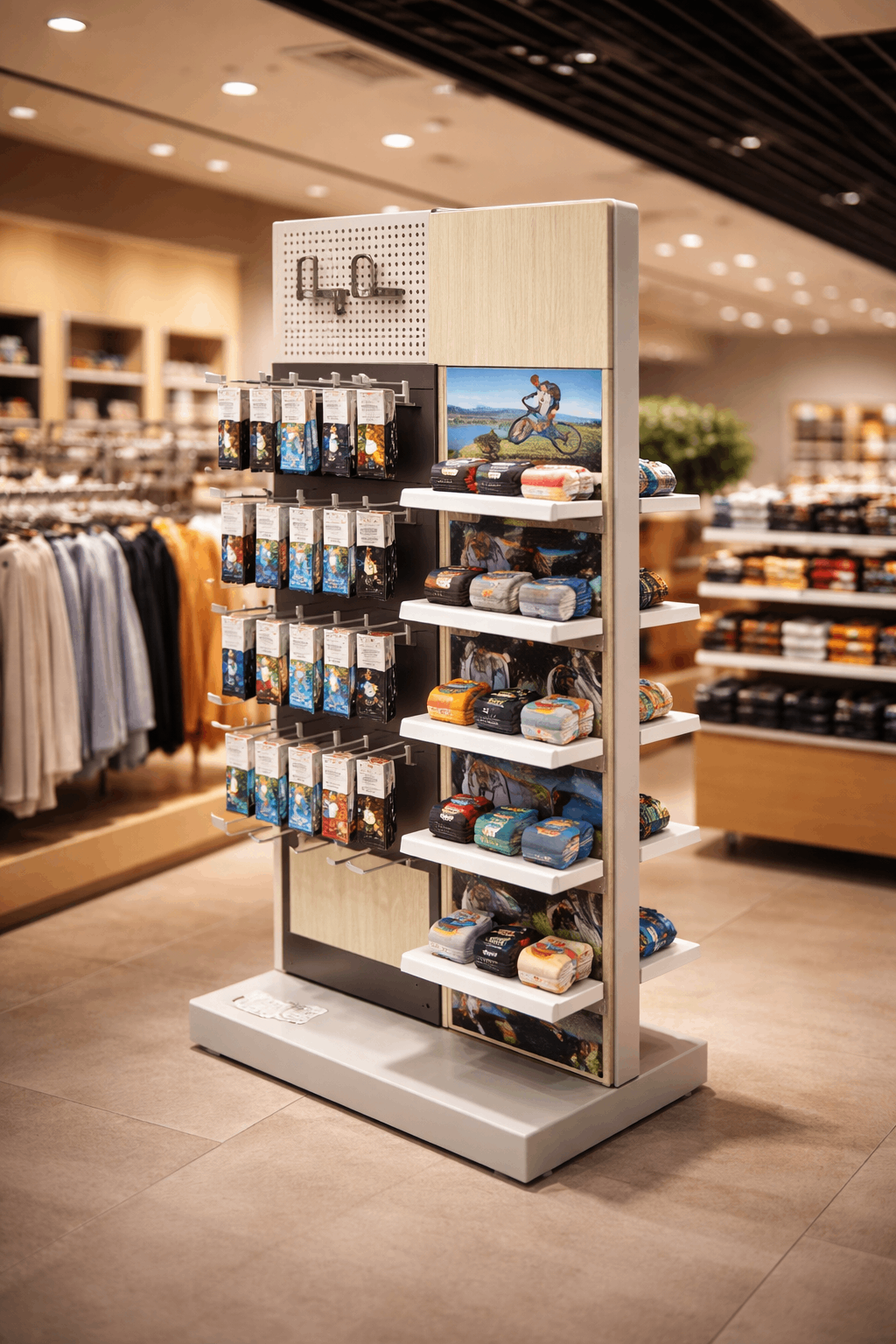
A 2 way retail sock display rack is a freestanding apparel fixture designed to present packaged socks, folded socks, hosiery, and small textile accessories on both sides of its structure. Dual sided presentations increase exposure by opening up two independent shopper approach angles and doubling the number of facing opportunities without expanding floor footprint. Overseas distributors often serve customers operating in supermarkets, sporting goods stores, and fashion boutiques, and therefore value a universal fixture platform that can serve multiple end markets without redesigning components from zero.
In wholesale oriented deployments, the same rack model may be sent to different retailers who use different packaging formats. For example, sporting goods stores frequently use carded athletic socks, while supermarkets favor hanging polybags for value packs, and boutiques may merchandise premium pairs in folding boxes. The dual format capability, consisting of hanging hooks and adjustable shelves, accommodates all three scenarios. This reduces SKU proliferation for fixtures, simplifies procurement forecasts, and reduces container space through unified packing systems.
The frame is constructed from steel tube and sheet metal components that are laser cut, bent, welded, and powder coated. The engineering objective is to achieve high structural rigidity, low wobble under fully loaded conditions, and strong resistance to abrasion and corrosion. Industrial style powder coatings are common because they withstand cleaning agents and routine contact without paint flaking. A KD (knock down) architecture is applied to minimize cubic space during export and to streamline installation at destination stores with basic hand tools.
Dual sided loading introduces mechanical considerations related to center of gravity, load distribution, and base footprint geometry. The base dimension is selected to resist tipping forces generated when one side carries heavier boxes and the opposite side carries lighter carded socks. In practical retail operations, inconsistent loading is common, so overseas buyers evaluate racks not in ideal symmetric load conditions but in realistic asymmetric ones. A well balanced footprint that maintains floor contact under such conditions supports safety approvals by major retail accounts.
Steel selection typically involves cold rolled carbon steel for cost efficiency and stainless steel grades for moisture sensitive environments. Shelf panels may use MDF, wood veneer, or powder coated steel depending on branding and durability targets. Wood veneer shelves deliver warmth for lifestyle brands, whereas steel shelves maximize durability and cleaning frequency tolerance. Acrylic can be used for header graphics or side panels to support branding without adding excessive weight.
Powder coating quality influences lifecycle cost experienced by chain store operators. Coatings that pass standard crosshatch adhesion and salt spray tests maintain aesthetic consistency during extended deployments. This matters because damaged coatings increase replacement and maintenance cost for downstream buyers, particularly when rolling out across multiple regions. Proper surface pre treatment, such as degreasing, iron phosphating, and thorough curing, reduces paint failure risk and extends fixture lifespan.
Retail categories such as socks rely on high product visibility and logical assortment structure to support quick selection. Shoppers often self serve without staff assistance, so fixtures must present clear access to sizes, colors, and performance categories. A dual sided retail sock display rack increases SKU facings per square meter, a metric used by category managers to evaluate fixture efficiency. More facings improve assortment communication and reduce out of stock perception during peak traffic.
From a visual merchandising (VM) standpoint, hooks support vertical narrative structures such as grouping by colorway or sport type, while shelves accommodate heavier multipacks or promotional gift sets. Sporting chains may place premium running socks at eye level and value packs lower down to encourage trade up behavior. Similarly, boutiques may focus on curated color blocking rather than volume, placing brightly colored happy socks style graphics in front rows to attract attention and support brand storytelling.
Compatibility with varied retail channels is essential for bulk buyers who sell into diverse accounts. Supermarkets focus on throughput and require fixtures that can handle high frequency restocking with minimal labor. Sporting goods chains emphasize performance segmentation and marketing messaging. Boutiques emphasize aesthetics and cohesive brand identity. The combination of metal hanging hooks and shelves gives the fixture an adaptable platform for all three types without redesign.
From a packaging perspective, the rack supports hanging socks on hooks, boxed socks on shelves, and combination packs that use both. For instance, a buyer may supply athletic socks to a chain in Guangdong Province, China using carded hang tags, while shipping multipacks to European supermarkets in box sets. The same fixture model reduces the need to re-engineer POP kits for each market because the hooks and shelves can be reconfigured during store level installation, turning one socks hanging stand design into a flexible solution for different retail sock display environments.
Bulk purchasing for retail chains and distributors often requires customization that reflects brand standards, store plans, and promotional campaigns. Customizable elements include overall dimensions, powder coat colors, shelf materials, hook spacing, header signage, and side graphics. These allow buyers to align fixtures with private label identity or licensed brand guidelines while still maintaining a common engineering platform across multiple clients.
Graphic areas support brand communication without permanent alteration of the metal structure. Acrylic headers can display logos, while side panels can showcase lifestyle photography. These elements are replaceable, enabling seasonal updates or promotional shifts without replacing the entire fixture. Imported fixtures with such flexibility are favored by distributors because they minimize sunk capital and encourage reusability across different marketing cycles.
| Attribute | Detail |
|---|---|
| Structure | Steel tube and sheet metal KD construction |
| Display Modes | Hanging hooks and shelves configurable on both sides |
| Dimensions | Customizable according to store planning drawings |
| Finish | Powder coat with optional stainless components |
| Shelves | MDF or metal shelves adjustable in height |
| Hooks | Metal hanging hooks with standardized spacing |
| Branding | Headers, side panels, and acrylic elements optional |
| Load Capacity | Tested for fully loaded asymmetric conditions |
| MOQ | Suited for regional tests and chain rollouts |
| Lead Time | Based on volume and customization scope |
| Origin | Guangdong Province, China |
These specifications represent typical wholesale level data points used by purchasing teams during comparison between suppliers. They also support search intent patterns where buyers include geographic qualifiers such as Guangdong Province, China when narrowing sourcing options by region.
KD (knock down) packaging allows multiple units to fit into a single export carton, reducing freight cost and import duties. It also reduces damage risk during international transit. Overseas buyers often request internal packing tests using vibration protocols or drop simulations to verify protection levels. Once cartons arrive at destination stores, assembly can be completed with basic tools and without specialized labor, lowering rollout cost for retail chains with hundreds of stores.
Lifecycle considerations include surface durability, replacement part availability, and compatibility with future campaigns. A fixture that uses standardized hooks, shelves, and graphic mounts can be maintained over years rather than months. Buyers benefit because long lifecycle reduces total cost of ownership, a key factor in procurement decisions for display infrastructure.
When compared with ad hoc shelving solutions or temporary cardboard displays, a metal retail sock display rack stretches capital over longer time horizons. Ad hoc fixtures may have lower unit price but higher indirect costs due to limited hooks, poor durability, or failure to support seasonal merchandising. Buyers who manage category profitability recognize that sturdy dual sided displays deliver downstream profit through higher facings, better presentation, and reduced maintenance labor. In this sense, fixtures become strategic procurement items rather than disposable promotional tools.
Competitive buyers typically evaluate three primary metrics: fixture flexibility, installation cost, and retail performance. Flexibility refers to how well a fixture handles changing packaging or customer requirements. Installation cost includes freight, duties, and store labor. Retail performance covers sell through, visibility, and SKU density. The 2 way retail sock display rack with hanging hooks and shelves performs strongly across all three, making it suitable for distributors building a portfolio of retail ready fixtures.
For overseas wholesalers, retail solution providers, and chain store buyers searching for a universal sock display rack that balances durability, visual clarity, ease of installation, and branding flexibility, this dual sided system presents a reliable option. The integration of metal hanging hooks and shelves supports both performance driven sports socks and visually expressive happy socks style assortments at the same time without requiring separate display infrastructures. Buyers who require further details can request specifications, drawings, and wholesale pricing from Yishang Display to evaluate suitability for their regional markets and end customers.


Yishang Display specializes in crafting bespoke display solutions. From initial concept and prototyping through to full-scale production, our in-house team manages every phase—delivering a seamless, one-stop experience for your brand.
If you have any questions or need a quote, please send us a message. One of our specialists will get back to you within 24 hours and help you select the correct valve for your needs.
All of our products are available for sampling