This practical acrylic and metal sunglasses display for supermarket is a lockable, countertop-style eyewear display cabinet built for wholesale procurement and repeatable retail rollouts. It combines clear acrylic panels for fast product visibility with a rigid metal frame for day-to-day stability in high‑traffic store zones.
It is designed for supermarket programs where buyers care about consistent presentation, easy replenishment, and predictable bulk supply—without turning the page into a company brochure.
Wholesale buyers usually scan product pages to answer a few sourcing questions quickly: Will it fit our planogram? Will it stay tidy in busy stores? Can the supplier deliver the same spec across batches? The cabinet format shown here is built around those procurement needs.
| Procurement Concern | What to look for in this cabinet | Why it matters in chain rollouts |
|---|---|---|
| Planogram fit | Compact countertop footprint; configurable internal layout | Keeps placement consistent across stores |
| Sell‑through support | Clear acrylic visibility; organized facing positions | Helps shoppers choose quickly at checkout |
| Loss prevention | Optional locking hardware | Aligns with shrink policy by region |
| Store labor | Fast replenishment; tidy layout that holds shape | Reduces staff time correcting messy displays |
| Bulk repeatability | Stable metal structure; consistent build spec | Avoids store-by-store variation and rework |
For procurement teams preparing internal approvals or supplier comparisons, the following specification framework helps speed up RFQ evaluation. Final parameters can be adjusted based on project requirements.
| Item | Typical Configuration | Procurement Relevance |
|---|---|---|
| Display type | Countertop eyewear display cabinet | Suitable for checkout and impulse zones |
| Capacity | Up to 18 pairs of sunglasses | Balances SKU variety and selection speed |
| Materials | Acrylic panels + metal frame | Visibility with long‑term structural stability |
| Header panel | PVC or acrylic, logo‑ready | Supports branding and seasonal campaigns |
| Lock option | Optional cam lock / keyed‑alike | Aligns with shrink‑management policy |
| Footprint | Customizable within planogram limits | Ensures consistent placement |
| MOQ | Project‑based | Supports wholesale pricing models |
| Lead time | Confirmed per order quantity | Enables rollout scheduling |
| Packaging | Export‑ready cartons, protective packing | Reduces damage and claim risk |
Supermarket eyewear merchandising runs on speed. Shoppers browse in seconds—often while queuing at checkout or passing a high‑visibility endcap—so the display needs to present sunglasses clearly without becoming cluttered after repeated handling. At the same time, store teams must replenish quickly, typically during peak hours, with minimal disruption.
This sunglasses display for supermarket environments is designed for those day-to-day realities. It suits checkout zones, impulse aisles, promotional endcaps, and seasonal areas where interaction levels are high. For overseas wholesale buyers managing multiple locations, the key requirement is not novelty. It is repeatability—a cabinet that behaves the same way in every store and keeps presentation standards consistent.
From a procurement perspective, the most important outcomes are practical. The unit should remain stable under frequent touch. It should support fast replenishment with minimal training. And it should arrive with consistent size, structure, and finish across bulk orders, reducing rollout risk.
In supermarket retail, practicality is not a design preference but an operational requirement. A practical display cabinet must remain stable in crowded areas, keep products readable from multiple angles, and maintain order after months of daily handling. Fixtures that prioritize appearance over function often require frequent adjustment or replacement, increasing operational cost.
Wholesale buyers typically assess displays through the lens of total cost of ownership, not aesthetics alone. Factors such as durability, ease of replenishment, and long-term reliability directly affect labor efficiency and maintenance expense across multiple stores. For this reason, practical retail display stands are favored in supermarket programs where scalability and consistency are critical.
A hybrid acrylic and metal sunglasses display is not a styling decision; it is a functional one. Supermarkets require both strong visibility and dependable structure, and no single material performs both roles equally well.
Acrylic panels provide transparency that allows customers to see lens colors and frame shapes instantly. This clear presentation improves impulse buying and helps maintain a clean, organized appearance. Acrylic also resists shattering and is suitable for high‑traffic areas where accidental contact is common.
The metal frame delivers structural integrity. A metal sunglasses display cabinet maintains its geometry over time, resists deformation, and provides enhanced stability when fully stocked. In practical use, the metal frame keeps doors aligned, supports optional locking mechanisms, and prevents long‑term wobbling. By assigning acrylic and metal to the tasks they perform best, the display achieves both visual appeal and long service life.
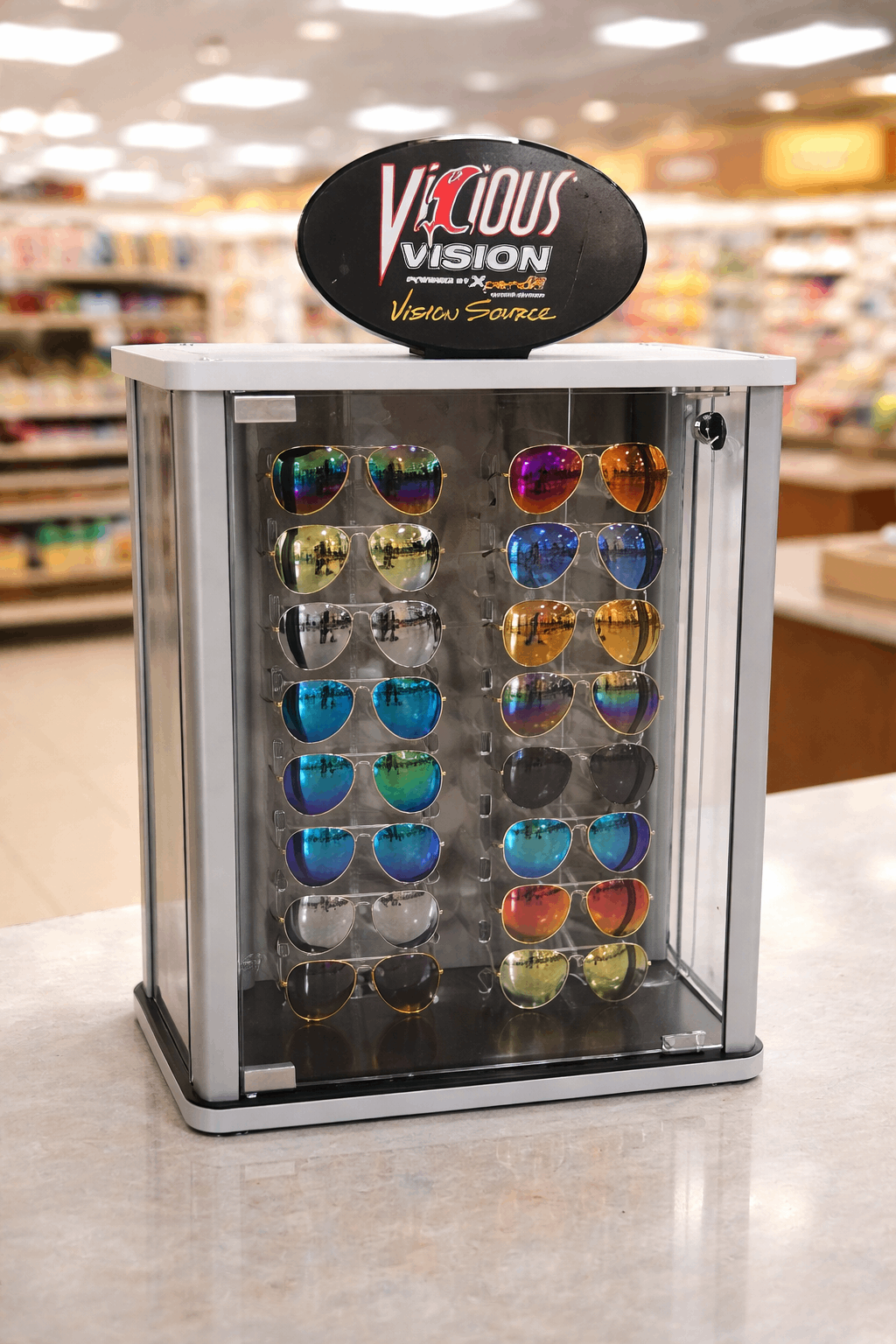
The product image shows a lockable countertop eyewear display cabinet with a compact footprint and a clear front panel. This cabinet-style format is popular in supermarkets because it keeps the assortment visible while maintaining order—an advantage in impulse zones where open hook racks often drift into clutter.
Inside, the layout is configured to hold multiple pairs of glasses in a neat, repeatable arrangement. Depending on your assortment strategy, the cabinet can be configured to display up to 18 pairs of sunglasses. That capacity is deliberate: enough variety to encourage browsing, but controlled enough to prevent visual overload.
A header area at the top supports merchandising identity such as your brand logo or a campaign message. Many buyers choose a PVC header panel because it is lightweight, durable, and straightforward to print and replace during seasonal resets.
Capacity is not only a number; it shapes how quickly a shopper can make a decision. In supermarkets, if an eyewear display looks crowded or disorganized, browsing drops sharply. That is why the best-performing programs treat capacity as a balance between SKU variety and readability.
This sunglass cabinet display uses structured spacing so each pair stays visible and easy to access. Clear separation helps shoppers compare styles quickly, and the cabinet layout reduces tangling and overlap—common issues with open racks in high‑touch zones.
For wholesale buyers managing planograms across many locations, the organized layout has another benefit: it reduces restocking errors. When each position is visually clear, store teams can replenish faster and keep the display looking full with less intervention.
Durability in supermarket fixtures is measured over months and years, not weeks. A display cabinet should tolerate daily bumps, frequent access, and repeated product handling without developing wobble, misalignment, or cosmetic deterioration that makes the program look neglected.
The metal frame for enhanced stability provides the structural support needed to maintain performance under these conditions. Metal framing helps the cabinet keep its geometry over time, which is especially important when a locking option is used and door alignment matters.
From a sourcing standpoint, durability protects total cost of ownership. A stable, long-lasting cabinet reduces replacement cycles and limits store-level maintenance across a rollout—savings that become meaningful when multiplied across dozens or hundreds of locations.
While operational performance is the priority, visibility still directly influences sell‑through in supermarket eyewear programs. The clear acrylic panels and clean metal frame are designed to keep sunglasses easy to read at a glance, even when customers approach from different directions. This matters in checkout and impulse zones, where attention spans are short and decisions are made quickly.
Instead of focusing on decorative styling, the display maintains a controlled, modern appearance that supports product clarity. The enclosed cabinet format keeps the assortment tidy, which helps maintain perceived value over time. For wholesale buyers, this balance between visibility and discipline is more effective than purely aesthetic fixtures that lose order after repeated use.
A lockable countertop eyewear display is not required in every supermarket, but it plays a role in specific store formats. Locations with higher‑value sunglasses, self‑checkout lanes, or entrances with higher shrink exposure often benefit from controlled access.
This display cabinet supports optional locking, allowing buyers to apply the same cabinet platform across regions while adapting security levels locally. Some chain programs also request keyed‑alike locks to simplify store operations and reduce key management during rollout.
Keeping locking optional rather than mandatory helps procurement teams standardize displays without over‑engineering low‑risk locations.
Procurement decisions often involve comparing cabinet displays with other common eyewear fixtures. Understanding when a cabinet format performs best helps reduce misapplication and post‑deployment adjustments.
| Display format | Typical use case | Key consideration |
|---|---|---|
| Cabinet display | Checkout, high‑risk impulse zones | Orderly presentation and optional security |
| Rotating stand | Space‑limited browsing areas | Maximizes visibility in small footprints |
| Wall or slatwall | Optical or dedicated eyewear sections | Permanent placement with staff oversight |
| Open hook rack | Low‑risk, fast self‑service zones | Lowest cost, higher maintenance |
For supermarket programs where consistency and control matter, cabinet displays are often selected as the most balanced solution.
Customization should support operational goals rather than introduce complexity. This acrylic and metal sunglasses display can be customized in size, internal layout, header branding, and material balance to meet supermarket requirements.
Common customization requests include adjusting capacity for specific assortments, modifying header dimensions for branding, and selecting material ratios that balance cost with durability. These options help buyers align the display with planograms and brand standards while keeping the structure consistent across bulk orders.
The focus of customization is repeatability. A customized display should still be easy to reorder, replace, and deploy across multiple stores without variation.
For overseas wholesale buyers, ease of store execution is a real cost driver. This cabinet is designed for straightforward setup and predictable handling so store teams can install and replenish it with minimal training. That reduces labor time during rollout and reduces the chance that the display drifts out of planogram.
Export handling also matters. Export‑ready packaging protects the cabinet during shipping and supports consistent arrival condition across cartons. Predictable packing improves logistics planning and helps reduce damage claims—an important factor when replenishment stock must match existing fixtures.
This display cabinet is optimized for supermarkets and high‑traffic retail. It is not intended for boutique environments where decorative styling and low interaction levels are the priority. In such cases, lighter or purely decorative fixtures may be more appropriate.
By clearly defining its intended use, the display helps buyers avoid misapplication and ensures performance expectations are met after deployment.
Bulk programs depend on consistency more than novelty. This eyewear display cabinet is produced for wholesale supply, with emphasis on repeatable dimensions, stable materials, and predictable lead times. For chain rollouts, that consistency reduces store-level adjustments and keeps installation predictable.
When buyers source display cabinets from China, what matters most is not the region name—it is repeatability across batches. The goal is simple: the next shipment should match the last shipment so replacements, expansions, and multi‑phase rollouts remain seamless.
International buyers often require clear compliance documentation. This display cabinet is produced under ISO 9001 quality management practices and supports RoHS‑related material requirements. These standards help buyers meet internal sourcing and compliance checks.
Quality control emphasizes consistency across batches, ensuring that replacement units match original installations. For supermarket programs, this consistency reduces operational risk and simplifies long‑term maintenance.
If your program targets supermarkets, convenience stores, or retail chains selling sunglasses as impulse products, this practical acrylic and metal sunglasses display for supermarket environments offers a balanced solution. It combines clear visibility, controlled capacity, optional security, and stable structure in a format that supports bulk procurement.
It is a strong fit when you need consistent presentation across locations and a cabinet that stays tidy under frequent touch. If your assortment or placement is different—such as boutique-only environments or low-traffic specialty stores—other fixture types may be more appropriate.
If you want to confirm sizing, capacity, header branding, and locking options for your planogram, a short RFQ is usually enough. Yishang Display can review your basic requirements and suggest a configuration that matches your rollout goals.
Yishang Display specializes in crafting bespoke display solutions. From initial concept and prototyping through to full-scale production, our in-house team manages every phase—delivering a seamless, one-stop experience for your brand.
If you have any questions or need a quote, please send us a message. One of our specialists will get back to you within 24 hours and help you select the correct valve for your needs.
All of our products are available for sampling