In many retail stores, socks are small products with high turnover. They are frequently purchased together with shoes, sportswear, or casual apparel. Because the packaging is compact, socks can easily become disorganized when placed on ordinary shelves. Retailers therefore rely on dedicated merchandising fixtures that keep products visible, organized, and easy to browse.
For overseas wholesalers, distributors, and procurement teams, a display rack is evaluated differently than ordinary store equipment. Buyers normally focus on durability, consistent production quality, efficient shipping, and the ability to deploy the same display format across many stores. These factors influence whether a fixture can support long‑term retail rollout programs.
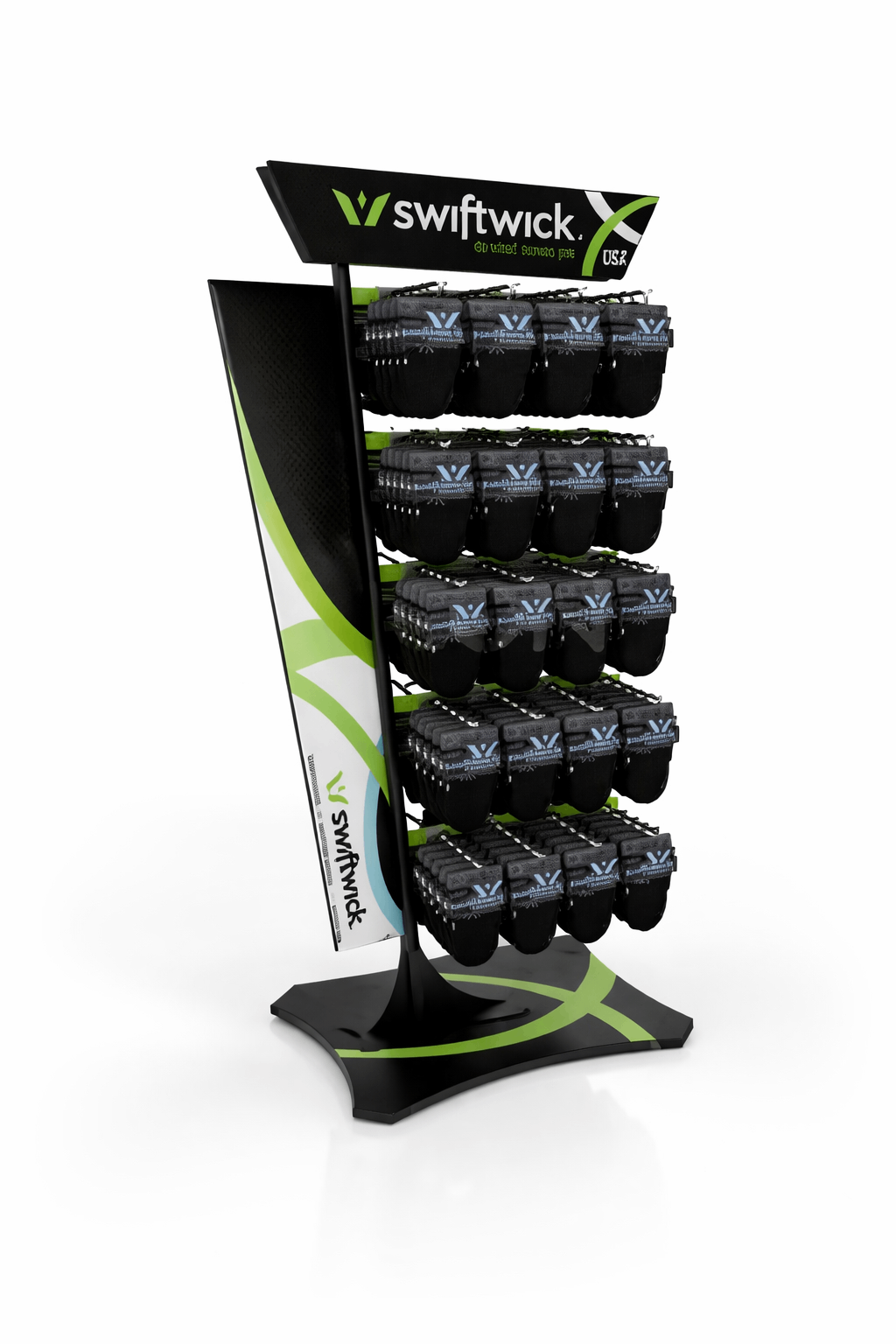
The metal 5‑layer floor sock merchandising retail store socks display stand by Yishang Display is designed with these sourcing requirements in mind. It combines durable metal fabrication, organized hook merchandising, and customizable POP branding areas. The structure allows retailers to present socks clearly while enabling buyers to scale production and distribution efficiently.
Socks are often impulse‑purchase items. Customers rarely spend much time comparing them, but they still want to see several designs before making a decision. When socks are stacked in boxes or placed randomly on shelves, the browsing process becomes inefficient.
A vertical merchandising rack solves this issue by presenting products in clearly organized rows. Each package hangs on a hook, making designs and sizes visible at a glance. Customers can quickly scan multiple options without digging through piles of products.
For store operations, this layout also reduces maintenance work. Staff can restock merchandise easily by adding new packages behind the front product on each hook. The display therefore remains tidy throughout the day.
For wholesale buyers supplying multiple stores, standardized fixtures also simplify merchandising. When every location uses the same display format, store teams can follow consistent product placement guidelines.
This display rack is designed as a single‑sided floor display, meaning all merchandise faces one direction. Single‑sided displays are commonly placed near walls, aisle ends, or footwear sections where customers approach from the front.
The five‑layer structure provides multiple merchandising zones while maintaining a compact footprint. Retailers can group products by color, style, or promotional category without occupying excessive floor space.
For distributors and retail chains, this standardized structure supports repeat purchasing. When the same display is used across different locations, brand presentation remains consistent and reorders can be produced with predictable specifications.
The display also includes several graphic areas that transform the rack into a POP display fixture. These elements help attract customer attention while reinforcing brand identity.
For distributors and sourcing managers evaluating retail fixtures, a quick overview of procurement factors is often helpful before reviewing detailed specifications.
| Procurement Factor | Typical Details |
|---|---|
| Production Type | OEM / Custom Retail Display |
| Structure | Single‑Sided Metal Floor Display |
| Shipping Format | Flat‑packed or Knock‑Down Structure |
| Branding Options | Header Sign, Side Graphic Panel, Base Graphics |
| Surface Finish | Powder‑Coated Metal Frame |
| Documentation | 2D/3D Drawings and Artwork Guidelines Available |
These elements help procurement teams quickly determine whether a display can fit into existing store rollout plans or branded merchandising programs.
Retail display fixtures are often the first place where customers notice a brand inside a store. Before reading product packaging, shoppers typically respond to the overall structure and graphics of the display.
The top header panel provides a prominent space for logos and promotional messaging. The header surface is designed with a slightly angled orientation, allowing graphics to remain visible from a distance as customers walk through the aisle.
A vertical side panel adds additional space for branding information such as product features or brand storytelling. Positioned beside the merchandise rows, this panel naturally directs attention toward the products.
Brand graphics can also extend to the base of the display. Together, the header, side panel, and base form a visual hierarchy that links brand communication with the merchandise presentation.
For wholesale buyers managing branded retail programs, these graphic components allow customization without altering the main structure of the display rack.
The five‑layer structure balances capacity with product visibility. Instead of crowding merchandise onto a single shelf, the display separates products into organized levels.
Vertical displays also match natural browsing behavior. Shoppers typically scan items from eye level downward, making layered arrangements easier to navigate than horizontal shelves.
Retail merchandising studies show that clearly organized displays increase customer interaction because shoppers can compare items quickly. When the assortment appears full and structured, customers feel more confident selecting products.
For procurement teams managing several retail locations, the consistent layer format also supports standardized merchandising plans across stores.
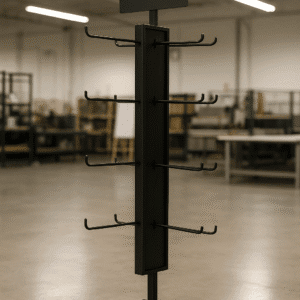
Each layer of the display includes multiple metal hooks designed for hanging retail packaging. Because most sock packages include a hanging hole, hook merchandising is one of the most efficient ways to organize the products.
Multiple rows of hooks increase product capacity while keeping the front product visible. Additional units can be placed behind the first package so the display remains organized even as inventory is replenished.
Depending on hook spacing and packaging thickness, a five‑layer configuration can typically hold around 40–50 pairs of packaged socks. This predictable capacity helps buyers plan inventory allocation during store rollout programs.
A stable base is essential for any floor display fixture. The metal base distributes weight evenly across the floor and helps prevent the rack from tipping when fully loaded.
In busy retail environments where customers frequently interact with displays, structural stability improves both safety and product protection.
For procurement teams, a reliable base also reduces operational risk and helps maintain a professional store presentation.
Durability is an important consideration when selecting retail fixtures. Display racks are handled frequently by both customers and store staff, so they must maintain structural stability over long periods of use.
This display uses a metal frame rather than lightweight plastic structures. Metal fabrication processes such as cutting, bending, and welding create a rigid structure capable of supporting multiple rows of merchandise.
After fabrication, the surface is finished with powder coating. Powder coating protects the metal from corrosion and scratches while providing a smooth, uniform appearance suitable for retail environments.
In branded display programs, acrylic or printed panels may be integrated into the structure. These materials provide visual contrast while keeping the overall fixture lightweight enough for efficient shipping and assembly.
For wholesale buyers, transparency about materials and manufacturing methods helps estimate the expected lifespan of the display fixture.
Even the best display fixture performs poorly if placed in the wrong location. Retailers typically position sock displays near footwear departments, entrance areas, or checkout counters where customer traffic is high.
When socks are placed close to shoes or sportswear, customers often add them to their purchase as complementary items. This cross‑merchandising strategy increases product visibility without requiring additional shelf space.
The layered design of the display also supports seasonal merchandising. Retailers may highlight new collections on upper levels while placing core products on lower rows.
For distributors supplying several retail channels, this flexible merchandising structure allows the same display fixture to adapt to different store layouts.
Retail display fixtures are frequently customized to match brand identity and packaging formats. Customization allows the same structural design to support different merchandising programs.
Display dimensions may be adjusted to fit different retail spaces or product assortments. Some buyers require higher capacity displays, while others prefer compact racks for smaller stores.
Brand graphics are usually applied to the header panel, side panel, and base area. These areas can feature logos, promotional messaging, or product imagery that reinforces brand recognition.
Powder coating also allows the metal frame to match brand color standards, ensuring consistent visual presentation across store locations.
When starting a custom display project, buyers typically provide packaging dimensions, artwork files, and expected display capacity. This information allows the supplier to prepare accurate engineering drawings and quotations. In OEM programs, this type of project may also be described as a custom sock display rack with logo or an OEM metal retail display stand, both common search terms used by procurement teams looking for tailored display solutions.
Large retail programs often require hundreds or thousands of identical display fixtures. For this reason, production repeatability is a critical factor for wholesale buyers.
Manufacturing normally begins with engineering design, where hook spacing, structural dimensions, and graphic placement are defined. Accurate drawings ensure that production batches remain consistent.
The frame is fabricated through cutting, bending, and welding processes that create the main structure. After fabrication, powder coating provides both protection and visual consistency.
Quality inspections verify structural strength, finishing quality, and dimensional accuracy. Maintaining consistent standards across production batches helps ensure that displays ordered later match previous installations.
Reliable export packaging is also essential. Protective materials such as foam layers, corner protectors, and reinforced cartons help prevent scratches, bent hooks, or damaged graphics during international shipping.
For international buyers, clear documentation also supports smoother project coordination. Suppliers typically provide engineering drawings, graphic artwork guidelines, and sometimes 3D renderings to confirm branding layout before production begins. This process reduces communication errors and ensures that the final display matches the merchandising concept approved by the buyer.
| Item | Specification |
|---|---|
| Product Name | Metal 5‑Layer Sock Display Stand |
| Structure | Single‑Sided Floor Display |
| Material | Powder Coated Metal |
| Hook Layout | Multi‑Row Hooks |
| Capacity | Approx. 40–50 Pairs |
| Branding Area | Header Sign, Side Panel, Base |
| Assembly | Simple Installation |
| Application | Apparel Stores, Sports Retail, Supermarkets |
| Customization | Size, layers, color, graphics |
Specifications can be adjusted according to merchandising requirements.
Wholesale buyers often ask about durability. Metal display fixtures usually provide longer service life than lightweight materials because they maintain structural stability under continuous use.
Another common question concerns customization. Display racks can normally be adapted to different packaging sizes or branding requirements without altering the main structure.
Buyers also ask about sampling and lead time. In many OEM display programs, a prototype sample is produced before mass production to confirm dimensions and graphic placement.
Shipping efficiency is also important. Most retail display racks are designed for compact export packaging and straightforward assembly so store teams can install them quickly.
An organized sock display stand improves product visibility while helping retailers maintain efficient merchandising. The combination of vertical presentation, durable metal construction, and customizable branding areas makes this display suitable for many retail environments.
For wholesalers and retail procurement teams, a reliable display fixture supports scalable store rollout programs through consistent manufacturing quality and predictable merchandising capacity.
If you are sourcing retail display fixtures for a merchandising program, Yishang Display can help evaluate configurations that match your store layout and branding requirements.
Yishang Display specializes in crafting bespoke display solutions. From initial concept and prototyping through to full-scale production, our in-house team manages every phase—delivering a seamless, one-stop experience for your brand.
If you have any questions or need a quote, please send us a message. One of our specialists will get back to you within 24 hours and help you select the correct valve for your needs.
All of our products are available for sampling