For overseas wholesale buyers, a clothing display rack is rarely judged on appearance alone. The real questions are practical: Will it hold up in daily store use, fit different retail layouts, ship efficiently, and support consistent brand presentation across multiple locations? That is how procurement teams, fixture buyers, and merchandising managers usually assess a retail display fixture supplier.
In boutique apparel retail, presentation quality directly affects how products are perceived. Stores do not simply need a place to hang garments. They need a fixture that helps organize collections, improves visual clarity, and supports faster replenishment on the sales floor. A well planned metal floor retail clothing display rack does all three without making the store feel crowded.
This matters even more in compact stores where floor area is limited and every fixture must justify its footprint. Buyers searching terms such as clothing racks wholesale, custom retail clothing display racks, or metal clothing rack manufacturer are often comparing not just price, but display efficiency, material durability, and ease of rollout across a chain or franchise network.
That is why this product should be understood as a merchandising tool rather than a basic storage unit. It is built to help retailers present apparel neatly, keep reserve stock close at hand, and maintain a cleaner visual standard across different store formats.
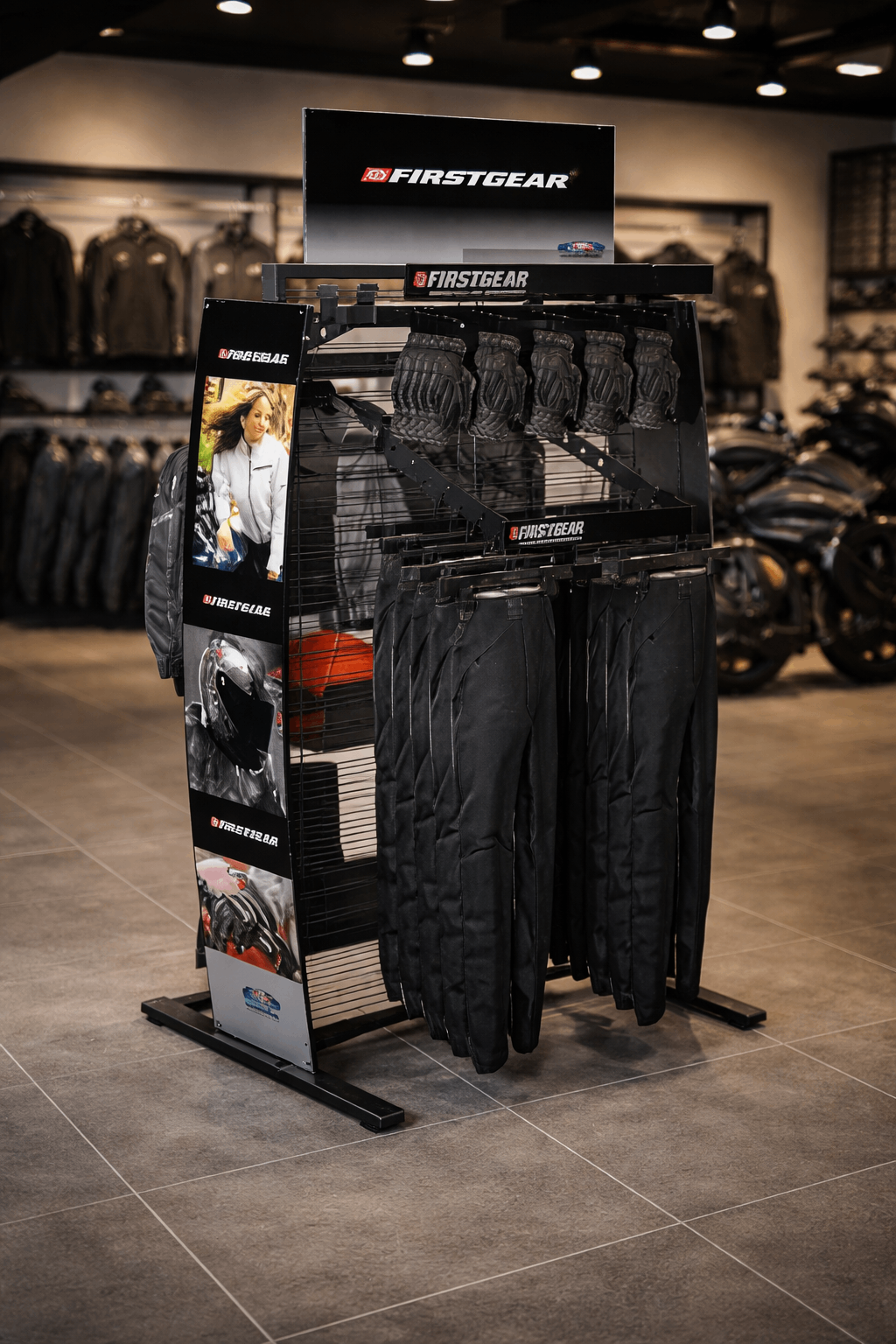
This trendy boutique metal floor retail clothing storage display rack is designed as a multi-category branded apparel display fixture, rather than a simple garment rack. The structure allows retailers to present different types of merchandise within one compact unit — for example trousers in the front hanging area, accessories or smaller items in the upper display zone, and brand storytelling through graphic panels.
Unlike standard boutique clothing racks that only provide a single hanging rail, this floor-standing retail display rack combines front-facing apparel presentation, upper accessory display, and branded graphic panels in one structure. This configuration makes it suitable for stores that want to create a small product zone or brand-focused display area.
The open multi-sided layout allows garments to be visible from several customer pathways. In busy retail environment where structured display systems are widely recommended by the National Retail Federation retail design guidances this increases product exposure without expanding the floor footprint. Buyers searching for clothing racks wholesale or custom retail clothing display racks often prefer this type of structure because one fixture can handle multiple merchandising functions at once.
For retail chains and distributors rolling out display fixtures across different stores, the rack offers a balanced solution: strong steel construction, flexible merchandising layout, and integrated brand presentation.
Good retail fixtures do more than hold products. They influence how customers move, what they notice first, and how easily store staff can maintain the display throughout the day. The structure of this retail clothing display rack is built around those priorities.
The upper hanging section uses reinforced bars to support organized garment presentation. Proper spacing between items helps each piece remain visible and makes the collection easier to browse. This is particularly important for boutique stores, where a crowded rack can lower perceived product value and make the display look disordered.
For buyers evaluating a heavy duty garment display rack, spacing is not a minor detail. It affects both shopping comfort and merchandising discipline. Jackets, shirts, trousers, or coordinated looks can be grouped by color, fit, or collection theme, making the fixture easier for store teams to manage.
This section also supports a cleaner presentation for fashion brands that want each garment to stand out. When apparel is displayed with enough breathing space, customers can assess cut, fabric, and styling more easily. That is a practical advantage in retail environments where product presentation directly supports sell-through.
A major benefit of this fixture is its multi-sided display format. Rather than presenting garments from one direction only, the rack allows the merchandise to be viewed from several angles. This creates a stronger visual presence in the store and makes better use of traffic flow around the fixture.
For chain stores and distributors buying floor standing apparel display racks in volume, this layout can improve fixture productivity. One unit can display more visible product than a single-sided rack while still keeping the footprint compact. That often matters when buyers are planning standard fixture packages for stores with limited space.
Multi-side presentation also works well for feature collections, seasonal campaigns, or new arrivals. If the fixture is placed in a central position, it can act as a small merchandising zone rather than just a garment holder.
Retail operations depend on replenishment speed. If backup stock is too far from the sales floor, staff spend more time restocking and less time supporting customers. That is one reason integrated clothing storage display is valuable in a boutique or specialty retail environment.
This rack includes practical storage space within the same structure. Folded garments, packaged accessories, or replacement sizes can be stored close to the display, helping staff keep the presentation full and organized. For buyers comparing storage display racks, this combined approach reduces the need for extra fixture pieces on the floor.
The result is a cleaner store layout and a more efficient workflow. The fixture continues to present products well, while also helping the sales team maintain the display with less interruption.
Retail display is also communication. Graphic panels give the fixture a clear branding function, allowing stores to add campaign visuals, category messages, or simple brand storytelling without installing a separate signage unit.
For procurement teams working with global or regional fashion brands, this matters because the same base fixture can be reused while graphic content changes by season, collection, or market. That improves flexibility without changing the underlying hardware.
From the customer side, brand graphics help connect the garments to a visual message aligned with modern visual merchandising principles. From the buyer side, they increase the value of the fixture by turning it into both a display system and a merchandising communication tool.
Material choice is one of the clearest indicators of whether a retail fixture is built for commercial use or short-term display. This product is centered on a steel frame because steel offers the strength, rigidity, and durability that wholesale buyers typically expect from long-life store equipment.
In practical terms, steel improves load capacity and reduces the risk of warping over time. That matters when the fixture is used for heavier garments such as denim, jackets, coats, or protective apparel. For buyers sourcing a metal clothing display rack for repeated deployment across stores, structural reliability has a direct effect on replacement cost and maintenance planning.
The frame is finished with powder coating, a common commercial finish in retail fixtures because it provides a more durable surface than many standard paint applications. Powder coating helps resist scratching, edge wear, and corrosion, which is useful in stores where racks are moved, cleaned, and handled frequently.
The design can also incorporate secondary materials such as acrylic or wood, depending on the visual direction of the retail environment. Acrylic creates a cleaner, more contemporary feel. Wood introduces warmth and can soften the industrial look of a metal display system. For buyers working on custom retail display rack programs, these material options make it easier to adapt the same core structure to different brand identities.
From a procurement point of view, this combination of steel structure and optional mixed materials supports a better total-use value. Buyers are not only purchasing a fixture that looks appropriate on day one. They are sourcing a display system built to perform over time.
Before placing an order, procurement teams usually want a fast technical overview. Clear specifications help buyers judge fit, capacity, and customization scope without searching through multiple documents.
| Feature | Specification |
|---|---|
| Primary Material | Powder coated steel frame |
| Optional Materials | Acrylic panels or wooden decorative boards |
| Structure | Floor standing clothing display rack |
| Display Orientation | Multi sided garment presentation |
| Hanging System | Reinforced metal hanging bars |
| Surface Finish | Scratch resistant powder coating |
| Branding Area | Graphic display panel support |
| Customization | Adjustable size, color, graphics, and layout |
| Typical Use | Boutique stores, apparel chains, promotional zones |
| Packing Option | Knock-down or semi-assembled subject to design |
For wholesale buyers, details such as finish type, assembly method, and customization range are often as important as appearance. These factors influence shipping cost, installation planning, and long-term usability across multiple locations.
This product is designed for apparel retail, but its usefulness depends on how different buyers apply it in practice. The fixture works best in store formats where product presentation, stock accessibility, and branded display need to be combined in one compact solution.
Boutiques often work with smaller collections and more curated product stories. In that setting, the fixture helps create a clean, focused presentation that supports higher perceived value. Coordinated outfits, category capsules, or seasonal edits can be presented without clutter.
The integrated storage area is also useful for boutique teams that need backup sizes nearby but do not want visible stock overflow on the floor.
Motorcycle gear and technical apparel typically carry more weight than standard fashion garments. A steel display structure is better suited to this product category because it handles heavier jackets and trousers more confidently than lighter retail racks.
This application also benefits from the rack’s branding panels, which can support product messaging or campaign visuals tied to a technical category.
Sportswear retailers often manage several subcategories at once, such as training apparel, running gear, and seasonal outerwear. A multi-side fixture helps separate these groups visually while keeping the presentation compact.
For buyers outfitting activewear stores, that means better category organization without needing too many individual display units.
Retail brands often need flexible fixture solutions for launches, limited collections, or campaign-driven floor sets. In these situations, the rack works as a branded feature display that combines apparel presentation with campaign graphics.
This is particularly useful for buyers who need a repeatable fixture for multiple store windows, event corners, or seasonal floor updates.
Customization is often a deciding factor for wholesale buyers because the same product category can require different display formats depending on store size, merchandise mix, and brand image. A fixture that is too fixed in structure may work in one location but create inefficiencies in another.
This rack can be adjusted in size to fit compact boutiques, standard apparel stores, or larger promotional zones. That flexibility helps buyers standardize fixture language while still adapting dimensions to local store conditions.
Color is another practical customization point. Powder coating allows the metal frame to match brand palettes, store interiors, or seasonal campaign requirements. For many buyers, finish consistency is important because it affects how well a fixture integrates with the rest of the store environment.
Graphic panels can also be customized with logos, product visuals, category labels, or campaign messaging. This makes the fixture more useful for fashion chains and branded retailers that update promotional content throughout the year.
Structural options such as shelf placement, hook additions, accessory holders, or the proportion between hanging and storage space can also be adjusted. For buyers sourcing custom retail clothing display racks, these details are often what determine whether the fixture works operationally in store.
For overseas wholesale buyers, product quality is not only about appearance in a sample photo. It is about repeatability, dimensional consistency, surface finish quality, and the confidence that the next shipment will match the first. That is why manufacturing control is a central part of fixture evaluation.
The steel components of this rack are fabricated using precision metalworking processes to keep dimensions accurate and assembly reliable. Consistency matters because fixture programs often involve repeat orders, partial store refreshes, or phased rollouts across regions.
Welding quality is equally important. A clothing display rack used every day in a retail environment must remain stable under repeated handling and changing garment loads. Strong, clean welds improve structural integrity and reduce the risk of long-term weakness at connection points.
After fabrication, the rack goes through surface preparation and powder coating. Finish consistency is important not only for appearance but also for durability, especially on edges and high-contact areas. Quality checks typically focus on dimensions, welding condition, finish quality, and structural performance before shipment.
For buyers sourcing from Yishang Display, these production details matter because they affect store rollout reliability, replacement frequency, and the overall confidence of the purchasing program.
Wholesale buyers often ask similar questions when evaluating clothing display racks, especially when the project involves multiple stores or international shipping.
One of the most common questions is load capacity. Steel structures are generally preferred for heavier apparel because they provide better rigidity and long-term stability than lighter materials.
Customization is another frequent topic. Buyers usually want to know whether the fixture can be adjusted for store size, branding, finish, and product mix. In most commercial programs, that flexibility is an important part of the buying decision.
Shipping method also matters. Many buyers prefer knock-down or partially disassembled structures because they help reduce freight volume and improve container efficiency. For international wholesale orders, packaging method can influence landed cost almost as much as fixture price.
The trendy boutique metal floor retail clothing storage display rack is designed for apparel retail programs that need more than a basic hanging unit. It combines strong steel construction, clear garment presentation, practical storage support, and branded display capability in one compact fixture.
For overseas wholesalers, brand buyers, and retail chain procurement teams, that means a display solution that is easier to standardize, easier to deploy, and better aligned with long-term store operations.
For project discussion, customization details, or quotation support, Yishang Display can help develop a fixture solution that fits your retail format and merchandising goals.


Yishang Display specializes in crafting bespoke display solutions. From initial concept and prototyping through to full-scale production, our in-house team manages every phase—delivering a seamless, one-stop experience for your brand.
If you have any questions or need a quote, please send us a message. One of our specialists will get back to you within 24 hours and help you select the correct valve for your needs.
All of our products are available for sampling