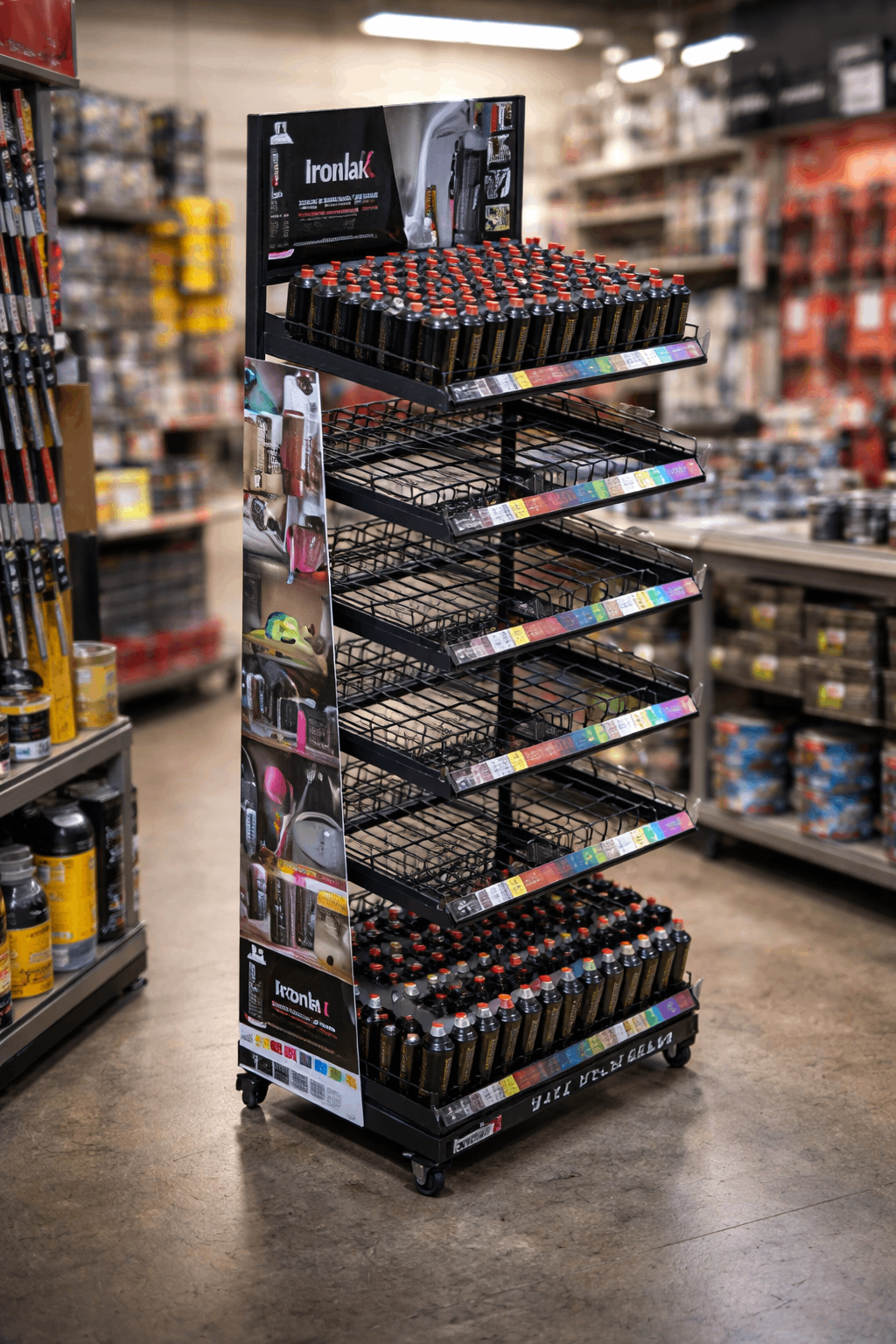
When a wholesale buyer searches for a floor standing display for retail stores, the goal is usually simple: keep products visible, organized, and stable in real stores where customers touch items all day. In high‑traffic aisles, endcaps, or open floor zones, a display is expected to perform like a store fixture—standing straight, staying tidy, and supporting quick replenishment.
This is why many distributors and project buyers choose a standing display for retail instead of relying only on wall shelving or countertop units. Floor‑standing fixtures help create a dedicated category “home” for fast‑moving SKUs, seasonal assortments, or multi‑variant products that need clear separation.
In this context, “functional” is not a style term. A functional black metal floor display is judged by stability under partial load, predictable recovery after customer interaction, and durability over a long merchandising cycle. Those outcomes directly affect store feedback, replacement frequency, and the total lifecycle cost of the fixture.
For buyers who need to scan fast, here is what this display is designed to deliver in a wholesale program.
It is a metal floor standing display built for repeatable retail deployment, supporting consistent presentation across stores. It prioritizes stability, wear resistance, and replenishment efficiency, with customization options based on SKU count, product weight, and planogram logic.
If your category requires a heavier duty floor display stand than temporary promotional units, this design aims to reduce field issues such as leaning, shelf deflection, and constant realignment during restocking.
Most retail display problems do not show up on day one. Many display fixtures for retail stores look acceptable at installation but lose alignment after weeks of uneven product removal and frequent replenishment. Over time, small weaknesses become store‑level friction: wobble, misalignment, products drifting out of order, and staff spending extra minutes on recovery.
The first issue is stability under partial load. Customers do not remove products evenly. When a display is half‑full, weight distribution changes and lightweight frames may loosen, lean, or shift. For wholesale buyers, that often becomes a chain of costs: store complaints, service time, replacements, and disrupted merchandising.
The second issue is cumulative load stress. Categories like spray paint cans, packaged tools, or automotive consumables may appear manageable individually, but the combined weight across tiers is not trivial. Without proper rigidity and joint strength, shelves can deflect, fasteners can loosen, and long‑term deformation can occur.
The third issue is operational efficiency. Store teams need a display rack display stand that supports fast restocking and predictable facing. If staff must constantly re‑align shelves or stop products from tipping during replenishment, labor cost rises and the display stops delivering value.
This functional black metal floor standing display is built around one priority: structural reliability first, merchandising usability second. The goal is to stay stable when fully loaded, stay aligned when partially loaded, and remain visually consistent through repeated customer contact.
The metal floor standing frame provides higher rigidity than lightweight alternatives. Reinforced vertical supports and a stable base help distribute weight across the structure instead of concentrating stress on one shelf or joint. In practical store terms, the display is less likely to shift when customers pull items or when staff restock quickly during peak hours.
The finish is also chosen for retail reality. A black metal floor surface with powder coating resists scuffs, scratches, and corrosion that occur in daily operation. Black remains visually neutral in most store design systems, helping products stay the focus while maintaining a clean, modern aesthetic.
This floor standing display format performs well when the category has frequent turnover and multiple variants. A common example is a paint display stand that helps organize spray paint cans by color, finish, or application. The tiered layout supports clear separation and quick replenishment, which helps stores keep the display looking “shoppable” throughout the day.
Hardware and automotive retailers also benefit from a metal rack display stand because these products are handled repeatedly and often carry moderate weight. A floor‑standing unit creates a dedicated merchandising zone where customers can compare items without crowding wall systems.
It also works well for packaged retail goods that need quick browsing and high visibility. For multi‑store rollouts, the advantage is consistency: the same merchandising logic can be repeated across locations, which wholesale buyers value when managing distributors, franchises, or chain programs.
A metal floor standing display is most effective when it is expected to stay in place and perform over a long cycle. Stores with steady foot traffic, standardized packaging, and regular replenishment tend to see the strongest return because the display becomes part of daily operations rather than a temporary accessory.
It is especially suitable as a permanent or semi‑permanent category fixture where stability and presentation consistency matter. Wholesale buyers often prefer this approach because it reduces variability in store feedback and simplifies future reorders.
If your program is short‑term, extremely price‑sensitive, or focused on ultra‑lightweight items, a temporary unit may be adequate. Clarifying this boundary helps buyers select the right display for retail stores based on real usage, which typically improves results and reduces avoidable after‑sales issues.
The long‑term performance of a store display fixture depends on details buyers care about but consumers rarely ask: rigidity, joint design, and surface treatment. These factors determine whether the display remains straight and stable after months of loading cycles.
Metal is used as the primary structural material because of its stiffness and fatigue resistance. A well‑designed metal frame maintains alignment under repeated loading and unloading, which matters for heavier categories or displays with multiple tiers.
A powder‑coated black finish helps protect the surface and keep the fixture looking consistent. For wholesale programs, color black or customized options support different retail concepts without changing the structural design. Where useful, acrylic or wood elements can be added for visibility or visual tone, but the load‑bearing structure remains metal‑based.
Many buyers choose a floor fixture not only for shelves, but for how it supports merchandising behavior in the aisle. Optional components can make a big difference in store compliance and sell‑through without changing the core structure.
A header panel or top sign area helps staff and shoppers identify the category from a distance, which is useful in busy hardware and automotive aisles. Side panels can also be used for seasonal messaging or brand blocks when you need one unit to work across multiple stores.
For smaller SKUs, samples, or add‑on items, an acrylic box or small bin section can be integrated on one side to keep loose items organized. This combination of open shelves and contained storage often reduces “messy display” feedback from stores and supports faster recovery after peak traffic.
If you have specific store fixture requirements—such as lockable storage, hooks, peg features, or mixed shelf geometry—these can be engineered into the layout while keeping the unit stable and easy to replenish.
This is a product detail page, so buyers typically want a quick reference without being locked into fixed numbers. The configuration below is adjustable based on your SKU and store requirements.
| Item | Typical Options | Notes for Buyers |
|---|---|---|
| Structure | Steel / metal frame | Designed for commercial retail use |
| Finish | Black powder coating | Wear‑resistant; professional appearance |
| Color | Black or customized | Match brand or store concept |
| Layout | Tiered shelves / mixed fixtures | Supports variants and fast recovery |
| Size | Customized | Built to fit footprint and planogram |
| Materials (optional) | Acrylic panels / wood accents | Used selectively for visibility or style |
| Logistics | Knock‑down or assembled | Chosen to optimize shipping and handling |
Wholesale buyers often compare display rack display stand options using performance criteria instead of marketing claims. The table below reflects common evaluation points used in retail merchandising programs.
| Evaluation Area | What Buyers Review | Procurement Relevance |
|---|---|---|
| Structural stability | Frame rigidity and base support | Reduces store complaints and safety risk |
| Load performance | Shelf behavior under full load | Extends service life and consistency |
| Surface durability | Scratch and corrosion resistance | Maintains appearance across locations |
| Assembly and packaging | Knock‑down design and protection | Lowers logistics cost and damage rate |
| Program repeatability | Consistent build across batches | Supports multi‑store deployment |
For wholesale buyers, customization should start with retail reality, not a generic size list. A custom retail store display is most effective when it is configured around SKU dimensions, weight per unit, replenishment rhythm, and how the category should be shopped in‑store.
Tier spacing, shelf depth, and reinforcement strategy can be adjusted to support heavier items, high‑turnover categories, or multi‑variant assortments. This makes the fixture easier to replenish and easier to keep visually consistent, which is often the difference between a display that performs for months and one that becomes a maintenance headache.
Branding elements such as headers, side panels, or acrylic messaging areas can be integrated after functional requirements are set. Options like black or customized finishes help maintain brand consistency across markets. Procurement teams also typically evaluate packaging, container utilization, and assembly time because these factors influence total landed cost.
This display for retail stores fits wholesale programs that value durability, repeatability, and consistent merchandising results. It is a strong match for moderately heavy products, multi‑variant assortments, or categories that require frequent replenishment.
For buyers managing multiple locations, a consistent standing display for retail reduces operational complexity and helps maintain a uniform planogram. The neutral black metal structure works across many store environments while keeping attention on the products.
If your program is strictly short‑term or focused on extremely lightweight items, a different fixture type may be more cost‑effective. Selecting based on real operating conditions tends to improve both performance and buyer satisfaction.
Can this be used as a paint display stand for spray paint cans?
Yes. This format is commonly used as a paint display stand because tiered shelves keep variants organized and easy to replenish. If your cans are heavier or you plan full‑shelf loading, share the approximate weight per tier so reinforcement can be planned correctly.
Can the color be matched to our brand or store concept?
Yes. Black is a common default because it fits most retail environments, but black or customized finishes are available so the unit can match a brand block or a specific store program.
Is this suitable for multi‑store rollout programs?
It can be. For rollouts, buyers typically care about batch repeatability, packaging protection, and consistent build details so every store receives the same merchandising result. Sharing your rollout plan and SKU mix helps define the most repeatable configuration.
How do you confirm the display will fit our products?
The fastest path is a simple SKU list with dimensions, weight per unit, and desired facing count. From there, shelf depth, tier spacing, and any accessory needs can be confirmed before sampling.
A reliable retail fixture should support product visibility while minimizing operational friction. This functional black metal floor standing display is engineered to balance durability, stability, and merchandising clarity for wholesale and project buyers.
Share your product type, approximate load, and intended placement area, and Yishang Display can recommend a configuration that fits your program. A short inquiry is usually enough to confirm suitability and outline customization options.


Yishang Display specializes in crafting bespoke display solutions. From initial concept and prototyping through to full-scale production, our in-house team manages every phase—delivering a seamless, one-stop experience for your brand.
If you have any questions or need a quote, please send us a message. One of our specialists will get back to you within 24 hours and help you select the correct valve for your needs.
All of our products are available for sampling