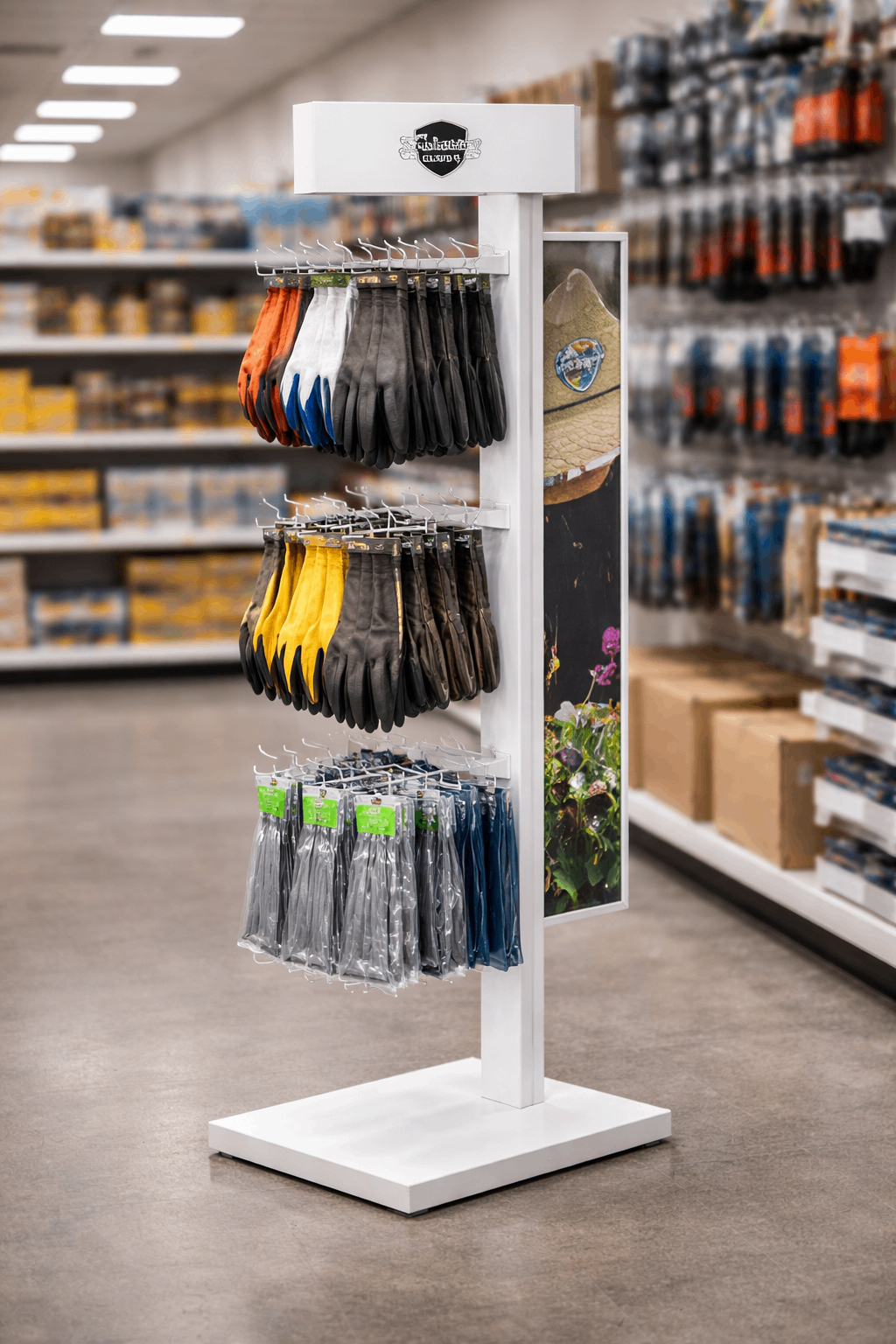
Yishang Display designs the Custom Floor Standing 6 Arms Metal Display Rack For Sleeves And Gloves specifically for overseas wholesalers, importers, and retail distributors who manage repeatable merchandising rollouts. In bulk purchasing, buyers judge a fixture by measurable outcomes: stable loading, consistent dimensions across batches, durable finishes, efficient shipping volume, and fast in-store setup.
Procurement teams typically screen suppliers against a focused checklist, including load capacity per arm, steel gauge options, surface durability, KD flat-pack efficiency, and reorder consistency. This metal display rack meets those sourcing standards while keeping the structure practical and production-friendly.
Yishang Display manufactures the rack in Guangdong Province China under ISO 9001 process control and with RoHS-compliant materials. As a result, buyers receive a dependable sleeve-and-glove hanging solution that they can specify once and reorder with confidence.
In PPE, hardware, and automotive supply retail, stores often place sleeves and gloves on basic hooks or temporary wire display stands. Consequently, mixed SKUs and uneven spacing reduce clarity, and replenishment slows down.
A structured hanging system protects the planogram from the start. With clearly defined arm positions, store teams keep sizes and protection levels separated. In addition, this layout makes audits faster and helps distributors compare sell-through across locations under similar merchandising conditions.
For wholesale programs, predictability matters most. When every store uses the same hanging display racks format, managers can train staff more easily, measure performance more accurately, and maintain category standards over time.
The floor standing 6 arms configuration uses a reinforced central axis to maximize vertical merchandising within a compact footprint. Engineers calculate arm spacing based on common glove and sleeve packaging widths, which reduces overlap and improves product separation.
Many buyers compare this design with light-duty metal hanging display racks. However, after weeks of handling, the difference becomes clear: the arms resist deflection, the structure maintains alignment, and the presentation remains clean even when shoppers remove products quickly.
Retailers often use this sleeve rack as a single-face presentation with a dedicated branding side. Alternatively, teams can configure double-sided capacity when warehouse clubs or high-density aisles require greater exposure.
Wholesale buyers frequently ask about total hanging capacity rather than simply counting arms. Typical programs use double-sided hooks on each arm, and teams can adjust hook quantity to match packaging formats.
For example, a common configuration uses 6 arms × 6 hooks per arm, which creates 36 hanging points. If sleeves and gloves require wider spacing, designers can reduce the hook count while preserving stability and accessibility.
Therefore, this approach prevents overcrowding, keeps packaging facing forward, and improves shopper access—especially in technical PPE categories where customers need to read labels carefully.
The central column transfers load evenly into the base, which reduces stress concentration and long-term fatigue. Because the design balances load effectively, the rack preserves alignment throughout the merchandising cycle.
For wholesalers who deploy hundreds of units, durability directly influences replacement cost and after-sales workload. A rigid column limits field fixes such as re-tightening joints or replacing bent components.
Production teams control welding tolerances carefully so that each unit maintains identical geometry. Consequently, when buyers reorder, replacement racks match existing store fixtures without adjustment.
The base plate maintains a low center of gravity to support safer use in high-traffic retail. Since customers and carts frequently contact displays, strong stability protects both merchandise and brand presentation.
Moreover, reduced micro-movement protects connection points and limits loosening over time. In practical terms, less movement supports a longer service life and reduces maintenance.
If warehouse environments require additional security, teams can integrate floor pads, concealed anchors, or weighted base upgrades.
The header panel holds your brand logo in a fixed, visible position. Depending on aisle direction and shopper flow, designers can position the brand logo on both sides or on a single front-facing panel.
Side panels add category communication—such as safety claims or regional language—without expanding the footprint. In addition, private label distributors can swap graphic panels quickly while keeping the core rack identical.
Because the design integrates branding elements into the structure rather than clipping them on, the panels resist damage better and reduce store-level replacements.
This display rack for sleeves and gloves uses industrial-grade steel to deliver rigidity and dimensional stability. Engineers select steel thickness according to expected product density and handling intensity.
In most wholesale programs, the structure supports 5–10 kg per arm. Compared with lighter wire display stands, reinforced fabrication limits deformation and performs reliably during frequent restocking cycles.
Additionally, consistent material selection simplifies repeat orders. When buyers reorder, the rack matches previous batches and protects store uniformity.
Manufacturers apply electrostatic powder coating to create corrosion resistance and abrasion protection. Retail environments expose display racks metal structures to humidity, cleaning agents, and constant contact, so finish durability directly affects appearance.
A high-quality coating preserves a clean, professional look over time. Furthermore, teams can match custom colors to align with brand logo standards and campaign requirements.
When buyers require documentation, suppliers can align coating and material choices with RoHS expectations.
Although steel forms the primary structure, designers can integrate acrylic signage inserts or alternate branding materials for premium retail channels.
As a result, wholesalers gain visual flexibility without sacrificing the strength of a metal hanging display system.
Wholesale procurement emphasizes efficiency and risk control. This sleeve rack consolidates a high-turn category into a dedicated footprint while keeping SKU positions clearly defined.
Defined arm allocation speeds replenishment because store teams immediately see missing items. Consequently, staff restock faster and maintain fuller displays.
Compared with generic hanging fixtures, the reinforced build sustains presentation quality over a longer lifecycle. Therefore, wholesalers experience lower replacement frequency and fewer service issues.
| Parameter | Standard Configuration (Customizable) |
|---|---|
| Overall Height | 1500–1800 mm |
| Base Size | Approx. 400 × 400 mm (stability upgrades available) |
| Arm Length | 300–400 mm |
| Arm Quantity | 6 arms metal display configuration |
| Hook Options | Single or double hooks; hook count per arm customizable |
| Load Capacity | 5–10 kg per arm (depends on steel thickness) |
| Surface Finish | Powder coated steel |
| Packaging | KD flat pack export carton |
Teams can adjust dimensions to suit specific merchandising plans. In addition, engineers can perform static weight testing and simulated dynamic handling to validate load targets.
For container shipments, KD packing improves carton efficiency and reduces freight cost per unit. Meanwhile, carton reinforcement and optional palletization help minimize transport damage on longer routes.
Customization supports wholesale scalability rather than cosmetic variation. Designers can adapt arm spacing, angle, and length to match packaging formats across markets.
If retailers require greater exposure, engineers can develop a double-sided version without expanding the footprint. This solution works particularly well in warehouse retail where shoppers approach from both sides.
Teams can standardize branding with a fixed header and optional side panels. Consequently, one base design can support multiple regional programs with limited structural change.
In addition, packaging configurations can align with centralized warehouse handling or direct-to-store shipping strategies.
Distributors widely deploy this rack in PPE networks, hardware retail chains, automotive supply stores, and industrial wholesale environments.
In safety equipment categories, structured hanging improves comparison clarity because customers quickly scan protection levels, coatings, and sizes. As a result, stores encourage incremental purchases without relying heavily on staff assistance.
Similarly, automotive retailers position gloves and sleeves near maintenance products. A dedicated fixture keeps the category grouped, tidy, and easy to refill.
Production teams focus on repeatability from the beginning. Inspectors check arm spacing and alignment, evaluate weld strength on load-bearing joints, and verify steel thickness against target specifications.
After coating, quality teams inspect surface uniformity and confirm resistance to visible defects. These steps protect both appearance and structural durability.
Because operations follow ISO 9001 process management, buyers gain documented control and traceability. Consequently, wholesalers reduce batch variation and reorder with greater confidence.
Lead time depends on order volume and customization scope; however, most programs complete production within 25–35 days after confirmation. When specifications remain stable, coordination becomes faster for repeat orders.
KD packing reduces shipping volume and improves container utilization. For importers using regional warehouses, pallet options simplify unloading and storage.
Suppliers can prepare specification sheets, assembly instructions, and carton marking details to support procurement approval and warehouse SOP alignment.
Can load capacity be increased?
Yes. Engineers can increase steel thickness and reinforce arms to support heavier packaging or higher density.
Can we add wheels or make it mobile?
Teams can evaluate mobility options based on load targets and store safety requirements.
Can branding be customized?
Yes. Designers integrate your brand logo, custom colors, and market-specific messaging into header and side panels.
Is assembly straightforward?
Yes. The KD format allows efficient assembly using standard tools.
Is a double-sided option available?
Yes, depending on merchandising density and aisle traffic patterns.
For wholesale programs, share your packaging dimensions, target volume, and shipping destination. Yishang Display will recommend a stable configuration and provide a quotation aligned with your sourcing requirements.
Yishang Display specializes in crafting bespoke display solutions. From initial concept and prototyping through to full-scale production, our in-house team manages every phase—delivering a seamless, one-stop experience for your brand.
If you have any questions or need a quote, please send us a message. One of our specialists will get back to you within 24 hours and help you select the correct valve for your needs.
All of our products are available for sampling