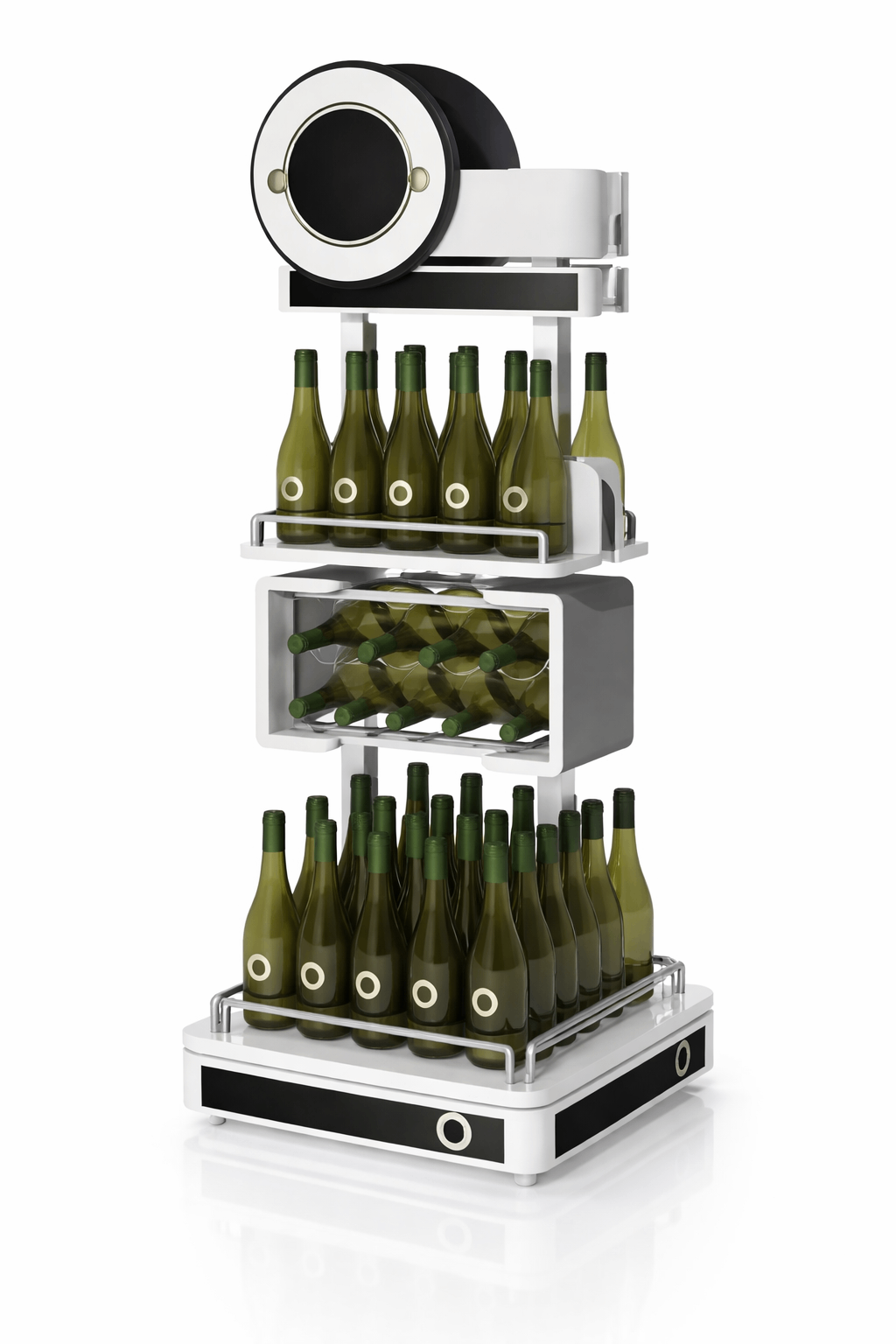
For overseas wholesale buyers and distributors, display performance drives procurement outcomes, not styling preferences. Consequently, teams evaluate merchandising beer displays by how reliably they scale across store networks, protect heavy bottles, and convert floor space into sell-through with predictable ROI. When retail store equipment underperforms, buyers see slower turns, higher service overhead, and inconsistent brand execution across locations.
Moreover, an eye catching beer retail presentation works when structure, visibility, and operational fit move together. A well-built wine display rack keeps SKUs readable under retail lighting, stabilizes planograms during peak promotions, and withstands daily handling. Therefore, buyers who manage beer retail store equipment across multiple outlets prioritize consistency of appearance and performance as much as visual impact.
This page focuses on durable metal display racks merchandising beer and wine, engineered for wholesale deployment. In practice, the system supports standardized rollouts, repeat campaigns, and predictable logistics for retail store equipment wine programs. As a result, buyers lower total cost of ownership while improving in-store visibility and compliance at scale.
On this page (quick scan): Eye‑catching design principles • Metal structure for heavy bottles • Real retail performance • Customization for rollouts • Procurement snapshot & specs • Logistics & deployment • Buying considerations • Use cases • QA & sustainability • Quote
In beverage merchandising, “eye-catching” reflects performance shaped by sightlines, hierarchy, and brand cues. Accordingly, catching beer retail attention depends on vertical presence, clean product blocking, and headers that read from distance. In crowded aisles, display racks merchandising beer perform best when premium SKUs sit at eye level while supporting items reinforce the message without visual noise.
Furthermore, wholesale programs demand repeatability across stores. Wine display racks merchandising formats benefit from modular tiers that preserve uniform bottle spacing and label legibility across different store footprints. When fixtures look consistent in supermarkets and compact liquor stores, brand programs retain coherence and buyers avoid site-by-site visual drift.
At the same time, operational clarity must reinforce visual impact. Clear product separation reduces replenishment errors, and stable shelf geometry protects planogram integrity during promotions. Consequently, when equipment wine display racks align visual hierarchy with operational clarity, buyers gain predictable performance across multi-store rollouts.
Beer and wine bottles impose continuous static load and frequent dynamic stress. Over time, lightweight fixtures fatigue and cause sagging shelves and instability. Therefore, metal display racks merchandising beer deliver higher load-bearing capacity and dimensional stability across repeated retail cycles.
In high-traffic zones, rigidity protects products and shoppers. Specifically, a stiff frame limits vibration when customers remove bottles, which matters for beer retail store equipment placed at aisle ends where carts and foot traffic pass closely.
Meanwhile, metal frames enable mixed-material finishes without sacrificing strength. Teams add acrylic accents or wood trims for brand tone while keeping a steel core. As a result, buyers achieve premium presentation and long service life, which lowers replacement frequency and maintenance cost.
In supermarkets, merchandising beer displays function as interceptors. Floor-standing units at promotional nodes capture traffic and support impulse purchase during launches and seasonal packs. Consequently, feature fixtures often outperform inline shelving when visibility spans multiple sightlines in high-velocity categories.
In liquor stores, discovery and curation dominate. Wine display rack layouts with tiered blocking help shoppers compare varietals and price tiers quickly; meanwhile, headers provide context for limited releases or tasting notes. Therefore, shoppers shorten decision time at shelf without adding staff burden.
Operationally, buyers value fixtures that restock fast and stay aligned. Modular shelves enable quick replenishment, and standardized components simplify chain-wide deployment. As a result, predictable fit reduces site-level adjustments and shortens rollout windows.
Customization should simplify buying, not complicate it. For wholesale buyers, custom beer retail store equipment must integrate with logistics, packaging, and campaign calendars. Therefore, interchangeable graphics enable seasonal refresh without replacing hardware, which preserves capital investment across campaigns.
Branding surfaces support consistent execution across regions. For example, teams select green or custom colors to align with brand palettes, whether color green or custom tones fit local programs. In addition, durable coating systems resist chipping in high-touch environments.
Dimensional tailoring ensures fit across varied store footprints. Because store equipment wine layouts vary by aisle width and endcap depth, custom footprints and shelf spacing reduce site rework. Consequently, buyers improve speed to shelf for network-wide deployments.
Wholesale programs require predictable specifications and repeatable quality. Engineers specify corrosion-resistant finishes for long-term use and set load ratings per tier to support full cases and mixed assortments without creep over time.
Reference Specifications
| Category | Typical Configuration |
|---|---|
| Frame | High-strength metal structure |
| Finish | Powder coating or plated options |
| Tiers | Modular multi-tier layout |
| Load | Configurable per shelf (typ. 25–40 kg per tier depending on span) |
| Assembly | Knock-down for efficient shipping |
| Footprint | Custom widths/depths for endcaps and aisle placements |
| Graphics | Interchangeable header panels and shelf talkers |
Production teams maintain consistency under ISO-aligned quality systems to reduce batch variance. During production process controls focus on dimensional tolerance, coating adhesion (cross-hatch adhesion testing), and packaging integrity (ISTA drop tests for transit). As a result, flat-pack design lowers freight cost and damage risk, which improves landed cost for overseas buyers in Guangdong province China and other export origins. Typical wholesale programs plan MOQ by batch and align lead-time windows to campaign calendars.
International procurement depends on packaging efficiency. Therefore, knock-down construction optimizes container utilization and reduces breakage. Clear assembly logic cuts installation time at store level and minimizes disruption during rollouts. Typically, crews complete on-site assembly for a floor-standing unit within minutes using basic tools, which reduces store labor exposure.
For distributors coordinating multi-country deployments, predictable lead times and documentation streamline customs clearance. For your reference, standardized packing lists, HS coding, and labeling reduce inbound handling time at regional DCs. In addition, consolidated palletization improves throughput at cross-docks.
Repeat campaigns benefit from component reuse. Consequently, modular parts enable reconfiguration for new promotions, extend fixture life, and lower long-term spend across merchandising cycles. Buyers who plan quarterly refreshes rotate graphics while retaining frames, which compresses time-to-shelf for each activation.
Procurement decisions center on lifecycle value. Metal racks merchandising beer displays last longer under heavy use, which reduces replacement cycles. Moreover, compatibility with multiple bottle formats minimizes SKU-specific tooling and simplifies inventory planning. Buyers commonly compare total landed cost (unit cost + freight + install labor + refresh cycles) across platforms.
Risk management also matters. Stable fixtures lower incident risk in busy stores, and consistent quality reduces service calls while protecting brand perception across chains. Therefore, clear specifications, sampling approval, and traceability speed supplier qualification for regional distributors and shorten onboarding with retail partners.
Beer retail store equipment must handle mixed packs, tall cans, and seasonal cartons. Accordingly, adjustable shelves support rapid assortment changes without retooling across campaigns.
Wine display racks merchandising premium labels benefit from angled presentation and clear price communication. In parallel, teams configure the same platform for spirits or display food display adjacency during cross-merchandising programs. As a result, wholesalers serve multiple categories with one standardized system, which simplifies sourcing and training.
Durable fixtures reduce waste. Reusable metal frames with replaceable graphics lower material turnover across campaigns. Therefore, buyers who track sustainability metrics extend asset life and reduce disposal frequency without compromising presentation quality.
Efficient logistics also lower carbon impact per unit shipped. Flat-pack packaging improves container utilization and, consequently, reduces emissions per deployed display.
Quality teams measure performance at scale. Batch consistency keeps display racks merchandising beer uniform across regions, while finish durability resists abrasion in high-touch environments common to beer retail store equipment.
Field reliability reduces downtime. Stable frames protect inventory and maintain visual standards through peak seasons; consequently, retailers strengthen partnerships and reduce service escalations.
This platform suits wholesalers supplying supermarkets, liquor chains, and convenience retail. Therefore, teams deploy standardized rollouts with localized branding, predictable logistics, and durable performance across retail store equipment wine programs.
For constrained footprints, compact variants integrate into store equipment wine endcaps without obstructing traffic. Meanwhile, high-volume programs use multi-tier formats to maximize SKU exposure per square meter.
Buyers often request green or custom colors to align with brand palettes. Accordingly, the finish system supports green or custom colors with durable coatings for frequent handling, which ensures visual consistency across stores without compromising wear resistance.
Wholesale buyers value partners who understand retail operations. Yishang Display emphasizes predictable manufacturing, packaging efficiency, and specification control to support multi-store deployment. As a result, batch repeatability, pre-production samples, and clear change control reduce rollout risk and support program continuity without interrupting store operations.
Can the racks ship flat-packed for lower freight? Yes. Knock-down design improves container utilization and reduces transit damage risk.
What lead time should buyers plan for chain rollouts? Teams align lead time to campaign calendars; buyers reserve production slots by batch to meet store reset windows.
Do the racks support different bottle sizes and mixed packs? Shelf spacing and load ratings adapt to varied formats across beer and wine assortments.
Are finishes suitable for high-touch retail environments? Powder-coated and plated finishes resist abrasion and frequent cleaning.
Can graphics refresh without replacing frames? Interchangeable headers and panels enable campaign updates while retaining the metal structure.
Share store formats, target quantities, bottle formats, and branding needs to receive a tailored proposal. A concise brief enables faster sampling, accurate costing, and aligned lead-time planning for scaled rollouts.
Yishang Display specializes in crafting bespoke display solutions. From initial concept and prototyping through to full-scale production, our in-house team manages every phase—delivering a seamless, one-stop experience for your brand.
If you have any questions or need a quote, please send us a message. One of our specialists will get back to you within 24 hours and help you select the correct valve for your needs.
All of our products are available for sampling