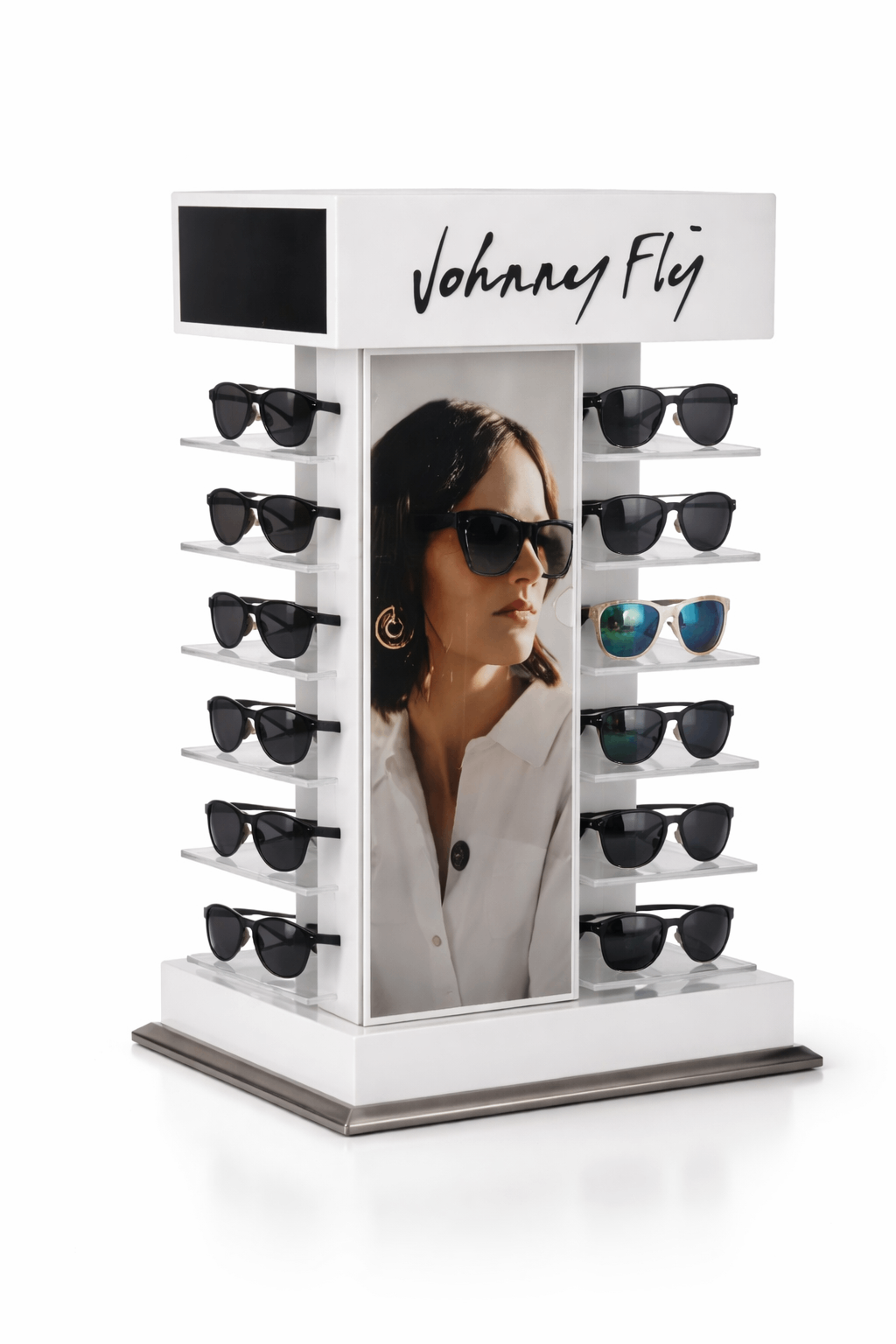
For overseas buyers who need to qualify a supplier quickly, the following overview summarizes how this countertop eyewear display is typically specified in wholesale programs. Values are indicative ranges used for evaluation and internal discussion rather than fixed limits.
This snapshot allows procurement teams to determine early whether the product aligns with their retail and sourcing requirements before reviewing design details.
For overseas wholesale buyers, a product detail page functions as a qualification filter rather than a marketing brochure. The language, structure, and depth of information immediately signal whether a supplier understands wholesale procurement realities. Buyers scan for evidence of manufacturability, repeatability, and risk control before investing time in further discussion.
This page is structured for that screening behavior. Each section focuses on how a customized countertop sunglass display performs in real wholesale or retail programs: how it fits on counters, how it supports merchandising, and how reliably it can be reproduced across multiple locations. The emphasis remains on the product itself rather than on company promotion.
A customized countertop sunglass display rack is designed to organize, present, and protect eyewear at high-traffic retail touchpoints. Typical placement includes optical shops, fashion boutiques, and department stores where customers naturally pause, interact with staff, and handle products. In these settings, the display must remain compact while still presenting a clear and orderly selection.
Unlike generic holders, a countertop eyewear display stand specified for wholesale or retail programs is engineered for repeat deployment. Dimensions, slot spacing, and visual elements are defined so that each unit performs consistently across stores. For buyers managing regional or international rollouts, this consistency reduces operational friction and supports controlled retail merchandising.
Sunglasses are highly visual and frequently handled products. Countertop placement supports this behavior by positioning frames within arm’s reach, encouraging customers to compare shapes and lens colors quickly. In optical shops and fashion boutiques, counters are often premium zones where product interaction already occurs.
From a store-planning perspective, countertop displays are also flexible. They avoid permanent installation, adapt to different store sizes, and allow brands to refresh merchandising without changing fixtures. This flexibility explains why countertop sunglass display racks are repeatedly specified in wholesale programs rather than treated as one-off solutions.
Once countertop placement is confirmed, buyers focus on performance factors that affect long-term use. Stability is evaluated first. Countertop displays are frequently moved for cleaning and restocking, so a rigid structure and balanced base are essential to avoid tipping or gradual deformation.
Visibility follows closely. Sunglasses must remain easy to view without appearing crowded. Buyers favor layouts that preserve clear spacing even when fully stocked. Interaction quality is equally important: customers should be able to remove and replace frames smoothly without disturbing adjacent pairs. These criteria define whether a sunglass display stand performs reliably beyond initial installation.
The structural design of this customized countertop sunglass display rack translates performance requirements into physical form. A rigid metal framework is typically used because it offers predictable strength, dimensional accuracy, and durability under repeated handling. This makes metal-based display racks for wholesale programs more reliable over time.
Multi-face configurations increase visibility without expanding the counter footprint. Where rotation is required, the mechanism is integrated with balance considerations so movement does not compromise stability. The base is engineered as a functional component, contributing to weight distribution and surface contact rather than serving only as decoration.
Capacity is often discussed early, but experienced procurement teams look beyond raw numbers. The real objective is usable capacity: how many pairs can be displayed while maintaining clarity and easy access. A countertop sunglass display rack that appears overcrowded may technically hold more units but often underperforms in retail settings.
Layout design considers SKU mix, frame size variation, and replenishment routines. Multi-tier arrangements make efficient use of vertical space, which is especially valuable on limited counters in boutiques and department stores. A well-planned layout also simplifies daily maintenance, reducing staff time spent reorganizing displays.
Material choice directly affects how a sunglass display stand performs over time. Metal is commonly specified for the main structure because it resists bending, maintains alignment, and supports consistent batch production. For wholesale buyers, this durability reduces early replacement risk and protects investment across store networks.
Acrylic is often used where transparency is needed. Clear acrylic shelves or holders keep the focus on the eyewear while reducing visual bulk. When thickness and edge finishing are properly specified, acrylic components perform reliably under daily handling and cleaning routines common in retail environments.
Surface finish selection is a practical decision rather than a purely aesthetic one. Powder coating is often chosen for metal parts because of its durability, color consistency, and resistance to chipping. Brushed or plated finishes may be specified for premium programs but require tighter production control.
Retail displays are cleaned frequently, sometimes with strong agents. Finishes must withstand this routine without fading or peeling. Acrylic surfaces should remain clear under store lighting and resist stress cracking. These considerations influence total cost of ownership, which is why buyers evaluate finishes carefully during sourcing.
A countertop eyewear display stand also functions as a brand touchpoint. Logo headers, side panels, or graphic inserts can reinforce brand identity at the point of sale. Effective branding supports the product rather than competing with it, keeping sunglasses visually dominant.
Replaceable graphic panels are often preferred in wholesale programs because they allow seasonal updates without replacing the entire rack. This approach supports brand consistency across fashion boutiques and department stores while controlling long-term costs.
Customization is a key reason brands commission customized countertop sunglass display racks instead of purchasing standard items. Effective customization focuses on areas that influence retail performance. Dimensions are typically customized first to ensure compatibility with existing counters in optical shops and fashion retail environments.
Layout configuration, materials, finishes, and branding elements follow. Wholesale buyers often standardize non-critical components to control cost and maintain production consistency, reserving customization for elements that directly affect presentation and usability.
For wholesale buyers, an approved sample is a reference point rather than the end of the process. What matters is whether production units consistently match that reference across the full order and across future reorders. Consistency in dimensions, finishes, and assembly ensures uniform presentation across all retail locations.
Controlling material specifications, tooling accuracy, and finishing processes is essential. In countertop eyewear display production, small deviations in slot angle or alignment can become noticeable when multiple units are deployed side by side.
Export packaging directly affects landed cost. Countertop sunglass display racks must be protected against scratching, deformation, and graphic damage during international transport. Protective films, internal supports, and carton design all play a role in reducing transit damage.
Packaging that supports store-ready deployment also reduces labor time during rollout. For chain programs, this efficiency becomes significant when multiplied across dozens or hundreds of stores.
This customized countertop sunglass display rack is widely used in optical shops where eyewear must remain organized and accessible. Fashion boutiques often use countertop displays to highlight seasonal collections, coordinating finishes and graphics with overall store design.
Department stores deploy countertop sunglass display racks at shared accessory counters or branded kiosks, where space efficiency and visual clarity are critical. The same format is suitable for promotional campaigns and pop-up retail where flexibility is required.
The table below summarizes specification dimensions commonly reviewed during internal approval and RFQ preparation. These parameters help buyers align design intent with production feasibility.
| Specification item | Typical consideration | Notes for wholesale programs |
|---|---|---|
| Footprint range | Counter width and depth | Adjusted to store counter standards |
| Height range | Eye-level visibility | Must not obstruct staff interaction |
| Faces | 2 / 3 / 4 sides | Affects visibility and capacity |
| Tiers per face | Based on frame size | Premium vs high-density layouts |
| Base type | Fixed or rotating | Rotation requires balance control |
| Primary material | Metal structure | Supports durability and repeatability |
| Secondary material | Acrylic components | Enhances visibility |
| Finish options | Powder coat, plating | Selected for durability |
| Branding zones | Header, panels, base | Replaceable options available |
| Packaging | Export-ready cartons | Reduces damage and setup time |
Can this display be reproduced consistently for repeat orders?
Yes. The design emphasizes controlled dimensions, stable materials, and repeatable finishes to support batch production.
Is this suitable for chain-store rollouts?
The countertop format and standardized structure are commonly used for multi-store programs where consistency matters.
Can graphics be updated seasonally?
Replaceable graphic panels can be specified to allow updates without changing the rack.
What information is needed for an accurate quote?
Target dimensions, estimated quantities, branding requirements, and reference images are typically sufficient to assess feasibility.
This countertop sunglass display is best suited for programs that require compact placement, frequent customer interaction, and consistent brand presentation across locations. It performs well when sunglasses are a core accessory category and when merchandising clarity supports conversion.
It may be less suitable for environments requiring locked displays or extremely low-profile fixtures. Assessing counter dimensions, SKU mix, and store traffic patterns early helps ensure alignment with operational needs.
Yishang Display focuses on manufacturing production-ready countertop eyewear display solutions for wholesale and retail programs. The emphasis is on durable structures, clear specifications, and consistent output rather than one-off decorative pieces.
If you are sourcing customized countertop sunglass display racks for wholesale or retail, a brief inquiry with target dimensions, estimated quantities, and branding references is usually sufficient to determine feasibility and quotation range.
Yishang Display specializes in crafting bespoke display solutions. From initial concept and prototyping through to full-scale production, our in-house team manages every phase—delivering a seamless, one-stop experience for your brand.
If you have any questions or need a quote, please send us a message. One of our specialists will get back to you within 24 hours and help you select the correct valve for your needs.
All of our products are available for sampling