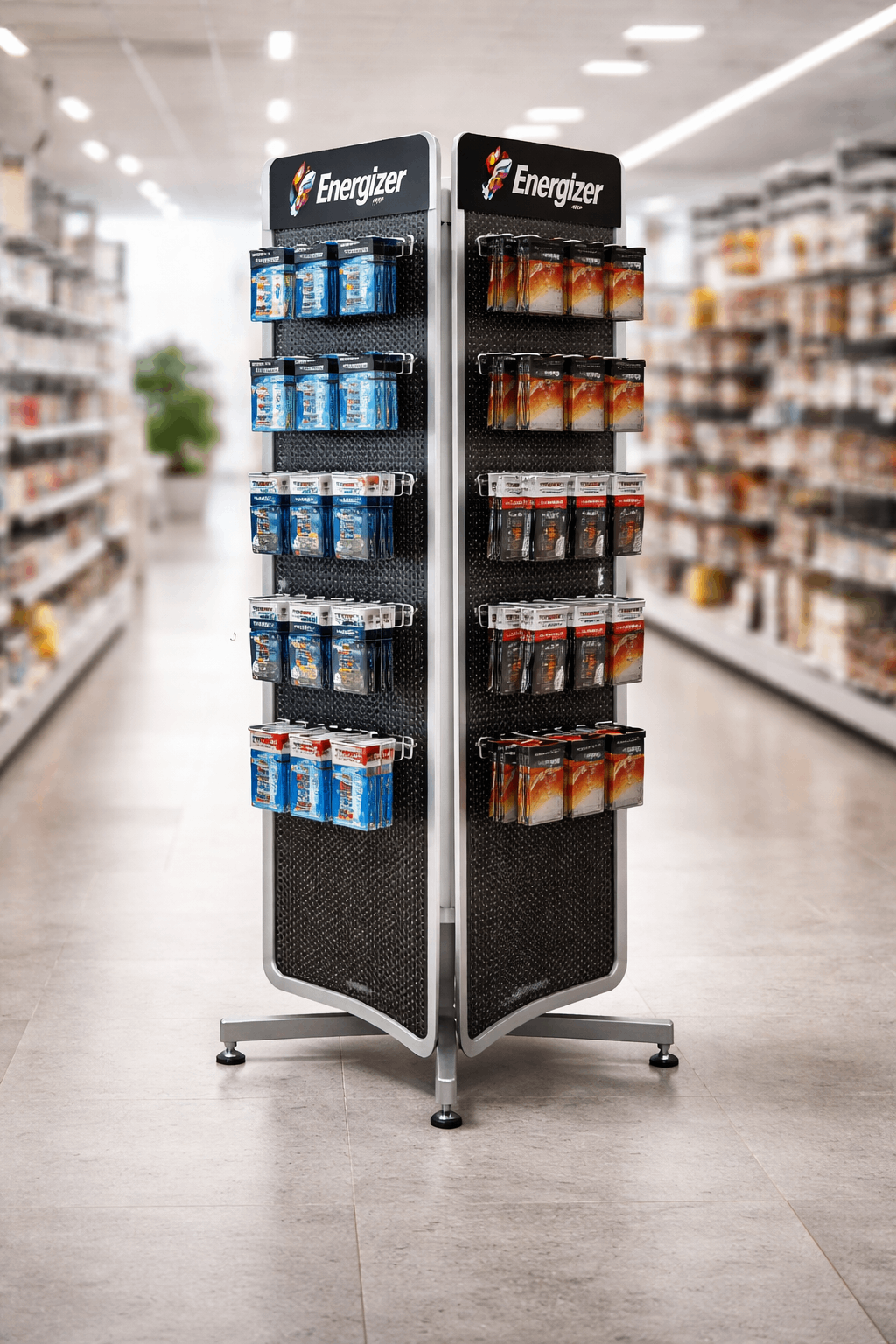
Overseas wholesale buyers typically land on a product page to answer a few practical questions fast: will this battery display rack stay stable in real stores, fit the packaging mix, ship efficiently, and remain consistent across a multi‑location rollout.
This display rack floor standing model is built for that buying behavior. It’s a commercial fixture engineered to support battery and accessory merchandising in supermarkets, convenience stores, auto parts chains, electronics retailers, and hardware outlets.
At a glance (for procurement teams)
| What you’re evaluating | What this rack is designed to deliver |
|---|---|
| Program consistency | Repeatable structure, stable geometry, batch‑to‑batch control |
| Retail safety | Low tipping risk through base and center‑of‑gravity design |
| Packaging fit | Hook and panel layouts optimized for common battery blister packs |
| Long service life | Metal frame + durable finishes for high‑touch retail cycles |
| Logistics efficiency | Standardized dimensions for predictable packing and container loading |
The rack floor standing format remains one of the most scalable options for battery merchandising because it increases product visibility without consuming excessive floor space. This rack is engineered as a repeatable unit for wholesale distribution and chain‑store execution.
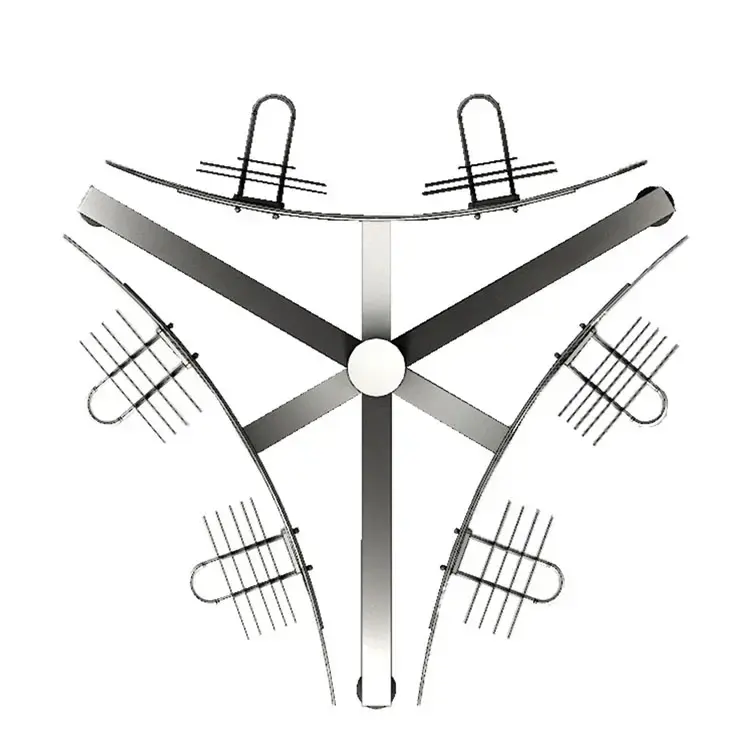
For buyers supplying multiple locations, uniform performance matters more than decorative variation. The multi‑sided presentation allows placement in aisles, end‑caps, and open selling zones with the same fixture SKU, which simplifies procurement and reduces planogram friction.
The core structure is a reinforced metal frame. Batteries are dense, frequently handled items, and lightweight fixtures often deform over time. A metal accessories rack keeps alignment stable through repeated replenishment cycles and maintains a clean retail presentation that supports brand credibility.
Wholesale buyers typically want customization that can be standardized. This customized metal accessories rack is built around modular components so you can adapt layout and branding while keeping the core structure consistent.
Dimensions such as height, footprint, and number of display faces can be adjusted to match regional retail standards and planogram requirements. Hook pitch, shelf spacing, and panel patterns can be set for common battery blister packs and accessory SKUs, reducing redesigns when assortments change.
Branding is separated from structure. Header cards, side graphics, and base wraps can be updated without retooling the metal frame, which helps buyers localize languages or run seasonal campaigns with lower long‑term tooling costs.
Battery merchandising succeeds when customers can understand options quickly. This rack battery display layout is designed to keep packaging upright, readable, and easy to pick without creating clutter.
Hooks and panels can be configured to separate AA, AAA, C, D, 9V, and button cell formats, as well as related accessories. That separation reduces mis‑picks and helps retailers keep the display visually consistent between restocking cycles.
If your assortment includes mixed SKUs, a hybrid layout can combine hooks for blister packs with trays or small shelves for chargers, testers, or bundled accessory kits. This approach supports cross‑selling without forcing multiple fixture types.
Batteries are compact but heavy relative to size, and they create repeated stress through frequent handling. A metal accessories rack battery solution offers predictable load behavior and long‑term stability.
The frame distributes weight across vertical supports to reduce localized stress and minimize deformation. Reinforced connectors help maintain alignment after repeated replenishment. For wholesale programs, this consistency reduces downstream replacement risk and protects your rollout budget.
Stability is engineered into the base and geometry. By managing center‑of‑gravity and footprint, the rack helps reduce tipping risk when products are removed unevenly. That is especially important in high‑traffic retail zones where customer interaction is constant.
Wholesale buyers increasingly evaluate displays by how they perform in store, not how they look in a catalog. This battery display rack floor design supports quick scanning, clear choice, and easy pickup.
Vertical placement keeps high‑rotation SKUs at natural eye and hand levels. Multi‑sided access reduces congestion in narrow aisles and improves traffic flow around the fixture. These factors support higher pick‑up rates without relying on aggressive signage.
Clear product separation also protects packaging. When items stay aligned and easy to read, retailers see fewer damaged packs and less re‑work from staff. Over a multi‑store rollout, those operational gains add up.
For professional buyers, clear specs reduce sourcing risk. Below are typical commercial ranges for a display rack floor standing build; final parameters are defined by your product mix and planogram.
| Specification Item | Typical Commercial Range |
|---|---|
| Overall Height | 1400–1800 mm, adjustable |
| Base Footprint | 400 × 400 mm to 600 × 600 mm |
| Primary Material | Steel frame with optional acrylic or wire components |
| Surface Treatment | Powder coating for wear and corrosion resistance |
| Load Capacity | ~5–10 kg per display section (layout dependent) |
| Display Interfaces | Hooks, trays, perforated panels |
| Branding Modules | Header panel, side graphics, base wrap |
| Customization Model | OEM and ODM supported |
If you need a specific standard (for example, store safety policies, cleaning protocols, or packaging constraints), the rack can be engineered to comply with your requirements at the drawing stage.
Many top‑ranking competitor pages focus on general “advantages” and broad specs, but wholesale buyers often need one more layer: how the rack stays consistent across volume, and how compliance is handled. On sourcing platforms, common buyer questions revolve around supplier reliability, certifications, and how quality is verified before shipment.
Yishang Display supports battery and accessory display programs with controlled manufacturing processes and documented quality checks. Materials and finishes can be aligned with your market’s requirements, and compliance documentation can be provided when needed. If your program requires RoHS‑aligned material selection or ISO‑style process control, that can be integrated into the project from the drawing stage.
For bulk orders, risk control typically comes down to repeatable checkpoints. Depending on your design, these may include incoming material verification, dimensional checks on key interfaces (hook pitch, panel alignment, base geometry), weld integrity checks, coating thickness / adhesion validation for powder‑coated parts, and packaging verification to reduce damage during international transport. The goal is simple: ensure the fixture you approve is the fixture your stores receive—unit after unit.
Wholesale buyers often want to compare options quickly, but pricing is rarely “one number” because fixtures are engineered around a planogram. A short set of inputs can speed up quoting and prevent redesign loops.
The main cost drivers are typically structural material thickness, number of display faces, hook count and hook type, size and construction of the header (single vs multi‑sided), the complexity of branding (printed panel, acrylic inserts, or interchangeable graphic sleeves), and packing method (knock‑down vs pre‑assembled). When these are defined early, programs move faster from sample to mass production.
If you already have packaging dimensions and target capacity (for example, how many facings per SKU), it’s usually enough to recommend a layout that balances visibility, stability, and shipping efficiency.
Competitor pages that rank well often show that the supplier has executed recognizable battery merchandising structures—multi‑sided hanging hooks, a branded header visible from multiple directions, and a stable base that holds alignment through high‑touch retail cycles.
This rack follows that proven structure and can be adjusted to your program: three‑ or four‑sided hook panels, a header designed for clear brand blocking, and modular graphics that can be refreshed for seasonal campaigns. If you’re building a family of displays (battery + adjacent accessories), the same frame geometry can be reused while the layout modules change.
For procurement teams, this means fewer fixture SKUs to manage, cleaner rollout planning, and easier replenishment standards across locations.
For overseas procurement, the fixture is only “affordable” if it ships efficiently and arrives ready for deployment. This rack is designed with standardized geometry that supports predictable packing and container utilization.
Packaging can be optimized based on whether your program prioritizes low cube, damage prevention, or faster store setup. For buyers sourcing from manufacturing hubs such as Guangdong province China, these details materially affect landed cost and rollout timelines.
If your rollout involves multiple countries, modular branding reduces complexity. You can keep the core metal frame constant and change only graphics or language inserts, which simplifies forecasting and reduces inventory fragmentation.
This accessories rack battery display solution is optimized for batteries, but it also supports adjacent accessories that buyers often bundle for higher basket value.
In supermarkets and convenience stores, it works well for disposable and rechargeable batteries plus small add‑ons. In automotive retail, it can support chargers, testers, and maintenance accessories alongside battery SKUs. The same core rack can serve multiple channels with controlled layout changes.
For trade shows and promotional rollouts, the metal structure withstands repeated transport and assembly, making it a reusable asset rather than a single‑use stand. That durability is often a deciding factor for wholesalers who need a fixture that lasts beyond one campaign.
Wholesale procurement usually follows defined gates: approve design, validate sample, then scale. This customized metal accessories rack supports that workflow with drawings, renderings, and sampling before mass production.
Once approved, production is executed with batch control so the rack behaves consistently across units. For multi‑store rollouts, this reduces the risk of “looks different in store” issues and keeps visual standards stable across locations.
If you are targeting a program launch date, the most efficient path is to align product packaging dimensions and planogram intent early. That reduces revision loops and shortens the time to mass production.
Can the same rack be used across different regions?
Yes. The core structure can remain consistent while branding and layout modules are adapted for regional rules, languages, and store formats.
Is it suitable for long‑term retail programs?
Yes. The metal frame and durable finishes are designed for multi‑year use under high‑touch retail conditions.
Do we need a full redesign when SKUs change?
Not usually. Hook pitch, panel layouts, and tray modules can be adjusted while keeping the main frame consistent.
Can you support knock‑down packing for lower freight?
Yes. Many wholesale programs choose knock‑down structures to reduce shipping cube. The design can be engineered to assemble quickly in store while maintaining stability.
What information helps you quote faster?
Packaging dimensions, target SKU count, desired capacity per facing, preferred placement (aisle / end‑cap), and branding approach (header, side graphics, base wrap). With these inputs, layout recommendations are much more accurate.
This Customized Metal Accessories Rack Battery Display Rack Floor Standing is designed for overseas wholesale buyers who need repeatable quality, stable performance, and rollout‑friendly customization. It balances structural durability with merchandising clarity, while keeping procurement variables under control.
If you want to confirm fit for your battery packaging, SKU mix, and store planogram, a short spec exchange is usually enough to recommend the most efficient configuration. Yishang Display can support that discussion and provide a quote based on your program requirements.

Yishang Display specializes in crafting bespoke display solutions. From initial concept and prototyping through to full-scale production, our in-house team manages every phase—delivering a seamless, one-stop experience for your brand.
If you have any questions or need a quote, please send us a message. One of our specialists will get back to you within 24 hours and help you select the correct valve for your needs.
All of our products are available for sampling