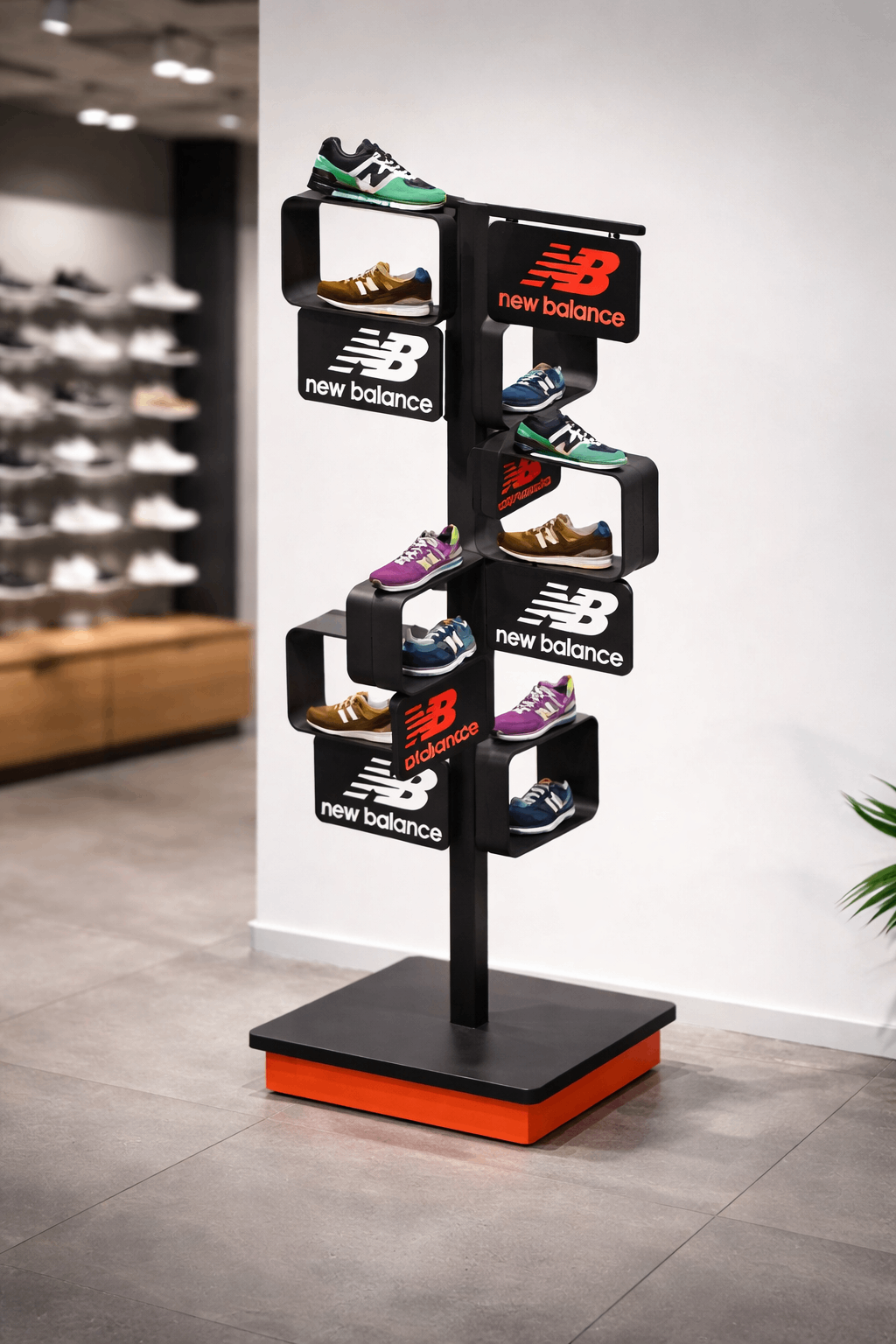
A retail shoe display should do more than hold products. Overseas wholesale buyers expect it to support brand presentation, use floor space efficiently, stay stable in daily traffic, and work well for sampling, bulk production, and export packing. This custom display answers those real project requirements.
This freestanding metal shoe display highlights selected footwear styles instead of serving as general storage. A single central column, a stable square base, and staggered compartments on both sides give it the look of a branded promotional fixture instead of a standard shoe rack. That distinction matters. Buyers often compare product appearance, but they also look closely at standardization, rollout fit, and production repeatability.
For buyers comparing a shoe display stand manufacturer or a custom retail display supplier, these factors often matter as much as visual appeal. A fixture for featured products needs to attract attention, communicate brand identity, and stay practical across multiple stores.
For quick project review, buyers can view this structure as a custom metal shoe display stand for featured footwear, branded retail corners, and multi-store rollout programs. It suits OEM and ODM development, supports custom logo panels and color matching, and allows sample approval, knock-down packing, and batch production.
This freestanding unit serves retail programs that need stronger product focus. The design uses a single-post structure with left-and-right staggered shoe holders, so each position feels intentional rather than crowded. In a shoe shop, brand corner, mall campaign, or seasonal launch area, it works as a compact display point. Each featured pair gets enough visual space to stand out.
The vertical format keeps the floor area open while making the fixture easier to notice from different customer angles. This clarity makes the display easier to assess at the sourcing stage. Buyers can quickly see where the branding sits, how many products the unit can show, and whether the structure suits rollout across multiple stores.
In practice, buyers reviewing shoe display fixtures often look first for clarity of purpose. When the display function is clear, quotation, sampling, and project approval usually move faster. The layout also avoids the crowded look that often weakens product presentation.
Each compartment acts as an individual product frame, while the printed brand panels directly beneath or beside the shoes strengthen recall at the point of display. In store use, this creates a cleaner visual rhythm and makes the product message easier to read without adding unnecessary complexity.
The main strength of this shoe display rack is its vertical multi-tier layout. Instead of using wide shelves, the design stacks selected shoes upward on staggered side-mounted holders. This keeps the presentation compact and visually active. By building upward rather than outward, the fixture can present several models in one location without taking the floor space of a long wall unit.
For stores where every square meter affects customer flow and product density, that layout offers a practical advantage. The branded side panels also play an important role. In retail display design, they connect the shoe, the campaign message, and the brand image at the same viewing point.
In this format, the panels sit directly in the display positions, so buyers read the product and branding together rather than as separate elements. For sports footwear, lifestyle collections, or launch programs, that improves visual continuity and helps the display do more than simply hold products.
The base and center column matter just as much as the visible presentation. A floor-standing fixture must stay balanced in high-traffic areas and still look visually clean. The square base gives the stand grounded visual weight, while the single upright column keeps the structure simple and easy to understand from a distance.
Together, these elements help the display stay stable without making it look visually heavy. The result is a display that feels light in appearance but remains reliable in daily use. At the production level, technical details shape the real value of the fixture.
Steel thickness, welding accuracy, edge finishing, and powder-coating adhesion all affect how the display performs after repeated use. Wholesale buyers usually value these points more than broad claims about quality because they relate directly to durability, consistency, and reorder confidence.
A good retail fixture should improve product presentation without making store maintenance harder. This layout separates shoes by style, collection, or campaign theme, so the display stays easier to browse and easier to refill. Instead of compressing products into one crowded rack, it gives each pair a clearer role in the overall presentation.
The staggered arrangement also improves visibility. Because the shoes sit at different heights, the eye moves more naturally across the fixture. That usually works better than a flat repetitive shelf when the goal is to highlight selected models, promotional items, or new arrivals.
For wholesale display programs, consistency is another major advantage. Buyers often need one proven structure that can be repeated across several stores with limited adjustment. A compact display like this is easier to standardize and approve. Buyers can also replenish it more easily later.
That is one reason many display stand wholesale projects prioritize repeatable formats, especially when store layouts differ slightly but the branded presentation still needs to remain consistent. From a sourcing perspective, a display design provider needs to deliver more than visuals.
Buyers also need a structure that suppliers can price clearly, sample efficiently, pack safely, and reproduce with stable quality. When teams address those points early, wholesale display design becomes easier to manage and far more useful commercially.
This product follows a metal-first approach. Metal remains the most dependable structural choice for this kind of retail fixture. It offers stronger load-bearing performance, cleaner fabrication, and better long-term durability in store use. It also supports batch production more reliably when the same display needs to serve a chain-store or multi-market program.
That does not mean the visible result has to feel purely industrial. Teams can add acrylic elements, wood accents, or printed graphic panels when the brand image calls for a softer or more premium look. Many buyers prefer this combination because it keeps the structural core strong while allowing the visible surfaces to match the brand direction more closely.
Customization can cover powder-coated color, logo treatment, panel size, holder spacing, and overall display layout. Some projects focus on stronger brand communication. Others care more about fitting a specific shoe range, shipping plan, or store footprint.
A useful provider display manufacturer treats sourcing practicality and display effect as one discussion, not two separate ones. In many projects, even small changes to holder spacing or panel proportion can make sample review and in-store presentation more efficient.
For overseas buyers, the most important starting inputs are usually straightforward. They want to define what products the unit will show, how many stores are involved, how the unit should ship, and how visible the brand message needs to be. Those inputs help teams turn an idea into manufacturable drawings, clearer specifications, and more realistic production planning.
This format works especially well in sports shoe shops, footwear brand stores, mall campaigns, and seasonal retail programs. It suits selected models that need stronger exposure. It is especially suitable for sneaker launches, hero-product merchandising, and branded display corners where a small number of styles need more attention than a full wall assortment.
It is not intended to replace every store fixture. Its role is to give featured products a cleaner and more branded display point. That distinction is useful for procurement teams. Buyers comparing a display rack for branded footwear usually review more than price alone.
They also assess display effect, packaging efficiency, assembly difficulty, sample accuracy, and whether the same format can be repeated across locations without creating extra operational complexity. In practice, this type of structure often works well for launch zones, collaboration releases, sneaker promotions, and store rollout programs.
A compact and repeatable form can simplify approval. Teams can visualize, document, and adapt the fixture more easily for standard retail spaces. This is especially helpful when buyers need a branded sneaker display stand that can be reviewed centrally and then executed across multiple branches.
It is also worth being clear about fit. A very small countertop promotion or a short-term paper campaign may require another format. For medium- to long-term retail use, however, this shoe display offers a stronger balance of durability, visual order, and repeatability.
Most buyers do not start with abstract design language. They begin with practical questions: how many pairs need to be shown, how large the branding area should be, whether the base fits the store layout, how the staggered holders should be arranged, and how the display will be packed for export. These questions shape a workable project.
Display capacity is one of the first variables to define. The number of tiers, spacing between holders, and presentation angle all affect the visual result and the structural balance. A compact fixture can still feel open and premium when teams handle these proportions well.
Branding area is another important consideration. Teams should plan graphic panels early because they affect logo visibility, campaign readability, and how clearly the fixture communicates from a distance. In many retail programs, the branded panel is one of the main reasons the display performs better than a generic rack.
Packaging and assembly are equally relevant in cross-border sourcing. Buyers often ask whether the unit can ship in knock-down form, how the cartons protect printed parts and corners, and whether local teams can complete assembly smoothly.
On a website, these details may seem secondary. In real projects, they influence lead time, landed cost, and reorder reliability.
The table below shows the typical configuration range for this display type. Final values depend on product mix, destination market, shipment plan, and branding requirements.
| Item | Typical Option |
|---|---|
| Product Type | Freestanding footwear display |
| Main Material | Metal |
| Optional Materials | Acrylic, wood accents, printed graphic panels |
| Structure | Single-post vertical multi-tier floor unit |
| Finish | Powder coating / custom surface finish |
| Branding | Custom logo, color matching, graphic boards |
| Display Use | Shoe stores, brand corners, mall campaigns |
| Service | OEM & ODM |
| Order Type | Wholesale / custom program |
| Compliance | ISO 9001 quality management, RoHS-compliant material option |
In retail fixture production, technical consistency matters. Dimensional stability, neat welding, accurate graphics, and durable finishing all affect whether the final unit looks reliable in store. Buyers reviewing display design provider options often watch these points closely because sample quality only matters when mass production follows the same standard.
Industry experience also shows that imported display programs usually succeed or fail on execution details rather than concept alone. Color consistency, structural tolerance, protective packaging, and assembly clarity often shape repeat orders more directly than visual ideas do.
That is why serious wholesale display design discussions usually move quickly from appearance to specification control.
This model is a strong fit for buyers who need visible branding, clear product presentation, and repeatable store execution in one fixture. It works particularly well when the goal is to feature a limited number of key shoes with stronger visual focus rather than to display a large inventory range.
It suits projects where the display needs to look organized, hold up under daily use, and remain practical for bulk purchasing. It fits sports footwear, casual shoe collections, branded promotions, and custom shoe display stand wholesale programs where visual order matters.
Buyers managing rollout programs often prefer this type of structure because it is easier to standardize than a one-off concept built around a single store only. At the same time, it is less suitable for very small countertop needs or short-term paper promotions.
In those cases, a lighter or lower-cost format may be more efficient. The point is not to make one fixture fit every situation, but to match the right structure to the right commercial use.
When buyers search for a display design provider, a shoe display stand manufacturer, or a supplier for wholesale fixture programs, they usually want more than attractive renderings. They want a partner that can turn a concept into drawings, samples, confirmed specifications, and stable bulk production.
Yishang Display supports that process with a metal-focused manufacturing approach. The emphasis stays on structure, finish control, graphic coordination, and packaging practicality, while the product itself remains at the center of the page. This makes the sourcing conversation more efficient for buyers who want clear answers on feasibility rather than broad claims.
For international projects, response speed and document clarity matter too. Delays in confirming artwork, dimensions, or packaging details can slow the entire purchasing cycle. A smoother process usually leads to fewer revisions, clearer quotations, and better alignment between the approved sample and the final shipment.
A common question is whether the layout can be adjusted for different product ranges. In most projects, yes. Teams can adjust tier spacing, holder position, panel size, and overall dimensions according to shoe type, campaign goals, and retail environment.
Another frequent question involves materials. Metal is usually the preferred structural option for long-term use because it provides better durability and more stable fabrication. Teams can still add acrylic or wood when the visual direction requires it, but the metal core gives the display greater reliability in bulk programs.
Buyers also often ask what information is needed before quotation. The most useful starting points are product range, quantity, logo files, preferred finish, destination market, and intended retail use. If knock-down packing, assembly requirements, or carton size limits are already known, including those details can make quotation and sample planning more accurate from the beginning.
If you are reviewing shoes display stand options for an upcoming project, sharing the product range, target quantity, branding needs, and destination market is usually the fastest way to begin.
A clear brief makes it easier to recommend the right structure, finish, and packaging approach for a workable wholesale program.


Yishang Display specializes in crafting bespoke display solutions. From initial concept and prototyping through to full-scale production, our in-house team manages every phase—delivering a seamless, one-stop experience for your brand.
If you have any questions or need a quote, please send us a message. One of our specialists will get back to you within 24 hours and help you select the correct valve for your needs.
All of our products are available for sampling