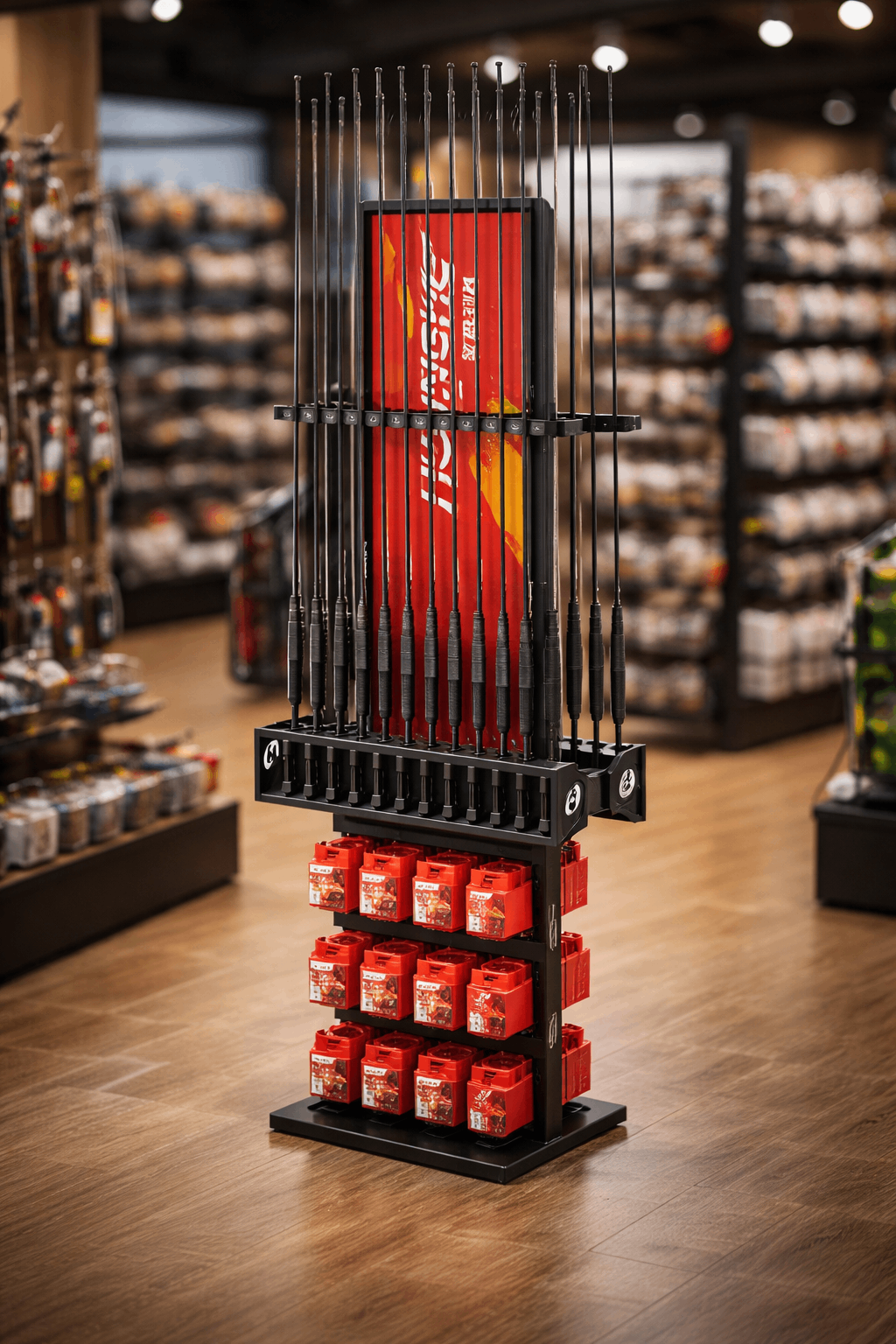
Fishing tackle retailing places unique demands on store fixtures due to SKU height, category breadth, and limited floor space. Overseas wholesale buyers supplying tackle shops and sporting goods chains often evaluate fixtures not only on appearance but also on capacity planning, freight efficiency, and store performance. The Custom 2‑Way Metal Fishing Rod Display Stand by Yishang Display is developed with those priorities in mind.
This dual‑sided stand presents rods vertically in a compact footprint, improving SKU visibility and browsing flow. Compared with single‑sided or barrel‑style stands, the two‑way layout supports smoother aisle traffic and clearer category navigation—practical benefits for stores with dense assortments.
Wholesale clients typically assess store display fixtures for structural integrity, customization scope, and supply consistency. This display reflects those criteria through a mild steel frame, socket‑based rod retention, and modular accessory grids near the base. These engineering choices influence stocking efficiency and fixture lifespan, which contribute to downstream resale performance.
The display stand functions as a freestanding, dual‑sided metal merchandising unit optimized for vertical rod presentation. Its steel frame provides dimensional stability, while the socket and retention grid system minimizes tangling and surface abrasion between adjacent rods. This engineering approach enhances usability for both end customers and store personnel.
The upper retention grid aligns rods vertically to maintain a uniform visual rhythm. This matters in fishing tackle merchandising because rods vary in height, blank material, and handle diameter. Proper separation reduces scratching and helps shoppers evaluate rod length, which is a purchasing criterion in both freshwater and saltwater categories. A central graphic or brand panel accommodates custom artwork, assisting downstream retailers with category marking and seasonal campaign support.
At mid‑height, laser‑cut or stamped metal sockets hold rod handles upright. Diameter tolerances can be adjusted during manufacturing to suit fly rods, surf rods, spinning rods, or offshore trolling rods. This avoids torque stress on blanks and prevents rods from leaning or slipping during customer handling.
Lower accessory grids support packaged terminal tackle, reels, or line spools. This adjacency approach is commonly used in sporting goods merchandising to encourage complementary purchases and reduce shopper travel time between categories. For wholesale buyers, the inclusion of accessory space adds value because it transforms the fixture into a combined presentation and cross‑selling platform.
For consistent performance across store environments, the frame uses mild steel (Q235) with a thickness range of 1.2–1.5mm. This metal grade balances strength, machining ease, and cost control, which is valuable when forecasting large‑volume deployments. Steel components undergo CNC cutting for precision, press brake forming for angles, and MIG/TIG welding at stress points to improve load handling.
Surface finishing uses powder coating with a matte black default. Powder coat surfaces resist abrasion, support color consistency across batches, and exhibit better corrosion resistance compared to solvent-based paints. In coastal markets—where salt air accelerates oxidation—powder coating delays surface deterioration, reducing fixture turnover. Buyers supplying marine‑adjacent markets sometimes specify enhanced coatings or stainless steel variations for extended lifespan.
From a compliance and sustainability perspective, powder coating avoids volatile organic compounds (VOCs), which aligns with RoHS‑friendly sourcing and environmental reporting expectations. Large sporting goods chains increasingly factor environmental compliance into supplier selection, making this coating method relevant for competitive bidding.
Vertical display enhances visibility for rods exceeding 180cm, allowing customers to visually compare length, action type, and grip style without removing multiple units from the rack. The two‑way surface increases presentation opportunities without consuming additional aisle frontage, which is valuable for smaller tackle shops and convenience‑style retail formats.
Dual‑sided access also distributes shopper flow, improving aisle mobility during peak retail hours. Sporting goods retailers have documented that reduced bottlenecks correlate with longer dwell time and higher conversion likelihood. For wholesale buyers supporting multiple retail clients, these ergonomic advantages can serve as downstream selling points.
Beyond customer behavior, store staff benefit from having dedicated sockets for SKU separation. Structured placement simplifies inventory checks, improves replenishment accuracy, and reduces mis-shelving. These operational efficiencies matter for chain retailers managing labor budgets and store compliance audits.
The modular accessory grid enables visual merchandising teams to maintain a cohesive tackle presentation zone, strengthening category identity. Reels, line, and lures placed beneath rods reinforce use‑case associations familiar to anglers and facilitate incremental purchases at the point of decision.
This rack adapts to varied store layouts including specialty tackle shops, mid‑size sporting goods retailers, and large-format outdoor chains. In smaller stores, corner or gondola end‑cap placement conserves floor space while maintaining visibility. In bigger stores, multiple fixtures may be deployed in linear aisles to create a fully developed rod selection zone.
Beyond retail interiors, rod display capabilities benefit brand manufacturers and distributors exhibiting at trade shows, tournaments, or seasonal demonstration events. A well‑designed display can showcase prototype rods or seasonal releases while incorporating brand graphics—a practice common in the angling industry.
The stand’s compatibility with saltwater, freshwater, fly, and surfcasting rods makes it suitable for distributors serving different markets. Wholesale buyers typically prefer display hardware that can support diverse assortments, as this reduces the need to manage multiple fixture SKUs.
Customization extends beyond aesthetic preferences into functional and logistical areas important to wholesale procurement. Dimensional modifications—including height, width, footprint depth, and socket count—can be tailored to match store ceilings, assortment sizes, or planogram requirements.
Brand integration offers multiple production methods such as UV printing, screen printing, and vinyl overlays for the central panel. These enable alignment with retail chain guidelines or seasonal branding campaigns. For wholesalers selling into multiple markets, consistent branding execution is a meaningful differentiator.
Material customization options include acrylic branding panels for clearer graphics, wood accents for premium store concepts, or aluminum for applications where reduced weight improves handling. For buyers targeting a wood-and-metal aesthetic, the stand can be specified as a wood metal fishing rod display rack, for example by combining a metal frame with wooden base panels or top trims. This allows you to match existing shopfitting while retaining the structural benefits of a metal fishing rod display stand. Coating colors can align with specific retail chain visual identities, and gloss levels can be selected based on merchandising tone.
| Category | Details |
|---|---|
| Fixture Type | Freestanding Dual‑Sided Metal Rod Display |
| Core Material | Mild Steel (Q235) |
| Steel Thickness | 1.2–1.5mm (Customizable) |
| Finish | Powder Coat (Matte Default) |
| Rod Capacity | 18–24 Units (Configurable) |
| Branding Panel | Acrylic or Metal with Custom Graphics |
| Accessory Zones | Grid Modules for Reels and Line |
| Dimensional Customization | Height/Width/Depth Adjustable |
| Fabrication | CNC Cutting, Forming, MIG/TIG Welding |
| Compliance | RoHS‑Supportive, ISO‑Aligned Practices |
These specifications provide a foundation for comparing competing fixture bids, verifying compatibility with existing retail layouts, and preparing internal merchandising documentation. Procurement teams often request 3D files, exploded diagrams, or packing specs to assess landed cost, storage requirements, and installation workflow prior to confirming volume orders.
Durability influences long-term resale value and operational efficiency. Welded steel construction provides structural resilience against vertical and lateral forces created during customer handling. Static and dynamic load considerations are relevant in rod displays because frequent removal and replacement create vibration and leverage forces.
Coating durability contributes to total cost of ownership, a key concern for wholesale buyers supplying multiple store locations. Salt spray simulation, cross‑hatch adhesion, and dimensional QC sampling are commonly used to validate coating performance and part consistency. These quality measures help reduce claims, fixture turnover, and warranty discussions downstream.
Compared to wood-metal hybrid displays, full-metal construction resists humidity-driven swelling and maintains dimensional accuracy over time. This improves fixture longevity in coastal or subtropical markets and minimizes service interventions.
International wholesale transactions introduce logistical and compliance factors not present in domestic retail purchasing. Buyers require clarity on MOQ structures, sample policies, mold or tooling fees (if applicable), and production lead times. Typical lead time ranges span 25–35 days, depending on customization and order volume. Production is based in Guangdong Province, China, close to major export ports such as Shenzhen and Guangzhou, which helps streamline international shipping arrangements for overseas buyers.
Shipping format impacts landed cost. Knock‑down or flat‑pack configurations improve container utilization, while reinforced cartons and palletization protect welds and powder coat surfaces during transit. Fast, tool‑assisted assembly on site keeps installation labor under control; in most cases, a small team can assemble each floorstanding fishing rod display rack within minutes using standard hand tools.
Detailed packing lists, commercial invoices, and certificates of origin streamline customs clearance for destinations across North America, Europe, and Oceania. Some buyers request HS code references, third‑party inspection options, or photographic pre‑shipment reports. These practices reduce perceived procurement risk and support internal quality governance policies. Clear documentation also assists distributors selling into markets with traceability expectations.
Wholesale buyers assess not only unit price but also how a fixture performs throughout its operational lifespan. Displays that preserve rod finishes, minimize tangling, and hold alignment reduce in‑store friction and maintenance time. These performance factors translate into improved resale margins for downstream retailers.
Total value also includes freight efficiency, installation simplicity, and branding adaptability. Fixtures that support planogram adjustments without structural modification help distributors service multiple retail formats using a single hardware platform. This multi‑channel compatibility is a competitive advantage in B2B distribution.
Can this stand be customized as a wood metal fishing rod display for retail stores?
Yes. While the core structure is a metal fishing rod display rack, we can integrate wooden base panels, header boards, or accents to create a custom 2‑way wood metal fishing rod display stand for retail store programs. This helps match existing shopfitting while maintaining steel frame stability.
Do you support custom fishing rod display racks with our brand logo?
Branding is a standard part of our OEM service. Yishang Display can print your brand logo on central panels or header boards, match corporate colors, and adjust finishes so that the fishing rod display rack fits into a wider family of store display fixtures.
What is the typical MOQ and lead time for a customized fishing rod display stand?
For most customized fishing rod display projects, MOQ starts from a practical batch size for export, and lead time is generally 25–35 days after design approval and deposit. Exact numbers depend on design complexity, surface treatment, and total order quantity.
Is the stand supplied assembled or as a knock‑down unit?
For international shipments, the rod display stand is usually supplied in a knock‑down format to improve container utilization and reduce freight cost. Clear assembly instructions and hardware are included so that store teams or installers can complete set‑up quickly on site.
Can one design fit different retail fishing rod assortments?
Yes. Socket diameter, spacing, and capacity can be tuned so that the same basic fishing rod display rack works for freshwater, saltwater, surf, or fly rod assortments. This allows distributors to standardize on one fixture platform while serving multiple retail formats.
From a procurement perspective, the content above is structured around how wholesale buyers typically evaluate a rod display stand: starting from retail purpose, moving through engineering design and customization options, and concluding with logistics, documentation, and value drivers. Each section connects directly to a purchasing decision point—fit for store layout, technical feasibility, sourcing risk, and long‑term cost of ownership—without unrelated company storytelling.
For specification packages, customization discussions, or volume quotations, buyers may contact Yishang Display with project details such as assortment type, store format, and branding requirements. Responses typically include lead time estimates, customization options, and packaging formats suitable for international freight.
This supports efficient decision‑making for distributors, importers, and retail procurement teams seeking dependable metal display fixture partners for fishing tackle and related outdoor categories.


Yishang Display specializes in crafting bespoke display solutions. From initial concept and prototyping through to full-scale production, our in-house team manages every phase—delivering a seamless, one-stop experience for your brand.
If you have any questions or need a quote, please send us a message. One of our specialists will get back to you within 24 hours and help you select the correct valve for your needs.
All of our products are available for sampling