A good retail fixture should do more than hold products in place. In footwear retail, the display affects how quickly shoppers understand a collection, how clearly they compare styles, and how strongly they remember the brand. The Cool 5-Layers Gray Metal Floor Wholesale Shoe Display Rack meets the needs of that commercial environment. It is a practical retail shoe display fixture built for branded presentation, stable daily use, and clearer in-store execution.
For overseas buyers, commercial value matters as much as visual appeal. A buyer looking for a shoe display rack usually checks whether the structure suits real stores, whether the team can customize the display with controlled specifications, and whether the project can move from sample to bulk order without unnecessary confusion. The key questions are product logic, display performance, and sourcing value.
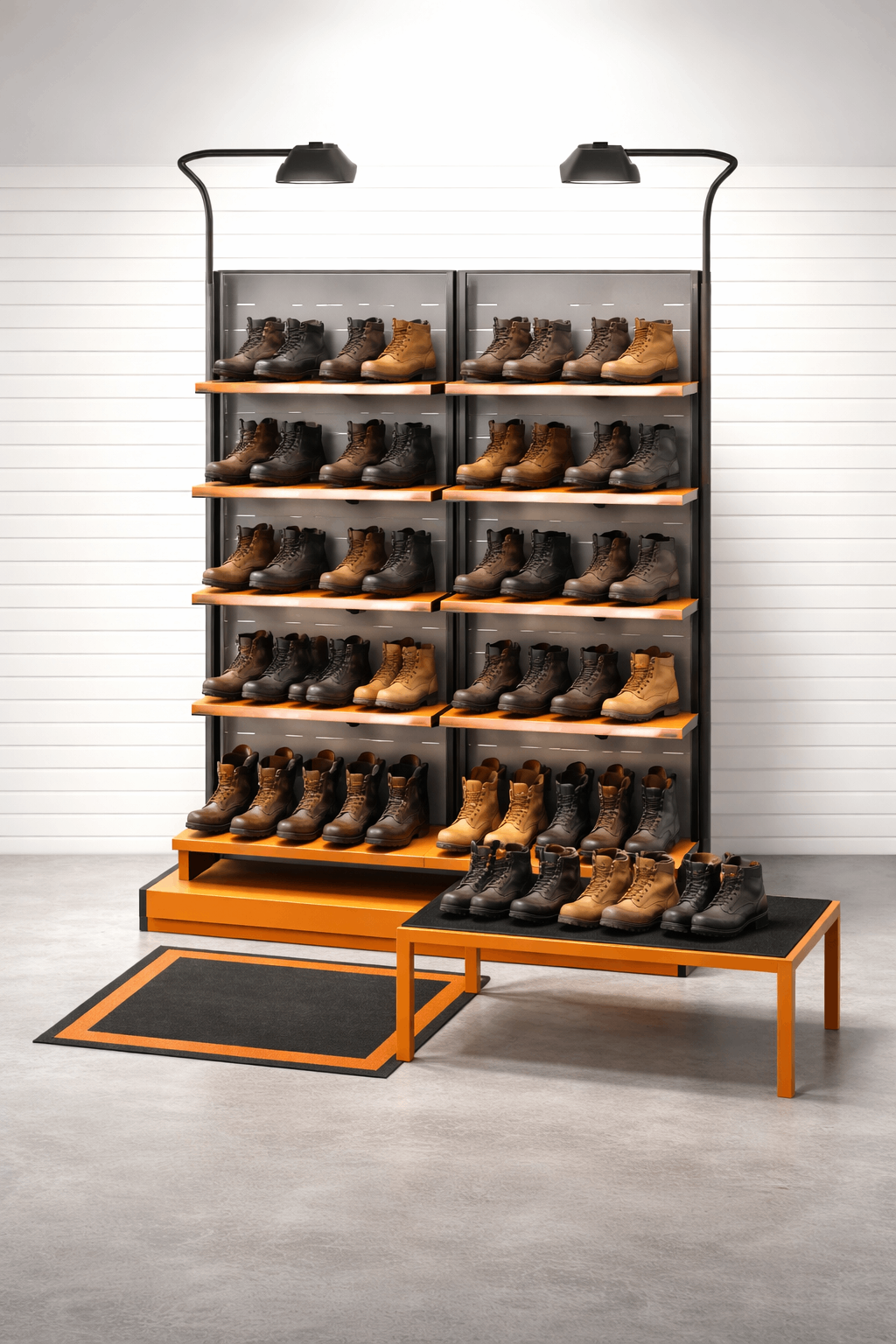
This display combines a tall vertical format, a durable metal structure, and visible branding areas that help turn multiple pairs of shoes into one strong retail statement. The image presents a more complete branded unit rather than a simple single rack, with a main display body, strong top signage, and a front-side presentation extension that adds extra display value on the retail floor. As a shoe display stand for branded programs, it supports organized presentation while keeping products easy to browse. For buyers comparing options for wholesale shoe display projects, that balance between visibility, durability, and customization is often the deciding factor.
Quick View
| Item | Overview |
|---|---|
| Product Type | Custom wholesale retail shoe display fixture |
| Main Material | Metal |
| Best For | Work boots, safety footwear, branded shoe campaigns |
| Service | OEM / ODM custom production |
| Project Use | Store rollout, retail promotion, branded display programs |
| Supply Basis | Sample review and bulk-order production |
In store, shoes compete with many other visual elements. They may sit near apparel, accessories, posters, or general shelving. If the presentation looks crowded or flat, even a good product can lose attention. That is why a dedicated floor fixture often performs better than standard shelves. This display creates a defined shoe zone where shoppers can see products more easily, compare them more quickly, and understand them as part of one brand message.
The product image shows a clear merchandising logic. The tall dual-upright frame gives the unit strong presence from distance, while the upper signage area helps attract attention before the shopper reaches the display. The middle and lower levels keep products at practical viewing height, and the front-side extension adds a low-level presentation area that holds extra pairs or supports campaign-led display. This is one reason a purpose-built wholesale shoe display can outperform ordinary storage-oriented shelving in campaign-driven retail spaces.
For buyers, that means the display serves two functions at once. It supports the shoes physically, and it supports the brand visually. That combination is useful in promotional areas, mono-brand stores, department store corners, and product launch zones where display clarity can influence how quickly customers engage.
The value of this fixture comes from how it works on the retail floor. A five-level layout gives enough vertical capacity to present several pairs or collections together, but it does not become so dense that the display loses readability. In footwear merchandising, that balance is useful because shoppers often compare products visually before they read any detailed information.
The upper section strengthens brand recognition and helps the display stand out from surrounding fixtures. The middle levels showcase hero products, key sellers, or feature-led styles effectively. The lower section supports extra pairs, category grouping, or campaign graphics, while the front extension gives the fixture another practical touchpoint for featured pairs or cross-merchandising. This arrangement creates a natural viewing sequence and gives store teams a clearer framework for product placement.
The floor-standing format is also practical in mixed retail environments. It helps define a dedicated footwear area without requiring permanent wall space. For buyers planning store rollouts or promotional programs, that flexibility can improve floor planning. A five-layer gray metal fixture like this is easier to position, easier to standardize, and easier to adapt across stores with slightly different layouts.
From a sourcing perspective, a display should not only look good in one photo. It should also support repeatable in-store execution. Buyers often evaluate whether a concept is easy to brief, easy to reproduce, and easy for store staff to maintain. This structure performs well on those points because the display levels and branding zones are visually clear.
A good shoe fixture should improve merchandising logic, not just add capacity. That is where this display concept becomes more useful than a standard shelf. A vertical layered layout allows the retailer to use floor space efficiently while still keeping a clear product hierarchy. In many commercial spaces, floor area is limited, so a stronger vertical display can create better product exposure without spreading one collection across several disconnected fixtures.
Layered presentation also improves comparison. Shoes are often judged through silhouette, outsole, upper material, finish, and color accents. When too many products sit at one flat level, those differences become harder to read quickly. By dividing the assortment into separate visible tiers, the display gives each group more breathing room and makes the selection easier to scan from medium distance.
This structure works especially well for promotions. A work boot launch, a safety-footwear program, or a seasonal footwear campaign should not look like ordinary stock storage. The upper area captures attention, the center carries the strongest commercial pairs, the lower section broadens the assortment, and the base reinforces campaign messages. That makes the fixture useful for retail programs that need clear visual hierarchy across branches.
For wholesale buyers, there is also an operational advantage. A display concept that looks attractive but lacks structure can lead to inconsistent execution after delivery. This layout is easier for store teams to understand, so product placement, graphic visibility, and refresh standards are more manageable over time. In practical sourcing terms, that reduces risk.
In busy stores, structure affects both performance and brand image. A fixture that wobbles, scratches too easily, or loses shape after restocking can reduce the perceived value of the merchandise. That is why metal remains the preferred base material for many POP and retail fixture projects. This gray metal floor display uses metal as its main framework, giving the unit the strength and stability expected from commercial use.
For this product, metal is not just an optional material. It is the core of the display. The frame, support sections, and load-bearing parts are built around metal construction so the unit can handle repeated product handling, daily shopper contact, regular cleaning, and longer campaign cycles. For buyers sourcing fixtures for multiple stores, that structural reliability is a meaningful purchasing point, especially when finish consistency and service life affect reorder decisions.
The finish also matters. Gray works well as a neutral visual base because it allows branded graphics and footwear colors to stand out more clearly. In the product image, the gray structure supports the black and orange brand elements without competing with the shoes, which is particularly effective for rugged footwear and work-boot presentation. This helps the fixture look commercial and organized instead of overly decorative.
Teams can specify surface treatment according to project needs. Buyers commonly prefer powder-coated finishes because they support appearance consistency, surface durability, and easier maintenance. In wholesale procurement, finish quality is not a minor detail. It influences how the fixture looks after packing, shipping, installation, and repeated store use.
Selected projects may also integrate acrylic, wood, or cardboard in non-structural areas where a different visual effect is useful. However, the product remains a metal display solution at its core. For buyers who prioritize longer service life, that is usually the right balance between structural strength and visual flexibility.
A footwear display should present the product and reinforce the brand at the same time. In many retail environments, shoppers read the graphic language of the fixture before they study the shoes. They notice the logo, color system, imagery, and overall display tone. That is why customization is central to the value of this product. It is built to support branding in a way that is practical for sourcing teams and useful for real store execution.
The upper header zone is especially important because it extends visibility and gives the unit a stronger recognition point from distance. The shelf fronts, bottom graphic areas, and branded floor panel provide additional surfaces for campaign messages, product series names, and brand communication. When store teams use these areas well, the fixture works as a full merchandising unit rather than a simple rack.
Customization should also stay commercially sensible. A fixture may look attractive in a rendering but still fail in store if products block the graphics or if spacing does not fit the shoe category. This custom shoe display rack lets buyers adjust logo scale, shelf spacing, display density, and selected accessories according to the retail objective. That makes it more useful for buyers who need controlled OEM or ODM development instead of vague visual customization.
For sourcing teams, the main question is usually not whether customization is possible. The real question is whether the customization can be produced consistently across a wholesale order. This is where practical display development matters. A good custom fixture should be clear in specification, efficient in production, and manageable in store after delivery.
This fixture works best in programs that present shoes as part of a branded retail story rather than placing them on a general-purpose shelf. It works well in footwear stores, sports shoe shops, fashion retail environments, department store shoe zones, showroom displays, and shopping mall promotional areas. The structure has enough presence to support a focused campaign without overpowering the surrounding floor layout.
Chain-store rollout projects are another good match. Retail teams often need a fixture concept that can be repeated across stores while still allowing measured changes for local assortment or available floor space. This store rollout display approach supports that need because the core structure stays clear, while the presentation details remain flexible.
In practice, buyers may use the same display logic for work boots, safety footwear, casual shoes, sneakers, or performance footwear. What changes is the spacing, the branding treatment, and the assortment density. That flexibility is one reason these projects often begin with specification review and trial-order discussions before a wider rollout.
In B2B sourcing, customization is rarely limited to color and logo. Buyers usually need the display to fit store size, assortment depth, display strategy, logistics planning, and brand standards. This product should therefore be understood as a custom retail fixture, not a fixed stock item. The image offers a strong reference direction, but buyers can adjust the final version according to the project.
Dimensions are one of the most common variables. Buyers can adapt width, height, and depth to available floor space and required display capacity. Teams can also refine the number of visible levels and the spacing between them to suit different shoe categories. Boots normally require a different rhythm from low-profile fashion shoes or athletic sneakers, and those details affect the final geometry of the fixture.
Branding elements are another major area. Some projects need a larger logo zone, more restrained graphics, interchangeable panels, or a different color system. Teams may also consider selected decorative materials in non-structural areas when they want a warmer or more premium visual effect. The most useful approach is one that matches the product line, the target retail environment, and the buyer’s rollout plan.
Packaging and assembly should also be part of the conversation. A fixture that looks correct on paper but packs poorly can increase freight cost and complicate installation. Overseas buyers often compare suppliers carefully on this point because packing efficiency, protective structure, and assembly clarity all influence the total landed value of the project.
Some buyers also ask whether suppliers can support small-quantity testing before a wider order. In practice, that depends on customization complexity and production planning. Trial discussions usually move faster when the buyer can already provide target dimensions, branding files, and intended retail use.
The table below summarizes the main commercial and technical profile of this product. It helps a sourcing team quickly decide whether the display fits the project before moving into drawing review or quotation.
| Item | Specification |
|---|---|
| Product Name | Cool 5-Layers Gray Metal Floor Wholesale Shoe Display Rack |
| Product Type | Floor-standing retail shoe display fixture |
| Main Material | Metal |
| Optional Material Elements | Acrylic, wood, or cardboard for selected custom parts |
| Color | Gray or customized |
| Structure | Vertical merchandising unit |
| Display Layers | 5 |
| Logo | Customized |
| Size | Customized according to project needs |
| Surface Treatment | Commonly specified according to project requirements |
| OEM / ODM | Supported |
| Main Use | Footwear display, retail promotion, branded merchandising |
| Supply Type | Wholesale and custom production |
| Project Type | Custom wholesale display program |
| Sample / Trial | Available upon project review |
| Quality Reference | ISO 9001 and RoHS |
| Origin | Guangdong Province, China |
Buyers should read these specifications as a decision-support summary rather than a full engineering sheet. For B2B buyers, the key points are straightforward. The fixture uses metal as the main structure, supports customization, and is intended for branded footwear presentation instead of off-the-shelf retail sale.
The specification block is useful because it reduces ambiguity early. A buyer can quickly confirm product type, material direction, customization scope, and application without guessing what the team can or cannot change. In cross-border sourcing, that kind of clarity often shortens the quotation cycle and improves communication accuracy.
For buyers evaluating multiple options, the practical meaning behind the specifications is just as important as the data itself. Five layers let retailers present more styles within one coordinated unit. Metal construction delivers better durability and a more dependable display cycle. Custom size and branding let the fixture fit the store instead of forcing the store to adapt to a fixed rack.
A display program works best when design intent and production discipline move together. That is especially true for a wholesale project where multiple units must perform consistently across stores, campaigns, or export shipments. Development usually begins with a review of practical variables such as shoe type, display quantity, floor space, visual hierarchy, branding level, and installation conditions.
Once those inputs are clear, the team can translate the concept into structure. The team can confirm dimensions, shelf spacing, graphic positions, and finish direction in a more controlled way. If the project needs a sample, buyers should check not only appearance, but also how the shoes sit on the display, whether graphics stay visible after loading, whether the front extension adds useful selling space, and whether the whole unit still looks clean from a shopper’s point of view.
After confirmation, the team moves the project into mass production with stronger attention to finish consistency, fit, assembly logic, and export packaging. This matters because a display that looks good once but cannot be reproduced reliably is not commercially strong. In footwear programs, even small differences in spacing or graphics can change how the presentation is perceived in store.
For sourcing teams, confidence is usually built through clarity. Clear specifications, clear revision records, and clear understanding of what is fixed or adjustable make wholesale execution smoother. That is one reason many buyers discuss trial-order options early, especially when testing a new retail concept or validating a pilot rollout.
Buyers still need enough context to judge supply reliability. Yishang Display focuses on display manufacturing with metal as a core material direction, which fits this product naturally. The main concern is whether the team can deliver the product with stable quality and clear customization boundaries.
For wholesale projects, the real question is not whether a supplier can create a rendering. It is whether the supplier can maintain branding quality, structural reliability, and consistency from sample to bulk order. Current quality references include ISO 9001 and RoHS, which support that expectation.
Yes. The team can adjust logo placement on the header, shelf fronts, graphic boards, base panels, or other visible communication areas according to the display concept.
Yes. The team can modify overall size, spacing between levels, and the visual rhythm of the display according to store format, footwear category, and display quantity.
Yes. Metal is the primary structural material because it offers the strength, stability, and longer service life expected from a commercial retail fixture.
Yes. The team may use acrylic, wood, or cardboard in selected non-structural or decorative areas when the project requires a different visual effect.
Yes. The structure, visual tone, and product spacing are especially suitable for work boots, safety footwear, and other rugged footwear categories that need stronger brand presentation on the retail floor.
Yes. The team can review the front-side extension as part of the project design. Depending on the display goal, they can resize, reposition, or adapt it to support additional product presentation.
Teams can discuss small-quantity or trial-order evaluation depending on customization complexity and production planning. Buyers usually get faster feedback when they share artwork, target dimensions, and application details first.
If you are sourcing a custom shoe display rack, a retail shoe display fixture, or a branded store rollout display for work boots or safety footwear, this product offers a practical starting point. It combines a clear merchandising structure, durable metal construction, and branding areas that support stronger in-store communication.
Share your target dimensions, estimated quantity, logo files, and shoe category, and Yishang Display can review the project with you and provide a more accurate quotation.
Yishang Display specializes in crafting bespoke display solutions. From initial concept and prototyping through to full-scale production, our in-house team manages every phase—delivering a seamless, one-stop experience for your brand.
If you have any questions or need a quote, please send us a message. One of our specialists will get back to you within 24 hours and help you select the correct valve for your needs.
All of our products are available for sampling