A retail display should do more than hold products. For overseas wholesale buyers, it also needs to fit the store concept, support brand presentation, use floor space efficiently, and remain practical for production, packing, shipment, and repeat orders.
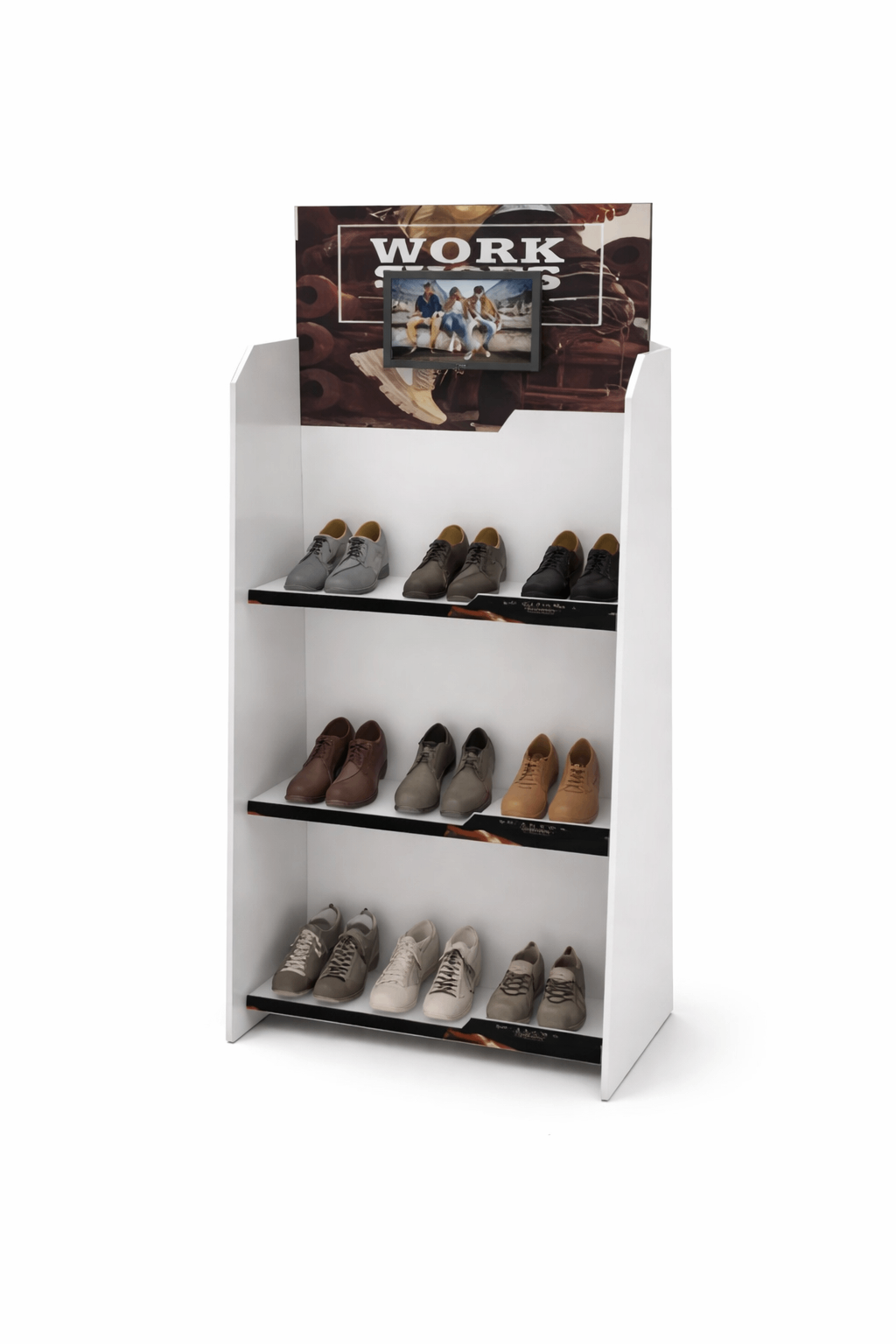
This 3-Tiers Custom White Acrylic Shoe Storage Display Rack With LCD Screen is built around those requirements. It is a compact shoe display rack that combines product presentation, light storage value, and digital promotion in one unit. For buyers sourcing a shoe display stand for footwear stores, campaign zones, or branded launch corners, that combination is often more useful than a basic shelf because it supports both merchandising and communication.
The structure is simple and commercially practical. Three display levels keep shoe samples visible, while the top header panel and integrated LCD screen create a clear communication point above the product. Instead of adding a separate digital fixture, the screen is integrated into the display itself. For wholesale purchasing teams, the real question is not only whether the fixture looks good in a photo. It is whether the design can be customized efficiently, whether the materials suit the target retail environment, and whether the unit can be packed and delivered reliably for a multi-store rollout.
In footwear retail, a display works best when customers can read the assortment quickly and understand the message behind it. This fixture is designed for that purpose. The three-tier arrangement presents several shoe samples in a clear vertical order, helping stores show key styles without taking too much floor space.
That makes the unit practical for entrances, side walls, promotional corners, and mall campaign areas where space is limited but visual impact still matters. The format supports organized presentation rather than random stacking, which is important when a retailer wants to guide attention toward a featured collection, seasonal launch, or promotional highlight.
The LCD screen adds another layer of value. Combined with the printed header panel, it turns the fixture from simple product shelving into a retail communication tool. A buyer comparing supplier pages often needs to know whether a display can do more than hold product. In this case, the answer is yes: the unit can support campaign visuals, launch content, product highlights, or short brand stories without increasing the footprint.
That distinction matters in procurement. A standard shelf may satisfy basic display needs, but a display rack with integrated screen support can improve campaign execution, product storytelling, and display efficiency in one structure. That is why this design is often chosen for branded retail programs, seasonal promotions, and product launch displays rather than only for general storage.
The most practical strength of this fixture is the vertical format. A 3-tier shoe display rack uses upward space effectively and keeps the floor area more open than wide, low merchandising units. For many retailers, the most valuable zones are compact rather than large, so space efficiency is part of the buying decision.
This layout also helps product zoning. Different tiers can be used for new arrivals, highlighted styles, or separate shoe categories. That improves readability for shoppers and gives store staff a simpler format to maintain throughout the day. A cleaner presentation often leads to stronger product focus, especially in stores that need fast visual communication.
As a freestanding shoe display stand, the unit is also flexible in store planning. It can be placed near a wall, at the front of a store, or inside a campaign area without complex installation. For wholesale buyers managing multiple locations, that kind of placement flexibility can reduce execution problems during rollout.
The visual tone of a fixture affects how the product is perceived. This white acrylic shoe display uses a bright, clean surface that helps footwear stand out clearly. White backgrounds reduce visual noise and keep attention on product shape, color, and detail, which is especially useful for fashion, lifestyle, and premium footwear programs.
The acrylic finish also works well with branded graphics. It creates a neat, modern look without competing with the merchandise. For buyers evaluating a custom program, that is useful because the fixture can support both neutral brand presentation and stronger campaign graphics without becoming visually heavy.
Acrylic, however, should be judged from a commercial angle as well as a visual one. Some projects require greater durability or stronger load support, especially in stores with heavier traffic or longer planned use. In those cases, the unit can be engineered as a metal-plus-acrylic structure so the display keeps its refined appearance while gaining a more robust frame. For a metal products company like Yishang Display, that mixed-material approach is often where display aesthetics and structural reliability meet most effectively.
One of the clearest reasons buyers choose this design is the screen feature. A shoe display rack with LCD screen gives the displayed product a stronger selling context. Instead of relying only on static graphics, the brand can run campaign loops, material stories, launch visuals, or styling footage above the actual shoes.
That is especially useful in retail environments where customer attention is limited. Motion content often creates a better stop effect than a printed panel alone, and it can explain a collection faster in busy traffic zones. For brands that refresh campaigns frequently, the screen also offers more flexibility than fixed graphics.
From a purchasing point of view, the value of the screen is not only visual. It can reduce the need for separate promotional hardware and help a compact display take on a larger communication role. For launch periods, branded corners, or short-term campaigns, that added merchandising value can justify the upgrade.
This unit fits best in branded footwear stores, sports shoe retail environments, mall campaign areas, department store promotions, and chain-store launch programs. In these settings, the fixture needs to do more than hold inventory. It should create a clear focal point, support fast product recognition, and remain practical for store staff to refill and maintain.
The vertical body, printed header area, and top screen make the display suitable for entrance areas, new-arrival corners, and feature-product zones. These placements usually demand a fixture that is compact, easy to read from a distance, and visually aligned with the rest of the store. A display that is too large can disrupt traffic flow, while one that is too simple may fail to attract enough attention.
For overseas buyers, application fit is a purchasing factor, not just a styling issue. A chain retailer may need consistency across multiple stores. A distributor may need a design that can be adapted for different customer programs. A brand team may need a compact display solution for a seasonal campaign. This format can support all three with the right customization and specification control.
The value of a custom fixture is not how many options appear in a list. It is how well the structure fits the actual retail task. For that reason, a custom shoe display rack should be reviewed according to product type, target store layout, branding needs, and shipping method before pricing is finalized.
For this model, common customization points include overall size, shelf spacing, header graphics, logo presentation, shelf-front branding strips, screen size, screen mounting method, and packaging detail. Footwear with larger silhouettes may require more shelf depth. Premium collections may need more open product spacing to preserve the visual effect.
Material selection also influences procurement decisions. Acrylic gives the unit a light and modern look, while metal reinforcement can improve stability for long-term use. This combination is often preferred by buyers who want the presentation value of acrylic without sacrificing structure. It is also relevant for buyers searching terms such as retail shoe display rack, custom footwear display stand, or branded shoe display fixture, because they are usually comparing both visual effect and service life.
The same logic applies to export packing. For overseas shipment, packaging should protect edges, screen components, and finished surfaces. Buyers comparing suppliers often pay close attention to this point because damaged display parts create avoidable cost, replacement work, and delivery delay.
For many projects, the best result comes from balancing appearance and durability. Acrylic is effective when the display needs a clean surface, consistent color, and a lighter visual profile. It is often selected for branded retail, seasonal promotions, and lifestyle-focused product presentation.
However, not all stores place the same demand on a fixture. In busier environments, metal reinforcement may be the better choice beneath or behind the acrylic surfaces. A stronger frame helps the unit remain stable during restocking, customer interaction, and repeated cleaning. That can be important for projects expected to stay on the sales floor for months rather than weeks.
Shelf spacing also deserves careful attention. Sneakers, dress shoes, and mixed footwear collections do not all require the same vertical clearance or display density. The shelf-front strips shown in this display can also be used for product messaging or branded identification, which helps the presentation stay organized at store level. A better fit at this stage improves both presentation and daily store use. It also reduces the risk of redesign after sampling.
From a procurement point of view, these details affect more than appearance. They influence cost, expected service life, pack-out method, and maintenance over time. Experienced buyers often review structure and material logic early because those points usually shape the final value of the project.
The specification framework below reflects the most common commercial requirements for this model. Final details can be adjusted according to project needs.
| Item | Specification |
|---|---|
| Product Name | 3-Tiers Custom White Acrylic Shoe Storage Display Rack With LCD Screen |
| Display Type | Freestanding footwear merchandising fixture |
| Main Material | Acrylic |
| Optional Structure | Acrylic only or metal + acrylic combination |
| Color | White, customizable |
| Shelf Layout | 3-tier vertical presentation |
| Screen Type | LCD screen |
| Application | Footwear stores, campaign areas, branded retail display |
| Branding | Custom logo, header graphic, shelf-front strips, visual panels |
| Size | Custom according to project |
| Lead Time | Around 30 days after approval, depending on quantity |
| Sample Development | Based on drawing confirmation and project details |
| Trade Terms | EXW, FOB, or CIF |
| Place of Origin | Guangdong Province, China |
| OEM / ODM | Available |
| Certifications | ISO 9001, RoHS |
For B2B buyers, these figures work best as a quotation basis rather than a fixed catalog rule. Pricing usually depends on size, material combination, screen specification, branding treatment, packaging standard, and destination market. In practice, buyers also look at how clearly a supplier defines these variables, because that often signals how smoothly the project will move later.
For repeat programs, this display format also has a practical advantage. The three-tier structure, unified header area, shelf-front strips, and integrated screen zone are relatively easy to standardize once the project specification is confirmed. That makes the design more suitable for multi-store rollout, distributor programs, and seasonal campaigns that need visual consistency across locations.
A project like this usually starts with the retail requirement, not just with a request for price. Buyers normally review target store type, expected quantity, preferred dimensions, logo position, screen requirement, and shipping market before asking for final quotation.
Once that direction is clear, drawing confirmation or sample development helps align material thickness, shelf geometry, screen position, graphics, and packing method. This is where a display moves from a visual idea to a workable product. For chain-store programs and repeat projects, that step matters because small changes in size, spacing, or assembly can affect store execution when units are delivered in volume.
A practical supplier approach matters here. Buyers usually value clear communication, realistic customization, and a fixture that works in daily retail use, not only in a render or quotation sheet.
For larger retail programs, the benefit of this process is consistency. Once dimensions, material thickness, header graphics, shelf-front strips, and screen details are fixed, the display becomes easier to reproduce across stores with fewer execution differences. That reduces risk for buyers who need a display solution that is not only attractive, but also repeatable in production.
One common question is whether the unit must remain acrylic only. It does not. Depending on project requirements, the display can be developed as a mixed-material structure to improve strength, durability, or mounting stability.
Another frequent question concerns display capacity. The answer depends on shoe width, shelf depth, and how open or dense the visual presentation should be. In most branded settings, fewer samples displayed well usually perform better than overcrowded shelves.
Buyers also ask whether the screen can be changed or updated later. In many projects, the answer is yes, provided the screen size, mounting method, and content format are confirmed early. That helps protect both the design and future campaign flexibility.
Maintenance is also part of the buying decision. Smooth surfaces, stable shelf edges, and sensible packing standards all contribute to longer service life and lower replacement cost over time.
If this display fits your retail plan, send your quantity, size preference, branding files, screen requirement, and destination market. A clear brief will help Yishang Display provide a faster and more accurate quotation.
Yishang Display specializes in crafting bespoke display solutions. From initial concept and prototyping through to full-scale production, our in-house team manages every phase—delivering a seamless, one-stop experience for your brand.
If you have any questions or need a quote, please send us a message. One of our specialists will get back to you within 24 hours and help you select the correct valve for your needs.
All of our products are available for sampling