In hardware retail, heavy tools are evaluated by how they look, feel, and are reached on the floor. Hammers and hand tools are tactile products. Buyers compare head geometry, grip texture, balance, and finish before deciding. When fixtures hide these cues or make access awkward, conversion suffers. A hardware display rack designed for tools must support weight, keep SKUs readable, and guide attention within tight aisles.
For overseas wholesale buyers, the evaluation lens focuses on repeatability and risk control rather than consumer appeal alone. Importers and distributors look for fixtures that can be specified once and deployed at scale with predictable results: stable dimensions, consistent finishes, export‑ready packing, and straightforward installation. In this context, a wholesale hardware display rack must perform reliably across stores and seasons while protecting total landed cost.
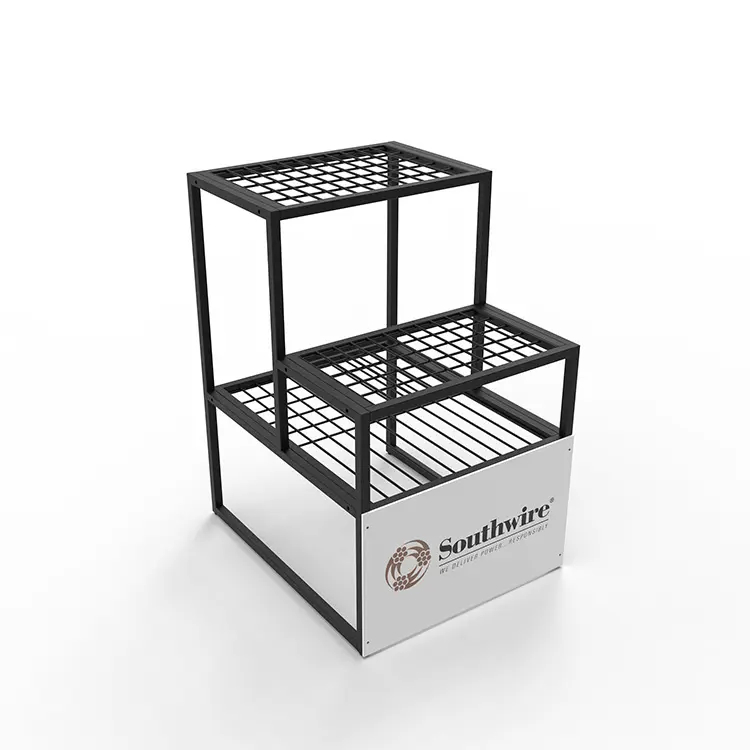
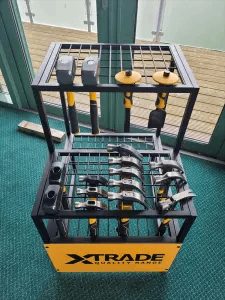
Retail chains increasingly optimize vertical presentation to increase face‑out exposure without expanding floor area. Stepped fixtures are widely used in tool aisles to shorten scan paths in dense assortments. The 3-step metal hardware shop store fixtures tool hammer display rack aligns with this practice by creating visual hierarchy and clear access zones, supporting faster browsing and cleaner replenishment.
At-a-glance for procurement teams
This floor‑standing tool hammer display rack combines a stepped, 3‑tier layout with a heavy‑duty metal frame. Typical programs specify powder‑coated finishes, adjustable tier spacing for mixed packaging, and knock‑down construction for export efficiency. Header panels enable branding without affecting structure, and export packing supports bulk order display rack rollouts across multiple stores.
A 3-step metal hardware layout uses tiered geometry to expand display surface within the same footprint. Each level is offset to create a stepped profile that improves face‑out visibility and reduces occlusion among varied handle lengths and packaging depths. This is the merchandising layer of the solution: how products are seen, compared, and selected.
For wholesale programs rolling out fixtures across multiple stores, the stepped structure simplifies planogram documentation and training. Tier assignments can be standardized by tool family or price band, reducing execution variance across doors and shortening onboarding time for store teams.
Ergonomics improve with stepped tiers because mid‑level placement aligns with natural reach zones. This reduces bending for customers and speeds staff replenishment, improving aisle flow and reducing handling friction during peak hours.
A metal hardware shop store fixture for hammers must be engineered around predictable load paths. Square‑section metal framing distributes weight vertically into the base, while reinforced joints and cross‑bracing keep tiers rigid under dense loads. This construction approach supports long service life in high‑traffic aisles.
Retail fixtures face dynamic loads as tools are lifted and returned. Stability depends on joint integrity, balanced mass, and a base that resists racking. Anti‑slip leveling feet and calibrated footprints maintain alignment during peak traffic, reducing micro‑movement that accelerates fatigue.
From a wholesale sourcing view, durability also includes transit resilience. Export‑ready protection at corners, abrasion‑resistant finishes, and standardized fasteners reduce in‑transit damage and speed installation across multi‑store rollouts. These details matter for bulk order display rack programs where field issues scale quickly.
On the floor, a tool hammer display rack must convert visibility into efficient operations. Stepped zoning creates clear access layers: lower tiers for boxed or multi‑packs, mid tiers for core SKUs, and upper tiers for featured lines without blocking sightlines. This improves browsing speed and reduces congestion in narrow aisles.
Cross‑merchandising benefits from separation by tier. Pairing hammers with fasteners or protective gear becomes cleaner when visual boundaries are maintained, supporting add‑on sales without adding fixtures. For chains, consistent hardware store fixtures across locations reinforce recognition and reduce exceptions during resets.
For wholesale rollouts, performance is measured by repeatability. A stepped rack that deploys consistently across end‑caps and aisle runs reduces field issues and returns. Knock‑down assembly and repeatable geometry shorten installation windows during seasonal resets.
Effective store fixtures tool hammer solutions start with product geometry. Head mass, handle length, and packaging depth determine tier spacing and shelf depth. Adjusting these parameters reduces fall risk and improves visibility without compromising stability.
Store layouts vary by market. Narrow aisles favor compact footprints. Feature zones benefit from multi‑angle visibility. Modular accessories and adjustable tiers let buyers tune the rack to local constraints while preserving the core metal frame.
Branding can be integrated without weakening structure. Header panels and base cladding in acrylic or wood add visual warmth. Finishes aligned to brand colorways keep presentation consistent across locations. Replaceable graphics support seasonal campaigns without replacing the frame.
For load‑bearing components, metal remains the standard. A metal hardware shop store fixture maintains dimensional stability under repeated loading cycles common in tool merchandising. This reduces misalignment and safety risk over time.
Secondary materials can support wayfinding and brand cues. Acrylic improves legibility under retail lighting. Wood cladding suits stores seeking a warmer look. Hybrid construction balances durability and presentation, and simplifies maintenance when graphics are refreshed.
From a wholesale sourcing view, materials affect shipping efficiency and total landed cost. Removable non‑structural panels can be packed flat to reduce damage risk. A robust metal frame protects against transit handling and repeated installation cycles.
The operational value of a fixtures tool hammer display depends on technical fit and procurement readiness. The parameters below reflect common requirements for dense hand‑tool assortments in chain retail and distributor programs.
| Specification Item | Typical Range / Description |
|---|---|
| Structure | 3-step tiered layout for compact footprints |
| Primary Material | Heavy-duty metal frame (tube frame + reinforced shelves) |
| Metal thickness (typ.) | Project‑specific range for retail load targets |
| Load handling (per tier) | Engineered for dense hand‑tool loads with safety factors |
| Footprint | Floor‑standing, aisle and end‑cap friendly |
| Tier spacing | Adjustable to suit mixed packaging sizes |
| Finish | Retail‑grade powder coating (matte/gloss options) |
| Branding | Header panels and base cladding optional |
| Assembly | Knock‑down for efficient shipping |
| Packing | Export carton with protective corners/foam |
Procurement snapshot (for RFQ readiness)
| Item | What buyers typically confirm |
|---|---|
| MOQ | Suitable for distributor and chain rollouts |
| Lead time | Stable window for seasonal programs |
| Compliance | RoHS documentation available upon request |
| Carton marking | Store/region codes for split deliveries |
| Spares | Replaceable panels and fasteners for field support |
For factory‑direct display rack sourcing, clarity on finishes, knock‑down packing, and carton marking shortens RFQ cycles and reduces exceptions during consolidated shipments.
Choosing the hammer display rack for a wholesale program begins with SKU mix and turnover. Dense steel tools benefit from stepped zoning that separates price tiers without expanding floor area. Mixed assortments perform better when tier spacing accommodates varied handle lengths.
Operational cadence matters. High‑turn categories need fixtures that allow front‑facing replenishment and quick visual audits. Defined zones reduce handling errors and keep planograms intact during resets.
Program risk should be assessed early. Knock‑down shipping, standardized fasteners, and replaceable panels reduce claims and simplify field support. These factors protect distributor margins during multi‑store rollouts.
Buyers often ask whether a stepped rack can support heavy tools. Structural reliability depends on reinforced joints and balanced load paths rather than nominal thickness alone. A properly engineered tool hammer display maintains rigidity under repeated handling.
Weight limits and tier spacing should be matched to SKU profiles. Adjustable tiers accommodate evolving assortments without structural compromise. Export packaging and carton marking for multi‑location distribution further reduce rollout friction.
Documentation matters. Clear packing lists, assembly guidance, and QC notes help procurement teams move faster from RFQ to purchase order, especially for regional programs.
Visual hierarchy improves discoverability in dense categories. Stepped presentation increases face‑out exposure and reduces occlusion among long handles and varied packaging. This supports quicker comparison at the shelf edge.
Consistent fixture geometry across locations reinforces brand recognition. Retailers using standardized shop store fixtures tool layouts report smoother resets and fewer presentation exceptions, which lowers labor variance across stores.
Lifecycle value extends beyond first cost. Durable finishes and stable frames reduce replacement frequency. Lower maintenance protects total cost of ownership for distributors managing multiple doors.
Predictable performance across seasons matters for wholesale programs. Fixtures that tolerate frequent resets and promotional swaps protect merchandising timelines and reduce field service tickets.
Wholesale buyers evaluate fixtures as part of a program, not as one‑off items. Predictable specifications, tight tolerances, and repeatable finishes shorten approvals and reduce rework across multi‑door deployments. Export‑ready packing and carton marking for split deliveries lower transit damage risk and accelerate receiving.
Where branding refreshes are frequent, modular graphics preserve the metal frame while enabling seasonal updates. This protects capex across program cycles and reduces downtime during changeovers.
Tool categories reward clarity at the shelf. Stepped layouts improve scan paths in high‑density assortments. This aligns with current retail trends toward vertical merchandising in compact footprints.
Across global hardware formats, compact hardware shop store fixtures that increase face‑out exposure without widening aisles are favored for remodels and new‑store rollouts.
This rack integrates with common gondola and end‑cap systems. Standard footprints support mixed merchandising zones without disrupting traffic flow. Consistency across fixture families improves visual rhythm on the floor.
For distributors, compatibility with existing store modules reduces customization overhead and shortens rollout timelines.
Yishang Display focuses on repeatable fixture geometry and export‑ready execution so wholesale programs can scale with fewer surprises. Modular branding elements support seasonal updates without altering the core metal structure, protecting long‑term fixture standards across doors.
This approach supports continuity for distributors managing multiple customers, where consistent footprints and finishes reduce variance in store execution and simplify replenishment planning.
If you are planning a rollout for tools and hammers, share your SKU mix, approximate unit weights, and placement zones. A short brief helps align tier spacing, footprint, and branding for your stores. For quotations and sampling, contact Yishang Display to discuss program‑fit details.


Yishang Display specializes in crafting bespoke display solutions. From initial concept and prototyping through to full-scale production, our in-house team manages every phase—delivering a seamless, one-stop experience for your brand.
If you have any questions or need a quote, please send us a message. One of our specialists will get back to you within 24 hours and help you select the correct valve for your needs.
All of our products are available for sampling