
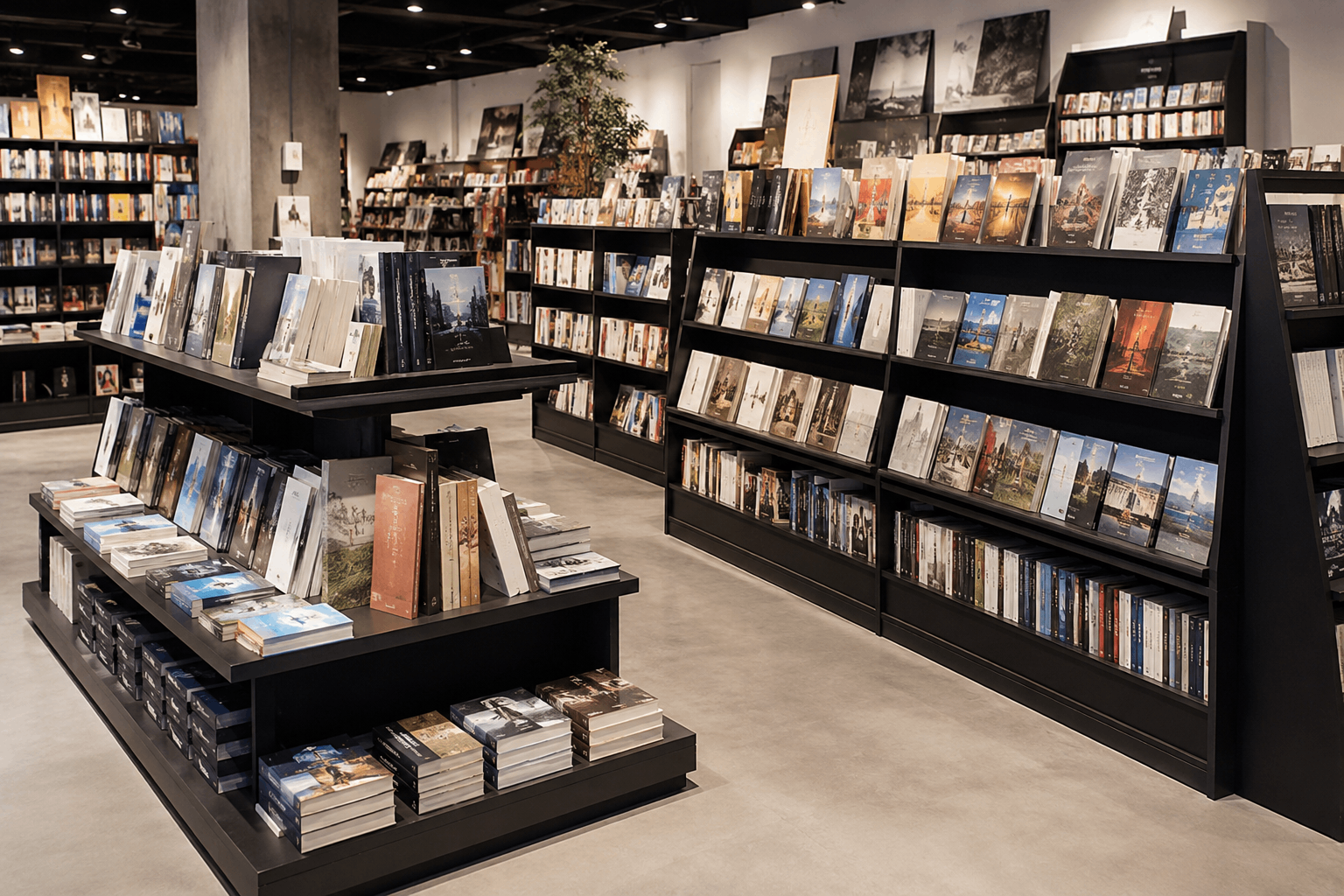
A Practical Fixture Guide for Overseas Buyers
When retailers open a bookstore, the fixture system does far more than fill the space. Shelving, display tables, window stands, signage holders, and checkout racks quietly shape how customers move, where they stop, how books are noticed, and how easily staff can keep the store looking organized.
For overseas wholesale buyers, distributors, shopfitting contractors, and chain bookstore procurement teams, the question is usually practical rather than decorative. Can the display solution be customized? Can it be produced consistently? Will it be packed safely, installed without confusion, and reordered later with the same specifications? These are the questions that often decide whether a fixture is suitable for a real retail project.
This guide focuses on metal book display racks and bookstore shelving for commercial bookshop projects. It is not a general article about starting a bookstore business. Instead, it looks at the part that matters most to fixture buyers: how shelving and display choices affect sourcing risk, retail performance, brand presentation, and long-term value.
What B2B Buyers Need to Confirm First
Wholesale buyers tend to scan supplier content quickly. They are usually looking for direct signals: product structure, load capacity, customization options, MOQ, lead time, packaging, sample approval, and repeat order consistency. A useful supplier article should help them understand these points without making them work through broad store design theory.
For bookstore projects, the first questions are simple, but they matter. What type of books will the rack carry? Will it be used in a window, entrance, aisle, wall area, or checkout counter? Does the buyer need a standard rack, a private-label product, or a custom OEM/ODM display system?
These questions matter because bookstore fixtures do not all face the same pressure. A window stand needs visual appeal and safe export packaging. A wall shelf usually needs stronger load capacity. A countertop rack needs compact dimensions and efficient carton packing. Treating every fixture as the same product may look convenient at first, but it often leads to a poor fit later.
Translate Store Layout Into Fixture Requirements
A bookstore layout should begin with how customers browse. Shoppers enter, slow down, scan covers, compare categories, and move toward displays that feel easy to understand. For procurement teams, that browsing behavior needs to be translated into clear fixture requirements.
The entrance often works as a decompression zone. It gives customers a moment to adjust before they begin browsing. A front-facing metal book rack can support new arrivals, bestsellers, seasonal titles, or promotional books in this area without making the entrance feel crowded.
The main shelving area has a different job. It holds category depth and keeps inventory organized. Adjustable metal shelving is useful here because paperbacks, magazines, textbooks, children’s books, and art books all require different shelf heights, spans, and load levels.
The central display area may need metal display tables for staff picks, gift books, or campaign themes. The checkout area may need compact countertop racks for small books, bookmarks, cards, stationery, or reading accessories. Each zone, in other words, should connect directly to a buying factor such as load capacity, footprint, packaging efficiency, or assembly time.
| Store Zone | Fixture Purpose | Recommended Product | Buyer Evaluation Focus |
|---|---|---|---|
| Window display | Market your business before entry | Tiered metal display stand | Stability, reusable design, export packaging |
| Entrance area | Create a clear first pause | Front-facing metal book rack | Cover visibility, base stability, easy restocking |
| Main shelving | Hold inventory depth | Adjustable metal shelving | Load capacity, shelf span, repeatable dimensions |
| Central display | Encourage discovery | Metal display table | Surface finish, structural strength, brand appearance |
| Checkout counter | Support impulse sales | Countertop metal display rack | Compact size, MOQ, packaging efficiency |
Common Bookstore Fixture Types for Wholesale Projects
A wholesale bookstore fixture project rarely depends on one product type. A practical layout may combine floor-standing book display racks, wall-mounted book shelving, countertop book display racks, metal display tables, rotating book display stands, magazine display racks, and signage holders. Each fixture plays a slightly different role.
Floor-standing book display racks are useful for entrances, promotional areas, and category highlights. Wall-mounted book shelving or wall-side metal shelving helps increase stock capacity while keeping the center of the store more open. Countertop book display racks work well near checkout counters, where small books, bookmarks, cards, or accessories need to be shown clearly in limited space.
Rotating book display stands and angled book display shelves are useful when the retailer wants more cover exposure within a small footprint. Magazine display racks may need a different shelf depth or angle from standard book shelving. For buyers, these distinctions are not minor details. They help prevent one rack design from being stretched across too many store functions.
Check Structure Before Appearance
Appearance matters in a bookstore. A fixture has to look right in the space. Still, for wholesale purchasing, structure should be checked before style. A rack that looks suitable in a catalog may still create problems if the shelf is too thin, the base is unstable, the welding is inconsistent, or the assembly method is unclear.
For bookstore shelving, buyers may want to ask about recommended load capacity, shelf thickness, frame material, welding quality, anti-rust surface treatment, connection hardware, and test assembly. These details help confirm whether the fixture is ready for heavy books and daily retail use, not just for a product photo.
Packaging deserves attention at the same stage. Metal fixtures may include powder-coated frames, acrylic sign holders, wood panels, screws, brackets, and printed headers. If these parts are not separated and protected properly, scratches, dents, or missing hardware can delay installation.
Sample approval is especially useful for custom projects. A pre-production sample allows the buyer to check finish color, edge quality, assembly steps, stability, packaging, and the real display effect before mass production begins. For OEM and ODM orders, this step can prevent small design issues from being repeated across a bulk order.
Match Display Method With Book Category
Face-out and spine-out displays are both important in bookstore merchandising, but they call for different fixture designs. Face-out display helps covers do the selling. It works well for bestsellers, children’s books, design books, new arrivals, gift books, and seasonal collections.
Angled metal book racks and tiered display stands are useful for face-out presentation because they improve cover exposure and make the display easier to scan. These fixtures often fit entrances, window displays, children’s sections, and promotional areas.
Spine-out shelving serves a different purpose. It supports inventory depth and works well for fiction, academic books, textbooks, reference books, and backlist titles. Because this method places more weight on each shelf, the fixture needs reliable load-bearing capacity and stable shelf support.
Display tables create a more relaxed browsing experience. Customers can walk around them, pick up books, and compare titles without entering a narrow aisle. For wholesale projects, a display table should be evaluated by frame strength, surface durability, packaging size, and whether it can include wood tops, signage holders, wheels, or brand panels.
Standard Book Racks vs. Custom Metal Display Fixtures
Standard book racks are useful when the buyer needs a straightforward product for general display use, smaller purchases, or short lead-time projects. They can work well for basic bookstore shelving, countertop displays, or temporary promotional areas where size, color, and branding requirements are limited.
Custom metal display fixtures are more suitable when the project requires brand consistency, special dimensions, mixed materials, higher load capacity, private-label design, or coordinated store rollout. For wholesalers and retail contractors, customization can also create a repeatable solution that can be supplied to multiple stores or customers.
The decision is not always about choosing the most complex option. In many projects, a balanced approach works best: standard racks for low-risk areas and custom fixtures for high-impact or high-load zones. This helps control cost while protecting the parts of the store that matter most for durability and brand presentation.
Balance Visibility, Capacity, Durability, and Flexibility
A strong bookstore fixture plan balances visibility, capacity, durability, and flexibility. Visibility helps customers notice important books quickly. Capacity allows the store to hold enough inventory without feeling crowded. Durability supports daily customer handling and staff restocking. Flexibility allows the store to update displays for campaigns, seasons, or new product categories.
These four priorities help wholesale buyers avoid choosing a rack only because it looks attractive. A beautiful display with poor capacity may fail in dense book categories. A strong shelf that cannot be adjusted may become inconvenient when the product mix changes.
Metal fixtures can support this balance when the structure is designed for the actual retail scenario. Slim frames, reinforced shelves, stable bases, adjustable layers, removable headers, wheels, and acrylic sign holders all help the display system adapt to different bookshop layouts.
| Priority | What It Means in a Bookstore | Useful Fixture Feature |
|---|---|---|
| Visibility | Customers can notice key titles quickly | Angled shelves, tiered layout, front-facing display |
| Capacity | Shelves hold enough stock safely | Strong frame, adjustable layers, wall shelving |
| Durability | Racks perform under daily use | Reinforced metal structure, stable base, smooth finish |
| Flexibility | Displays can change over time | Modular units, wheels, removable signage |
Use Metal as the Core Material
For bookstore fixture projects, metal is often most valuable as the structural core. It supports weight, shape stability, repeated handling, and long-term use. Powder-coated metal can also carry brand colors and create a clean, consistent retail appearance.
Other materials can add value when used carefully. Wood can make a bookstore feel warmer, especially on display table tops, side panels, or decorative surfaces. Acrylic works well for sign holders, category boards, shelf talkers, and clear promotional panels.
Cardboard can support temporary publisher promotions or short-term campaigns. It is usually not the right main structure for heavy book displays, though. For wholesale buyers, this material strategy helps balance appearance, cost, durability, and transport requirements without forcing one material to do everything.
Confirm Sourcing Details Before Bulk Production
For overseas buyers, fixture sourcing is not complete when the design looks acceptable. Before mass production, buyers should confirm technical drawings, dimensions, surface finish, load reference, sample approval, packaging method, assembly instructions, quality inspection, MOQ, lead time, and repeat order consistency.
These details are especially important for distributors and contractors because they often buy for resale, multi-store rollout, or project installation. A missing screw pack, unclear instruction sheet, color inconsistency, or weak carton can create costs that do not appear in the unit price.
A practical inquiry should include the target store type, product categories, expected quantity, destination market, display dimensions, color requirements, logo needs, packaging preference, and whether repeat orders are expected. With this information, the manufacturer can recommend a structure that fits the project instead of only quoting a standard rack.
| Sourcing Detail | Why It Matters to Wholesale Buyers |
|---|---|
| Technical drawing | Confirms dimensions, angles, and assembly structure |
| Sample approval | Reduces risk before mass production |
| Load reference | Matches rack strength to book categories |
| Surface finish | Supports brand consistency and corrosion resistance |
| Export packaging | Helps reduce scratches, dents, and missing parts |
| Assembly guide | Makes installation easier for retailers or contractors |
| Quality inspection | Supports stable production across bulk orders |
| Repeat order control | Keeps future orders consistent in size and color |
A Practical Sourcing Workflow for Custom Bookstore Fixtures
A custom bookstore fixture project usually starts with the buyer’s store layout, product categories, target quantity, and branding requirements. From there, the manufacturer can review the expected application and suggest a suitable structure, material combination, surface finish, and packaging method.
The next step is usually drawing confirmation. This stage helps both sides check dimensions, shelf angles, logo position, hardware, and assembly logic. For metal display rack projects, small details such as base width, shelf angle, and connection method can affect both stability and shipping efficiency.
After the drawing is confirmed, a sample or pre-production unit can be produced for review. This gives the buyer a practical view of color, finish, strength, packaging, and installation. Once the sample is approved, mass production, inspection, packaging, and shipment can move forward with lower risk.
For repeat orders, keeping the approved drawings, color references, packaging standards, and inspection notes is worth the effort. It helps maintain consistency when the same custom bookstore display fixtures are ordered again months later.
Keep Signage and Brand Presentation Integrated
Signage is part of the fixture system, not just a separate decoration. Category signs, shelf talkers, price strips, logo plates, and promotional headers help customers understand the store faster. They are especially useful when a bookstore organizes products by theme, author, age group, genre, or promotion.
For B2B buyers, integrated signage also improves consistency. A rack with removable acrylic sign holders or metal header frames is easier to update than a rack that relies on temporary tape or separate accessories. This matters for chain projects, franchise stores, and wholesale customers that need a repeatable display standard.
Yishang Display can support metal display racks with acrylic panels, wood accents, logo areas, removable headers, and customized finishes. This helps buyers connect fixture structure with brand presentation without turning the rack into a complicated installation project.
Avoid Sourcing Mistakes That Increase Long-Term Cost
The lowest unit price is not always the lowest project cost. If a rack bends, scratches easily, ships with damage, or requires complicated assembly, the buyer may face replacement costs, delayed installation, or customer complaints. For wholesale buyers, lifecycle cost is often more important than the first quotation.
Another common mistake is using one rack design for every store zone. A window display, entrance rack, wall shelf, central table, children’s section, and checkout counter do not perform the same job. Each area needs a different balance of height, visibility, capacity, access, and stability.
A third risk is confirming mass production without enough technical review. A product photo cannot show welding strength, packing protection, assembly accuracy, or long-term stability. Reviewing drawings, samples, packaging, and inspection standards early helps reduce problems after shipment.
When Custom Metal Display Racks Are Worth Considering
Custom metal display racks are worth considering when a bookstore project has limited floor space, unusual dimensions, heavy book categories, mixed products, frequent promotional changes, or brand consistency requirements. This is especially relevant for wholesalers, franchise projects, and shopfitting contractors that need repeatable solutions across different retail sites.
Customization also helps when a bookstore sells more than books. Many modern stores combine books with stationery, gifts, toys, magazines, and lifestyle products. A flexible metal fixture can include shelves, baskets, hooks, wheels, acrylic signage, or wood panels to support different product types.
Yishang Display supports custom metal display rack projects for retail environments where structure, durability, and flexible presentation matter. Its manufacturing capabilities include OEM and ODM customization, metal-based mixed-material structures, RoHS-supported production, and ISO 9001 quality management for buyers who need repeatable retail display solutions.
FAQ
What type of shelving is best for a bookshop?
The best shelving depends on book weight, store size, layout, and display goals. Metal shelving is often suitable for long-term bookstore use because it provides strength, stability, and load-bearing capacity. Wood, acrylic, and cardboard can be added where they improve appearance, signage, or short-term promotion.
What should wholesale buyers ask before ordering bookstore fixtures?
Wholesale buyers should ask about material specifications, load capacity, customization options, drawings, sample approval, surface finish, packaging, assembly instructions, quality inspection, MOQ, lead time, and repeat order consistency.
Are metal display racks suitable for small bookshops?
Yes. Metal display racks can be designed for small bookshops with narrow aisles, limited wall space, compact entrances, and small checkout counters. Custom sizing helps buyers use limited space more efficiently.
How should a bookshop balance face-out and spine-out displays?
Face-out displays are useful for books that need visual attention, such as new releases, bestsellers, children’s books, gift books, and seasonal titles. Spine-out shelving is better for inventory depth and organized category browsing. Most bookstores need both.
What is the difference between standard book racks and custom bookstore fixtures?
Standard book racks are suitable for general display needs and simple purchasing. Custom bookstore fixtures are better for branded retail projects, unusual store dimensions, higher load requirements, mixed materials, and repeatable multi-store rollout.
When should a bookshop choose custom display racks?
Custom display racks are useful when a store has unusual dimensions, heavy book categories, mixed products, frequent campaign changes, or a need for consistent brand presentation across multiple locations.
Build a Bookshop Fixture System That Works After Opening Day
A bookstore should look attractive when it opens, but it also needs to perform after daily use begins. Customers will browse, touch, compare, and move books. Staff will restock, rearrange, and update displays. Seasonal campaigns will change how space is used.
For overseas wholesalers, distributors, and retail project buyers, the right fixture supplier should understand both the retail environment and the sourcing process. Custom metal display racks offer a practical way to build a bookshop display system that is organized, durable, brand-ready, and prepared for future growth.
If you are sourcing bookstore shelving or custom metal display racks for a retail project, Yishang Display can help turn your layout, product categories, and brand requirements into a workable fixture solution.