

Introduction: Why Product Placement Still Drives Retail Sell-Through
In physical retail environments, visibility often determines whether a product sells or stays unnoticed. Before shoppers compare specifications, read labels, or evaluate price, they first need to notice the product. That moment of visibility is where in-store product placement plays a decisive role.
For overseas wholesalers, distributors, and retail procurement teams, product placement is not just a marketing concept. It directly affects sell-through performance, replenishment efficiency, and the long-term success of a retail program. Buyers responsible for supplying supermarkets, chain stores, or specialty retailers often evaluate display suppliers based on one key question: will the display solution actually help products perform better in real stores?
Crowded shelves, similar packaging, and limited customer attention make product visibility increasingly competitive. This is why many retailers combine shelf placement strategies with retail display racks, floor display stands, and custom retail displays to improve product exposure. These solutions help brands create clear focal points in stores where customers are constantly scanning for quick purchase decisions.
This article explores how product placement works in modern retail environments and how well-designed retail display fixtures support that strategy. Instead of focusing only on marketing theory, it connects placement strategy with real procurement decisions, display engineering considerations, and practical retail execution.
How Shopper Behavior Influences Product Placement
Retail environments are information-dense spaces. A typical supermarket aisle can contain hundreds of products competing for the same few seconds of customer attention. Shoppers rarely analyze every option; instead, they scan shelves quickly and focus on the most visible items.
Studies in retail merchandising show that a majority of purchase decisions are made inside the store itself. Customers often arrive with a general intention to buy a product category, but they decide on the brand only after seeing it displayed. This behavior explains why the positioning of products on shelves strongly influences sales performance. (See research from the National Retail Federation).
The most visible position is usually eye-level placement. Products located at eye level are easier to notice because they fall directly within the shopper’s natural viewing range. However, visibility is not determined by height alone. Clear product grouping, strong facings, and organized shelf structures also help shoppers process options quickly.
Displays that create visual interruption can further increase attention. Inline displays, sidekick racks, or floor display racks positioned near shelf sections help guide the shopper’s eyes toward specific products. For buyers sourcing retail display solutions, this means display structure must support both visibility and easy product access.
Retail Space: Why Store Layout Affects Product Performance
Not all retail space performs equally. Some store zones naturally receive more traffic and attention than others. Retailers design store layouts carefully to influence customer movement and purchasing behavior.
High-traffic areas typically include store entrances, main aisles, aisle intersections, and promotional islands. Products displayed in these zones benefit from early visibility and higher engagement. Many brands therefore place floor display stands or promotional retail display racks in these areas to capture attention before shoppers reach the main shelf.
Another highly valuable location is the aisle endcap. Endcap displays face the main walking path and can be seen from multiple directions. Because of their visibility, endcaps are widely used to promote seasonal products, new launches, and higher-margin items. (Retail layout practices are widely discussed in guides such as Shopify’s visual merchandising resources).
By contrast, products placed deep inside shelf rows or in low-traffic corners usually rely on intentional search rather than spontaneous discovery. For wholesale buyers managing retail programs, this difference in store zones is important when selecting retail display fixtures or POP display stands.
Core Product Placement Strategies Used by Retailers
Retailers rely on several structured merchandising strategies to organize products while maximizing visibility. Understanding these approaches helps buyers choose display systems that align with store merchandising practices.
Horizontal placement arranges products across a shelf row from left to right. This strategy works well for brands offering multiple variations such as flavors or sizes because shoppers can compare options quickly.
Vertical placement distributes products across multiple shelf levels. This ensures that at least part of the assortment appears within the shopper’s primary viewing zone while maintaining broader shelf presence.
Another widely used method is block placement, where products from the same brand are grouped in one section of the shelf. This reinforces brand identity and makes it easier for customers to locate the brand quickly.
Retailers may also apply margin level placement, giving the most visible positions to products that generate stronger profitability for the category. Complementary placement is another strategy where related items are positioned together to encourage combined purchases. For example, snacks may appear near beverages, or pet toys near pet food.
These methods form the foundation of most product placement strategies used in modern retail merchandising.
How Retail Display Solutions Improve Product Placement
While shelf placement remains essential, crowded retail environments often require additional display solutions. This is where retail display racks, POS displays, and POP display stands become important tools.
Freestanding display racks create separation from crowded shelves and provide stronger visual impact. These displays are often used for promotional programs, product launches, and impulse-purchase categories.
Retail merchandising often distinguishes between POP vs POS displays. POP displays (point-of-purchase) appear within shopping aisles and help customers discover products during browsing. POS displays (point-of-sale) are positioned near checkout areas where customers make final purchase decisions. (Definition reference: Wikipedia – Point of Purchase Display).
Both types of displays serve different roles in the shopping journey. POP displays help generate product discovery, while POS displays encourage last-minute purchases. For distributors and importers, selecting the right types of retail displays depends on product size, price point, and store layout.
How Retail Display Racks Support Effective Product Placement
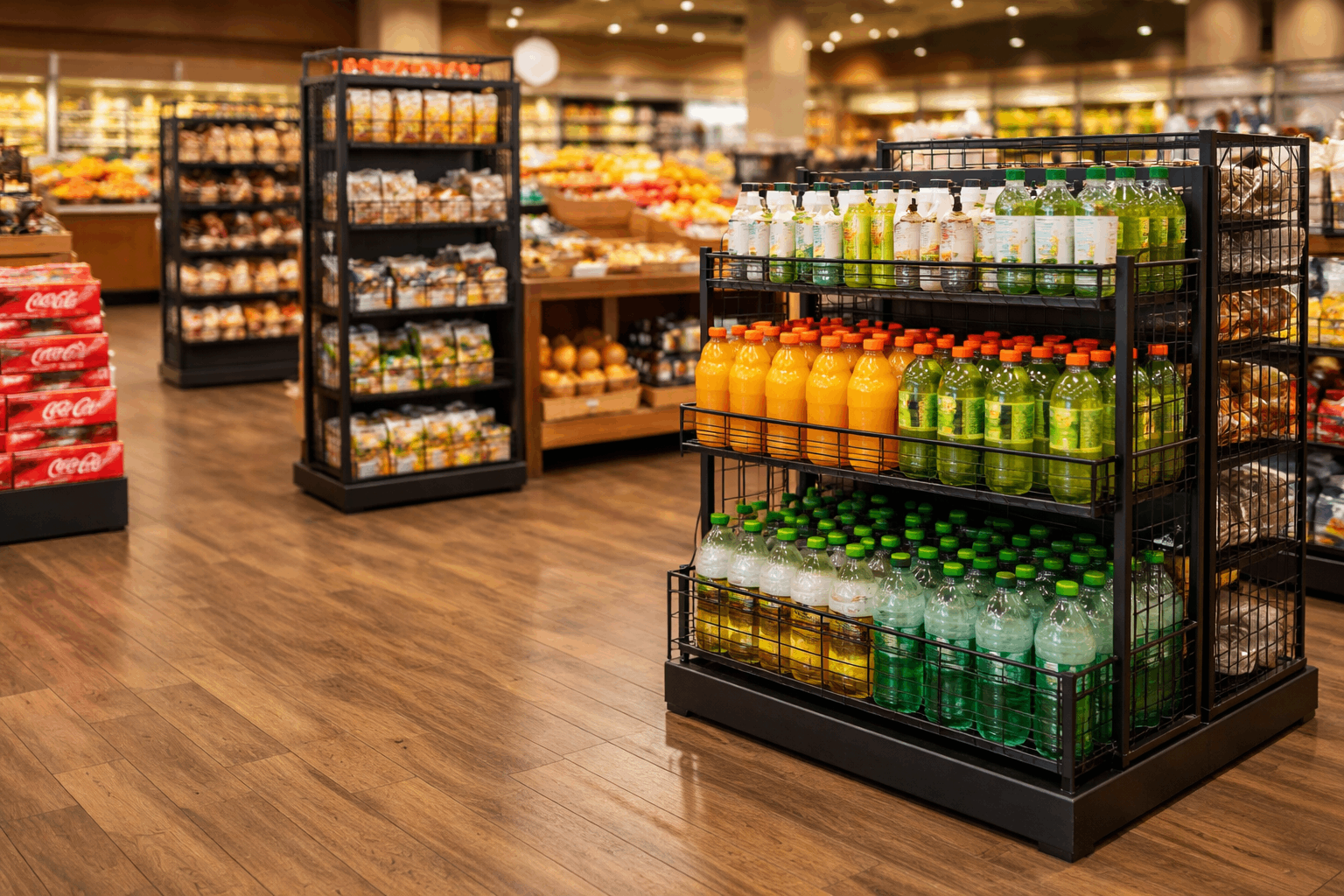
When retailers want to strengthen product visibility, they often rely on specialized retail display racks or floor display stands. These structures allow products to be placed outside the main shelf area, increasing visibility and improving access.
For example, beverage brands often use heavy-duty metal display racks to hold large quantities of product near aisle intersections. Snack brands may use compact display stands positioned near checkout areas to encourage impulse purchases.
These displays not only improve visibility but also support merchandising efficiency. Well-designed racks allow store staff to replenish products quickly while maintaining organized facings.
For procurement teams, selecting the right display structure is therefore both a merchandising decision and an operational one. Displays must balance visibility, capacity, durability, and ease of restocking.
What Buyers Should Evaluate When Sourcing Retail Displays
Buyers responsible for retail display procurement often evaluate several practical factors beyond visual appearance.
Load capacity is one of the most important considerations. Products such as beverages, pet food, canned goods, or hardware items require displays capable of supporting significant weight. In these situations, metal display racks are often preferred because they provide reliable structural support and long service life.
Durability is another critical factor. Displays must survive transportation, assembly, and daily store use without losing stability or visual quality. Weak structures can quickly damage brand presentation or create safety concerns in stores.
Buyers also evaluate replenishment efficiency. Displays that allow quick product restocking help store staff maintain organized shelves and prevent empty facings. In busy retail environments, this practical detail can influence the long-term success of a display program.
Finally, procurement teams consider logistics efficiency. Flat-pack designs, standardized components, and simplified assembly structures can reduce shipping costs and make large-scale retail rollouts easier.
Choosing the Right Material for Retail Displays
Material selection directly affects display durability, shipping efficiency, and long-term cost performance.
Metal structures are widely used for custom metal display racks and retail display stands because they support heavy loads and maintain structural stability during repeated restocking. For categories such as beverages, automotive products, hardware, or pet supplies, metal fixtures are often the most reliable option.
Acrylic materials are commonly used in premium retail environments where product visibility and a clean aesthetic are priorities. Wood structures are sometimes used for lifestyle brands or specialty retail environments.
Cardboard displays remain a cost-effective solution for short promotional campaigns. However, their durability is usually limited compared with metal or acrylic structures.
Retail Display Material Comparison
| Material | Key Advantage | Typical Use Case |
|---|---|---|
| Metal | High durability and load capacity | Heavy products and long-term retail programs |
| Acrylic | Clear product visibility | Cosmetics or premium accessories |
| Wood | Natural brand presentation | Lifestyle retail environments |
| Cardboard | Low cost and lightweight | Temporary promotions |
For procurement teams managing multi-store programs, the best choice is often the material that balances durability, cost efficiency, and operational practicality.
Common Execution Challenges in Retail Display Programs
Even well-planned merchandising strategies can face execution challenges once displays reach real stores.
One common issue is overcrowded displays. When too many products compete within the same space, visual clarity disappears and shoppers struggle to identify key items.
Another challenge occurs when displays are placed in unsuitable store locations. A large floor display may perform well in an open aisle but poorly in narrow retail formats.
Restocking efficiency is another frequent problem. Displays must allow store staff to refill products quickly. If replenishment becomes difficult, displays may appear empty or disorganized.
Durability also affects program success. Displays exposed to heavy product loads or frequent movement must maintain structural stability throughout the retail cycle.
Why Many Retailers Invest in Custom Retail Displays
Standard shelving systems are designed for basic assortment storage rather than brand visibility. In competitive categories, this limitation can reduce product discovery.
Custom retail displays allow brands and distributors to design presentation structures that better match their products and retail environments. Adjustable shelving, modular components, and branded panels can help improve visibility while maintaining efficient product storage.
For procurement teams, custom display solutions also solve practical challenges such as packaging dimensions, transportation efficiency, and store rollout requirements.
Manufacturers such as Yishang Display focus on developing durable retail display systems that combine structural strength with flexible customization. For wholesalers and importers managing multi-store programs, this approach helps maintain consistent presentation while simplifying large-scale deployment.
Retail Trends Shaping Display Procurement
Retail merchandising continues to evolve as retailers rely more heavily on data to optimize shelf performance.
Many retailers now analyze sales data to evaluate how different display positions influence product performance. These insights help refine product placement strategies and improve future merchandising programs.
Another growing trend is the use of reusable display systems. Buyers increasingly look for fixtures that can support multiple campaigns rather than single-use promotional displays.
Modular metal display racks are particularly suited to this approach because they combine durability with flexible product configurations.
For international distributors and wholesalers, reusable displays can reduce long-term program costs while supporting more sustainable retail operations.
FAQ: Common Questions About In-Store Product Placement
What is in-store product placement?
In-store product placement refers to the strategic positioning of products within a retail store to maximize visibility and encourage purchases.
What is the difference between POP and POS displays?
POP (point-of-purchase) displays are placed within the shopping area to promote product discovery, while POS (point-of-sale) displays are located near checkout counters to encourage impulse purchases.
Why do retailers use display racks instead of only shelves?
Retail display racks create visual separation from crowded shelves and help highlight specific products, promotions, or new product launches.
What type of display is best for heavy products?
Heavy products such as beverages or hardware items typically require metal retail display racks because they provide stronger structural support and long-term durability.
Conclusion: Connecting Product Placement With Retail Performance
Effective in-store product placement combines shopper behavior insights, strategic shelf positioning, and well-designed retail display solutions.
For wholesalers, distributors, and retail buyers, selecting the right display system can significantly improve product visibility, merchandising efficiency, and long-term retail performance.
If you are planning a retail display program or exploring custom metal display racks for wholesale distribution, the team at Yishang Display works with international buyers to develop durable display solutions tailored to real retail environments.