
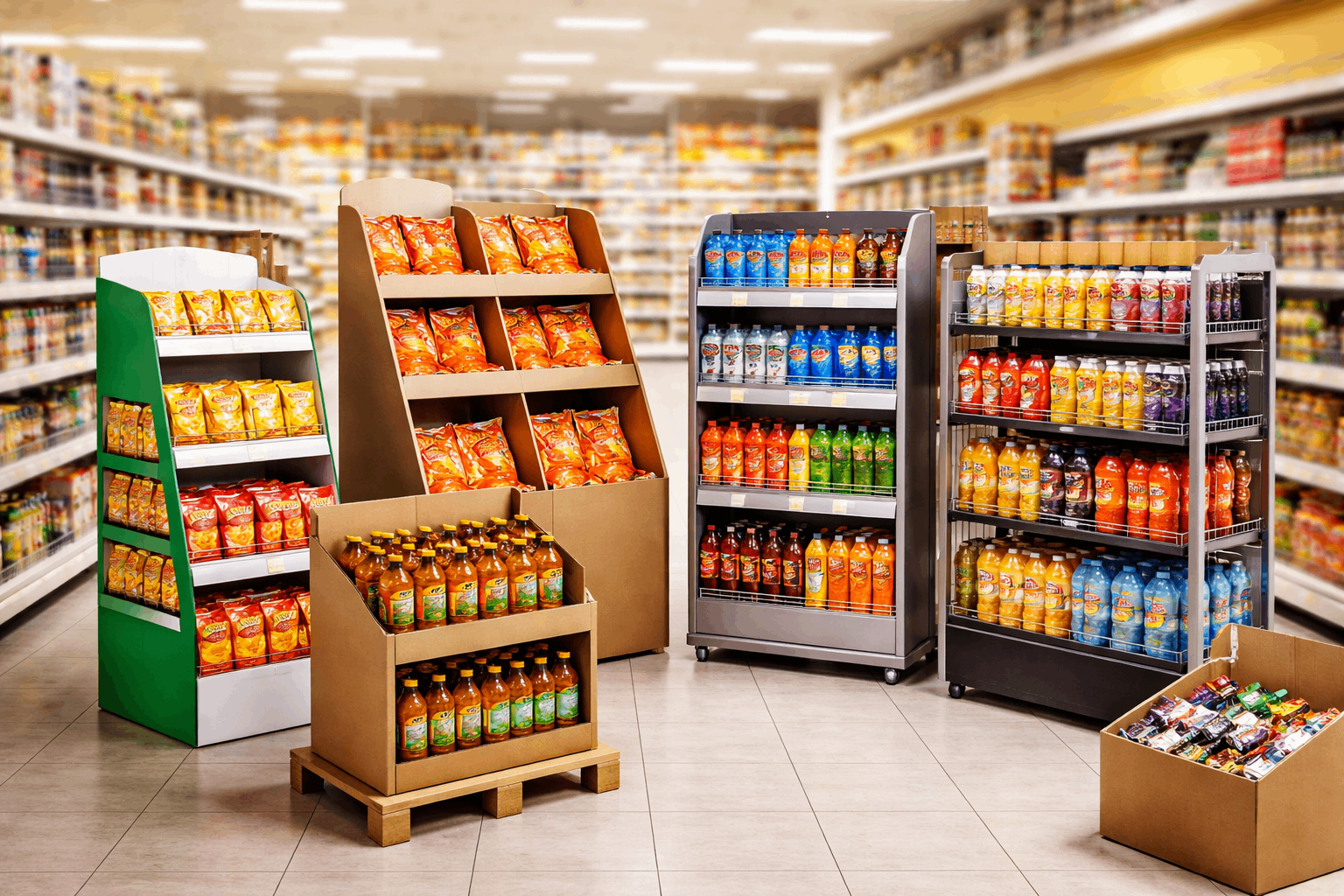
Overseas wholesale buyers do not usually read supplier blog articles the way end consumers do. They scan for decision-useful information: whether the display fits the product, whether it is practical to ship and assemble, whether it can stay presentable during the campaign, and whether the supplier understands the difference between a temporary promotion and a long-term merchandising program.
That is the perspective behind this article. At Yishang Display, we work with retail display projects where material choice, structural logic, and rollout efficiency matter just as much as visual design. In the context of short-cycle promotions, corrugated displays remain a strong option, but only when the format matches the campaign objective, the product load, and the store environment.
This guide focuses on that buying logic. It explains where corrugated displays create the most value, how buyers should compare display formats, what technical points should be checked before approval, and when a more durable material may be the better commercial choice.
Why Corrugated Displays Still Work in Retail Promotions
Corrugated displays are still widely used because they match the economics of temporary retail activity. Many promotions need speed, visibility, and controlled cost more than they need a permanent fixture. A seasonal launch, a checkout promotion, or a short-term bundle program often has a narrow selling window, so a lighter structure can be more practical than a long-life fixture.
They also combine merchandising and communication in one unit. A good display can hold stock, present the main selling message, and make the product easier to notice at the point of purchase. For buyers, this matters because the display is not only a holder. It becomes part of the sales mechanism inside the store.
There is also a logistics advantage. Corrugated units are usually easier to transport, easier to store before placement, and easier to distribute across multiple locations than permanent display systems. In short-cycle campaigns, that can reduce handling pressure and improve rollout speed. This is one reason sustainable POS solutions based on corrugated material continue to appeal to brands that want both operational efficiency and recyclable material options.
Where Corrugated Displays Create the Most Value
The strongest use cases are promotions where speed, flexibility, and in-store visibility need to work together. New product launches are a common example. A buyer may need to test a new SKU, secure temporary display space, and support sell-through without committing to a permanent display system. In that setting, corrugated structures can help the product reach the floor faster.
Checkout and impulse zones are another strong fit. Compact retail display stands, PDQ units, and countertop displays work well because they reduce the distance between seeing the product and picking it up. This is particularly useful for small packaged goods, accessories, cosmetics, confectionery, pet products, and other categories where convenience often supports conversion.
Cross-merchandising is also an effective application. A sidekick display placed beside a related product group can support add-on purchases without taking much floor space. For B2B buyers, the key benefit is not only visibility and drive sales potential. It is the way the display fits into existing store traffic and temporary promotional planning.
How Buyers Should Match Display Format to Campaign Objective
Once the retail job is clear, format selection becomes more precise. For launches and high-traffic promotions, floor displays and endcap units usually provide stronger visual interruption. They offer more branding area and better distance visibility, which is useful when several competing products are fighting for attention.
For last-minute conversion, smaller formats often perform better. Counter displays and PDQ units place the product close to the buying decision, which makes them suitable for fast-moving SKUs and promotional add-ons. In many cases, a compact format delivers better commercial value than a larger display that costs more to ship and manage.
For cross-selling, sidekick displays remain one of the most practical formats because they use existing shelf traffic efficiently. For high-volume campaigns, open-access bins can also work well, provided replenishment has been planned from the beginning.
| Display format | Best use case | Main strength | Main procurement concern |
|---|---|---|---|
| Floor display | Launches and feature promotions | Strong visibility and broader branding space | Stability, refill ease, shipping volume |
| Counter display | Impulse purchases | Close to the point of decision | Capacity limits and clutter control |
| Sidekick display | Cross-merchandising | Efficient use of adjacent shelf space | Placement accuracy and category fit |
| Dump bin | High-volume promotions | Easy access and quick loading | Maintaining a neat presentation |
| PDQ unit | Fast retail rollout | Labor-saving setup | Product size and weight suitability |
What Buyers Should Evaluate Before Approving a Corrugated Display
A suitable format does not automatically mean a suitable display. Buyers still need to assess whether the structure supports the actual product, store conditions, and campaign duration. One of the first points to review is message hierarchy. In-store shoppers scan quickly, so the main communication should be understandable within seconds. A unit overloaded with copy or graphics can weaken the display rather than strengthen it.
Visibility from real shopper angles matters just as much as the front rendering. Many concepts look strong in a presentation but lose impact once they are placed near an aisle, an endcap, or a checkout queue. Side visibility, header clarity, facing layout, and pickup access all influence in-store performance.
Structural quality is the next major checkpoint. Busy stores create repeated handling pressure, and refill conditions are rarely ideal. That is why experienced buyers usually review board grade, support design, lock structure, shelf loading, and front-facing retention before approving production. These factors affect whether the display remains presentable long enough to support the full promotion.
Execution should be checked separately. A display that takes too long to assemble or refill may create hidden cost at store level. In multi-store campaigns, setup efficiency can influence compliance just as much as design quality.
| Performance criterion | Why it matters in procurement | Questions to review early |
|---|---|---|
| Visual hierarchy | Affects message clarity and product visibility | Is the main message readable within seconds? |
| Structural support | Affects durability during shipping and refill | Is the board grade suitable for the product load? |
| Product accessibility | Affects pickup ease and browsing | Can shoppers remove items without disturbing the unit? |
| Setup efficiency | Affects store compliance and labor time | How quickly can staff assemble and place the unit? |
| Material fit | Affects cost and lifespan | Is corrugated the right choice for the campaign window? |
A Practical Buyer Check Before RFQ and Sampling
Before requesting a quotation or sample, buyers usually save time by confirming a few practical points internally. The first is campaign purpose. A display for a launch, a checkout push, and a bundled promotion may all use corrugated material, but they should not be quoted as the same project. The second is product reality, including pack dimensions, product weight, target facings, and expected refill frequency. The third is rollout expectation: how many stores are involved, whether the unit needs flat-pack shipping, and how much assembly time store staff can realistically handle.
This early check matters because many display delays do not come from manufacturing complexity alone. They come from incomplete project inputs. When buyers define the retail objective, product conditions, and rollout model earlier, suppliers can recommend a more suitable structure faster and reduce revision cycles during sampling.
Choosing the Right Structure for Rollout and Handling
After the core format is selected, buyers still need to think about distribution and store handling. Foldable corrugated displays are attractive because they reduce shipping volume and simplify storage before placement. For larger regional programs, that can improve container efficiency and help control landed cost.
PDQ units solve a different operational issue. They reduce assembly work and support quicker shelf or counter placement. In retail networks where staff time is limited, that can improve retail compliance because the display is easier to handle correctly. This is also why retail-ready and shelf-ready display concepts continue to matter in high-volume promotional programs: they make execution simpler at store level, not just cleaner in theory.
Reinforced structures are usually better for heavier products or campaigns that need a longer on-floor life. They may use more board or require more precise packing, but they offer better support under pressure. The real decision is not whether foldable or non-foldable corrugated displays are always superior. It is which structure best matches the rollout model, product behavior, and store handling conditions.
Sustainability Matters, but It Has to Make Commercial Sense
Sustainability is part of many sourcing discussions, especially for short-cycle promotions where recyclable materials and lower shipping weight are important. Corrugated cardboard can support that objective because it is paper-based and generally easier to integrate into temporary programs than many heavier fixtures.
Even so, professional buyers rarely choose a display only because it sounds eco-friendly. They also look at structural efficiency, wasted board area, mixed-material use, and whether the display performs properly during shipping and refill. A unit that claims environmental value but creates higher damage or weak in-store execution is not automatically the better commercial choice.
The most effective sustainable display programs balance environmental value with practical execution. For buyers, the priority is usually the same: a display solution that supports environmental goals without creating extra cost, delay, or execution risk.
When Corrugated Is the Right Choice, and When It Is Not
Corrugated displays are usually the better option for temporary promotions, fast retail rollout, trial launches, and budget-sensitive campaigns. They are especially effective when a brand needs a visible but time-limited structure that can move quickly from production to store floor.
However, some projects require a different material strategy. Long-term merchandising, heavier product loads, and permanent fixture programs may call for metal display racks or other more durable store fixtures. In those cases, the display has to do more than support a promotion. It has to remain stable over time and withstand repeated handling as part of a longer retail program.
For buyers, this material boundary is important. A reliable supplier should understand not only where corrugated creates value, but also where another material will perform better. That is especially relevant for a company like Yishang Display, where metal display manufacturing remains a core strength and other materials are selected according to project needs rather than used as a one-size-fits-all answer.
Common Mistakes Buyers Make in Corrugated Display Projects
One common mistake is choosing a display format before defining the campaign objective. This often leads to a unit that looks familiar but does not support the actual sales task. Another is focusing too heavily on appearance while overlooking refill speed, shipping volume, or structural support.
A second issue is assuming one concept works across every retail channel. In practice, store layout, traffic flow, and staff handling conditions vary too much for that assumption to hold. A display that works in a supermarket may not work as well in a pharmacy, convenience store, or specialty outlet.
The final issue is treating sustainability as a slogan rather than a sourcing criterion. The best corrugated displays are not the most complicated ones. They are the ones that remain practical from production through shipment to in-store execution.
Conclusion
The best corrugated display is the one that fits the promotion, product, store format, and rollout model. For temporary retail campaigns, these units can offer a strong mix of speed, visibility, flexibility, and cost control. That combination is what makes them such a practical option for many short-cycle programs.
For wholesale buyers, the better sourcing decision comes from evaluating the full display process, not just the visual concept. Product load, assembly, refill convenience, transport efficiency, and campaign duration all matter. If you are reviewing a new in-store promotion program, Yishang Display can help you assess the right structure and material for your project. Send us your concept or product details to discuss a practical display solution for your market.
FAQ
What are corrugated displays best used for in retail promotions?
They are best suited to temporary campaigns such as launches, seasonal promotions, checkout offers, bundled programs, and cross-merchandising where quick deployment and visible presentation matter.
Are corrugated displays durable enough for busy stores?
Yes, when they are engineered for the real product load, campaign duration, and refill conditions. Board grade and support design make a major difference.
Which display works best for impulse purchases?
Counter displays and PDQ units are usually the most effective because they place small, fast-moving products close to the point of decision.
Are corrugated displays a good option for sustainable POS programs?
They can be, especially for short-term campaigns where recyclable materials, lower shipping weight, and efficient rollout are important.
When should a buyer choose corrugated instead of metal?
Corrugated is usually better for short-cycle promotions and faster rollout, while metal is often the stronger option for long-term or heavier-duty retail programs.