

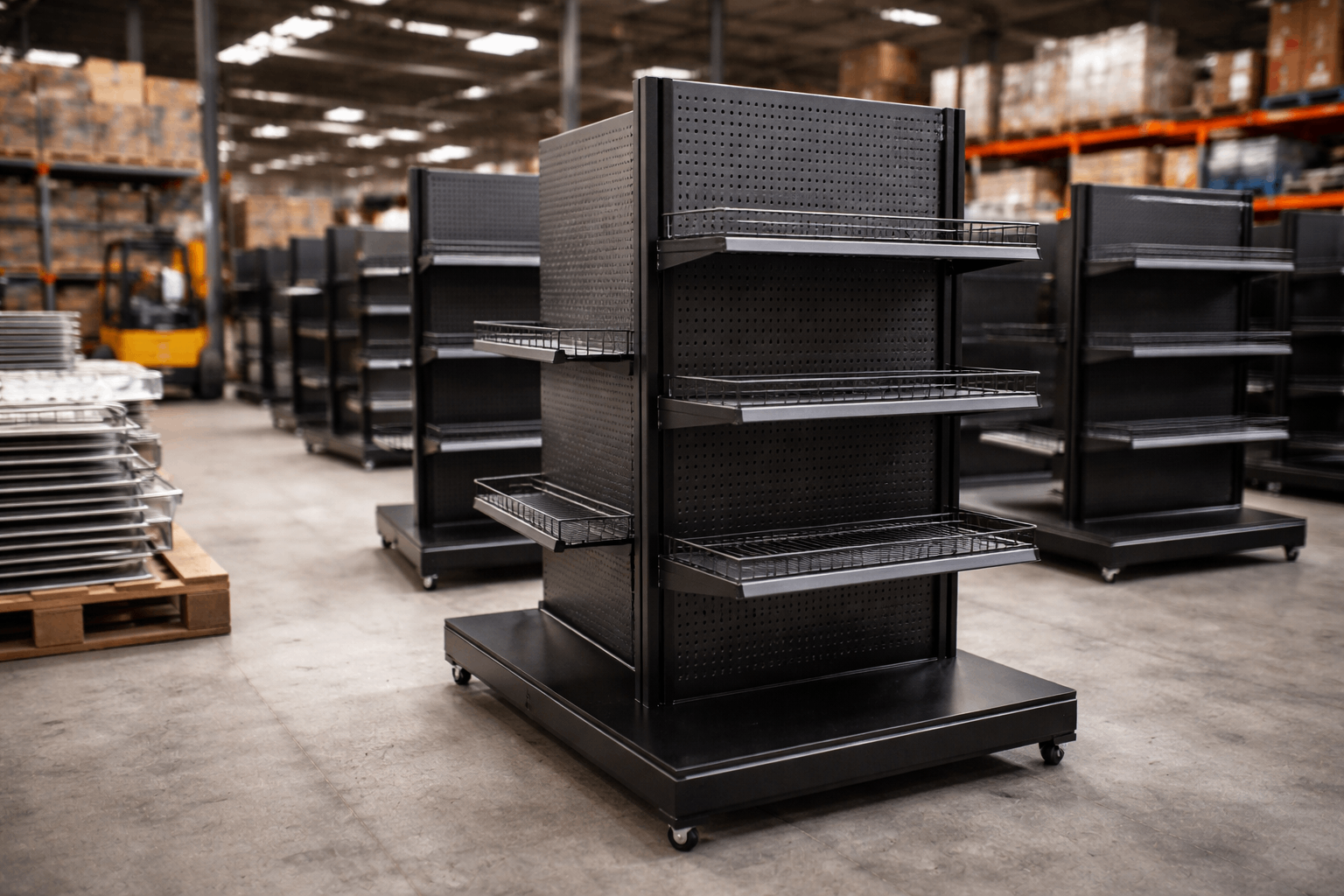
Why Many In‑Store Displays Fail at Scale — And What Wholesale Buyers Should Evaluate Instead
Who this article is for: procurement managers, wholesale buyers, and sourcing teams evaluating in‑store display systems for multi‑store CPG programs.
Most discussions around effective CPG displays are written with brand marketing teams or end consumers in mind. Overseas wholesale buyers, however, evaluate in‑store displays through a very different lens. Their concern is not whether a display looks creative in a render, but whether it can be produced consistently, shipped efficiently, assembled correctly in unfamiliar stores, and remain stable throughout its intended service life.
For procurement and sourcing teams, an in‑store display is a physical asset with operational consequences. When displays arrive damaged, require excessive assembly time, or degrade quickly in store, the result is not only lost visibility but also increased handling cost, retailer complaints, and program delays. From this perspective, retail display effectiveness is driven less by creative intent and more by structural design, material selection, and execution tolerance.
This article is written for CPG brands and international wholesale buyers sourcing metal retail displays and other durable display systems. It focuses on practical, decision‑relevant factors that buyers actively search for: durability, repeatability, logistics efficiency, compliance reliability, and total cost of ownership. These are the criteria that determine whether a display program performs beyond the first rollout.
How Wholesale Buyers Read and Evaluate Display Content
Wholesale buyers do not read supplier blogs linearly. They scan quickly, looking for confirmation that a supplier understands large‑scale deployment realities. Their browsing behavior favors clear sectioning, concise explanations, and terminology aligned with sourcing workflows rather than marketing language.
Search queries from this audience often include phrases such as custom retail displays manufacturer, durable display rack, metal display stand for retail, point of purchase displays for CPG brands, or retail display logistics. These terms signal comparison and risk assessment, not early‑stage inspiration.
Content that resonates with this group avoids exaggerated promises and instead explains trade‑offs. When a supplier can articulate why certain designs succeed or fail in real retail environments, it reduces perceived risk and accelerates trust, even before commercial discussions begin.
Why Effective Displays Are Uncommon in Real Retail Environments
In multi‑store rollouts, display issues often emerge gradually. Minor problems such as loose fasteners, scratched finishes, uneven shelves, or missing components compound over time. Store staff may relocate unstable fixtures, remove them from prime locations, or stop using them altogether.
The root cause is rarely lack of effort. More often, it is a mismatch between design assumptions and retail reality. Many displays are engineered for ideal conditions, while actual stores involve uneven floors, frequent restocking, limited setup time, and staff with no specialized training.
From a wholesale procurement standpoint, an effective display is one that performs predictably. Stability, clarity, and acceptable appearance over time matter more than novelty. Predictable performance is what allows buyers to scale programs across regions without constant intervention.
What In‑Store Displays Are Expected to Do at the Shelf
At the shelf, displays serve a functional role in the purchase process. They must capture attention briefly, but more importantly, they must reduce friction. Friction includes awkward product access, visual clutter, and signals that suggest instability or low quality.
For wholesale buyers, this means retail display effectiveness depends on design elements that are often invisible early on. Product access height, load distribution, shelf rigidity, and resistance to disorder all influence how a display performs once shoppers interact with it.
Displays that maintain order after repeated handling support quicker decisions and higher retailer acceptance. This is why many successful CPG programs treat displays as part of store infrastructure rather than short‑term promotional fixtures.
How Market Changes Have Raised Display Requirements
CPG categories have become more crowded, and retailers are more selective about floor space. Displays are expected to justify their footprint through consistent performance rather than one‑time impact.
At the same time, digital commerce has shaped shopper expectations around clarity and usability. Shoppers are accustomed to clean interfaces and straightforward choices. Displays that rely heavily on visual complexity often struggle to meet these expectations in physical environments.
For sourcing teams, these shifts translate into higher requirements for durability, batch consistency, and adaptability. Display systems that can be reused or updated without full redesign offer better long‑term value than one‑off constructions.
Displays as Physical Decision Interfaces
A useful way to approach in‑store display design is to treat the fixture as a physical decision interface. Similar to a digital product page, an effective display guides attention, presents information hierarchically, and supports a clear next action.
A well‑designed interface remains understandable after repeated use. Products stay aligned, shelves remain level, and the structure continues to communicate order. This reduces cognitive effort for shoppers and reduces maintenance demands for store staff.
For buyers, this perspective shifts evaluation criteria. Instead of asking whether a display stands out visually, they ask whether it will continue to function after weeks of real use. Material selection and structural stability become central because they determine whether the interface remains effective at scale.
Structural Cues, Perceived Quality, and Shopper Trust
Shoppers form rapid judgments based on physical cues. Displays that appear unstable or temporary can signal risk, regardless of branding. Displays that appear solid, balanced, and well‑finished communicate reliability before any product interaction occurs.
Structural rigidity directly influences this perception. When shelves sag or hooks bend, visual order deteriorates and cognitive load increases. Over time, this disorder discourages engagement and weakens confidence in the assortment.
Metal display structures often help preserve alignment and geometry under load. This is an operational outcome rather than a theoretical one: displays that maintain their form continue to support shopper trust and retailer acceptance throughout their service life.
Why Retail Execution Challenges Undermine Good Designs
Retail environments introduce variability that is difficult to control. Displays are assembled by busy staff, moved during resets, and stocked quickly. Designs that depend on precise assembly or delicate components are vulnerable under these conditions.
Effective display systems tolerate variation. They minimize critical alignment points, use straightforward connections, and remain stable even when floors are uneven or loads shift. This tolerance reduces the risk of partial setups and early removal.
For wholesale buyers comparing suppliers, recognition of these execution realities is a strong credibility signal. It suggests the design has been developed with real deployment conditions in mind.
Material and Structural Choices That Influence Long‑Term Performance
Material choice affects more than initial cost. It determines load capacity, stiffness, finish durability, and service life. The appropriate material depends on usage duration, handling frequency, and product weight.
| Material Type | Strengths | Limitations | Typical Use |
|---|---|---|---|
| Metal | High durability, strong load support, reusable | Higher unit cost, finish protection required | Long‑term and multi‑store programs |
| Cardboard | Low cost, lightweight | Limited durability, moisture sensitivity | Short‑term promotions |
| Hybrid | Balanced cost and strength | Interface design critical | Seasonal or modular programs |
For overseas buyers, total cost of ownership is the key metric. A lower‑cost material that requires frequent replacement often results in higher overall expense than a durable system reused across multiple cycles.
Finish Quality and Environmental Exposure
Selecting metal alone does not guarantee performance. Finish quality determines how a display looks after shipping, assembly, and daily use. Scratches, chipped edges, and corrosion quickly reduce perceived value.
In grocery, beverage, and high‑traffic retail environments, displays may be exposed to moisture and cleaning chemicals. Powder‑coated finishes are common, but buyers should clarify expectations for edge coverage, abrasion resistance, and packaging protection.
Clear finish specifications help align production with real conditions and reduce disputes during inspection and rollout.
Customization Versus Consistency
Customization adds value when it improves function. Adjusting shelf angles or reinforcing load points can enhance usability. Cosmetic customization that increases part count or assembly complexity often undermines consistency.
From a sourcing perspective, highly customized one‑off designs increase production and execution risk. Modular display systems allow variation without sacrificing repeatability, making them better suited for regional and multi‑program rollouts.
A practical rule is to evaluate how sensitive a display is to assembly accuracy. The more precise the assembly must be to look correct, the higher the likelihood of failure in real stores.
Logistics, Assembly, and Execution Considerations
Logistics decisions directly affect display performance. Flat‑packed displays reduce freight cost but increase assembly time. Pre‑assembled displays reduce setup time but increase shipping volume and damage exposure.
Wholesale buyers benefit from aligning packaging strategy with store capabilities. Where labor is limited, simplifying assembly improves compliance. Where freight cost dominates, optimized carton design and surface protection are critical.
Addressing these factors early prevents costly adjustments later in the program lifecycle.
Sustainability and Compliance in Practice
Sustainability is closely linked to durability and reuse. Displays that last longer and require fewer replacements reduce material waste over time, aligning with retailer expectations.
Compliance consistency is equally important in cross‑border sourcing. Documentation for material compliance, such as RoHS, must reflect actual production rather than prototypes. Reliable documentation reduces audit risk and supports long‑term partnerships.
Testing Displays for Scaled Deployment
Testing should focus on how displays behave after shipping, assembly, and repeated handling. Pilot programs reveal issues that prototypes often miss, including finish wear, joint loosening, and assembly errors.
Buyers reduce risk by aligning sample approval with production methods and defining acceptable tolerances. Testing is most effective when it targets likely failure modes rather than visual perfection.
Common Patterns Behind Display Failures
Across many programs, similar issues recur. Displays are approved based on internal review rather than store conditions. Visual elements accumulate until clarity is lost. Assembly requirements exceed what retail staff can realistically deliver.
Addressing these patterns requires a systems approach. Stable structure, disciplined layouts, and realistic specifications help ensure displays remain effective throughout their lifecycle.
Conclusion: Effective Displays Are Built for Reliability
For overseas wholesale buyers, the most valuable display programs are those that reduce uncertainty. Displays that ship predictably, assemble consistently, and maintain appearance under real use provide measurable advantages.
Treating displays as physical systems rather than temporary visuals aligns procurement, retail, and brand needs. When durability, usability, and execution tolerance are designed in from the start, in‑store displays deliver sustained value.
If you are evaluating display solutions for large‑scale CPG programs, Yishang Display supports wholesale partners with display systems designed for durability, manufacturability, and cost efficiency. We welcome practical discussions focused on specifications and real‑world requirements.