

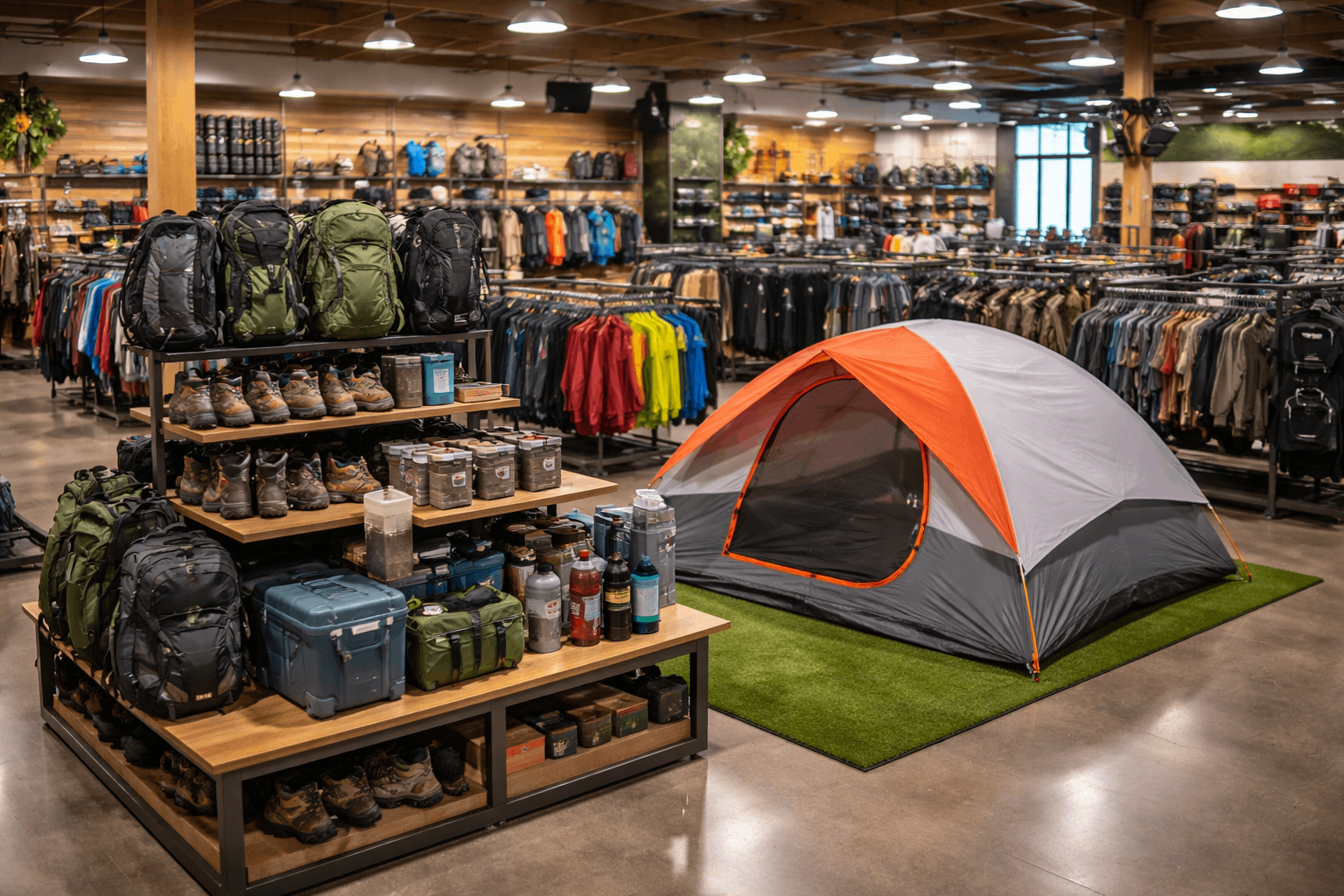
If you source retail fixtures as a wholesaler, importer, or store‑rollout manager, you do not read a merchandising article to learn “what looks nice.” You read to reduce risk: fewer failures on the floor, fewer resets that run over schedule, fewer complaints from retail partners, and fewer surprises in freight and installation.
That is why display strategies for sports and outdoors merchandising should be treated as a supplier‑driven engineering and operations topic. Sports and outdoor products include heavy equipment, awkward shapes, and high‑touch gear that customers handle repeatedly. The display system becomes the layer that protects sell‑through and protects the program budget.
This guide follows a simple progression that matches how B2B buyers search and scan. We start with what makes sports and outdoor merchandising structurally different, then connect those realities to shopper behavior, then translate them into fixture specifications, layout decisions, and lifecycle cost control. Along the way, we use practical terminology buyers use in search queries—retail display fixtures, modular display systems, custom metal display racks, POP vs POS displays, planogram compliance, and store fixture programs—without forcing repetition or keyword stuffing.
Why Sports and Outdoor Merchandising Requires Purpose‑Built Display Systems
Sports and outdoor merchandising is structurally demanding. Heavy and irregular items require defined load paths, secure anchoring, and tip resistance. A fixture that looks fine in a showroom can fail quickly in major retail stores when products are lifted, returned, and re‑faced hundreds of times per day.
For B2B procurement, this changes how you evaluate retail display fixtures. Unit price matters, but not as much as durability under traffic, compatibility with resets, and predictable maintenance. Under‑specified fixtures create hidden costs through repair calls, replacement shipments, and downtime that disrupts planograms.
Technical gear also requires information access at the point of evaluation. If a merchandising layout blocks labels and specs, staff workload rises and conversion drops. Many sports and outdoor companies therefore organize products in one section by activity or use case, then layer brand blocks where they add clarity. A purpose‑built display system should support both.
Seasonality makes the problem sharper. Peak windows compress execution timelines. Modular retail display systems that support fast reconfiguration—standardized connectors, adjustable bays, and repeatable footprints—protect on‑time resets. For wholesalers supplying multiple customers, modularity also reduces the number of fixture SKUs you must stock and support.
How Shoppers Evaluate Sports and Outdoor Products in Store
In‑store evaluation of sporting and outdoor products is tactile and comparative. Customers lift, test fit, and inspect build quality. That behavior is not a marketing detail—it drives engineering requirements. Fixtures must tolerate repeated interaction without loosening, bending, or creating pinch points.
Stable, load‑rated hardware influences perceived product reliability. If a bike rack wobbles or a hook flexes under a heavy bag, the shopper does not blame the fixture. They question the product. In other words, fixture stability is a trust signal that affects sell‑through.
Choice overload is another reality in gear‑dense categories. When product display organization is unclear, shoppers scan longer but decide less. Activity‑based grouping reduces cognitive friction, while brand blocks help experienced buyers compare familiar lines. Buyers who align displays with how customers search in physical space typically see faster decisions and fewer abandoned interactions.
Omnichannel research also changes expectations. Shoppers often arrive with a shortlist. POS displays that surface key specs right beside the product reduce staff dependence and shorten decision time. This is one of the most practical ways display strategies can help in high‑involvement categories.
Retail Displays as Commercial Infrastructure
Retail display strategy works best when treated like infrastructure. Geometry, reach zones, and anchoring are functional attributes with measurable impact on conversion and safety compliance. Displays that complicate access create hidden labor cost and reduce throughput.
Standardization for Multi‑Store Programs
For wholesalers and rollout teams, consistency is a conversion lever because it enables execution. Standardized footprints, repeatable components, and predictable load ratings support planogram compliance across varied store formats. Standardization also simplifies training, spares, and field maintenance.
A store fixture program built on common modules scales more cleanly than a set of one‑off “creative” pieces. It gives you control over reset time, installation effort, and refresh cost. It also reduces freight risk because packaging can be standardized around repeatable parts.
Information Architecture in the Fixture
Information architecture belongs in the display. Integrated holders for spec cards, QR touchpoints, or small digital labels place decision support where it is used. This reduces reliance on separate signage programs that drift out of date and add labor.
When fixtures carry the information layer cleanly, stores can maintain a tidy presentation even when assortments change. That is a practical advantage for wholesalers supporting customers with frequent line updates.
POP vs POS Displays in Sports and Outdoor Programs
Many buyers search for “POP vs POS displays” because the distinction influences both fixture design and rollout planning. In practice, POP displays are the conversion surfaces that pull attention and drive consideration in the aisle—endcaps, dump bins, pallet displays, and wall features. POS displays sit closer to checkout or service points, supporting add‑on decisions, quick replenishment, and last‑meter conversion.
For sports and outdoor products, the line can blur. A footwear “try zone” can function like POP by attracting traffic, but also like POS by supporting final fit decisions at a bench. The procurement implication is to specify by function rather than label. When you define what the display must accomplish—highlight new product, enable trial, carry technical specs, hold heavy items safely—you reduce the risk of buying the wrong hardware for the wrong zone.
A practical approach is to map fixture roles to store zones. POP fixtures typically need stronger visual hierarchy, larger facing capacity, and higher durability under frequent interaction. POS fixtures prioritize fast replenishment, compact footprints, and clear product identification for quick decisions. Aligning these roles with the merchandising layout keeps resets cleaner and prevents “temporary” units from becoming permanent clutter.
Engineering Attention Without Clutter
Visibility alone does not secure attention in dense assortments. Sports store visual merchandising benefits from deliberate hierarchy, spacing, and approach‑angle legibility that guide the eye to priority products without adding noise.
Endcaps and islands should frame hero items while preserving adjacency to complements. Buyers evaluating POP displays that draw attention often focus on graphics first, but geometry and negative space matter just as much. A well‑proportioned endcap can outperform a louder sign because it remains readable across the aisle.
Material contrast is a useful tool when applied sparingly. Mixed‑material systems—metal frames with wood or acrylic surfaces—signal transitions between activities or price tiers while maintaining durability. For procurement, specifying replaceable wear panels keeps refresh costs predictable and reduces the need to replace full assemblies.
Structuring Choice Across Assortments
Choice architecture should mirror shopper intent. In many sports and outdoor companies, activity‑based grouping accelerates discovery, especially for newer shoppers. Brand blocks still matter, but they work best inside activity zones rather than replacing them.
Modularity as a Merchandising Hedge
Modular display systems let you adjust the structure when data changes. Adjustable bays, standardized hook spacing, and interchangeable shelves allow you to re‑balance facings and introduce new lines without replacing infrastructure.
This matters to wholesalers because assortments are rarely stable. When your retail partners change packaging, add a new sub‑category, or shift price tiers, a modular backbone prevents stranded fixtures and reduces the cost of adaptation.
Clean Information Placement
Structured choice improves further when information sits where the decision happens. POS displays that integrate spec references near the product reduce staff intervention and support faster comparison.
This is not about adding more signage. It is about placing a small amount of high‑value information—load rating, size range, material, compatibility—exactly where it reduces hesitation.
Designing Retail Flow Through Fixture Placement
Retail flow is shaped more by fixture placement than by signage. Freestanding units, wall‑mounted runs, and islands define micro‑paths and dwell zones. Buyers planning types of retail display should evaluate footprints, depths, and sightlines the same way they evaluate aisle capacity.
High‑interest categories positioned along primary paths sustain momentum. Adjacent bays can host complementary items, increasing basket size without aggressive promotions. Flow‑aware placement embeds navigation into the display system and reduces the need for temporary wayfinding.
Geometry choices compound across stores. A slightly oversized island can create dead zones in smaller footprints. Procurement specifications that set maximum depths for endcaps and islands protect sightlines and keep circulation consistent.
Interaction as a Commercial Interface
Experiential merchandising is effective for sports and outdoor products when it is operationally justified and structurally integrated. Demo zones and try‑before‑you‑buy areas must be engineered for safety and durability. Buyers sourcing interactive displays should prioritize load ratings, anti‑tilt features, and replaceable wear components.
Interaction also needs to fit the flow. Poorly placed demos disrupt movement and concentrate congestion. When experiential elements are built as modular inserts rather than permanent builds, they can be moved seasonally without rebuilding infrastructure.
For wholesalers, this approach supports customer variation. One retail partner may want more interaction for premium gear, while another prioritizes throughput. Modular inserts let you serve both without creating entirely different fixture families.
Packaging, Freight, and Installation: The Operational Side Buyers Search For
Even the best fixture design can underperform if packaging and logistics are not engineered for rollout. Wholesalers often search for terms like “display and packaging” because damage rates, carton efficiency, and installation time directly affect landed cost. For metal‑based programs, protective packaging must prevent abrasion on coated surfaces and reduce corner impact, while still keeping carton sizes compatible with common pallet patterns.
Installation is a hidden variable in total cost of ownership. A fixture that saves one minute per unit during assembly can save days across a chain rollout. Buyers should ask whether modules are designed for tool‑less assembly where feasible, whether fasteners are standardized, and whether parts are clearly labeled. These details reduce field errors and shorten store disruption.
For multi‑store projects, packaging should also support parts control. Inner packs for hardware, clear BOM labeling, and consistent carton naming conventions help installers complete resets with fewer missing‑part delays. When packaging is designed as part of the fixture program, replenishment and after‑sales support become easier for wholesalers.
The Cost of Under‑Specified Infrastructure
Under‑specified fixtures create hidden costs through replacement cycles, emergency repairs, and downtime. For multi‑store programs, total cost of ownership often outweighs the initial unit price.
A practical TCO view includes reset labor, spares, freight for replacements, and the cost of interrupted selling space. It also includes reputational risk when retail partners experience safety incidents or recurring failures.
Standardization reduces risk because it simplifies spares and training. Documenting load and anchoring requirements at sourcing aligns expectations and reduces retrofit risk. This is especially important for heavier categories like weights, bikes, and large packs.
Modularity and Material Strategy
Modular retail display systems with standardized connectors enable fast resets and predictable labor. For wholesalers, standard connectors reduce the number of unique parts and make after‑sales support easier.
Why Metal Matters in Sports Retail Fixtures
Metal display racks provide the structural backbone for heavy‑duty retail fixtures. Powder‑coated steel fixtures in particular are widely specified because they balance strength, corrosion resistance, and surface durability in high‑touch environments.
Pairing metal frames with replaceable wood or acrylic surfaces supports refresh without replacing frames. This mixed‑material approach can deliver a premium look while keeping the structural core consistent across programs.
Repairability and Program Longevity
Designing for repairability extends service life. Replaceable panels, standardized hooks, and bolt‑on modules reduce waste and keep refurbishment costs manageable.
For wholesalers, repairability is also a service advantage. It reduces the need for full replacement shipments and supports faster turnaround when retail partners request updates.
Technical Reference for Fixture Specification
| Area | Practical Benchmarks | Procurement Implications |
|---|---|---|
| Load Capacity | Category‑appropriate static loads for equipment | Reinforced frames, documented ratings |
| Stability | Tip resistance and anchoring | Floor or wall anchors included |
| Accessibility | Ergonomic reach zones | Shelf heights within comfortable ranges |
| Durability | High‑touch wear resistance | Replaceable panels, coated metal |
| Reconfigurability | Tool‑less adjustments where feasible | Standardized connectors |
What High‑Performing Programs Do Differently
High‑performing programs treat displays as systems, not one‑off builds. They standardize footprints and components, align fixtures to reset cycles, and specify durability for real traffic. This discipline supports consistent execution in major retail stores and reduces variability across locations.
They also connect merchandising layout to operational reality. High‑velocity categories receive accessible placements, while specialized gear is contextualized inside activity zones. Over time, these patterns compound into better sell‑through and lower labor pressure during resets.
Most underperforming programs fail for predictable reasons: over‑customization without modular foundations, inconsistent standards across suppliers, and procurement focused on initial cost rather than lifecycle performance.
Evaluating and Improving Existing Strategies
Evaluation should consider visibility, accessibility, flexibility, and durability together. Field observation of dwell time, reach behavior, and product interaction often reveals issues that sales reports alone cannot explain.
Pairing observations with sell‑through data helps prioritize improvements. Reinforcing load paths, improving information placement, and simplifying reconfiguration can yield faster returns than cosmetic refreshes.
For wholesalers supporting multiple customers, consistent metrics also make comparisons meaningful. When fixture families are standardized, you can learn what works across regions and apply it to future programs.
Future Directions
Future‑ready fixture programs emphasize adaptability, durability, and selective digital integration. Smart fixtures that capture interaction data can inform assortment and layout decisions when deployed in the right zones.
Sustainable procurement increasingly favors repairable systems. Reconfigurable metal backbones with replaceable surfaces extend service life and reduce waste across multi‑year programs.
Across trends, the constant is structural adaptability. Programs designed for change protect investment as categories evolve.
Supplier Selection Signals Buyers Use to De‑Risk Fixture Programs
If you are sourcing for sports and outdoor companies, the supplier question is usually “where to start” rather than “who is cheapest.” A reliable process is to translate merchandising goals into measurable acceptance criteria: documented load ratings, anchoring methods, finish durability expectations, and reconfiguration requirements. This allows apples‑to‑apples comparison across suppliers and reduces the risk of surprises after production.
Buyers also look for evidence that a supplier can support scale. That does not mean long company stories on the page. It means operational proof points that appear naturally in the content: repeatable modules, controlled tolerances, consistent packaging, and the ability to maintain parts compatibility across runs. When these signals are present, procurement teams gain confidence that the fixture program can expand without redesign.
Finally, wholesalers and importers value responsiveness during specification. An “ask an expert” moment is often triggered when a buyer is not sure whether to use a wall system, a freestanding bay, or a mixed approach for a specific product set. The fastest way to support that decision is to discuss real constraints: store footprint, product weights, replenishment cadence, and reset frequency. Content that frames those inputs helps buyers prepare an RFQ that gets accurate pricing and fewer revisions.
Conclusion
For B2B buyers, effective display strategies for sports and outdoors merchandising are the ones that perform across resets, traffic, and assortment change. Systems that integrate durability, modularity, and embedded information placement support sell‑through while controlling operating risk.
At Yishang Display, we work with wholesalers and rollout teams on scalable store fixture programs and custom metal display racks for sports and outdoor retail. If you are planning a multi‑store rollout or upgrading existing systems, a brief message is enough to start a specification conversation.