

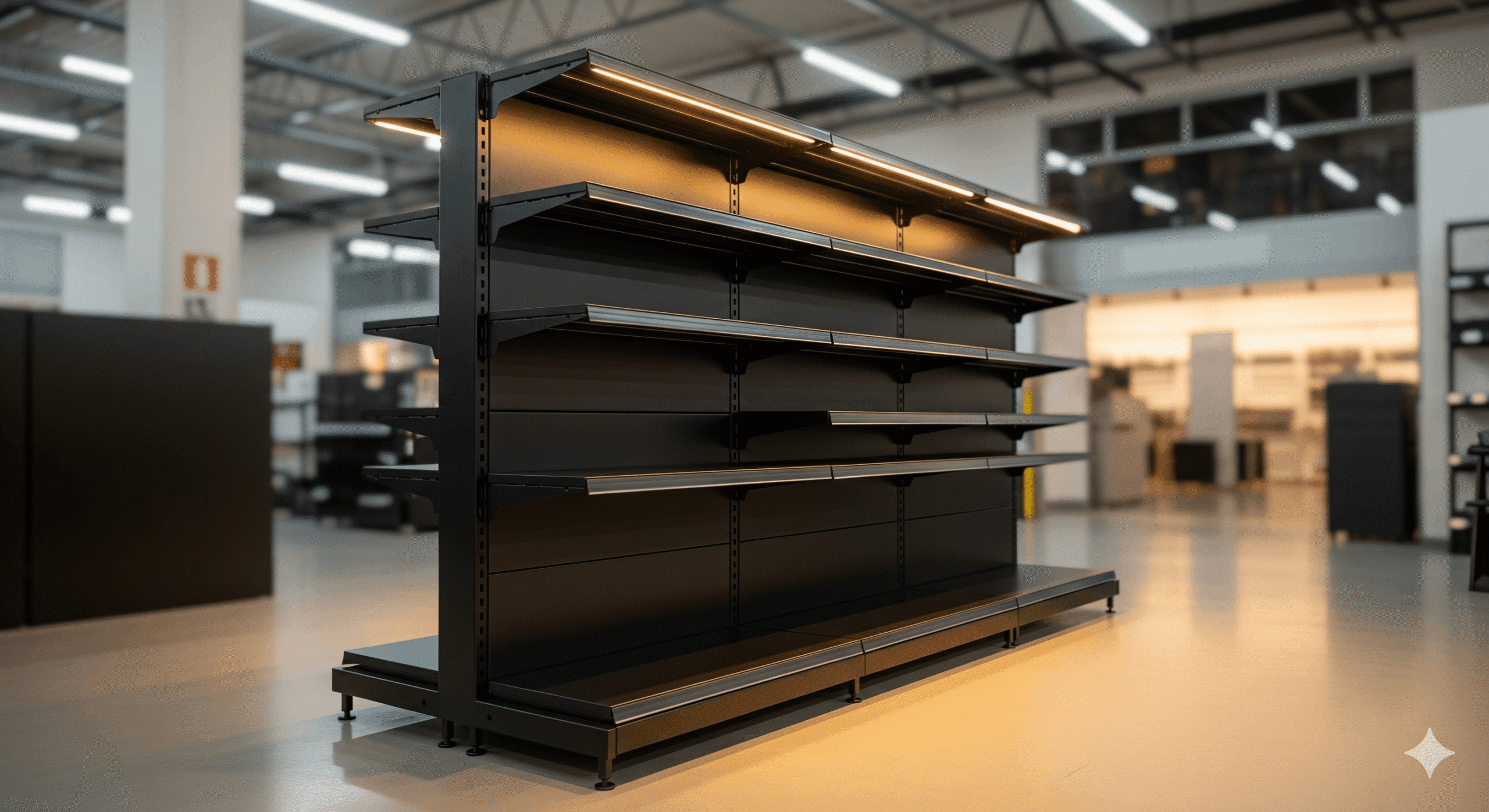
I. Introduction: Why “Hardware” is the Key to Supply Chain Profitability
In the global retail supply chain, brands often obsess over the product—the “software.” However, for wholesale importers and procurement officers, the “hardware”—the custom metal display—is equally critical. It is a strategic asset that directly impacts landed costs, warehouse efficiency, and your leverage in negotiations with major retailers.
For distributors moving thousands of units across borders, the risks are substantial. A display that fails structurally, contains restricted substances, or “ships air” due to poor packaging can erode profit margins instantly. Major retail gatekeepers reject suppliers not just for product quality, but for supply chain inefficiency and compliance risks.
At Yishang Display, we define our role not just as a manufacturer, but as a supply chain partner. We leverage 26 years of engineering data to help importers mitigate risk. This guide outlines how to leverage industrial-grade manufacturing to secure shelf space and optimize your import economics, transforming your logistics from a cost center into a competitive advantage.
II. The Financial Case: Material Science & Asset ROI
Total Cost of Ownership (TCO) Analysis
Seasoned buyers know that the “Cheapest Price Ex-Works” often leads to the highest “Total Cost of Ownership.” While corrugated or plastic displays offer a low entry barrier, their high failure rate creates a hidden liability for wholesalers.
Relying on temporary fixtures for long-term retail programs is a gamble. A collapsed display leads to retailer chargebacks, returned inventory, and damaged brand equity. The cost of replacing a failed unit—including air freighting emergency replacements—often exceeds the original purchase price.
For high-volume categories like automotive fluids or heavy hardware, industrial-grade metal fixtures are the only viable option for risk mitigation.
- Durability: A powder-coated steel rack typically lasts 3-5 years.
- Comparison: Cardboard typically degrades within 3 months in high-traffic zones.
- ROI Calculation: Wholesale buyers lock in specific shelf space for years with a single capital investment.
Engineered Durability: Beyond “Heavy Duty”
“Heavy duty” is a marketing term; Tensile Strength is an engineering specification. In our ISO 9001 certified facility, we prioritize material science over vague descriptions.
We primarily utilize Cold-Rolled Steel (SPCC). Unlike hot-rolled alternatives, SPCC provides a smoother surface for coating and tighter dimensional tolerances.
- Load Dynamics: A rack holding 50kg of motor oil must withstand not just the static weight, but the “dynamic load” of a shopper dropping a bottle back onto the shelf.
- Deflection Limits: We engineer shelf stiffeners to ensure that even at maximum load, shelf deflection remains under 1/200th of the span, preventing the “sagging shelf” look that retailers reject.
Procurement Pro Tip: When comparing quotes, always ask for the steel grade and thickness (gauge). A lighter gauge might save 5% upfront but reduce load capacity by 30%.
| Feature | Temporary Displays (Cardboard/Plastic) | Yishang Custom Metal (Steel/Iron) | Wholesaler Benefit |
|---|---|---|---|
| Lifespan | < 3 Months | 3-5 Years+ | Zero Replacement Costs |
| Material | Corrugated Fiberboard | SPCC Cold-Rolled Steel | Industrial Structural Integrity |
| Supply Chain Risk | High (Humidity/Damage) | Low (Moisture/Impact Resistant) | Reduced Returns/Claims |
| Cost Model | Recurring Expense | One-time Asset Investment | Higher Long-term GMROI |
III. Strategic Engineering: From Concept to Manufacturable SKU
Planogram Precision & ODM Capability
Retailers are obsessed with “Sales per Square Foot.” A display that exceeds the allocated planogram dimensions by even 10mm will likely be rejected at the Distribution Center.
When preparing to enter big-box stores, precise fit is mandatory. Standard off-the-shelf racks rarely fit the specific requirements of a retailer’s unique aisle configuration. As an ODM (Original Design Manufacturer), we reverse-engineer from the retailer’s constraints. Whether you need endcap displays or inline racking, we adhere to strict dimensional limits.
If you provide a napkin sketch or a 3D render, our in-house engineering team converts it into a manufacturable blueprint. This ensures your sales team can pitch a solution that integrates seamlessly into the retailer’s environment.
Modular Engineering for SKU Versatility
For a wholesaler, managing inventory is a challenge. Stocking five different displays for five different products is inefficient. Modular engineering solves this.
We design metal systems with adjustable chassis. By simply changing hook positions or swapping a magnetic graphic header, the same metal frame can serve seasonal items or different product lines.
- Scenario: A tool distributor uses the same base rack for drills in Q1 and garden shears in Q2.
- Benefit: This reduces your warehouse SKU count and allows you to encourage retailers to keep the display on the floor year-round.
IV. The “Hidden” Gatekeepers: Compliance & Import Security
RoHS Compliance: Preventing Customs Seizures
For importers targeting the EU (CE standards) or premium US chains, material compliance is a critical legal hurdle. Using non-compliant paint or plastics can lead to customs seizures.
RoHS (Restriction of Hazardous Substances) is non-negotiable. We strictly control our supply chain to ensure:
- Lead-Free Powder Coating: Monitoring chemical composition of epoxy polyester powders.
- Safe Plastics: No cadmium or mercury in shelf talkers.
We provide material safety data sheets (MSDS) and compliance reports, arming your logistics team with the documentation needed for smooth customs clearance.
Liability Mitigation: Stability Testing
Retailers fear lawsuits from tipping displays. A “top-heavy” rack is a massive liability.
During the Golden Sample prototyping phase, rigorous testing based on international safety standards is essential.
- Tilt Testing: Verifying the unit remains stable on a 10-15 degree incline while fully loaded.
- Edge Safety: Automated deburring removes sharp metal edges to prevent customer injury.
By delivering a product that meets strict safety standards, you protect your retail partners from liability, positioning yourself as a “preferred supplier.”
V. Logistics Engineering: Optimizing the “Landed Cost”
The Economics of Knock-Down (KD) Design
For a wholesaler, ocean freight is a massive cost component. Shipping fully assembled metal racks is essentially “paying to ship air.”
To maximize margin, cube utilization must be optimized. Our engineering team specializes in high-efficiency Knock-Down (KD) designs, creating welded-strength structures that disassemble into flat, compact profiles.
- The Impact: We can often increase the Container Loading Quantity by 40% to 60%.
- The Math: If a 40HQ container costs $4,000, fitting 500 units instead of 300 significantly reduces per-unit freight cost.
Tool-Free Assembly: Solving the “Last Mile” Problem
A flat-packed display saves freight, but it must not burden store staff. If assembly requires tools and takes 20 minutes, store managers will refuse to set it up.
Retail labor is expensive. We champion Tool-Free Assembly—utilizing wing nuts, snap-lock buttons, and gravity-fed slots—to design racks assembled by one person in under 5 minutes. Additionally, ISTA-standard drop tests on packaging ensure heavy metal parts do not damage each other during transit.
VI. The Production Protocol: Quality Control from Coil to Carton
Why Factory Direct Matters
Many suppliers are merely trading companies. Working directly with a manufacturer is crucial for quality control to ISO 9001:2015 standards.
Our production process is transparent and validated:
- Laser Cutting & CNC Punching: Precision automated cutting ensures tolerance levels within +/- 0.5mm, guaranteeing every part fits perfectly for assembly.
- Robotic Welding: We utilize automated arms for consistent weld penetration and uniformity, eliminating the “human error” risk found in manual welding shops.
- Pre-Treatment & Powder Coating: We employ a 5-stage wash and phosphate pre-treatment before coating. This ensures the paint bonds to the steel, verified by 48-hour Salt Spray Tests for corrosion resistance.
- Final Assembly Audit: Random units are pulled daily to verify assembly speed and fit.
VII. Frequently Asked Questions (FAQ) for Importers
To help you make informed procurement decisions, here are answers to common questions from our wholesale partners.
Q: Do you charge for display tooling and molds? A: For standard metal fabrication (cutting/bending), tooling costs are minimal. For custom plastic molds or specialized stamping, we offer amortized tooling policies—once you reach a certain volume, we rebate the tooling cost.
Q: Can you handle drop-shipping to individual retail stores? A: Yes. While we primarily ship full containers (FCL) to distribution centers, our packaging is engineered to ISTA 3A standards, making it safe for courier delivery if you need to split shipments.
Q: What is the typical lead time for a custom metal display? A: After “Golden Sample” approval, our standard production lead time is 25-30 days for a 40HQ container. This allows for raw material sourcing, fabrication, coating, and packing.
VIII. Conclusion: Partnering for Scalable Growth
For the global wholesale buyer, a custom display is more than a marketing tool—it is supply chain infrastructure. It must be engineered for profit: strong enough to minimize liability, smart enough to maximize container space, and compliant enough to pass every border.
Yishang Display offers procurement security, bridging the gap between your product and the retailer’s shelf.
Optimize your supply chain today. Contact our engineering team for a Free Logistics Volume Analysis—send us your current design, and we will calculate how much you could save on freight with our KD optimization.