

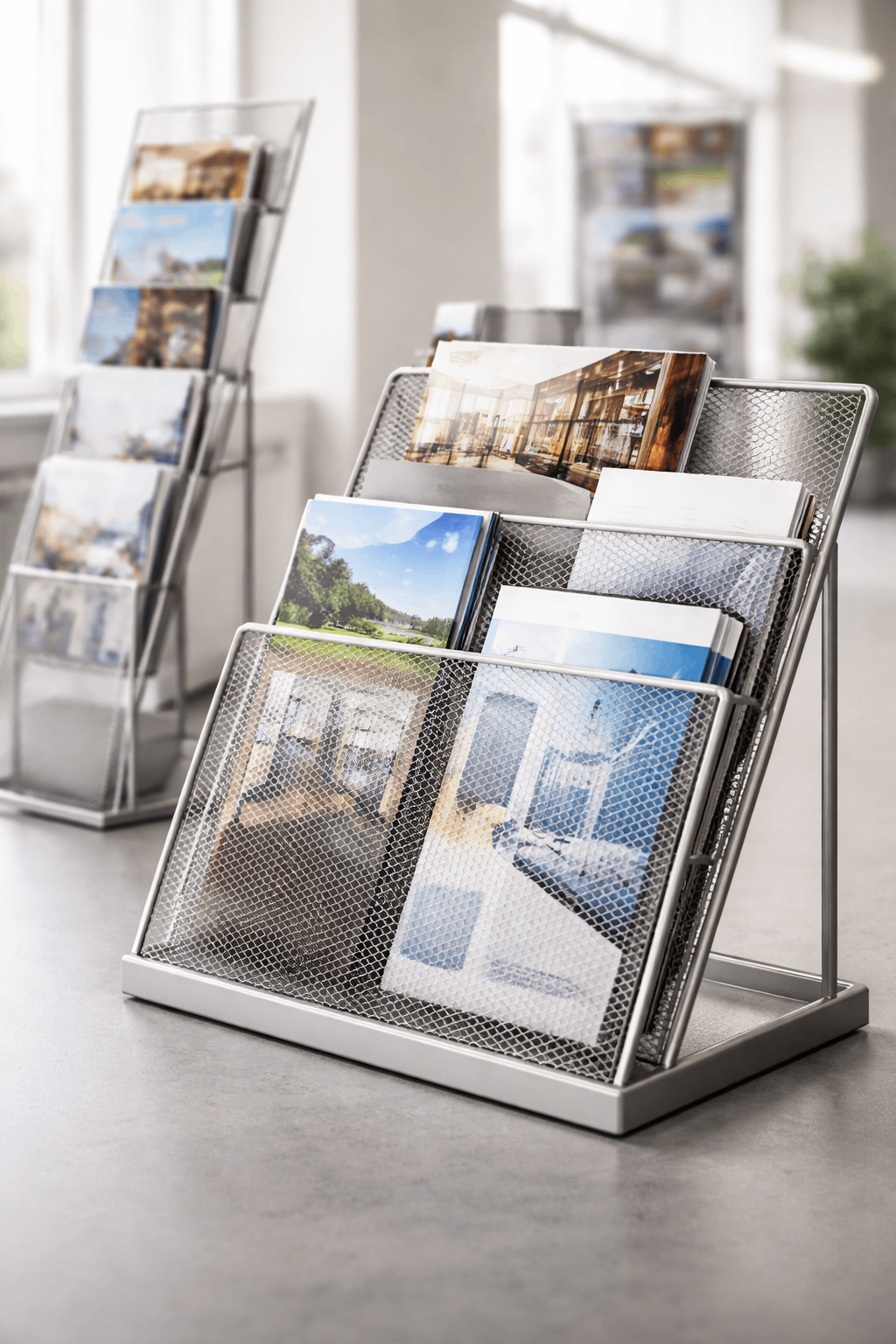
For overseas wholesalers, fixture importers, and sourcing teams, brochure holders are not small add-on products. They are part of a retail display program that needs to work across real stores, real timelines, and real replenishment cycles. When buyers search for a supplier online, they usually look for practical signals: suitable materials, custom capability, structural reliability, repeat-order consistency, and export-ready production.
That is why brochure holders are best evaluated in context. A display that looks good in a product photo may not fit heavier catalogs, multi-store rollouts, or flat-pack shipping requirements. In retail programs, the better question is not simply what the holder looks like, but whether it matches the application, the display lifecycle, and the buyer’s operational goals.
The sections below explain how custom brochure holders support retail communication, how buyers typically compare materials and structures, and which factors procurement teams usually review when selecting a display supplier.
Why Brochures Still Matter in Retail Environments
Printed brochures still play an important role in many retail and commercial settings, especially where products need explanation. Automotive accessories, electronics, building materials, healthcare products, tourism services, and premium beverages often rely on brochures to present specifications, options, or service details that packaging alone cannot communicate clearly.
For retailers, brochures work best when they are easy to notice and easy to take. A brochure hidden behind a counter or stacked loosely on a shelf usually gets ignored. A structured literature display stand improves visibility, protects the printed material, and makes self-service browsing easier for customers.
For wholesale buyers, this is not just a presentation issue. It affects store consistency, campaign execution, and the perceived quality of the retail environment. Standardized brochure display racks across multiple locations can help keep communication clear and branding consistent.
The Role of Brochure Holders in Retail Display Strategy
Brochure holders work best when they are treated as part of the store’s information flow rather than as isolated accessories. In many projects, they sit beside product displays, counters, endcaps, or showroom fixtures to help customers move from visual interest to detailed product understanding.
This matters in procurement because the holder often needs to fit into an existing retail system. Buyers may need a brochure display holder that matches a metal display rack, aligns with a shelf module, or supports a point-of-purchase display program already in use. In these cases, customization is often more important than choosing from standard sizes.
Placement also affects performance. Countertop brochure holders can support one-to-one consultation at service desks. Floor-standing literature display racks are more suitable when visibility and brochure capacity matter most. Wall-mounted brochure holders work well in clinics, visitor centers, and waiting areas where floor space must remain clear.
Choosing the Right Material for Brochure Displays
Material choice is one of the most practical parts of brochure holder sourcing because it affects durability, cost structure, transport efficiency, and how long the display is expected to stay in service. For wholesale buyers, the best material is usually the one that matches the use cycle and the retail environment rather than the one with the lowest unit price.
Metal brochure holders are widely used for long-term retail programs. Powder-coated steel and aluminum are common options because they offer strong load-bearing performance, good surface finish, and reliable repeatability in production. In stores where brochures are thicker, where customer traffic is high, or where the display is expected to remain in place for a long period, metal structures often provide better lifecycle value.
Cardboard brochure holders are commonly used for short-term promotions, seasonal campaigns, and new product launches. Corrugated cardboard can be printed easily, shipped efficiently, and replaced quickly when campaign graphics change. Acrylic brochure displays are often chosen for counters, reception areas, and premium presentation zones where a cleaner visual effect is preferred.
| Material | Typical Program Length | Common Use Case | Main Buying Advantage |
|---|---|---|---|
| Metal | Long-term | Retail chains, showrooms, dealer networks | Durability and structural strength |
| Cardboard | Short-term to medium-term | Promotions, launches, exhibitions | Low cost and graphic flexibility |
| Acrylic | Medium-term | Reception areas, premium counters | Clean appearance and visibility |
| Wood | Medium-term to long-term | Boutique retail, hospitality | Premium visual style |
For buyers searching terms like custom brochure holders for retail stores, metal brochure holders for showrooms, or brochure display racks for stores, this comparison is often more useful than broad product claims. It helps them match the structure to the project instead of comparing materials in isolation.
Engineering Considerations in Brochure Holder Design
For B2B buyers, display quality is often judged by how well the structure performs in use. A brochure holder needs to remain stable, present literature neatly, and support repeated interaction without creating maintenance problems at store level.
Load distribution is one of the main engineering considerations. Pocket depth, base width, tier spacing, and overall center of gravity all affect stability. A multi-pocket literature display rack that is not engineered correctly may bend, lean, or tip when fully loaded. This is especially important when the literature includes product catalogs rather than lightweight leaflets.
Usability matters just as much. Brochures should be easy to remove without bending corners or disturbing the stack behind them. Clear front openings, practical pocket angles, and appropriate spacing between tiers improve customer interaction. These details are often small, but they directly affect how often the display is used.
Good engineering also includes manufacturability. Buyers generally prefer structures that are efficient to fabricate, easy to assemble, and practical to pack. For international shipments, flat-pack capability and repeatable production tolerances can be just as important as visual design.
Types of Brochure Holders Used in Retail Programs
Different store environments call for different brochure holder formats. Buyers usually evaluate these types based on display location, brochure volume, and the role the holder will play within the wider retail program.
Countertop brochure holders are typically used where staff and customers interact directly, such as service counters, reception desks, and consultation points. They are suitable for smaller-format brochures, high-frequency access, and spaces where footprint must stay compact.
Floor-standing brochure displays are better suited to higher-volume distribution and stronger visual presence. These units are often used near entrances, aisle junctions, or promotional zones, and can support several brochure titles at once. For multi-store rollout projects, a floor-standing brochure display can also strengthen brand presence in the retail environment.
Wall-mounted brochure holders are often chosen when floor space is limited. Portable brochure holders are more common in trade shows and temporary activations where shipping convenience, quick assembly, and easy replacement matter most.
Industry Applications of Brochure Displays
Although the product category is the same, the buying logic can change significantly by industry. In automotive showrooms, brochure display racks often need to support heavier specification sheets or accessory catalogs, which makes structural strength more important than decorative styling.
In tourism and hospitality, the focus is often on accessibility, compact layout, and easy replenishment. Visitor centers may need brochure holders that can organize many leaflet titles at once while remaining easy for travelers to browse quickly.
Healthcare, education, and public-service environments usually prioritize readability and orderly presentation. Retail launches and branded promotions often require brochure holders that coordinate with other point-of-sale displays and temporary merchandising fixtures.
Because of these practical requirements, buyers often search using application-focused terms such as literature display stand for showroom, brochure holder for trade show, or custom brochure display stand for retail rollout. Content that reflects those use cases is generally more useful than generic product copy.
What Wholesale Buyers Usually Check Before Sending an Inquiry
When overseas buyers move from browsing to shortlisting suppliers, they usually focus on a few practical questions. They want to know whether the supplier can customize dimensions, whether the display can match existing fixtures, whether the structure is suitable for the brochure format, and whether repeat orders will remain consistent.
They also evaluate whether the supplier understands logistics. A brochure holder for a single showroom sample is very different from a brochure holder program for dozens or hundreds of stores. Buyers may need flat-pack shipping, barcode labeling, compact export cartons, or modular assembly to support rollout efficiency.
For buyers comparing suppliers, clear explanations of material suitability, structural logic, and production considerations usually create more confidence than broad promotional claims. For B2B conversion, practical detail usually performs better than broad promotional language.
Manufacturing Capability and Supplier Evaluation
For international procurement teams, supplier capability is often the deciding factor. Product images can generate interest, but they do not prove that a manufacturer can deliver consistent results across samples, trial orders, and repeat production.
A professional process usually begins with requirement review. Brochure size, quantity per pocket, store environment, branding, and packing method all affect the final structure. From there, design teams can propose a suitable concept that balances appearance, usability, and cost.
Sampling is an important stage because it reduces project risk. A prototype allows the buyer to verify fit, stability, finish quality, and assembly logic before confirming volume production. This is especially important for custom brochure display stands that must integrate with wider retail fixture systems.
Production methods depend on the material. Metal brochure holders may involve laser cutting, bending, welding, grinding, and powder coating. Cardboard structures may use die-cutting, printing, lamination, and gluing. Buyers often value suppliers that can explain these processes clearly because process transparency supports trust.
Sustainability in Retail Display Manufacturing
Sustainability has become more relevant in retail display sourcing, but most wholesale buyers evaluate it in practical terms. They usually want to understand whether the material is recyclable, whether the service life matches the project, and whether the supplier can support responsible production without compromising durability or delivery.
Cardboard brochure holders are often selected for campaigns where lightweight shipping and recyclability are key priorities. Metal brochure holders support sustainability in a different way: they can remain in use for years, which may reduce replacement frequency across long-term retail programs.
For many buyers, understanding the full lifecycle of a display is often more helpful than general environmental claims. Buyers tend to respond better to realistic discussions of durability, use cycle, and material fit than to generic green messaging.
Common Mistakes in Brochure Holder Sourcing
One common mistake is selecting a brochure holder based mainly on appearance without checking whether it suits the brochure format, weight, and expected usage frequency. This can create problems later in the rollout when displays are difficult to replenish or unstable in store conditions.
Another issue is using the wrong material for the project cycle. A short campaign may not need a permanent metal structure, while a long-term showroom program may suffer if the display is too temporary. Matching the display type to the business objective is usually more cost-effective than focusing on the lowest initial quote.
Placement is another factor that can reduce results. Even a well-made brochure display rack may underperform if it is positioned away from the customer path or disconnected from the relevant product area. In many cases, the commercial result depends as much on use context as on structure.
The Future of Retail Brochure Displays
Retail programs continue to evolve as physical and digital communication become more connected. Many brochures now include QR codes, campaign links, or product-page references, which means the holder still plays a role even when the customer journey continues online.
There is also growing demand for modular retail display solutions. Buyers increasingly look for brochure holders that can work with broader fixture systems, adapt to updated campaigns, and fit changing store layouts without requiring a complete redesign.
For suppliers, this creates a clear direction. The most competitive brochure display solutions are likely to be those that combine structural reliability, customization flexibility, and practical rollout efficiency.
Quick Buyer Checklist for Custom Brochure Holder Projects
Before sending an inquiry to a display manufacturer, many wholesale buyers quickly review several practical factors. These points often determine whether a display solution will work smoothly in real retail programs.
First, confirm the brochure format and quantity per pocket. Brochures vary from thin leaflets to thick product catalogs, and the holder must support the correct weight and dimensions. A mismatch here can cause bending pockets or unstable displays.
Second, consider the expected program duration. Short promotional campaigns may benefit from cardboard brochure holders, while long‑term retail environments often require metal brochure holders with stronger structural support.
Third, evaluate logistics and installation requirements. Buyers managing international shipments often prefer displays that support flat‑pack transport, compact cartons, and quick in‑store assembly. These factors reduce shipping cost and simplify store rollout.
Finally, check whether the supplier can maintain consistency across repeat orders. Retail chains frequently reorder displays months later, so dimensional accuracy and finish consistency become important for maintaining brand standards.
Why Metal Brochure Holders Are Often Preferred in Long‑Term Retail Programs
While different materials serve different purposes, metal brochure holders remain one of the most widely used options for permanent retail installations. Their structural rigidity allows them to support heavier literature such as product catalogs, manuals, and technical brochures.
Powder‑coated steel structures are especially common in automotive dealerships, hardware retailers, and electronics showrooms where brochure usage is frequent and displays must remain stable for long periods. Metal also allows manufacturers to create slimmer frames without sacrificing strength, which helps displays integrate cleanly with other retail fixtures.
For buyers sourcing retail fixture programs, metal brochure holders also offer advantages in repeatability. Precision fabrication processes such as laser cutting and CNC bending allow manufacturers to maintain consistent dimensions across production batches. This consistency is valuable when displays are distributed across dozens or hundreds of locations.
Frequently Asked Questions from Wholesale Buyers
What is the most durable brochure holder material for retail stores?
Metal brochure holders are typically the most durable option for high‑traffic retail environments because they provide strong structural support and resist deformation over time.
Can brochure holders be customized for different brochure sizes?
Yes. Custom brochure holders can be designed for specific brochure dimensions, pocket depth requirements, and branding needs. Many retail programs require tailored solutions rather than standard display sizes.
Are cardboard brochure holders suitable for long‑term use?
Cardboard brochure holders are usually better suited to short promotional campaigns. For permanent installations, metal or acrylic structures generally provide longer service life.
What information should buyers provide when requesting a quote?
Typical information includes brochure size, number of pockets, expected order quantity, target environment (store, showroom, exhibition), and any branding or packaging requirements.
Conclusion
For overseas wholesale buyers, brochure holders are not just literature accessories. They are part of a display system that needs to support communication, merchandising consistency, and operational efficiency across retail programs.
The strongest sourcing decisions usually come from matching the right material and structure to the right application. That may mean metal brochure holders for permanent showroom use, cardboard brochure holders for campaign-driven promotions, or other formats depending on the retail setting.
At Yishang Display, brochure holder projects are usually approached from that practical perspective. If you are evaluating brochure display options for a retail program, showroom project, or trade distribution network, the right structure can improve both presentation and rollout performance. Contact Yishang Display to discuss your project requirements.