
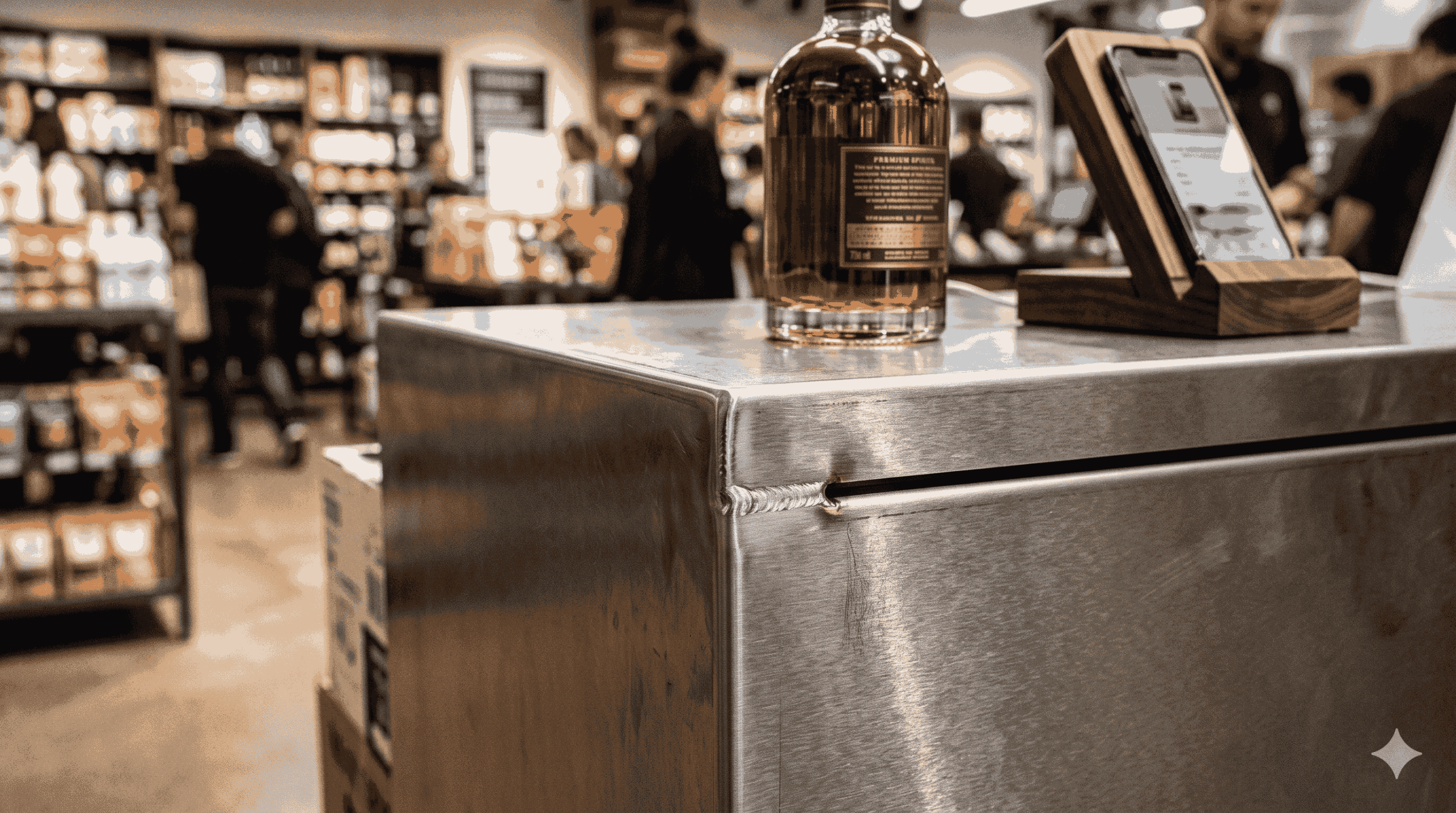
Key Takeaways
- The Structural Backbone: A premium retail display counter relies on precision-engineered metal as its architectural foundation; alternative materials should only serve as aesthetic accents.
- The Vetting Metric: True factory capability is validated by long-term structural consistency (ISO 9001) and international material safety (RoHS), not a superficial portfolio of dozens of unverified certificates.
- The Sourcing ROI: Direct-from-factory sourcing with an annual capacity of 10,000+ units eliminates intermediary markups and guarantees synchronous cross-border rollouts.
I. Introduction: The Invisible Cost of Structural Fatigue in Retail
Walk into any busy flagship store, and you can instantly spot the exact moment a procurement decision went wrong. For instance, it is the wobbly checkout counter, the sagging heavy-duty shelf, or the hair-line fracture on a metal seam.
Too many global procurement teams fall into the CAD-render trap, approving a supplier based on a beautiful 3D model or a rock-bottom unit price. Consequently, the physical realities of high-traffic store environments hit home only ninety days later.
When a display begins to sag or wobble, the hidden financial costs start piling up. Indeed, it is not just the price of a replacement frame; it is the cost of shipping, the operational headache of in-store repairs, and the subtle damage to your brand.
Sourcing retail fixtures shouldn’t feel like a gamble. Therefore, to protect your store ROI, you have to look past the surface styling and partner with a manufacturer who understands the deep-rooted physical realities of metal fabrication.
II. The Core Engineering: Decoding Precision Metal Fabrication
The Physics of Steel Gauges
Metal is the unvarnished spine of any retail store layout. Specifically, while acrylic and timber look fantastic, they simply cannot carry the weight of a busy commercial environment without a rigid metal core.
However, not all metal fixtures are built to the same standard. Budget manufacturers cut corners by using thin, 18-to-20-gauge steel, which looks fine on a spec sheet but bends under real-world commercial loads.
In contrast, a premium builder uses heavy-duty, commercial-grade 14-to-16-gauge mild steel or carbon steel. Ultimately, this difference in steel thickness determines how your retail displays handle years of constant customer interaction.
Continuous Welding vs. Cosmetic Cover-ups
Behind every long-lasting metal display counter is a highly controlled sequence of manufacturing steps. Cheap fixtures often rely on quick spot-welding covered up with auto-body filler and heavy paint.
Conversely, the constant vibration of shopping carts and customer foot traffic will eventually snap those weak points. To prevent this, continuous MIG/TIG precision welding melts the base metals together, creating a unified chemical bond across the entire joint.
As a result, the weld seam becomes structurally stronger than the surrounding metal itself. This rigorous engineering process is essential for high-turnover retail sectors like beverages, auto parts, or hardware.
The Science of Electrostatic Surface Pre-treatment
A custom metal fixture’s finish must do far more than look clean on opening day. Specifically, it must withstand daily contact with abrasive shopping carts and aggressive chemical cleaning agents.
For this reason, a professional, multi-stage electrostatic powder coating process is essential. First, the metal goes through an automated chemical pre-treatment wash to remove oils and apply a phosphate conversion coating for maximum finish adhesion.
Subsequently, curing the protective polymer resin in industrial ovens at temperatures exceeding 200°C creates a resilient, cross-linked polymer shell. Consequently, the final surface becomes scratch-resistant, rust-proof, and exceptionally easy to sanitize.
III. Beyond the Steel: Cross-Material Integration and Multimodal Action
Engineering the Multi-Material Connection
No one builds modern retail spaces out of just one material anymore. Indeed, brands want to mix the cold, clean strength of steel with the warm texture of wood or the sleek transparency of acrylic display accents.
However, the secret to a successful multi-material display is treating the metal chassis as the hidden, load-bearing skeleton. By doing so, the delicate secondary materials are protected from stress fractures, warping, and bowing.
For instance, when mounting timber elements, a smart builder uses anti-vibration rubber gaskets and flush-mount brackets at key connection points. As a result, the wood can expand and contract naturally without warping or cracking.
Integrated Power and Interactive Electronics
Sourcing managers are also no longer just looking for static shelves. Specifically, they need motorized display counters, integrated LED lighting, and interactive touchscreens to engage shoppers.
To achieve this, fusing technology with metal requires serious foresight. Consequently, a manufacturer must design dedicated, hidden wiring channels directly inside the steel frame to protect power cables from heat, pinching, and physical wear.
IV. The B2B Sourcing Audit: Demystifying Certificates and Capacity
The Reality of “Certificate Inflation”
When you start looking for international suppliers, you are immediately bombarded with marketing buzzwords. Indeed, we call this “certificate inflation” in the industry.
Many middleman trading companies collect every badge under the sun to hide the fact that they don’t actually own a factory floor. In contrast, compliance for a direct-from-factory partner like Yishang Display is a tool for production consistency.
For this reason, two specific standards actually matter for global procurement: ISO 9001 and RoHS. Specifically, ISO 9001 guarantees that the 10,000th display unit matches the exact quality of the initial approved prototype.
Meanwhile, RoHS compliance ensures that all raw materials and coatings are 100% free of hazardous heavy metals. Consequently, this ensures trouble-free customs clearance in North America and Europe.
Validating Production Scalability and Export Footprint
You must also verify scale. For example, a factory with an annual capacity of over 10,000 units has the supply chain leverage to handle massive rollouts without missing your grand opening deadlines.
Similarly, export experience is another quiet indicator of quality. Shipping heavy metal structures across the ocean exposes them to extreme humidity and temperature swings.
Therefore, a supplier with 26+ years of experience shipping to over 50 countries knows how to pack containers to prevent warping and rust before the cargo even arrives at your warehouse.
| Sourcing Metric | Tier-1 Direct Metal Factories (e.g., Yishang Display Model) | Sourcing & Trading Companies | Stock Wholesale Distributors |
|---|---|---|---|
| Customization Depth (OEM/ODM) | Maximum (Full blueprint-to-product) | Limited (Pre-set catalogs) | None (Off-the-shelf only) |
| Structural Durability | High (Precision metal welding) | Variable (Multi-sourced quality) | Medium (Mass-produced) |
| Pricing for Bulk Orders | Highly Competitive (Factory-Direct) | High (Middleman markups) | Fixed (Low volume margins) |
| Material Versatility | Metal, Acrylic, Wood, Carbon | Dependent on vendor network | Rigid stock options |
| Size & Style Flexibility | Unlimited | Limited to partner tooling | Strictly standardized |
| Regulatory Compliance | Targeted (ISO 9001, RoHS) | Often unverified | General market standards |
| Production Scalability | High (10,000+ units annually) | Low-to-Medium | High (Subject to stock) |
| Dynamic Options (Electric) | Available via custom engineering | Rarely supported | Non-existent |
| Industry Expertise Depth | Multi-sector (Auto to Fashion) | General retail knowledge | Consumer-level focus |
| TCO (Total Cost of Ownership) | Lowest (Longest product lifespan) | Medium-to-High | High (Frequent replacements) |
V. The Strategic Procurement Checklist
Before you sign a contract or wire a deposit for your next store rollout, run your prospective manufacturer through this quick engineering audit:
- Steel Check: Do they specify the exact gauge of the structural steel (like 14-to-16-gauge), or do they just use vague words like “high-strength steel”?
- Welding Check: Can they show you clean, un-ground photos of their TIG and MIG weld seams?
- Finishing Check: Do they have an automated chemical pre-treatment line for their powder coating, or are they manually spraying paint in a dusty workshop?
- Material Check: Can they demonstrate projects where they successfully integrated metal frames with wood, acrylic, or electrical elements?
- Audit Check: Can they provide verified, up-to-date ISO 9001 and RoHS documents linked directly to their physical manufacturing facility?
The Path Forward
Sourcing retail display counters is a major investment in your store’s infrastructure. By focusing on real metal engineering, direct-to-factory capacity, and clear quality metrics, you can secure displays that protect your products and deliver long-term ROI.
Looking to elevate your next store rollout with durable, precision-engineered displays? Get in touch with the team at Yishang Display today to discuss your project requirements.