
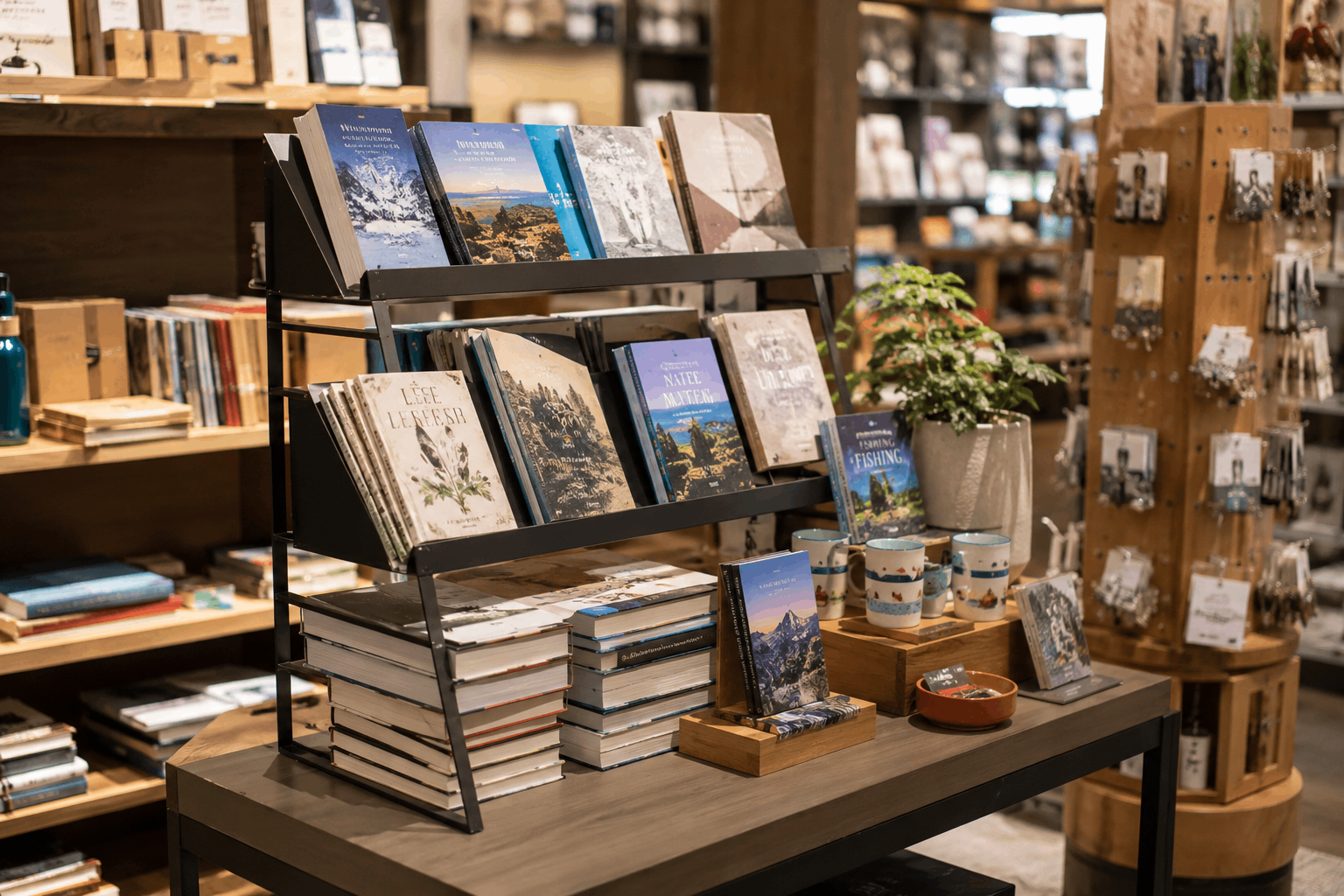
Introduction: Book Displays Should Be Easy to Buy, Ship, and Use
Using books in a gift shop display is more than a merchandising idea. For overseas wholesale buyers, importers, distributors, and retail fixture purchasers, it is also a sourcing decision. The rack has to present the books well, of course, but it also needs to carry the weight, fit the store layout, hold up under daily handling, and ship without creating unnecessary cost.
Gift shop shoppers rarely browse the way bookstore customers do. They often buy by occasion, destination, or recipient rather than by author or category. A book can explain a souvenir theme, support a children’s section, or complete a food, home décor, or travel gift set. The right metal book display rack makes that role easier to understand while keeping the display stable and manageable.
This guide focuses on the practical decisions behind a book display: rack structure, cover visibility, shelf load, packaging, branding, and customization. It is written for buyers who need displays that look good in store and, just as importantly, keep working after repeated retail use.
Quick Sourcing Priorities for Wholesale Buyers
Before reviewing design options, buyers usually need to confirm whether the display rack can match the actual retail program. The main details are not complicated, but they are easy to overlook: book size, estimated weight per shelf, display location, rack footprint, assembly method, finish, branding area, and packing requirements.
These details affect cost, sampling, production, and customer satisfaction. A rack for small guidebooks near checkout does not need the same structure as a rack for heavy coffee table books. Likewise, a short-term promotional rack may need replaceable signage, while a long-term museum store fixture often needs stronger shelves and a more durable finish.
| Buyer Priority | What to Confirm | Why It Matters |
|---|---|---|
| Book size | Height, width, thickness, and format | Determines shelf depth and tier spacing |
| Shelf load | Estimated weight per shelf | Reduces bending and stability risk |
| Store location | Checkout, wall, entrance, aisle, or island | Affects rack footprint and customer flow |
| Display style | Face-out, spine-out, mixed merchandise | Affects shelf angle and product access |
| Branding | Logo panel, header card, or sign holder | Supports retail campaigns and private label programs |
| Shipping | Knock-down or welded structure | Influences carton size, freight cost, and assembly |
Why Wholesale Buyers Evaluate Book Displays Differently
A single store owner may focus on one attractive display corner. A wholesale buyer usually has a wider concern: can this fixture be produced consistently, packed safely, installed by local teams, and used across different retail environments? That is why B2B buyers tend to evaluate book display stands through structure, material, finish, assembly, and long-term durability.
Books place a particular kind of pressure on a fixture. Hardcovers, cookbooks, museum books, and children’s picture books can be heavier than many small gift items. They are also handled frequently. Customers pick them up, flip through them, compare covers, and return them quickly — sometimes neatly, sometimes not. If the rack is unstable, too tight, or poorly angled, the display can become messy sooner than expected.
A good retail book display stand should solve both merchandising and purchasing concerns. It should help the retailer show books clearly, while also helping the buyer reduce risks such as shelf bending, product damage, poor assembly, inefficient packaging, or inconsistent branding across stores.
Start with the Display Purpose Before Choosing the Rack
The first question is not simply which rack looks best. A better question is what role the books will play in the store.
- In museum stores, tourist shops, cultural retail, hotel gift areas, and local-interest sections, books may be the main product.
- In that case, the rack needs strong cover visibility, clear browsing access, and enough capacity to keep the display organized.
- In other programs, books support nearby merchandise.
A cookbook can strengthen a kitchenware or gourmet food section. A local photography book can add meaning to souvenirs. A children’s storybook can support puzzles, plush toys, or educational kits. Here, the rack should support the product group without taking attention away from the full gift offer.
This distinction matters more than it may seem at first. A main book display may need more tiers, wider shelves, and a stronger frame. A supporting display may need a smaller footprint, side hooks, acrylic pockets, or a sign holder. A seasonal display may need replaceable graphics or wheels with locks. Defining the purpose early helps avoid a fixture that looks appealing but does not quite match the buying program.
Connect Books with Real Buying Intent
Gift shop customers often shop with a simple intention: something local, something meaningful, something for children, something for a host, or something easy to buy before leaving. Displays that reflect these intentions are usually easier to understand than displays arranged only by book category.
A local souvenir display can combine city photo books, travel guides, postcards, magnets, mugs, and small crafts. The books provide context, while the smaller items offer accessible price points. In high-traffic locations, a slim floor-standing metal rack or wall-mounted book rack can keep covers visible without blocking movement.
A food or hosting display may combine cookbooks, wine guides, drinkware, serving trays, napkins, and specialty food. Since cookbooks are often larger and heavier, the rack should be designed with suitable shelf depth, reinforced support, and a stable base. For buyers, the merchandising idea and fixture structure should be reviewed together, not as two separate decisions.
Children’s displays need a slightly different approach. Picture books, activity books, puzzles, educational products, and plush toys are often browsed by both adults and children. A lower metal display stand with smooth edges and good base stability can make the section easier to use while reducing safety and maintenance concerns.
Make Book Covers Visible Without Sacrificing Stability
In gift retail, the cover is one of the book’s strongest selling surfaces. Customers may not spend much time reading descriptions. They scan the display, recognize the theme, and decide whether the product feels suitable as a gift. This is why face-out presentation is often more effective than spine-only shelving in gift shop environments.
Face-out display is especially useful for coffee table books, art books, travel books, cookbooks, children’s books, illustrated guides, and seasonal titles. These products depend heavily on visual impact. If the cover is hidden, the display loses much of its value.
The rack design controls how well the cover can be seen. Shelf angle helps the cover face the customer. Tier spacing affects whether customers can remove and return books comfortably. A front lip prevents books from sliding, but if it is too high, it can block the lower part of the cover. Shelf depth should support the book without making it disappear into the fixture.
For wholesale projects, these are not cosmetic details. They affect every store using the rack. During sampling, buyers should test real book sizes whenever possible, because drawings and reference photos do not always show how the product will sit on the shelf.
Design for Daily Handling and Store Maintenance
A display that looks good on installation day must still work after weeks or months of use. Books are repeatedly touched, moved, and replaced. During busy seasons, staff may need to straighten the display many times a day. If the rack is difficult to refill or too easy to disturb, the retail team may stop using it as planned.
A stable base reduces shaking when customers browse. Smooth edges improve handling comfort. A retaining lip helps prevent books from sliding forward. Proper tier spacing makes restocking easier. A powder-coated metal finish can also help the rack maintain a clean appearance during regular use.
For importers and distributors, daily operation often affects after-sales feedback. A rack that reduces maintenance and protects product presentation is more likely to support repeat orders. A rack that looks good in a catalog but performs poorly in store can lead to complaints, replacement requests, and unnecessary pressure on the buyer-supplier relationship.
Confirm Technical Details Before Production
Before placing a wholesale order, buyers should confirm the product and use conditions as clearly as possible. Approximate book dimensions, expected load per shelf, number of tiers, rack placement, browsing direction, and whether the fixture will hold only books or mixed merchandise should all be discussed before sampling.
Load capacity is one of the most important factors. A rack for small paperbacks does not need the same structure as one for hardcovers or oversized coffee table books. Heavy books may require reinforced shelves, thicker wire, stronger sheet metal, or welded construction. For floor-standing racks, the base size and center of gravity should also be reviewed carefully.
Packaging and assembly influence the purchasing decision as well. Knock-down display racks may reduce shipping volume and storage cost. Welded structures can provide stronger rigidity, but they may increase carton size. The better choice depends on order quantity, freight method, installation environment, and expected product load.
Surface treatment should match the retail environment. Powder coating is commonly used for metal display racks because it provides a clean finish and practical durability for daily retail use. Buyers may also request brand colors, neutral finishes, logo panels, acrylic pockets, wood shelves, or cardboard graphic panels, depending on the retail program.
| Technical Factor | Why It Matters | Buyer Question |
|---|---|---|
| Load capacity | Prevents bending and instability | What weight should each shelf carry? |
| Shelf angle | Affects cover visibility | Should books face outward or stand upright? |
| Base stability | Reduces wobble in traffic areas | Will customers browse from one or multiple sides? |
| Finish | Affects appearance and durability | Is powder coating, brand color, or neutral finish preferred? |
| Packaging | Affects freight and storage | Should the rack be knock-down or welded? |
| Branding area | Supports retail campaigns | Is a logo header or replaceable sign needed? |
Match Rack Format to the Purchase Scenario
Different retail programs need different rack formats. A museum or local book section may use a floor-standing face-out rack with a header sign. This helps the display attract attention while leaving room for branding or campaign messaging.
Checkout add-on products usually need a compact countertop book display stand. Mini books, journals, notebooks, cards, and small guides can perform well near payment areas because customers make quick decisions there. The rack should be stable, easy to reach, and not oversized.
Coffee table books, art books, and cookbooks require stronger support. Wider spacing, reinforced shelves, and a lower center of gravity help protect both the product and the customer experience. For seasonal programs, buyers may prefer movable or modular racks with replaceable signage so the same fixture can be reused for holidays, exhibitions, or product launches.
| Purchase Scenario | Suitable Rack Direction | Key Buying Factor |
|---|---|---|
| Museum or local book section | Floor-standing face-out rack | Cover visibility and branding area |
| Checkout display | Countertop tiered stand | Compact footprint and fast access |
| Coffee table book display | Reinforced shelf rack | Load capacity and premium appearance |
| Tourist retail program | Slim or wall-mounted rack | Space efficiency and traffic flow |
| Seasonal campaign | Movable or modular rack | Reusability and quick update |
Which Type of Metal Book Display Rack Fits Your Program?
A floor-standing book display rack is suitable when books need to be a visible feature in the store. It works well for museum books, local-interest titles, illustrated guides, and branded retail programs that need a logo header or theme sign. Buyers should review the base size, shelf load, and carton dimensions before confirming this type of rack.
A countertop book display stand is more suitable for checkout areas, small gift books, journals, notebooks, greeting cards, or compact souvenir guides. The main purchasing concern is not maximum capacity, but whether the stand is stable, easy to refill, and small enough to avoid crowding the payment counter.
A rotating book display rack can be useful in tourist shops or compact stores where shoppers need access from different sides. For this format, buyers should pay attention to rotation smoothness, base balance, and whether the rack remains stable when one side is fully loaded.
A wall-mounted book rack can save floor space in narrow retail areas. It is useful for hotel shops, museum exits, and small gift sections, but buyers should confirm wall-fixing requirements, installation method, and expected book weight before choosing this structure.
Keep the Metal Structure Clean and Adaptable
Metal is useful because it provides strength, stability, and production consistency. Still, the rack should not compete with the books. In many gift shop displays, a clean metal frame works best because it allows covers, packaging, and campaign graphics to remain the focus.
Black, white, metallic, and neutral powder-coated finishes fit many store styles. Metal can also be combined with wood for a warmer lifestyle look, acrylic for a lighter modern appearance, or cardboard panels for short-term campaign graphics. The main structure remains durable, while the visual elements can adapt to the retail program.
This flexibility is useful for wholesale buyers serving different customers or markets. One reliable metal structure can be adjusted through color, signage, material accents, and layout. In practice, that often keeps sourcing more efficient while still allowing different retail presentations.
When Metal Is the Better Choice for Book Displays
Different materials can work well in different display programs. Cardboard is often useful for short-term campaigns, lightweight products, and cost-sensitive promotional displays. Acrylic can create a clean and transparent look for small books, single-title displays, or premium countertop presentations. Wood can add warmth to boutique-style gift sections and lifestyle retail areas.
Metal is usually the stronger choice when the display needs to carry heavier books, handle frequent customer touch, support repeated seasonal use, or remain consistent across multiple stores. It is also suitable when buyers need welded frames, knock-down structures, powder-coated finishes, logo headers, or mixed-material retail fixtures.
For wholesale sourcing, the question is not which material looks best in a photo. The better question is which material matches the expected load, campaign duration, store traffic, packing method, and maintenance requirements. In many book-and-gift programs, a metal structure with wood, acrylic, or printed graphic elements provides a practical balance between durability and visual presentation.
Avoid Common Sourcing Mistakes
One common mistake is choosing a rack based only on appearance. Product photos can show style, but they do not always show whether the shelf will bend, whether the rack will wobble, or whether the packaging method is suitable for overseas shipment. Buyers should review appearance and structure together.
Another mistake is maximizing capacity at the cost of visibility. In gift shop merchandising, a curated display with clear covers often works better than a crowded rack. If customers cannot understand the theme quickly, the display loses its selling function.
A third mistake is using vague specifications. Terms such as “standard size” or “strong enough” are not precise enough for custom production. Book dimensions, estimated shelf load, rack placement, finish, logo requirements, and packaging preferences should be discussed before quotation or sampling.
Quality Checks Buyers Can Discuss Before Bulk Production
For custom metal book display racks, quality control is best discussed before mass production rather than after delivery. A buyer may request sample approval using real book sizes, especially when the project involves heavy hardcovers, mixed merchandise, or branded signage.
Useful inspection points include shelf load testing, welding point review, surface finish checking, assembly testing, logo or header alignment, carton protection, and packing label confirmation. These checks help reduce the risk of bending, scratching, unstable assembly, or incorrect branding during bulk orders.
This section does not need to become a formal technical standard on every project. It simply helps buyers and suppliers align expectations before production begins. For overseas orders, that alignment can reduce rework, shipping delays, and after-sales disputes.
What to Include in Your RFQ for a Custom Metal Book Display Rack
Before requesting a quotation, buyers can prepare basic project details. These include book size, expected weight per shelf, number of tiers, display location, preferred rack type, branding needs, finish color, order quantity, and whether the rack should be knock-down or fully welded.
It is also helpful to clarify the retail purpose. Will the rack be used for local books, children’s titles, premium hardcovers, journals, or mixed gift products? Will it be placed near checkout, against a wall, in the center of the store, or beside souvenir shelves?
Buyers may also include target market, sample requirements, expected lead time, private label needs, and export packaging preferences. Clear information helps the supplier recommend the right structure faster. It also improves sampling accuracy, quotation efficiency, and production communication. For importers and distributors, this can reduce revision cycles and make bulk purchasing smoother.
FAQ
What should wholesale buyers consider when sourcing book display racks?
Buyers should consider book size, expected load, shelf angle, rack footprint, store traffic, finish, branding area, packaging method, assembly requirements, and order quantity. These factors affect both retail presentation and purchasing risk.
Are metal display racks suitable for heavy books?
Yes. Metal racks are suitable for hardcovers, cookbooks, coffee table books, and frequently handled books because they can provide stronger support and better long-term stability than many lightweight temporary fixtures.
Should gift shop books be displayed face-out or spine-out?
Face-out presentation is usually better for gift shops because customers scan quickly and respond to covers. Spine-out shelving can be useful for storage, but it is less effective when the goal is visual merchandising and impulse purchase.
Can one rack support books and other gift products?
Yes, if the structure is designed for mixed merchandise. A custom rack can include shelves, hooks, pockets, sign holders, or side display areas for souvenirs, cards, small packaged goods, or accessories.
What information should buyers provide before requesting a quote?
Buyers should provide approximate book dimensions, expected shelf load, rack placement, quantity, preferred material, finish, logo or signage needs, packing preference, and whether the fixture will be used for long-term retail or seasonal campaigns.
Is metal better than cardboard, wood, or acrylic for book display racks?
It depends on the project. Cardboard may suit short-term promotions, acrylic can work for light and clean countertop displays, and wood can create a warmer boutique appearance. Metal is usually more suitable for heavy books, high-traffic stores, repeated handling, and long-term wholesale retail programs.
Can a custom metal book display rack include branding?
Yes. Depending on the structure, buyers can request a logo header, replaceable sign holder, branded color finish, printed graphic panel, or private label packaging. These options are useful for museum stores, tourist retail, chain stores, and branded gift programs.
Conclusion: Build Displays That Work for Retail and Purchasing
Books can help gift shops create stronger themes, clearer product groups, and more meaningful gift presentations. For wholesale buyers, the value of a book display depends on both merchandising effect and practical performance.
A well-designed metal book display rack should improve cover visibility, support daily handling, protect product presentation, and fit the buyer’s shipping, assembly, and branding requirements. When the fixture is designed around real product dimensions and retail use, it becomes a more reliable purchasing decision.
Yishang Display provides OEM and ODM metal display rack solutions for gift shops, museum stores, tourist retail, hotel retail areas, and multi-category retailers. Share your book sizes, display goals, and purchasing requirements to explore a custom rack solution for your program.
Editorial Note
This guide is written from the perspective of retail fixture manufacturing and wholesale sourcing. Final rack specifications should be confirmed based on actual book dimensions, target load, store layout, packaging method, and project requirements.