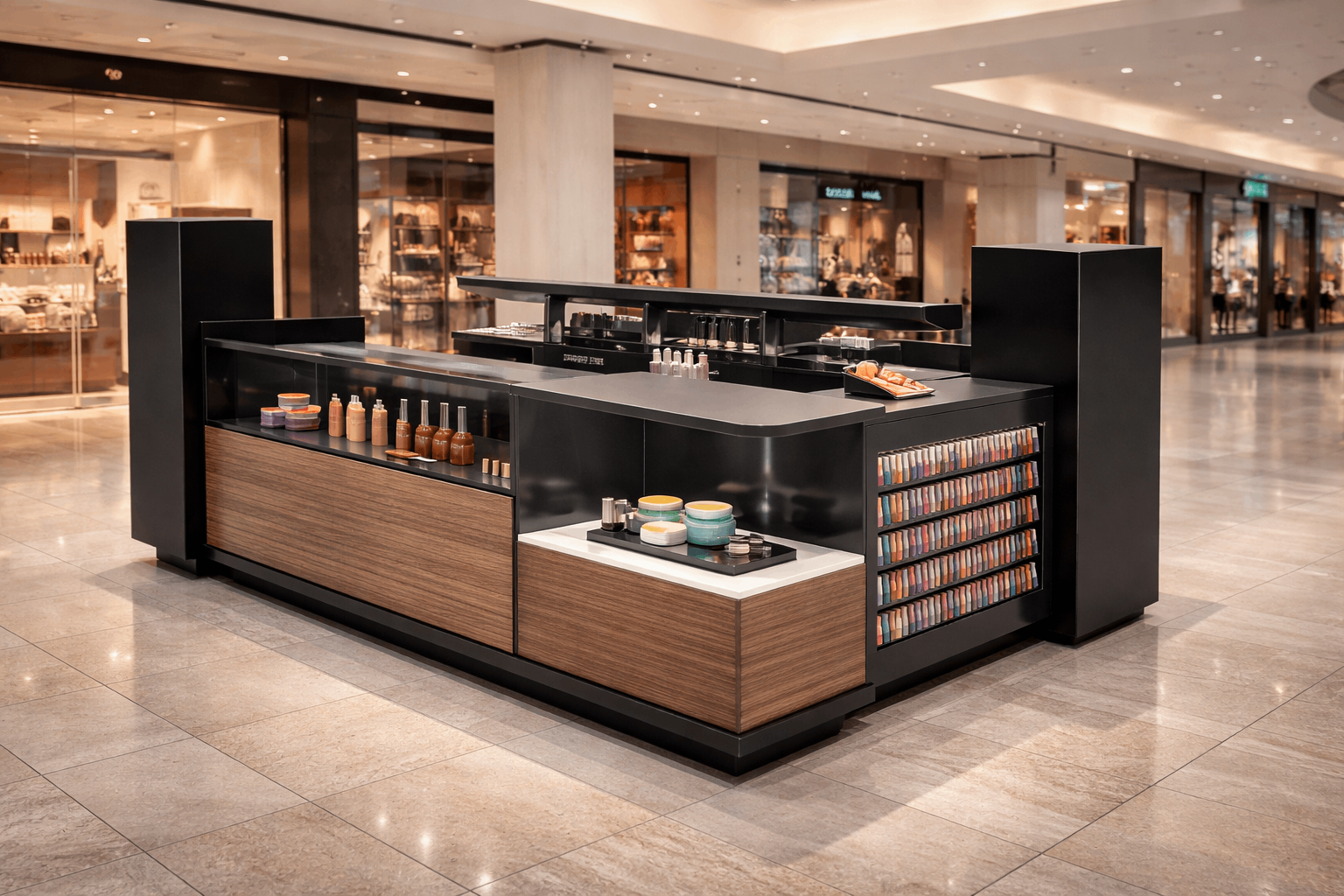
A Beauty Supply Cosmetics Shop Advertising Eyebrow Threading Kiosk Display should do more than simply occupy floor space. For overseas wholesalers, importers, and project buyers, the real question is a practical one: can the kiosk support daily service, retail sell-through, and repeatable production in one workable format?
This model is developed with that kind of buying logic in mind. It brings together a central beauty service zone, integrated product presentation, concealed storage, and bold side towers that double as cosmetics shop advertising in open retail space. The black finish gives the unit a sharper, more premium character, while the wood-effect front panel softens the look and makes the display area feel a little more inviting.
The layout, too, feels aligned with how buyers often review a project online. The open front supports quick consultation, the side shelving improves display density without making the counter feel crowded, and the front-facing zones are useful for brow products, testers, or impulse items. For buyers weighing a cosmetic display stand against a full-service kiosk, that distinction matters. This unit is not just there to display products; it is there to support service speed, merchandising efficiency, and stronger brand presentation at the same time.
This kiosk is designed for businesses that need a beauty service kiosk, a cosmetic display stand, and a branded service counter in one unit. That combination is especially valuable in malls and beauty centers, where every square meter is expected to do real work for both service output and retail sell-through.
In beauty retail, service often brings the traffic; merchandising, meanwhile, tends to lift the average order value. A customer may come in for threading, then leave with brow products, cosmetics, or a few small accessories placed close at hand. That is why the display areas here are not treated as decorative extras. They are positioned to support add-on sales and stronger product visibility without getting in the way of service flow.
The service side of the design matters just as much. Technicians need a practical working height, enough surface area for tools and product, and clear movement around the core workstation. When those basics are handled well, the kiosk feels more organized, the service process tends to run more smoothly, and the overall presentation looks more professional.
The advertising function is built into the structure rather than added on later. The side towers, front graphics, and clean display lines give the kiosk strong cosmetics shop advertising value in open retail environments. For distributors and private-label buyers, that also makes the unit easier to adapt across different projects, whether the plan is a single site or, perhaps, a broader multi-location rollout.
One of the strongest selling points of this beauty kiosk display is visibility. The side towers create vertical brand surfaces that shoppers notice from a distance, which helps in shopping malls and corridor locations. In these settings, the first few seconds often decide whether a passerby slows down, asks a question, or keeps walking.
The material contrast supports that first impression. Black structural sections create a clean premium frame, while the wood-tone front panel adds warmth and keeps the unit from looking too industrial. For buyers reviewing options online, that creates a clear difference between a basic counter and a stronger retail display solution.
The internal layout also supports workflow, not just appearance. The central working area defines the service zone, while the surrounding counters support product handling and consultation. When the operator can reach tools and products easily and still keep the public-facing side neat, service tends to move faster.
Display capacity is another reason this design works well. Front-facing compartments, side shelving, and countertop presentation areas support cosmetics, brow care products, small accessories, or seasonal promotional items. For many buyers, that makes it more useful than a single-purpose cosmetic display stand because service and sales share the same footprint.
Durability remains a major procurement factor. Staff and customers touch the unit frequently, teams clean it often, and daily use brings cosmetic residue, packaging movement, and wear. That is why buyers look closely at frame stability, countertop resistance, edge finishing, hinge quality, and finish consistency.
These details also influence total cost of ownership. A better finish reduces visible wear, stronger hardware lowers maintenance issues, and cleaner edge treatment improves perceived quality when buyers inspect the kiosk in person.
This design is a strong fit for mall operators who rely on visibility, quick consultation, and efficient turnover. In many shopping centers, the site has to attract attention from multiple directions, work within landlord guidelines, and still leave enough room for service movement. The open configuration and brand-facing towers make that easier.
It also suits beauty retailers that want to add service revenue without expanding into a full salon build-out. By combining a beauty service station with retail merchandising, the kiosk can support both service income and product sales from one location. That mixed-use format is often more attractive than buying a separate counter and service unit because it creates a cleaner look and a more efficient footprint.
For distributors and brand owners, the same structure can be adjusted into a launch kiosk, a branded brow bar, or a compact cosmetics retail point. This flexibility matters in procurement because the same platform can be adapted for different customers, markets, or seasonal campaigns with changes in graphics, shelving, finish, and logo treatment.
Once the layout concept is clear, the next question is whether the kiosk can match the site, the target market, and the required finish level. The exact dimensions, internal layout, and decorative details of this model can all be customized, but the specification framework below gives a practical view of how a custom cosmetics kiosk typically develops.
| Item | Specification Range / Option |
|---|---|
| Product Type | Beauty service kiosk / cosmetic retail kiosk |
| Main Materials | Metal, acrylic, wood, decorative panel |
| Operation Mode | Manual, optional electric features |
| Size | Customized according to site plan |
| Layout | Open kiosk, island kiosk, semi-open service layout |
| Branding | Logo panels, graphic surfaces, lightbox options |
| Display Areas | Countertop display, side shelving, front visual merchandising |
| Storage | Internal cabinets and concealed storage zones |
| Surface Finish | Powder coating, laminate, acrylic finish |
| Service Application | Eyebrow threading, beauty consultation, cosmetics retail |
| Customization | OEM & ODM supported |
| Certifications | RoHS, ISO 9001 |
| Typical Lead Time | Based on design complexity and order quantity |
| Suitable Location | Shopping mall, beauty retail store, open commercial area |
From a commercial perspective, these specifications matter because each element changes the final performance of the kiosk. A metal frame improves structural stability for long-term retail use. Acrylic and decorative panels strengthen brand presentation. Storage design affects workflow and cleanliness. Counter dimensions influence staff comfort and customer interaction. Surface finish matters just as much, especially in high-touch beauty retail where fingerprints, cosmetic residue, and frequent cleaning can quickly reduce visual quality if the finish is poorly chosen.
For procurement teams, the specification table also works as a risk-control tool. It clarifies what will be customized, what material combination is proposed, and which technical standards support the project. RoHS and ISO 9001 do not replace project-specific approval, but they do suggest that the production process follows quality and compliance controls more consistently.
That level of clarity matters, perhaps more than some suppliers realize, in overseas wholesale procurement. Buyers often compare multiple sources in a short time, and a vague product page can be screened out very early. Clear specifications, realistic use cases, and a transparent customization scope make the product easier to evaluate and easier to shortlist.
For metal-based retail fixtures, buyers also pay attention to whether the structural system can stay consistent across repeat orders. Stable metal fabrication helps improve frame strength, shelf support, dimensional control, and finish consistency. Those points become especially important when a kiosk program moves from one approved sample to a larger quantity order.
In practice, many sourcing teams look at the same few points first: can the structure be customized, can the finish match the target brand, is the display area sufficient for sell-through, and is the supplier clear about what happens after design approval? When a page answers those points directly, it generally performs better with professional buyers because it reduces qualification time.
Once a buyer decides that the overall format is suitable, the next step is defining the project clearly enough to get a useful proposal. For this type of kiosk, the most practical inputs are site dimensions, required service positions, target product categories, preferred finish, logo files, and destination market. If the unit is intended for a mall, local rules on power, signage, and floor coverage should also come into the discussion early.
A practical custom process should feel collaborative. Some clients want a compact service-led format with limited display. Others want stronger merchandising, more shelving, or a more promotional front. When the supplier understands those goals from the beginning, the proposal is easier to approve and the quotation is usually more accurate.
In many projects, the next step after confirming the brief is a layout proposal or 3D design review, followed by material confirmation and production planning. That process matters to wholesale buyers because it makes the transition from concept to sample, and then to bulk production, more predictable.
This is also where buyers often save time. A clearer brief reduces revisions, shortens design communication, and helps avoid mismatches between the approved drawing and the final expectation. In B2B procurement, that kind of efficiency matters because it affects both project speed and sourcing confidence.
For a product like this, the best results usually come from aligning service workflow, display logic, and local site compliance at the same time. When those three factors work together, the kiosk becomes easier to install, easier to use, and easier to sell onward.
Not every kiosk built for a similar purpose performs in the same way. Layout, branding treatment, display density, and material selection can change both cost and commercial value. An open format may improve customer approach, while a more enclosed version can create stronger internal organization.
Branding decisions matter as well. A simple logo panel can help control cost, but a lightbox or more developed sign system often increases visibility in mall traffic. Finish level also changes perception. A straightforward laminate may suit some programs, while a higher-grade surface can improve wear resistance and elevate the brand image.
For larger procurement volumes, these decisions add up quickly. A small change in shelving, hardware, finish, or graphics can influence unit price, packing, maintenance, and installation consistency. For a beauty kiosk, the biggest variables are usually footprint, service capacity, product presentation, brand visibility, and finish durability.
For a wholesale buyer, supplier credibility matters most when it supports the product decision. Yishang Display focuses on custom retail fixtures and brings more than 26 years of manufacturing experience, with export delivery to 50+ countries. For a beauty kiosk, that matters because the project often involves mixed materials, customized graphics, production coordination, and repeatable quality control rather than simple fabrication alone.
For buyers sourcing from a metal products company, this adds practical value. Metal fabrication is not only about strength. It affects structural precision, edge quality, load-bearing performance, and the long-term stability of a kiosk expected to handle daily use in a commercial environment.
This product is also supported by OEM and ODM capability, annual output of 10,000+ display units, and commonly requested certifications such as RoHS and ISO 9001. For procurement teams, these points are useful because they suggest the supplier can move from approved design to controlled production with fewer gaps.
Related project experience is valuable when it shows how a supplier handles real retail requirements. In beauty and service-led formats, the challenge is often the same: combine brand presence, practical storage, product display, and smooth customer interaction in a limited footprint.
That is why similar kiosk experience helps reduce sourcing risk. It suggests the supplier already understands issues such as display density, service clearance, graphic placement, and finish selection. For distributors and project buyers, that kind of familiarity often shortens approval time because the design logic is easier to trust.
One frequent question is whether the kiosk can fit a specific mall footprint. In most projects, yes. Size, layout, logo treatment, materials, and display configuration can all change according to the site brief and target market.
Buyers also ask which materials work best in high-traffic settings. For long-term durability, a metal structure with selected acrylic or wood-effect components is usually the most practical direction.
Another common question is whether the unit can support both service and retail sales. For this model, that dual role is one of its main strengths. It supports eyebrow threading or beauty consultation while still keeping enough merchandising area for cosmetics and related products.
Buyers also want to know what is needed for an accurate quotation. The most useful starting information is the floor plan, dimensions, preferred style, product categories, logo files, estimated quantity, and destination country.
A final concern is whether the kiosk can look premium without becoming overdesigned. In most cases, yes. Clean lines, balanced proportions, efficient storage, and controlled branding usually create a stronger result than too many decorative elements.
If you are planning a custom beauty kiosk solution, start with the real project conditions. A floor plan, reference image, logo file, preferred finish, and product list are usually enough to begin a useful discussion.
A strong beauty service kiosk should look good, work efficiently, and remain commercially practical after installation. When service workflow, display strategy, and finish quality align from the beginning, the result is easier to approve, source, and operate.
Send Yishang Display your project brief, and we can help develop a kiosk layout that fits your brand, site, and wholesale purchasing plan.



Yishang Display specializes in crafting bespoke display solutions. From initial concept and prototyping through to full-scale production, our in-house team manages every phase—delivering a seamless, one-stop experience for your brand.
If you have any questions or need a quote, please send us a message. One of our specialists will get back to you within 24 hours and help you select the correct valve for your needs.
All of our products are available for sampling