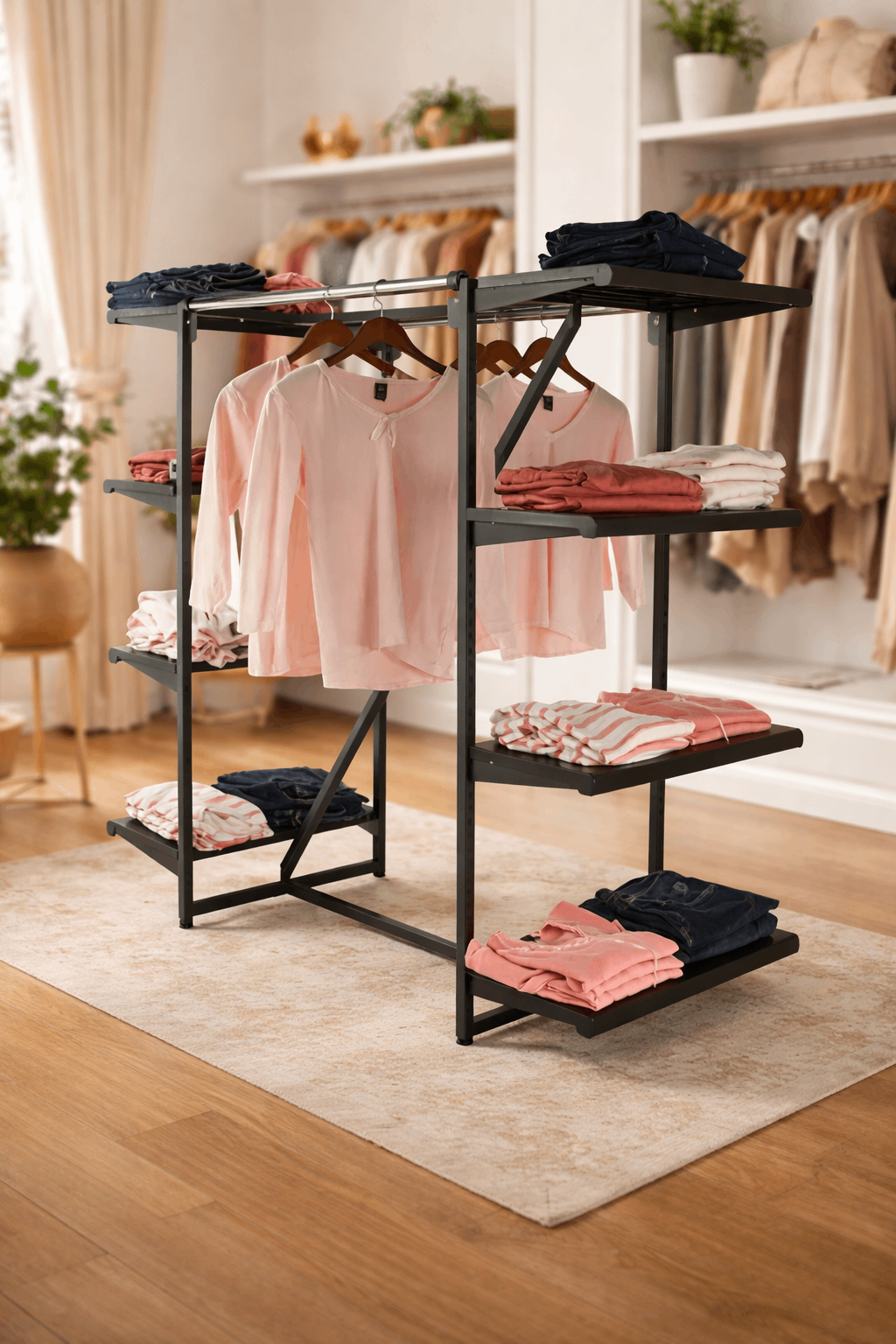
This simple customized black metal clothes display hanger idea rack serves real retail use rather than a product photo alone. Visually, it is a compact black metal boutique clothing display rack built around a central hanging rail and surrounded by multi-level shelves. That structure allows buyers to present featured garments, folded apparel, and coordinated items in one organized unit. For wholesale sourcing teams, that combination is useful because one well-planned fixture can often support more than one display function without making the floor look crowded.
Overseas buyers read supplier pages with a practical filter. They want quick answers about structure, customization, sampling, project use, and repeat production. For that reason, this product works best when the page explains merchandising logic, retail application, and quotation relevance instead of relying on broad sales claims.
The design stays clear and easy to read. The black metal frame gives the fixture a stable visual identity, while the open layout prevents visual heaviness. Shelves create clear zones for folded apparel, and the central rail keeps key garments visible. This retail garment display fits boutiques, womenswear stores, showroom programs, fashion-led retail spaces, and other environments that need clean presentation and controlled product grouping.
A useful product page should explain how a fixture works in store planning, daily merchandising, customization, and repeat production instead of simply calling it high quality. That level of clarity reduces screening time, supports supplier comparison, and links the product image directly to the buying decision.
This black metal clothes display rack supports mixed apparel presentation. Instead of handling only hanging garments or only folded products, it supports both in one coordinated fixture. The product logic is clear: garments hang in the center where shape and drape can be seen easily, while folded items are placed on the surrounding shelves for color grouping, size organization, and styling support. In retail terms, that mix often improves both display efficiency and product readability.
A clothes display hanger should help shoppers understand the merchandise quickly. In many apparel environments, too much density makes products look less valuable, while too little structure makes a category feel incomplete. This rack creates a middle ground. It provides enough surface area to build a complete product story, yet it remains open enough to preserve clean sightlines and a more premium store feel. That balance is especially useful for boutiques, branded corners, and fashion-led retail spaces.
For wholesale buyers, use-case definition directly affects project fit. A rack for folded T-shirts and lightweight tops will not serve the same role as a fixture for jackets or high-volume stock holding. This design works best for curated apparel presentation rather than warehouse-style storage. That distinction keeps the page specific and useful, because a well-matched fixture usually performs better in stores and leads to fewer changes during sample review or rollout planning.
The black finish supports broad compatibility with store interiors. Lighter garments stand out against the frame, while darker categories still look controlled and refined. From a sourcing perspective, black metal fixtures fit existing shop fitting systems more easily, pair well with brand graphics, and usually gain approval across different retail markets more easily than trend-sensitive color schemes.
The first defining feature is the open black metal frame. The structure uses vertical supports and clean horizontal lines to create multiple merchandising levels without making the unit look bulky. For a freestanding clothing rack, that visual openness is important. Retailers want functional display capacity, but they do not want the fixture to block views across the store or overpower surrounding merchandise.
The second feature is the combined use of a central hanging rail and surrounding shelves. This is what moves the product from a basic clothes display rack into a more useful apparel merchandising fixture. Hanging garments remain visible and easy to browse in the middle, while folded stock on the side and lower shelves stays close enough to support category logic and upselling. That arrangement is often preferred by buyers who want each display unit to carry both presentation value and stock support value in a limited footprint.
The third structural advantage is the freestanding layout. Because the rack is floor-standing and self-supporting, it can work in open floor zones, near perimeter walls, within a promotional display area, or as part of a shop-in-shop setup. For wholesale buyers handling multiple client types, this flexibility increases the product’s commercial usefulness. It means the same basic design can be adapted for different store plans without changing its core display logic.
This is also important from a sourcing angle. Buyers generally prefer fixtures with a clear structural base because clear structures are easier to size, sample, revise, and repeat across project orders. In other words, the rack is not only flexible in the store; it is also easier to manage during development.
Another important detail is the visual proportion of the unit. Multiple shelves can sometimes make a display look top-heavy or crowded, especially in lower-grade designs. Here, the frame remains visually light while still providing enough support for regular retail use. That combination of openness and strength is a practical reason why black metal clothes display systems remain popular in modern store fixture programs.
A strong retail fixture should improve how apparel looks, compares, and reads on the sales floor. This rack does that through clear visual layering. Hanging garments occupy the most visible center zone, while folded items on the shelves build rhythm around them. The result is a cleaner display hierarchy. Customers notice the featured style first and then explore related pieces nearby.
That matters because product visibility drives merchandising efficiency. In apparel stores, fixtures that combine hanging and folded presentation reduce visual clutter and make assortment logic easier to understand. This is one reason why a mixed display format often outperforms a very simple single-rail stand.
The rack also supports everyday store operations. Garments should not only look good when freshly arranged; they should stay easy to remove, touch, refold, and restock during trading hours. Shelves on this unit work as real merchandising surfaces, not decorative extras, and the hanging section stays accessible for both staff and customers. For buyers evaluating long-term store use, that practical accessibility often indicates value better than appearance alone.
Another advantage is that the fixture helps maintain a cleaner store layout. Closed or oversized displays can make a retail floor feel crowded, especially in boutiques and mid-size apparel stores. The open-frame design keeps the product visible without closing off surrounding space. This helps neighboring fixtures work together more effectively, which matters when buyers plan a full display program rather than one isolated piece.
This clothes display rack works especially well in boutique clothing stores, womenswear shops, and fashion-led retail spaces where merchandise is presented in edited stories rather than packed in volume. In that setting, the fixture can support new arrivals, color-coordinated looks, knitwear stories, denim edits, or feature collections. Because the unit combines surrounding shelves with a central hanger section, it works well for retailers who want to show styling logic rather than simply store inventory.
It is also suitable for branded showrooms and sample display areas. In showroom use, buyers often need an apparel display that looks organized enough for line review but practical enough for handling repeated changes. This rack strikes that balance. Products can be regrouped by style, category, or color without forcing the team to rebuild the display from scratch. For exporters and wholesalers, that adaptability increases the product’s appeal to different customer profiles.
Seasonal retail campaigns are another strong fit. During spring launches, holiday promotions, capsule drops, or themed womenswear assortments, retailers often need a compact fixture that can define a collection clearly without making the floor feel crowded. This design works as a feature display because it creates a clear visual center while still supporting secondary folded stock on multiple shelves. In sourcing terms, that gives buyers a product with good cross-season usability rather than a highly limited seasonal prop.
The rack also serves well in stores that need a middle-ground fixture between a minimal rail display and a full wall system. Many retailers do not want every category on wall-mounted systems, but they still need more merchandising capacity than a single bar can offer. In those cases, this freestanding clothes display rack becomes a practical bridge. It supports more product, better category grouping, and stronger presentation without requiring a complete refit.
For wholesale buyers, customization is useful only when it stays practical. A supplier may say a product is customizable, but buyers still need to know what that really means. In this design, customization can include overall dimensions, shelf quantity, shelf spacing, rail height, finish, branding details, and selected material combinations. That makes the product flexible enough for project needs without turning it into an entirely different structure each time.
The core of the design remains metal. That is important because the product is intended as a stable commercial display rather than a temporary decorative stand. Steel-based or metal-based frames are often preferred in store fixture procurement because they support repeat use, consistent finish standards, and more reliable structural control. Optional accents in acrylic or wood buyers can add where needed, but the fixture still follows a metal-display logic that suits long-term retail programs.
Finish customization is another area buyers often focus on. Black powder coating is the standard direction for this display because it works across a wide range of apparel environments and supports a consistent commercial look. At the same time, custom colors buyers can discuss for branded projects where fixture identity needs to match an existing store concept. Buyers normally prefer finish options that are visually consistent, practical to maintain, and repeatable across orders.
Branding can also be integrated carefully. Some wholesale customers want a neutral display rack that can serve many clients, while brand owners may require a logo plate, sign holder, or visual element that aligns with their current store fixture program. The value here is not branding for its own sake. It is the ability to adapt the fixture to a store concept without compromising the basic structure that makes it commercially viable.
A specification table helps buyers scan the product quickly, especially when they are comparing several supplier pages in one sourcing session. For procurement teams, clear technical information reduces the chance of misunderstanding during quotation and sample development. It also makes it easier to judge whether a fixture is being presented as a real commercial product or only as a design idea.
| Item | Specification |
|---|---|
| Product Name | Simple Customized Black Metal Clothes Display Hanger Idea Rack |
| Product Type | Freestanding retail clothing display rack |
| Main Material | Metal |
| Optional Materials | Acrylic, wood, cardboard, according to project needs |
| Color | Black or customized |
| Surface Finish | Powder coating or custom finish |
| Display Style | Hanging and shelving combination |
| Structure Type | Floor standing, open-frame display |
| Size | Customized |
| Usage | Apparel merchandising and retail product presentation |
| Application | Boutique stores, fashion retail stores, showrooms, feature display areas |
| OEM / ODM | Supported |
| Certifications | RoHS, ISO 9001 |
| Production Orientation | Suitable for custom project orders and volume production |
From a sourcing point of view, these specifications are not simply descriptive. They help define quotation boundaries. Material, finish, display style, and structure type all affect both manufacturing and shipment planning. Buyers often need this information early because it allows them to compare suppliers more accurately and determine whether the fixture is realistic for their market, store format, and target price level.
This kind of clarity also supports search quality. Pages that explain what the product is made of, how it is used, and what can be changed tend to be more useful than pages that rely mainly on vague promotional language. That is good for users and good for search visibility, because the page is clearly aligned with the actual search intent behind terms such as clothes display rack, metal clothes display, custom retail garment display, freestanding clothing rack, and black metal clothes display rack.
For commercial buyers, a second layer of information is often just as important as the basic specification. When comparing suppliers, they usually want to know which project details need to be confirmed before a sample or quotation can be finalized.
| Commercial Detail | Why Buyers Usually Check It |
|---|---|
| Sample requirement | Confirms whether development is needed before bulk production |
| Target quantity | Affects costing, production planning, and packaging method |
| Finish standard | Helps align color, surface treatment, and visual consistency |
| Assembly expectation | Clarifies flat-pack, knock-down, or assembled shipment direction |
| Export packaging | Reduces transport risk for overseas delivery |
| Matching fixture program | Ensures the rack fits a wider store fixture system when needed |
A second and more useful way to assess the rack is to connect the structure to merchandising outcomes.
| Retail Need | How This Rack Responds |
|---|---|
| Show featured garments clearly | Central hanging section keeps key styles visible |
| Present folded stock neatly | Multi-level shelves support organized apparel stacks |
| Maintain clean store sightlines | Open-frame structure reduces visual heaviness |
| Match modern apparel interiors | Black finish works with a wide range of shop concepts |
| Support project customization | Size, shelf layout, finish, and branding buyers can adjust |
| Handle repeat store use | Metal-based construction is suitable for commercial environments |
Retail buyers usually judge a fixture from two directions. They look at display performance, and they look at commercial manageability. The display value has already been explained above. Here, the focus shifts to why the product makes sense as a buying decision for wholesale customers.
This design meets that need well. It offers a clean visual identity and a rational structure, which many wholesale customers prefer. For overseas buyers, quotation clarity forms part of product value. A fixture with unclear construction or undefined customization boundaries often creates delays and repeated revisions. This rack avoids that problem because buyers can discuss the rail sections, shelves, finish, and dimensions in practical terms.
The rack also improves efficiency because it combines more than one display role. Instead of using separate stands for hanging garments and folded stock, buyers can work with one coordinated fixture built around a central apparel presentation area and surrounding folded-goods shelves. In stores with limited floor area, that setup improves product density without creating a cluttered appearance.
For repeat orders and broader programs, structure consistency matters even more. Buyers who manage chain stores, distributors, or rollout projects need products that repeat with controlled finish and reliable dimensions. A custom display manufacturer earns trust by adapting the right parts of a design while keeping the commercial structure stable. This rack fits that expectation well.
Before requesting a formal quotation, buyers usually benefit from confirming a few core details. The first is product use. Lightweight tops, denim, dresses, and accessories may require different shelf depth, spacing, or hanging proportions. Store size matters as well. A fixture for a compact boutique aisle will often differ from one for a large feature area or a wall-side apparel zone.
The second point is order scope. Buyers should know the expected quantity, finish direction, branding preference, and whether the rack needs to match an existing store fixture family. These details directly affect pricing and development. For example, custom finish control, logo integration, and export packaging can change both production steps and quote accuracy. The more precise the project input, the more useful the quotation becomes.
Wholesale buyers browse quickly and selectively. They look for signs that a supplier understands procurement behavior, not only product styling. That includes sample development, bulk order suitability, packing awareness, and practical project communication. This information shortens the path from product interest to serious inquiry and keeps the discussion tied to real purchasing behavior.
Shipping and packaging should also be discussed early. A display rack for domestic delivery may not require the same packaging plan as one going to overseas markets. Carton protection, flat-pack considerations, assembly expectations, and destination handling all influence the final solution. For buyers working under store opening schedules or seasonal deadlines, these details form part of project reliability.
Many supplier pages that rank well for commercial display terms also surface buying fields such as MOQ, sample time, or delivery time, even when those values vary by project. The page can remain product-led while still presenting those details as dynamic quotation information or a short inquiry-support block. That often helps conversion because buyers can confirm commercial fit faster without weakening the product focus.
Serious buyers still need enough context to assess sourcing reliability. Yishang Display focuses on metal-based custom display solutions, which is directly relevant to this rack because the product depends on stable structure, repeatable finish quality, and controlled project execution rather than on decorative styling alone.
For project orders, the most useful trust signals are practical ones: whether the supplier can support OEM and ODM development, whether specifications are clear enough for quotation, and whether production is managed to recognized standards such as RoHS and ISO 9001. These points are included here only to support the buying decision around the rack itself, not to turn the page into a company profile.
Source location can matter during supplier screening, and Guangdong Province, China is widely recognized as a major manufacturing base for display hardware and store fixtures. Even so, location is only a starting point. What matters more is whether the product page shows a realistic understanding of merchandising use, customization boundaries, and commercial execution. That is the kind of sourcing confidence this section is intended to add.
For B2B buyers, FAQ content works best when it answers the questions that usually delay quotation or sampling, so concise, product-led answers are more useful than long generic FAQ blocks.
Yes. The overall size can be adjusted according to store layout, product category, and display purpose. Width, height, shelf depth, and shelf spacing are often the first areas buyers review during customization. A rack that fits the floor plan correctly usually performs better in both appearance and daily use.
A practical approach is to begin with the intended merchandise and placement area rather than choosing dimensions in isolation. When buyers share the store zone, garment type, and display objective, the recommended size becomes easier to define and the quotation becomes more accurate.
Yes. Shelf quantity and spacing buyers can modify for different apparel needs. Knitwear, folded tops, denim, accessories, and mixed-category displays often require different shelf proportions. That is why the shelf layout is treated as part of the functional design, not just as a fixed visual feature.
For buyers planning a program with several related fixtures, shelf changes can also help create consistency across a broader display family. The goal is not simply to change the rack, but to make it work better for the product mix being sold.
Metal is the main material and remains the most important structural component because it provides stability, commercial durability, and better long-term repeatability. For most wholesale projects, that is the preferred starting point.
At the same time, selected acrylic or wood elements buyers can consider when the visual direction calls for them. These additions are optional accents rather than replacements for the metal frame. The product still remains a metal clothes display solution at its core.
Yes. Black is the standard direction for this rack because it is versatile, professional, and easy to integrate into many apparel environments. It also works well with a broad range of merchandise colors and store materials.
Custom finishes work well if a project requires stronger alignment with an existing shop concept or brand standard. In most cases, buyers prefer finishes that are easy to maintain, commercially durable, and repeatable across orders, which is why powder-coated black remains the most common choice.
Yes. The product is suitable for sample development, project orders, and repeat production. Because the structure is clear and commercially practical, it adapts well without losing its basic production logic.
That makes it relevant for importers, wholesalers, distributors, and brand teams that need more than a one-time display idea. In a store program, repeatability often matters as much as appearance, and this rack is designed with that requirement in mind.
The most useful starting details are the intended product category, approximate dimensions, expected quantity, preferred finish, destination market, and any available reference images or drawings. These points help define the project more accurately.
If the rack needs to match existing furniture, packaging standards, or a broader fixture family, that information should also be shared early. Small details such as shelf proportion or logo placement can affect the final proposal more than buyers sometimes expect.
If this black metal clothes display rack fits your retail project, send your target dimensions, quantity, finish needs, and reference images. Yishang Display can review the requirement and prepare a practical quotation based on the actual use scenario, especially for boutique apparel, womenswear, and fashion retail projects.
A clear inquiry usually leads to a better result. When the product logic, customization scope, and shipment expectations are defined early, the sourcing process becomes faster, more accurate, and easier to manage.
Yishang Display specializes in crafting bespoke display solutions. From initial concept and prototyping through to full-scale production, our in-house team manages every phase—delivering a seamless, one-stop experience for your brand.
If you have any questions or need a quote, please send us a message. One of our specialists will get back to you within 24 hours and help you select the correct valve for your needs.
All of our products are available for sampling