Wholesale buyers rarely focus on decoration alone when sourcing store fixtures. Procurement teams usually check whether a display rack performs reliably in daily store operations, ships efficiently in bulk orders, and can become a repeat‑order SKU for distributors and retail chains. These practical factors often influence purchasing decisions far more than appearance. This page presents a wooden decoration high quality display clothes rack developed around these practical purchasing considerations.
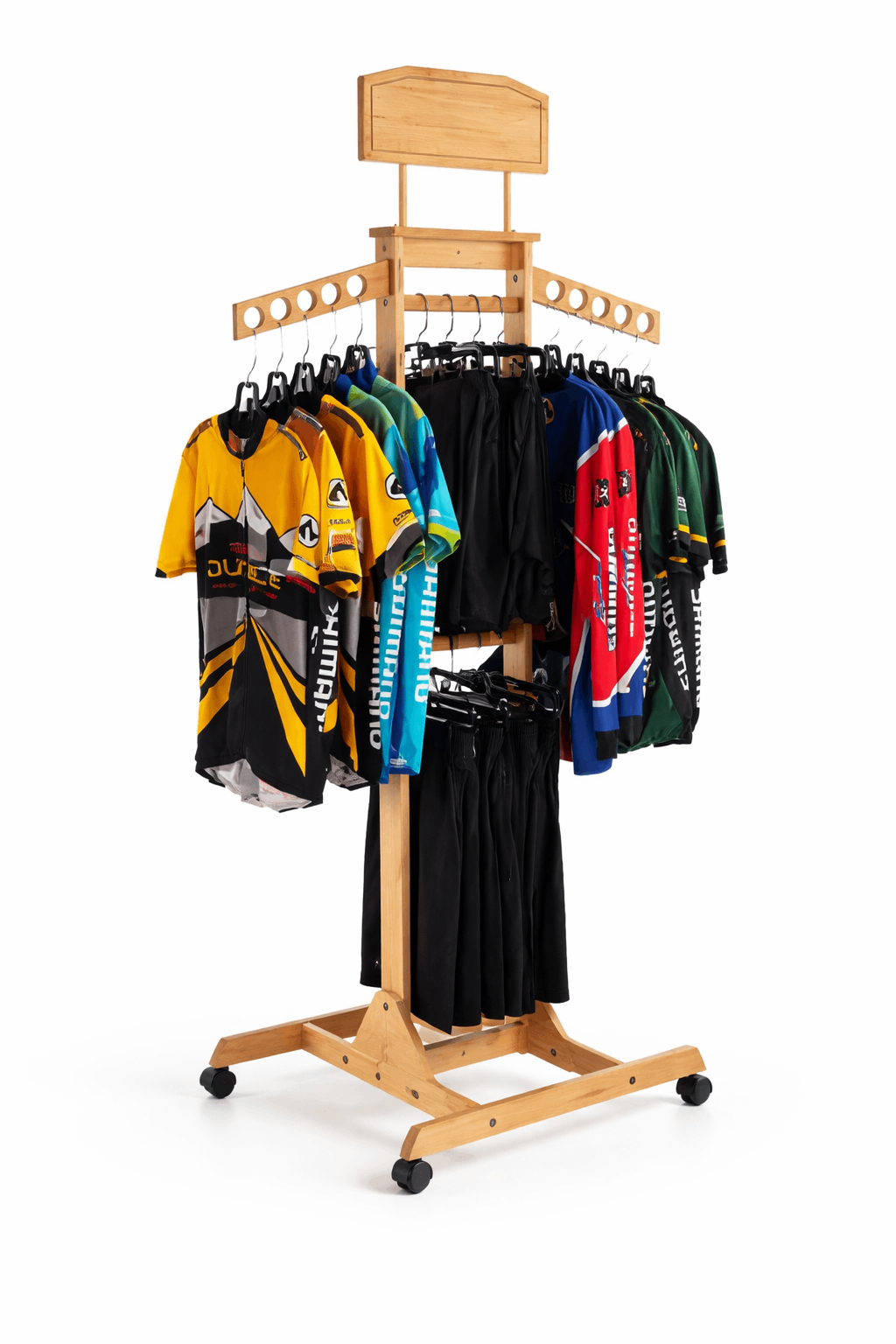
The product image shows a customized wooden clothes rack stand on wheels with hooks and arms to hang clothes in retail stores or shops. It combines a warm natural appearance with commercial durability. Instead of focusing only on aesthetics, the design considers merchandising flow, garment capacity, and long‑term use in busy clothing store display areas such as entrances, promotional zones, or central merchandising spaces.
For wholesalers, importers, and retail fixture distributors, reliability and repeatability define the real value of a garment display stand. A fixture that performs well in real stores can become a long‑term product line rather than a one‑time purchase. A display that performs well in stores leads to fewer complaints, smoother reorders, and stronger retailer relationships. This product page therefore focuses on the features that typically matter most during procurement evaluation: structural stability, display efficiency, customization flexibility, and shipping practicality.
The rack also reflects how modern apparel retailers present merchandise today.
• Display Type: Circular clothing display rack with four arms
• Structure: Wooden decorative body with optional reinforcement
• Mobility: Wheels for easy repositioning in retail stores
• Assembly: Knock‑down structure for efficient shipping
• Signage: Top label holder for category or brand display
• Typical Use: Apparel stores, boutiques, sportswear shops, and promotional floor areas
Retail merchandising now focuses heavily on open browsing areas where customers quickly understand a product collection. Retailers therefore need fixtures that combine display capacity with easy accessibility. Instead of relying only on long straight rails, many stores now use circular racks and clothes display stand systems that encourage browsing from multiple directions. This structure lets customers scan collections quickly and improves product visibility across the store floor.
In a clothing retail environment, the arrangement of fixtures strongly influences customer movement and browsing behavior. Store layout studies in apparel retail consistently show that displays positioned in open floor areas attract more interaction than fixtures placed along walls. Retail merchandising studies show that customers interact more frequently with products that are easy to access and clearly visible. A display clothes rack designed in a circular configuration allows garments to be approached from all sides, encouraging natural browsing behavior.
Compared with wall rails or linear racks, a circular stand clothes display system allows retailers to place the fixture in open areas such as entrances, mid‑floor promotional zones, or seasonal collection displays. This layout works particularly well in fashion boutiques and sportswear stores where multiple garments from the same collection need to be presented together.
For wholesale buyers supplying retail chains, this flexibility is important. A rack that can function in different store formats is easier to sell across multiple retail clients. Instead of designing separate fixtures for each store layout, a versatile rack can serve many merchandising scenarios.
The warm wooden appearance also plays a role. Wood surfaces tend to create a more inviting atmosphere than purely industrial metal fixtures. In fashion retail environments where presentation influences perceived product quality, this subtle difference can affect how customers interact with displayed garments.
A retail display fixture must perform reliably under continuous use because garments are constantly added, removed, and repositioned throughout the day. Structural stability is therefore one of the first factors wholesale buyers evaluate when selecting a rack for retail distribution. The structure of this rack is designed to support repeated garment handling while maintaining stability. At the center of the rack is a vertical support column that distributes weight across the base structure.
From this column extend four directional arms arranged around the center post. These arms include hooks and arms to hang clothes, allowing garments to be evenly spaced and clearly visible. Precision drilled hanger holes keep garments aligned and prevent them from sliding together during browsing. The lower section of the rack can also support additional garments such as pants or folded apparel, helping retailers present multi‑level product displays.
This design forms a rack stand on wheels that allows garments to be displayed around the entire structure. Because shoppers can approach from any direction, the display remains accessible even during busy shopping periods.
The base uses a cross‑support layout that distributes load across a wider footprint. This helps the rack remain stable even when fully loaded with clothing. Stability is particularly important in stores where customers frequently remove garments or lean slightly against fixtures while browsing.
Mobility is another key feature. The clothes rack stand on wheels allows retail staff to move the rack quickly when adjusting store layouts or preparing for promotional events. For store operators, this reduces labor and allows displays to be refreshed without heavy lifting.
Material selection directly affects the lifespan of a retail display fixture. Buyers supplying retail chains often look for materials that balance appearance, durability, and production consistency across multiple batches. The visible structure of this rack is made primarily from carefully finished wood, chosen for both durability and visual appeal.
Wood surfaces provide a natural appearance that complements apparel merchandise while maintaining the durability required for commercial retail fixtures. In many fashion stores, wooden fixtures help create a warm environment that encourages customers to explore collections more comfortably.
Although the design emphasizes wood, certain configurations may incorporate optional reinforcement structures to support higher load requirements. This ensures that the rack remains durable when used in busy retail stores or shops displaying heavier garments.
The construction process typically involves several stages including material cutting, sanding, assembly preparation, and surface finishing. These steps help ensure consistent quality across production batches, which is especially important for wholesalers managing repeat orders.
Surface finishes can vary depending on the store concept. Options may include natural wood stain, matte coatings, or customized color finishes. Retail buyers often request finishes that match shelving systems or existing store furniture.
The versatility of this rack becomes clearer when examining how similar fixtures are used in real retail environments. Circular clothing racks are commonly placed in high‑visibility areas where customers naturally circulate through the store. Many clothing stores position circular racks near entrances or central walkways to highlight featured collections, promotional items, or seasonal merchandise.
Because the rack allows garments to be viewed from multiple directions, it helps customers quickly understand the available styles. This is particularly effective in boutiques where curated collections are displayed together.
Sportswear retailers frequently use similar racks to present jerseys or branded apparel collections. The circular format allows team merchandise to be grouped by color or category, creating a strong visual impact.
Department stores often use movable racks like this for promotional zones. During seasonal campaigns or clearance events, racks can be repositioned easily to create temporary product areas.
For distributors supplying international markets, these examples demonstrate how a single fixture can support multiple retail concepts. A rack that works in boutiques, chain stores, and pop‑up events provides broader commercial potential.
Many wholesale customers prefer display fixtures that can be adapted to their clients’ store designs because retail chains often operate different store formats across regions. The customized wooden clothes rack shown here can be adjusted in several ways depending on project requirements.
Size adjustments are among the most common requests. Buyers may specify different heights, arm lengths, or base dimensions depending on available floor space. These adjustments help the rack integrate into different store layouts.
Material combinations can also be customized. Although this model features a wooden decorative structure, many wholesale buyers request combinations of wood with metal frames or acrylic signage elements to match different retail concepts.
Branding features are another common customization request. The signage holder at the top of the rack can display category labels, promotional graphics, or store logos. This allows retailers to use the rack as both a display fixture and a communication element within the store.
Color options can be adjusted as well. Retail chains sometimes request finishes that match brand guidelines or store furniture. In bulk orders, confirming finish samples before production helps maintain consistency across shipments.
For overseas buyers, transportation efficiency is often as important as product design. Freight cost, container loading efficiency, and packaging protection can directly influence the profitability of large fixture orders. This rack uses a knock‑down structure that simplifies packing and reduces shipping volume.
A knock‑down format allows components to be packed in export cartons with protective materials. This approach improves container loading efficiency and helps reduce freight costs for large orders.
Assembly in the destination market is typically straightforward. Store staff can assemble the rack using basic tools, allowing retailers to install fixtures quickly when preparing store layouts.
Bulk buyers also evaluate packaging durability and carton strength. Protective packing materials and clear component labeling help reduce installation time and minimize the risk of damage during international transportation.
Below is an example of a typical configuration used for retail display environments. Final specifications can be adjusted depending on project requirements.
| Specification | Description |
|---|---|
| Product Name | Wooden Decoration High Quality Display Clothes Rack |
| Material | Wood structure with optional reinforcement |
| Structure | Circular arms with hanger holes |
| Mobility | Wheels for easy movement |
| Sign Holder | Top display signage |
| Assembly | Knock down construction |
| Application | Retail stores or shops clothing display |
| Packaging | Export carton packaging |
When evaluating a display stand for clothes, wholesalers often confirm load capacity, packaging dimensions, and finishing requirements during the sampling stage.
Professional buyers typically assess display fixtures using operational, logistical, and merchandising criteria rather than visual design alone. One of the first questions is how efficiently the fixture presents products.
A rack that supports clear garment spacing allows customers to browse easily. If garments overlap excessively, browsing becomes difficult and the display loses its visual appeal.
Mobility is another factor. Fixtures placed on wheels can be repositioned during seasonal campaigns or promotional events. This flexibility is useful for retailers who frequently update store layouts.
Buyers also consider how the rack integrates with other fixtures such as wall displays, mannequins, and shelving systems. When materials and finishes align across fixtures, the overall store environment appears more organized.
Cost efficiency is also important. A rack that ships efficiently, assembles quickly, and minimizes damage risk during transport helps distributors maintain better margins and smoother supply chains.
Many buyers ask whether the rack can be produced with customized dimensions or branding elements because retailers often require fixtures that align with their store identity and merchandising layout. In most cases, adjustments to size, signage, and finishes can be accommodated depending on order volume.
Durability is another common concern. Retail fixtures must support frequent garment handling and long operating hours. Reinforced structural components and stable base designs help ensure reliable performance.
Shipping logistics are also frequently discussed. Knock‑down structures allow more units to be loaded per container, improving cost efficiency for large orders.
Lead time varies depending on customization requirements and order quantity. Buyers planning bulk orders often confirm details such as packaging method, logo signage requirements, and shipment terms during the quotation stage. Confirming design details early in the project usually helps shorten the overall production timeline.
In modern retail environments, store fixtures are an essential part of merchandising strategy because they shape how customers interact with products and how efficiently retailers can organize collections. A well‑designed clothes rack stand on wheels with hooks and arms to hang clothes in retail stores helps retailers organize garments clearly and present collections effectively.
For wholesalers and distributors, the most valuable fixtures are those that combine durability, display efficiency, and flexible customization options. When a rack performs reliably across different retail environments, it becomes easier to market and reorder.
The rack described here reflects those priorities. Its circular layout supports natural browsing, while its wooden construction adds warmth to the retail environment. With the ability to adapt size, finish, and branding elements, it provides a practical solution for many clothing retail projects.
If you are sourcing a wooden clothes rack for retail stores or shops, planning a retail fixture rollout, or developing a new display program for apparel stores, you can share your design requirements and estimated order quantity. The Yishang Display team can help review specifications and recommend suitable configurations for your project.



Yishang Display specializes in crafting bespoke display solutions. From initial concept and prototyping through to full-scale production, our in-house team manages every phase—delivering a seamless, one-stop experience for your brand.
If you have any questions or need a quote, please send us a message. One of our specialists will get back to you within 24 hours and help you select the correct valve for your needs.
All of our products are available for sampling